
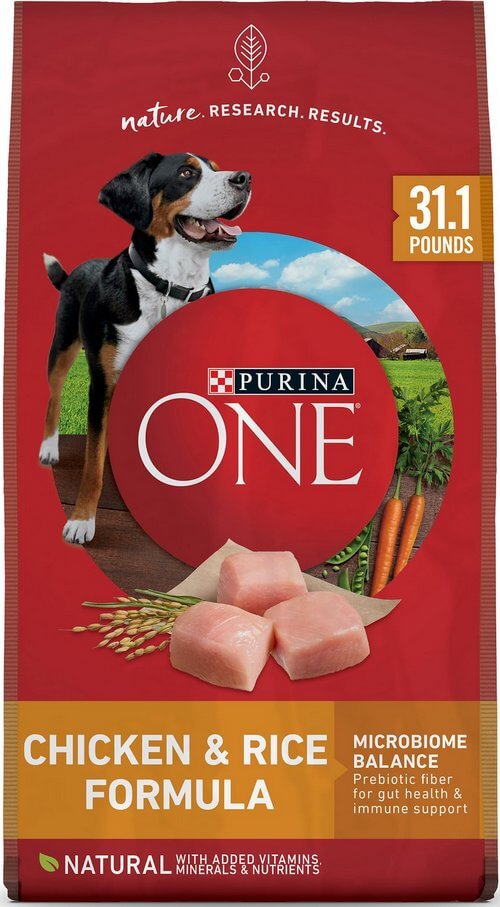
Purina One (Dry)

Share

Rating: ★★☆☆☆

Purina One dry dog food earns the Advisor’s below-average rating of 2 stars.

The Purina One Dog Food product line includes 3 kibbles… two claimed to meet AAFCO nutrient profiles for adult maintenance and one for both growth and maintenance (Large Breed Puppy).

  • Purina One Sensitive Systems
  • Purina One Large Breed Adult
  • Purina One Large Breed Puppy

Purina One Large Breed Adult Dog Food was chosen to represent the others in the line for this review.

Purina One Large Breed Adult

Dry Dog Food

Estimated Dry Matter Nutrient Content

Protein = 30% | Fat = 14% | Carbs = 49%

Ingredients: Chicken (natural source of glucosamine), brewers rice, poultry by-product meal (natural source of glucosamine), corn gluten meal, whole grain wheat, whole grain corn, animal fat preserved with mixed-tocopherols (form of vitamin E), pea fiber, oat meal, fish meal, animal digest, salt, potassium chloride, calcium phosphate, potassium citrate, vitamin E supplement, choline chloride, zinc sulfate, l-lysine monohydrochloride, l-ascorbyl-2-polyphosphate (source of vitamin C), ferrous sulfate, manganese sulfate, niacin, vitamin A supplement, calcium carbonate, copper sulfate, calcium pantothenate, garlic oil, pyridoxine hydrochloride, vitamin B12 supplement, thiamine mononitrate, riboflavin supplement, calcium iodate, vitamin D3 supplement, menadione sodium bisulfite complex (source of vitamin K activity), folic acid, biotin, sodium selenite

Fiber (estimated dry matter content) = 5.1%

Red items when present indicate controversial ingredients

Estimated Nutrient Content
MethodProteinFatCarbs
Guaranteed Analysis26%12%NA
Dry Matter Basis30%14%49%
Calorie Weighted Basis27%30%44%

The first ingredient in this dog food lists chicken. Although it is a quality item, raw chicken contains about 80% water. After cooking, most of that moisture is lost… reducing the meat content to just a fraction of its original weight.

After processing, this item would probably account for a smaller part of the total content of the finished product.

Which brings us to brewers rice… the second and (more likely) the dominant ingredient in this dog food.

Brewers rice represents the small grain fragments left over after milling whole rice.

This is an inexpensive cereal grain by-product and not considered a quality ingredient.

The third ingredient is poultry by-product meal… a dry rendered product of slaughterhouse waste. It’s made from what’s left of slaughtered poultry after all the prime cuts have been removed.

In a nutshell, poultry by-products are those unsavory and inedible leftovers deemed “unfit for human consumption”.

This stuff can contain almost anything… feet, beaks, undeveloped eggs… you name it.

We consider poultry by-products slightly lower in quality than a single-species ingredient (like chicken by-products).

On the brighter side, by-product meals are meat concentrates and contain nearly 300% more protein than fresh poultry.

The fourth ingredient is corn gluten meal. Gluten is the rubbery residue remaining once corn has had most of its starchy carbohydrate washed out of it.

Compared to meat, glutens are inferior grain-based proteins lower in many of the essential amino acids dogs need for life.

This inexpensive plant-based ingredient can significantly boost the total protein content reported in this dog food.

The next two ingredients include wheat and corn. Wheat and corn are inexpensive and controversial cereal grains of only modest nutritional value to a dog.

For this reason, we do not consider either wheat or corn preferred components in any dog food.

The seventh item is animal fat. Animal fat is a generic by-product of “rendering”… the same high-temperature process used to make meat meals.

Since there’s no mention of a specific animal, this stuff could come from almost anywhere… restaurant grease, slaughterhouse waste, diseased cattle… even euthanized pets.

We do not consider generic animal fat a quality ingredient.

The eighth ingredient is pea fiber… a mix of soluble and insoluble plant fiber derived from pea hulls. It is probably used here to add bulk.

In addition to the usual benefits of fiber, pea fiber can account for a trace of extra protein in this food.

The ninth ingredient is oatmeal… a whole-grain product made from coarsely ground oats. Oatmeal is naturally rich in B-vitamins, fiber and is also (unlike many other grains) gluten-free.

The tenth ingredient includes fish meal. Because it is considered a meat concentrate, fish meal contains almost 300% more protein than fresh fish itself.

Unfortunately, this particular item is anonymous. Because various fish contain different types of fats, we would have preferred to have known the source species.

Fish meal is commonly made from the by-products of commercial fish operations.

What’s more, the controversial chemical ethoxyquin is frequently used as a preservative in fish meals.

But because it’s usually added to the raw fish before processing, the chemical does not have to be reported to consumers.

We find no public assurances from the company this product is ethoxyquin-free.

Without knowing more, and based upon this fish meal’s location on the list of ingredients, we would expect to find only a trace of ethoxyquin in this product.

Animal digest is a chemically hydrolyzed concoction of unspecified body parts… from unspecified animals. Animal digest is usually sprayed onto the surface of a dry kibble to improve its taste.

From here, the list goes on to include a number of other items.

But to be realistic, ingredients located this far down the list (other than nutritional supplements) are not likely to have much of an effect on the overall rating of this product.

With four notable exceptions

First, garlic oil may be a controversial item. We say “may be” here because we are not certain of the oil’s chemical relationship to raw garlic itself. Although the majority of experts favor the ingredient for its numerous health benefits, garlic (in rare cases) has been linked to Heinz body anemia in dogs.1

However, the limited professional literature we surveyed provided no definitive warnings regarding the use of garlic… especially in small amounts (as it is here).

Next, we find no mention of probiotics… friendly microorganisms applied to the surface of the kibble after processing.

Thirdly, the minerals listed here do not appear to be chelated. And that can make them more difficult to absorb. Non-chelated minerals are usually associated with lower quality dog foods.

And lastly, this Purina One recipe also contains menadione… a controversial form of vitamin K linked to liver toxicity, allergies and the abnormal break-down of red blood cells.

Purina One Dry Dog Food
The Bottom Line

Judging by its ingredients alone, Purina One Dry Dog Food appears to be a below-average kibble.

But ingredient quality by itself cannot tell the whole story. We still need to estimate the product’s meat content before determining a final rating.

The dashboard displays a dry matter protein reading of 30%, a fat level of 14% and an estimated carbohydrate content of 49%.

As a group, the brand features an average protein content of 30% and an average fat level of 16%. Together, these figures suggest an overall carbohydrate content of 46% for the full product line.

Near-average protein. Average fat. And average carbohydrates… when compared to a typical dry dog food.

Yet when you consider the plant-based protein-boosting effect of the corn gluten meal, this is the profile of a kibble containing only a modest amount of meat.

What’s more, it’s difficult to ignore the presence of so many Red Flag items.

Bottom line?

Purina One Dry Dog Food is a grain-based kibble using only a modest amount of poultry or fish as its main sources of animal protein… thus earning the brand 2 stars.

Not recommended.

Those looking for a better kibble from the same company may wish to check out our review of Purina Pro Plan Selects Dry Dog Food.

A Final Word

This review is designed to help you make a more informed decision when buying dog food. However, our rating system is not intended to suggest feeding a particular product will result in specific health benefits for your pet.

For a better understanding of how we analyzed this product, please be sure to read our article, “The Problem with Dog Food Reviews

Remember, no dog food can possibly be appropriate for every life stage, lifestyle or health condition. So, choose wisely. And when in doubt consult a veterinarian for help.

Have an opinion about this dog food brand… or maybe the review itself? Please know… we welcome your comments.

Notes and Updates

12/04/2009 Original review
07/16/2010 Updated
06/02/2011 Updated (upgraded to 1.5 stars)
09/09/2011 Updated (SmartBlend recipes moved to dedicated report)
06/02/2011 Last Update

  1. Yamato et al, Heinz Body hemolytic anemia with eccentrocytosis from ingestion of Chinese chive (Allium tuberosum) and garlic (Allium sativum) in a dog, Journal of the American Animal Hospital Association 41:68-73 (2005)
Dog Food Advisor IconThe Dog Food Advisor publishes independent reviews to help pet owners make better choices when shopping for dog food.


  • http://www.purinaonecoupons.org/ Keller Tiemann

    My dog loves Purina One and his digestive system runs best on it to be honest. Even when compared with some expensive premium nutritional dog foods.

  • Megs

    I’m happy you found out in time! We weren’t so lucky with our golden and she had the same issues as your dog. We had to put her to sleep one day because she was groaning all day from the pain.

  • Donnie2545

    Your dog does the same thing as mine. He picks out one of the bits and spits the others out on the floor. I guess it’s time to find another type of food he likes. Speedy is my descerning shopper. If he doesn’t like it I won’t buy it.

  • http://palsfurrus.blogspot.com/ Pals Furr Us dog blog

    Ouch, Purina makes this kind of stuff? I feed Purina Hi-Pro to my labs. Maybe i’ll switch :-( (Could you please make a review of Purina Hi-Pro..) Thanks.. -Namae (Pals Furr Us)

  • Mike P

    My vet told me to get off the grain free and feed her Purina,Iams,science diet,or beneful. He said Purina inspects all the corn batches and the ones rejected ends up in the cheaper foods….wow do you believe that??? My vet is a good surgeon though so I have to keep seeing (just in case).Very nice people but doesn’t get dog nutrition.Feel bad for owners that take that advice.

  • LAURA

    MY 5 YR OLD BASSET/TERRIER MIX WAS EXTREMELY SICK VOMITTING AND HAVING TROUBLE WALKING LAST NITE. TOLD MY VET TODAY I WAS FEEDING HIM BENEFUL DOG FOOD. SHE SAID THERE IS AN ARTICLE ON A SITE SHARED BY VETS THAT WAS CALLED “BENEFUL BELLY” AND THIS DOGFOOD COULD BE THE CULPRIT BEHIND HIS PROBLEMS. HAVE FOUND MANY COMPLAINTS FROM OTHER DOG OWNERS ONLINE ABOUT BENEFUL. DO NOT FEED YOUR DOGS THIS FOOD. IT IS MADE BY PURINA. PLEASE SPREAD THE WORD ABOUT THIS. SHE SAID OLD ROY DOGFOOD USED TO BE THOUGHT AS THE MOST WORTHLESS FOOD, BUT BENEFUL MAY BE JUST AS BAD. THANKS!!! LAURA

  • http://en.wikipedia.org/wiki/Ninja Dog Food Ninja

    Lucy, from your post, it seems you think you are sending a message to Purina… Dogfoodadvisor.com is a review website. Not Purina’s. Clearly, they would give their own product a better rating. lol

  • Lucy

    My lab has been on Purina one almost all of her 13 years and she’s eaten it without any problems. Since you changed, and a third of the food is now soft, I have food all over my floor. She won’t eat the soft bits. Feeding times take forever as I have to remove each piece of soft, and pepper the remaining with bits of chicken and chopped up doggie sausage. Now I have to look for another dog food which she likes and without corn as it’s main ingredient. Not pleased

  • Liza

    Also, since the formula change for Purina One we have noticed that our GSDs coat is not as shiny, more shedding than usual, less energy, stool changes and increased frequency, increased gas

  • Liza

    We’ve had our GSD on Purina One since he was a puppy (he is now six). He seemed to do well with it until they changed to the Smart Blend. After being on it for two weeks his ears were bothering him. We took him to the vet and she asked what his diet was. We told her and she said that he was the third dog she’d seen that day that had the same ear infection (one of those dogs was actually the dog seen before us) and all three of them had been eating Smart Blend. She gave us meds for his ears and they don’t bother him like they did before but they still seem a little sensitive. Now he won’t eat it unless he’s really hungry so we’ve just switched to Nature’s Domain so hopefully that will help.

  • S Fowler

    FYI…I’ve been feeding my 8 yr old lab Purina One Healthy Formula for years. Recently he became lathargic, diarreah, and couldn’t walk, refusing to drink, eat and couldn’t pick his head up. We took him to the vet and after complete blood work and several xrays they were showing all inconclusive. The vet told us to take him home and “enjoy him while we got him”. So that’s when I thought about his food. I immediately started feeding him something else that I had in the pantry from months ago when the store was out of Purina. Thank God! He’s been a new dog since I did. I Googled “Purina dog food complaints” and there is a slew of them. For some reason there is no recall yet, but there are many pets suffering because of this company. I’m just thankful mine isn’t anymore.

  • Bob K

    Sarah – You should be happy, you now have free access to all the information on this website as valuable tool for you and your friends. Many of the brands and Mfgs and food formulas did not exist 12 years ago. We know much more about both human and pet nutrition than ever before and websites like this one empowers consumers. I fed my dog ProPlan for 12 years starting about 20 years ago. Its not a bad food but for what I paid I now learned I could have provided better nutrition for my pet and and had more money in my pocket. Purina One is better than many mass marketed dog foods available at many big box grocery and discount stores. Check out Kirklands at Costco – What a bargain.

  • Sarah

    I am so sad. I wish these reviews had been around twelve years ago. I switched my three dogs over to Purina One because a vet told me that it would help my new puppy’s dandruff. I thought it was a high quality dog food, the price certainly seemed to reflect that. It did clear up his skin and my other dogs seemed to like it and had no ill effects until they were about 10-11 years old. They ALL developed fatty tumors which were worrisome but did not harm their health. But as seniors they were all pretty sluggish. I didn’t know that they really shouldn’t have been acting so old. After two died- one from unknown age related disease and one from cancer- we switched the youngest to a home made diet. At twelve years old, he is a puppy again! I am absolutely certain that if we had switched them all years ago we would have not only added years to their life, but life to their years- as they say.

  • http://DogFoodAdvisor.com Mike Sagman

    John… After reviewing this and similar comments posted by you here or on other articles on this website, it’s apparent you’re either working together with others (or as a fraudulent individual using multiple identities) from the same computer IP address. Any further postings by you designed to deliberately defraud our users will be deleted.

  • http://www.facebook.com John

    Okay here is my story. I feed my dog pinnacle (good food) but due to the economy I switched over to purina (bad food) my dog had diarrhea, lost a lot of hair, went skinny. I even found a peace of plastic once. Now that I got my job back I’m switching to pinnacle. I remember the day I came home with the bag of pinnacle my dog got so happy it was unbielivable!!! So if you want a good healthy long lasting dog..Don’t feed him/her purina.

  • http://brotherscomplete.com Richard Darlington

    Darren

    It is NEVER too late to switch to healthier food in my opinion. Two of our four dogs were fed the same mass marketed junk for about 14 years or so and we switched over to a combination of raw for one meal and a good grain free for the other meal (and later a grain/potato free kibble for the other meal). They are still going strong at 20 and 21 years of age (a Yorkie and Lhaso Apso).

    i just had a customer come into the store who spoke to me 6 months ago when her Yorkie was on junk food and required constant doses of phenobarbital for his frequent siezures. I recommended she put the dog on a good grain and potato free kibble (Brothers Complete) and she came in today (six months later) to tell me that the dog was now completely off all phenobarbital and was doing great. She brought the little bugger in to show me. So a bad diet can cause ALL kinds of problems that are not necessarily connected to diet. Get your dog off grain and potato and watch him bloom. Feed him some raw each day (as well as the kibble) if you can, or at least a raw meaty bone every few days for dental health.

    We hear all the time in the store that Vets and other dog owners caution against mixing kibble with raw. Normally I agree unless you are using a kibble that is grain/potato free and has digestive enzymes added. We have been able to mix the Brothers Complete with raw on all four of our dogs with no problems. Recently, however, we have put our 21 yr old on just Brothers but I think the reason most kibbles cannot mix with the raw has more to do with the grain/potato that doesn’t combine well with the raw in a dog.

    So take the leap of faith, put your best bud on 5 star food and report back in three months so we can see if you have joined the long line of the “good food converts”.

  • Darren

    I’ve been feeding my dogs Purina One SmartBlend for a couple of years now. While they seem to like it and have had no obvious health problems from eating it, I now feel terrible about feeding it to them, given the poor rating. I am going to switch them over to a much higher rated food, but I now worry that I may have done them irreparable harm by feeding them this junk food. I would certainly welcome any thoughts as to whether upgrading their diet now will help offset any damage done by this inferior food.

  • peter b

    Hi guys,

    i used to feed this food from my local supermarket and it didnt do a great deal in keeping my kelpie healthy. he would often eat grass and even his own poo…yuck! and i noticed i was taking him to the vet for this or that on a regular basis. it could have been from beneful to but i dont like eirther now from my experience. 4 months on and hes on a totally different type of diet and is so far doing good and it to early to see whether his vet visits will slow down but well see. i can see why now with all the red flag stuff that this is a bad food.

  • Antonio

    Man you guys sure have some highly intelligent responses. I’ve never read either book your referencing, maybe I need to pick it up a bit and get more information since it’s readily available. Between work and training my time gets a bit congested.

  • http://www.drianbillinghurst.com Gordon

    aimee – lol @ just reading the cover of Dr. Ian Billinghurst’s book. The short answer is no, that doesn’t count. But thanks for the honesty.

    I actually agree that Dr. Tom Lonsdale’s arrogance didn’t do him any favours, however his message comes from his passionate heartfelt educated opinion. I admit, he could have handled himself a little more moderately, in his blatant accusations of the mainstream pet food industry.

    No aimee, we are not at war, hence the ‘lol’ at the end. It’s all in good faith. :)

  • aimee

    Richard,
    I have no idea what study you are referring to as I can’t conceive of any research being done in which grain is put into a dog’s colon. Perhaps if you provide a link I can then discuss it with you.

    Richard wrote “How about wearing out the “Islands of Langerhans”

    I’ve heard of this idea before but it just makes no sense to me. Does not drinking enough water cause Diabeties Insipidus because we wear out our Anti Diurectic Hormone producing cells? Do we develop Addison’s disease because we are under stress and wear out our cortisol producing cells?? This idea of wearing out our cells only seems to be mentioned in relation to Diabetes Mellitus. Why that is I have no idea.

    Richard wrote “and whose degeneration leads to – DIABETES MELLITUS. So much for the geniuses who are telling you type II diabetes is not in the pet population.”

    To clarify type 2 diabetes is well recognized in the cat. Type 2 diabetes is due to insulin resistance and it is not recognized in the dog. If you have a loss of beta cells what would result is type 1 diabetes.

    For those interested in a different perspective on grains read Dr. Susan Wynn’s blog http://vetnutrition.blogspot.com/2009/05/are-grains-all-bad.html

    Richard wrote “because science has said love cannot be proven?” Love transcends science but many biochemical markers have been identified : ).

  • aimee

    Hi Gordon, As promised, I’m back.

    Gordon wrote “Is pub med and NRC American government endorsed sources?”

    From the website, PubMed is a free resource that is developed and maintained by the National Center for Biotechnology Information (NCBI), at the U.S. National Library of Medicine (NLM), located at the National Institutes of Health (NIH).
    “over 20 million citations for biomedical literature from MEDLINE, life science journals, and online books. PubMed citations and abstracts include the fields of medicine, nursing, dentistry, veterinary medicine, the health care system, and preclinical sciences.

    NRC is the National Research Council, one of the National Academies from the website “private, nonprofit institutions that provide expert advice…..”

    When I refer to NRC I’m referring to the book Nutrient Requirements of Dogs and Cats, by the NRC.

    Gordon wrote “I would try and finish my Biology Major if I was you” Actually, truth be told I did go back to school… but instead of finishing the bio major I decided to take classes to round out my education as it was previously all so science based. I took English lit, and history, and religion and lots of classes in psych /sociology department, including research methods and statistics in prep for writing a thesis. But… the prof. that I would be under, I had no respect for (he was eventually fired). So as embarrassing as it is, I admit to almost finishing not one degree, but two! : ) I was thinking of going back for a degree in nutrition, who knows maybe the third times the charm! Congrats on finishing your degrees!

    In reference to Ian Billinghurst, Gordon wrote “He’s written books such as the very well renown ‘Give Your Dog A Bone’. Have you read it. Let me guess, you have”

    I’ve seen the cover does that count??

    I’ve read a bit of Lonsdale’s stuff but it read more like a political manifesto than a nutrition book. I found such things he wrote like “foul mouths AIDS” to be offensive, Frankly, I just couldn’t continue to read it. If he was expelled from the AVA based on what I read of his I’d have to say it was the messenger not the message that was the problem.

    Gordon wrote “aimee, you wrote, “As I don’t know of any veterinary nutritionists”

    What I refer to here are board certified veterinary nutritionists, in US they are members of the American College of Veterinary Nutrition.

    Gordon wrote “I got plenty more ammunition, lol” Are we at war??
    I have no love of commercial dog foods. They exist because of convenience and costs. As I said before, man is arrogant if we think we put every nutritional need into a dried kibble. What I do like though is objective data instead of emotional rhetoric when discussing diets.

  • http://brotherscomplete.com Richard Darlington

    Aimee,
    I’ll save you an inquiry regarding my “research”. My “research” is a compilation of over 5 years of experience with our customers dogs and changing their diet to remedy “skin” associated problems. The problems included, itching, licking / gnawing of paws, hot spots, excessive shedding, biting tail or base of tail, general scratching, repetitive ear infections, rashes, loss of hair in large areas, dull eyes, dull fur, or any other condition that exhibited problems on the skin (generally Candida overgrowth will cause Candidiasis which can produce a wide variety of issues including hypersensitivity to things that might otherwise not bother the dog and would often exhibit as a skin condition).

    I think I can hear your mental gears turning and you are wondering if the Candida was diagnosed and confirmed with a test. Actually this was very rare but not unheard of. The strain of Candida which gets out of hand in the colon must be tested for with a stool analysis and must be specifically targeted so not many were verified. Having had personal experience with a systemic Candida overgrowth I was familiar with the problem and the solution. To bring Candida back into balance takes a concerted effort over 6 to 12 months on a diet of no grain, potato, or sugar along with the addition of probiotic strains that are specific to a dogs gut (the bacteria in a dogs gut do not necessarily match those in a human). This helps the other bacteria to flourish and crowd the Candida back into balance. Our experience was that approximately 20% of the dogs had Candida to some extent but responded when kept on a grain / potato free diet for at least 6 months.

    Over a fairly long life and association with scientific studies I find that without a healthy dose of skepticism and common sense they can actually be misleading. An example of how science can twist something is the test they did where they “proved” that dogs could metabolize grains by injecting them directly into the colon of some test dogs and measuring to what extent the grain was metabolized. This looks good on the surface but for two salient (at least in my opinion) points not addressed.

    First, dogs do not ingest grain directly into their colon where their Pancreas actually does have some Amylase to help break it down. It goes into the stomach where it changes the PH in the wrong direction (more basic). The enzymes that digest meat function best at very acid levels (Ph 1) or thereabouts. The other thing not addressed is that before it goes into the stomach it does not get salivary Amylase mixed in with it as is the case in humans because dogs do not have enzymes in their mouths. Besides, their mouths are designed to rip and swallow so even if they did have salivary Amylase (which they don’t) the enzymes wouldn’t have a chance to be very effective. So now the grain, which is NOT being predigested and broken down by salivary Amylase and the grinding, mashing effect of flat molars, dumps into the stomach and then into the small intestine where it is absorbed in very quickly. Unlike people, dogs have very short small intestines because their extremely low stomach PH does most of the work so the small intestine just absorbs what’s left in short order.

    Second, Dogs historic diet has been very low on the glycemic index as meat basically has a zero rating. The fact that the test shows the grain is metabolized in the colon does not even address the issue that it would cause a huge spike in the dogs blood sugar. The Pancreas in a dog has two functions: First, produce digestive enzymes to augment what enzymes are already in the raw food that has been their diet for at least 4 million years. Since we cook their food the enzymes are killed (at 118 degrees F) so the Pancreas must work overtime secreting enzymes. Second, regulate blood sugar which is quite a big job when we are dumping high glycemic starches into them and their historic diet has been high in meat and fat which are zero on the glycemic scale. It should be mentioned here that the Glycemic index of foods is based on human consumption. Humans pre-digest grains/potatoes with an enzyme in their mouths called Amylase which mixes with the grain as it is crushed by our molars. I’m not sure how the glycemic rating of foods in dogs would be different but that it would be different seems apparent.

    Now, as a quick side note, we’ve all heard that too much fat in a dogs diet can cause Pancreatitis and yet have you ever heard anyone say anything about chronic overproduction of enzymes or the chronic overproduction of insulin necessary to balance a dogs modern diet having any effect on wearing out the Pancreas? How about wearing out the “Islands of Langerhans”
    whose beta cells job is to produce insulin and whose degeneration leads to – DIABETES MELLITUS. So much for the geniuses who are telling you type II diabetes is not in the pet population. They are apparently unaware that we are capable of doing our own research. Actually they are just trying to con the masses who still think if it’s from “science” it’s real.

    So this was a case of a wonderfully misleading scientific test (paid for by one of the four mega companies who own 90% of all the dog foods made and who are filling their dog food with grain). This is hearsay from our PH.D. nutritionist who was actually doing some work for this large company at the time.

    Keep in mind that science has “proved” that woman’s intuition or psychic phenomenon does not exist because they cannot reproduce it at will in a laboratory. As a sentient human being who has lived a few good years I can tell you unequivocally that I have personally experienced psychic phenomena on numerous occasions and it has even saved my life a few times.
    I do understand the desire to hold on to the safety of “proven” data only, but life is so replete with examples of todays “proven” facts giving way to tomorrows new realities that you must take it all with a grain of sand in my opinion. As Jonathan so often reminds us, the people that have the money or interest to fund these scientific studies very often have a hidden agenda. In this country it is often wise to follow the money trail.

    Not everything can be “proven” anyway. Sometimes the organic process of life is far to complex to understand every detail and it is wiser to look at the whole and rely on empirical observation in my opinion. I will leave you with a final thought on the efficacy and reliability of science in all things. I understand you have a child, as I do. Science cannot prove that love exists – so do you, for one moment, discount your ability to love your child with all your heart because science has said love cannot be proven? Who said, “Life is a mystery, wrapped in an enigma, etc”?

    Unfortunately for everyone this is a topic that I can go on about endlessly so I will show some compassion and just shut up right now.

  • http://www.drianbillinghurst.com Gordon

    Well aimee, better to make you laugh than cry hey? You take your time now ya hear? I got plenty more ammunition, lol.

    Oh yeah, I also went over what I wrote as we all do, and I realised when I asked, “Is pub med and NRC American government endorsed sources?”, that, that might have implied some racism. If it did, I apologise for that was not the intention of the question. I’m weary of any government endorsed or otherwise sources, including my own. Not always, just some of the time, lol.

  • Anna

    A lot of dogs don’t like the smell of ‘duck’ or can’t tolerate it at all. I know mine can’t to this day. A 13 year old dog of mine.

  • aimee

    Gordon,

    You make me laugh: ) I promise I”l get back to you but it may not be for a few days.. plumbing in kitchen spewed water everywhere… long day.

    In regards to my dog.. She was on a home made diet of, as I remember, corn starch, dried milk, beef lard, corn oil?? molassass and I’m sure other things. All I remember is after mixing the stuff up it looked like a bunch of brown sugar! This recipe was provided to me from her vet . She was on that for maybe her first year??? Then she was put on crimminy… I can’t remember I think it was either Hills RD or WD. She had a real problem with fat, but her protein couldn’t be too high either. At some point Iams came out with a restricted fat diet that was lower in fat than the Hill’s and she stayed on that the rest of her life. When she was 7 she got into my cat’s food and that is what triggered the severe pancreatitis. At that point in her life she was probably on the Iams food??? There was no diet change as a result of her pancreatitis episode.
    Yep, steroids cause insulin resistance. I was terrified of putting her on them, because I already knew she had a damaged pancreas and her glucoses ran high. But she needed them as part of her cancer treatment and we( her Dr and I) figered if we tipped her over into DM we’d just have to deal with that with insulin. She was probably 12 at the time she started steroids.

    <<>>

    Perhaps I should have said “saved by very weird diets” and left the “a” out. As it is written each dog was saved individually by a single weird diet. For my dog the weird diet saved her in her first year when she was vomiting just about everything. Passionate referred to explaining how a weird diet can be life saving. I’m sure there are lots of weird diets out there… Til later

  • http://www.drianbillinghurst.com Gordon

    aimee – My apologies re the links I provided that references my quotes of your comments, which won’t work from your end if trying to click on them. The error in the 3 links I’m referring to contain “https…” at the start, instead of just “http”. They appear that way, because I left clicked the mouse and chose the “copy link location” then pasted it. Because I often use Secure Socket Layer encryption when writing in forums, when I copy any link location with in that website/forum, it will automatically add the “s” at the end of “http” which if you click on your end, won’t work.

    So to rectify that, just in case you do read and click on those links I’m referring to above, same are below shown correctly:-

    http://www.dogfoodadvisor.com/canine-nutrition/dogs-carnivores-omnivores/#comment-22892 ….This link is the proper one that I referred to in my 2nd paragraph of my above post.

    http://www.dogfoodadvisor.com/dog-food-reviews/purina-veterinary-diets-ha/comment-page-3/#comment-21322 ….This link is the proper one that I referred to in my 15th paragraph of my above post.

    http://www.dogfoodadvisor.com/dog-food-reviews/purina-veterinary-diets-ha/#comment-22806 ….This link is the proper one that I referred to in my 16th paragraph of my above post.

    Sorry for any confusion.

  • Michelle

    Hi Antonio, Seriously, You have proof that dogs have lived 20+ years on completely vegetarian diets? With no meat / protein whatsoever? I, for one, would love to see your proof.

  • http://www.drianbillinghurst.com Gordon

    aimee – You turn me on, as does Shameless. In different ways though. (Gee I hope that didn’t sound sleazy. I mean in a good way) You wrote, “Wow that guy is busy!! That is on average nearly 11 homes a day, 365 days a year. If he has tracked and accumulated all that data he should publish it! Where can I read Richard Darlington’s published research? I don’t see anything in pub med or google scholar, which are my go to sources for publications. Nor can I find anything published by Ian Billinghurst, in a recognized peer reviewed journal.
    It all maybe may be completely true but without that “measuring stick” I have no choice but to file it all as opinion.”

    Actually, the dog trainer I spoke of who claims to have visited about 60,000 homes in 15 years, is not Richard Darlington. With regard to Richard Darlington, where I eluded to his claimed research was actually not under the ‘Dry Food and Cleaner Teeth’ Article but rather the ‘Are Dogs Omnivores or Carnivores….’ You’ll have to ask him directly if he can provide you with recorded data. However, you can find one of his comments that I was referring to here, https://www.dogfoodadvisor.com/canine-nutrition/dogs-carnivores-omnivores/#comment-22892

    The dog trainer that I was referring to works in Australia. I’m not aware that he’s written any books, however he has written articles and does conduct seminars as well as give advice over email correspondence. I think he’s retired from actual dog training field work, but as I said, still travels to conduct seminars through out his state and the rest of Australia, I think.

    Is pub med and NRC American government endorsed sources?

    With regard to Dr.Ian Billinghurst his credentials are BVSc (Hons), BSc.Agr,,Dip.Ed. (The BVSc with Honours is equivalent to America’s DVM with Honours). He’s written books such as the very well renown ‘Give Your Dog A Bone’. Have you read it. Let me guess, you have, just like when ever someone else refers to a source, article or book, you seem to say, that you’ve read it.If you have read it and all the rest you say you have, then Madam, I would try and finish my Biology Major if I was you, being that you knit pick every single rebuttal someone else discloses, impresses that you’re more than capable of completing your Biology Major. Because you can do it such via correspondence nowadays that may help balance your understandable house wife and child care duties. I plan to complete my Electrical Engineering degree the same way, having completed the Electrical Associate Diploma and Bachelor or Electrical Technology diploma and degree. I’m uncertain that Dr. Billinghurst has input in peer reviewed journals, however such journals can unwelcome unconventional and pet food industry threatened thinking and theories, and therefore may not have even been able to make such inputs. However, his books…. “explain why processed foods are the major cause of growth, reproductive, dental and most of the degenerative diseases including problems such as cancer, diabetes, arthritis, kidney failure, cardiac disease, the auto-immune diseases etc.”

    The subjects covered in his most popular book are:-

    “Modern dog feeding myths
    • The question of cooked or raw foods
    • Your dog’s enemy, commercial processed dog foods
    • The common problems associated with home produced food
    • Basic nutrition
    • Bones as dog food
    • Offal as dog food
    • Fruit as dog food
    • Dairy products as dog food
    • Table scraps as dog food
    • Feeding puppies
    • How much food to feed
    • Feeding your dog vegetarian style food combining
    • Meat as dog food
    • Vegetables as dog food
    • Grains and legumes as dog food
    • Eggs as dog food
    • Useful supplements
    • Feeding the adult dog
    • Getting a dog started on this new diet
    • Feeding your dog for a healthy old age.”

    “This book has changed the thinking of tens of thousands of people worldwide.
    More importantly, it has in most instances improved the health of these people’s dogs.
    Many of these people now look to Dr. Billinghurst as ‘the authority’ on feeding pet carnivores their evolutionary diet.
    Some say that “Give Your Dog a Bone” has become their “Bible.”

    “Give Your Dog a Bone” is essential background reading for Dr. Billinghurst’s second book “Grow Your Pups With Bones.”

    Quotes from http://www.bowhouse.com.au/p/526678/give-your-dog-a-bone—book-by-dr-ian-billinghurst.html

    You can also order from http://www.drianbillinghurst.com/products.php?pid=2

    Sorry aimee, but I’ll believe the greatness of experts such as Dr.Ian Billinghurst on the subject at hand than that of you and your arguments, whether based on some government endorsed pubmed or otherwsie full stop (Period).

    Another example of an enemy against the appeasement of the Pet Food Industry and conventional and brainwashed Veterinary ideology is that of Dr. Tom Lonsdale’s expulsion from the Australian Veterinary Association (AVA). His ideology with proven results is a threat to the very establishment and you can read the report about his expulsion and more here http://www.rawmeatybones.com/tdt.htm

    Also check out his website at http://www.rawmeatybones.com/ . Also check out the Nexus publication headed ‘Junk Pet Food and The Damage Done’ at http://www.rawmeatybones.com/articles/Nexus07_pub_articletext.pdf

    aimee, you wrote, “As I don’t know of any veterinary nutritionists that across the board recommend organic over inorganic forms of minerals” shown in your comment at https://www.dogfoodadvisor.com/dog-food-reviews/purina-veterinary-diets-ha/comment-page-3/#comment-21322 . To this I say, check out Dr. Tom Lonsdale’s discourse at http://www.rawmeatybones.com/diet/ExpDiet.html, under the heading ‘Things to Avoid’, where he writes amongst that list to avoid, “Mineral and vitamin additives — create imbalance.” However whilst I agree with all else he wrote, this one, even I question.

    aimee, under https://www.dogfoodadvisor.com/dog-food-reviews/purina-veterinary-diets-ha/#comment-22806, you wrote, “She was eventually changed over to a veterinary specific diet’. This being after you stated sometime prior that you placed her on a home made diet 20 years ago resembling Purina’s HA formula, which I’m not disputing, however how did you even know back then that such a home made remedy could have had success, given your Vet was ready to euthanise her? This tells me that you have some knowledge more than your willing to disclose about your back ground. And what Veterinary specific diet was she put on if you don’t mind me asking, and if not Purina HA as you say your home made formula resembled?

    You also wrote, “She lived another 7 and a half years on a high glycemic food and never developed diabetes despite having little functional pancreas left and being on high doses of steroids as part of her chemo treatment”. Aren’t steroid medications such as corticosteroids or progesterone a possibility in inducing canine diabetes? I don’t profess to know the different types of steroids, but Dr. Julia Adams who I quoted also stated as follows “…..and chronic administration of drugs such as corticosteroids or progesterone (in dogs) can predispose to diabetes mellitus.”

    You also wrote, “I can identify with Jewel because of the experience with my dog. Both her dog and mine were saved by a very weird diet (Not diets as in plural – eluding more belief that you’re referring to the exact same diet). I guess this is why I’m so passionate about trying to explain it” So which diet are you trying to explain that saved your dog’s life. Could the “Veterinary specific diet” actually be the one about Purina Veterinary HA diet, of which is the very thread you posted your perspectives and defense over?

    aimee – Please don’t take offense in these probing questions and this post in general. I want you to know that I speak from the heart and only seek the truth with out distorting and questionable influences.

    The profession I’m currently trained in, also teaches me to note the most subtle of changes or pecularities in all sorts of communications. Please take no offense and allow me to reiterate, that your comments and posts are challenging and interesting, but sill unpersuasive.

  • Mary

    Wow, just for fun I wanted to look and see what score Purina One would get, and I stumble upon this heated discussion. I have commented only one other time on the Solid Gold food. All I can say is, I am a veterinarian, and about 5 years ago after REALLY educating myself on nutrition (we don’t get any instruction on this in school, I graduated in 1991) I no longer recd Science Diet, Purina products, Iams, etc. to any of my clients. Kudos to Mike for this site and for all his and his wife’s hard work. I currently feed Blue Buffalo to my golden and boston, I used to feed Solid Gold – love both diets. We now carry the Blue at the clinic where I work – largely in part because I tweaked everyone’s thinking (including the owner) about dog food and cat food. Don’t even ask me what I think about Rx diets – it’s difficult to move away from them. My feeling is if the pet is at least started on a quality diet to beging with, then hopefully we won’t see as many disease processes later in life requiring a special diet. I love the idea of cooking for your pet and feeding quality “people” food – for example, my dogs get appropriate fruits and veggies for treats instead of junk. Anyway, I choose not to feed a diet with artificial anything or with Menadione. Another good website for anyone interested is thedogfoodproject.com by Sabine Contreras, and a good periodical is the Whole Dog Journal.

  • Antonio

    Honestly I think Aimee’s comments has caused problems for many b/c it does force us to learn and to think. B/c just when we think we know it all, we are presented w/ factual information. I for one have no problem with someone telling the truth and prooving it with factual data to back up the claims. I mean I hear all the time about the dogs need meat comment and I always ask the simple question how are some many dogs THRIVING 20 plus human years eating vegetarian diets? That would imply to me that it’s not 100% true that dogs must have meat in their diet to survive and thrive.

  • aimee

    Gordon and Michelle,
    Actually these discussions have nothing to do with Purina. It is just a coincidence that I read posts on Purina product threads that piqued my interest.

    My dog that needed a special diet never was on Purina products.

    And as I said in the very first post I ever made “ I‘ll start by saying that I don’t work for Purina, nor do any of my relatives, friends or acquaintances. I am not a mole, nor have I received payment, of any type or form from Purina.:)” I started off that way because it seems common that if you post anything other than “this product (insert favorite derogatory term)” on a product that rates lower on Mike’s star rating, the poster automatically works for the company in question.

    Realistically, I think that there is no one diet that all dogs will do well on. So just as there are dogs that will do better on a 5 star product that will be others that do better on a lower rated product.

  • aimee

    Mike,
    I included the information from the cat company because you and others frequently ask why companies don’t use fresh sources of Vit K in their foods. This response from a company that needs active Vit K in their diet is indicating that natural sources are not stable.
    Also, I knew that you were planning on launching a cat food advisor so this is an issue you will have to address in that forum. How though you can even keep up with this site in amazing to me I can’t imagine you adding more to your workload.

    I’m sorry you see my contributions as “your relentless mission to find fault with so much of my work” I’m only trying in some small way to expand upon the wealth of information on this site. You and others ask questions and so I try to find those answers and post what information I find. It is as Shamelsss stated, to provide “Food For Thought.

  • aimee

    Gordon,
    I apologize for the delay in getting back to you. In regards to diet induced diabetes. What you posted agrees with what I posted earlier. High fat diets are a risk factor for pancreatitis, and pancreatitis is a risk factor for diabetes. The reason I said diet induced diabetes doesn’t exist is because there isn’t a direct cause and effect.

    We really are saying the same thing here but the semantics is different. Any caloric source in excess of need can be stored as fat. Obesity in dogs causes insulin resistance, but this on it’s own doesn’t cause diabetes. There needs to be concurrent destruction of the beta cells.

    The examples I gave regarding correlation were not meant to give an impression I thought these things were related, though I have seen it written that others do. They were simply examples that things change over time in parallel with each other. Vaccinations use has increased, commercial food use has increased, and parasite control increased.
    <<<>> Wow that guy is busy!! That is on average nearly 11 homes a day, 365 days a year. If he has tracked and accumulated all that data he should publish it! Where can I read Richard Darlington’s published research? I don’t see anything in pub med or google scholar, which are my go to sources for publications. Nor can I find anything published by Ian Billinghurst, in a recognized peer reviewed journal.
    It all maybe may be completely true but without that “measuring stick” I have no choice but to file it all as opinion.

    In regards to natural sources of Vit K in food, I can’t see how there would be enough kale, spinach etc to supply the manufactures needs. Additionally, the reference I supplied in my reply to Mike points to a lack of stability.

    I had asked you to name a carb source and protein source so we could do some direct comparisons of nutrient analysis of source ingredients. Picking fruits and vegetables isn’t a primary carb source in any dry food I know, and it would make your work very complicated. But if you want to play along, find a nutrient analysis for poultry meal, cite your source and I’ll find one for poultry by product meal and we can compare.

  • http://www.drianbillinghurst.com Gordon

    True Jonathan, but there’s always an exception to the rule regarding your last sentence above. She is articulate and vehement because she’s behind an agenda, or who the hell knows, lol. Anyway, I’m off for now.

  • Jonathan

    I still have trouble understanding her determination in defending this and other Purina foods. It’s almost like some one going to a health food forum and trying to explain to everyone there with all sorts of research that McDonald’s is actually good for you. Usually, people who defend low-quality products aren’t quite so articulate and vehement. Oh well, what do you do. :-)

  • http://www.drianbillinghurst.com Gordon

    Yeah Michelle, that’s what I thought and actually made the written assumption that she’s a shill for Purina, and got attacked in no uncertain terms about my accusation. So it’s probably better to give people the benefit of the doubt and not make such accusations with out actual proof. So I’m happy to entertain the notion that what she explained about her experiences, and to believe that she’s not related to Purina in anyway despite her constant impressionable advocacy for them, even though I still have my doubts about her actual agenda. Other than that, she is quite intelligent and astute and these forums are all about debating each of our perspectives.

    In the end, it’s all good!

  • Michelle

    Gordon, we have no way of knowing this for sure but, maybe she works for Purina? I’m with you, I can’t see how this concoction of grains, by products, and toxic “vitamins” could help any animal live, except for providing calories. I too have seen a huge difference in my pets. I started out with Purina One lbp when my Lab was a pup. Went to Natures Recipe. Finally moved my dogs to Holistic foods Fromm, Merrick, Orijen, and meat based canned.I also add human grade meats,eggs,fish, and throw in some fruits-veggies. My dogs went from looking okay on the old junk food,to looking great on their new diet.Bright shiny eyes and super soft shiny coats, and nice firm stools.And much higher energy levels. They would probably look even better on raw…… One thing I know for sure, I will never return to cheaply made grocery store food again!

  • http://www.drianbillinghurst.com Gordon

    To Michelle – aimee has provided many references to spin her side of the story. If you re-read all her posts (I know they’re long) she does back up her perspectives, albeit a as a predilection to predispose or sway people to consider and believe that in particular Purina products and its concoction of grain riddled and synthetic properties are actually good for our dogs. I guess, since one of the hypoallergenic Purina products saved her dog’s life from its particular illness and prolonged its life for another 7 years or so, might have given her a lease of reason to maintain Purina’s defense. I’m only speculating.

    As someone else said (can’t recall who now…too many posts, but with out scrolling up it may have been Jonathan?), most research findings in favour of such products and/or particular additive/ingredient, may be funded by the very institutes who ultimately gain to benefit from sales of same.

    The evidence that aimee (Not that it’s probably conspicuous, but I normally spell someone’s posted name as they have posted it, hence is why I don’t quote aimee’s name first with a capital “A”) requests many times to contradict her’s, has really been in front of us the whole time. I last spoke of it in my last post under this thread and since it was way too long, I wouldn’t hold it against anyone who couldn’t be bothered reading it. The general evidence, I’m speaking of, is the very fact that there are so many articles disclosing findings from studies and in the course of source work, that show just how dogs have shown dramatic improvements in their overall health from a change of diet from these types of grain riddled doggy biscuits/pellets to the way more naturally formulated and bonded grain free doggy biscuits, processed wet, air-dried and biologically appropriate raw foods. This is evidence of sorts that will suffice me just fine aimee. Not to mention that my dogs who went from being fed Pedigree, to Purina Pro Plan, to a rotation of Artemis and BARF, have shown (with out exaggeration) an astonishing improvement to their coats, stools, breath, gum lines, energy levels, and overall content and happiness.

  • Michelle

    Shameless, from your name, I am guessing that you feed your dogs raw. Please correct me if I am wrong. If so do you add Menadione,BHA,BHT,and Ethoxyquin to their raw diet? Dumb question right? Of course it is. No one in their right mind ever would. That’s all I’m saying, tons of people have done a lot of research on the effects of these additives. So in my opinion why risk it? Thanks to the research that I have done on various websites, I have taken these out of my pets as well as my 6 year old son’s diet. Check cereal boxes for BHA, BHT. I am not willing to risk any of my babies health. If Aimee isn’t convinced,then that’s up to her, but she may be swaying people’s opinions about this site that are just starting to learn / research for themselves, into thinking (incorrectly) that Dr. Sagman is incorrect, so maybe they will just continue with low grade food. I agree with Dr. Mike about these Controversial ( to say the least) ingredients.