
NutriSource Grain Free (Dry)

Share

Rating: ★★★★☆

NutriSource Grain Free dog food gets the Advisor’s second tier rating of 4 stars.

The NutriSource Grain Free product line lists six dry dog foods, each claimed to meet AAFCO nutrient profiles for all life stages.

  • NutriSource Grain Free Chicken Formula
  • NutriSource Grain Free Lamb Meal Formula
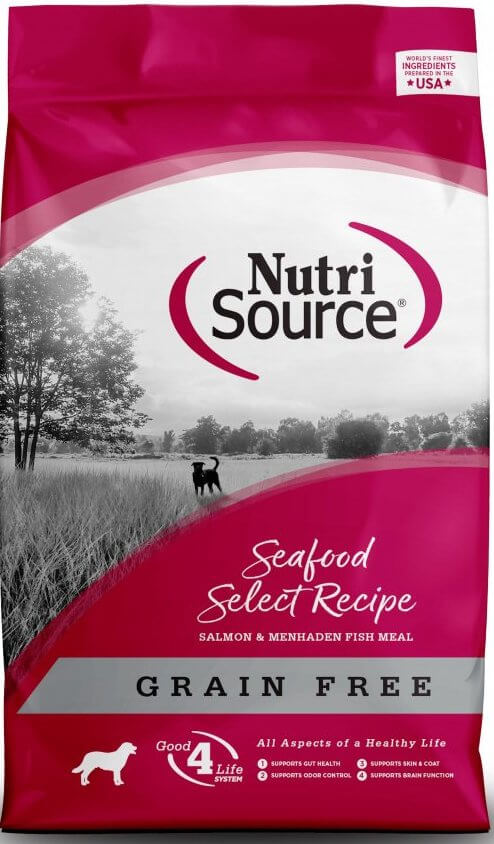
  • NutriSource Grain Free Seafood Select Formula
  • NutriSource Grain Free Heartland Select Formula
  • NutriSource Grain Free Large Breed Lamb Formula
  • NutriSource Grain Free Large Breed Chicken Formula

NutriSource Grain Free Heartland Select Formula was selected to represent the others in the line for this review.

NutriSource Grain Free Heartland Select

Dry Dog Food

Estimated Dry Matter Nutrient Content

Protein = 28% | Fat = 17% | Carbs = 48%

Ingredients: Bison, chicken, chicken meal, peas, pea flour, pea starch, menhaden fishmeal, sunflower meal, alfalfa meal, flax seeds, sunflower oil, natural turkey and chicken flavor, chicken fat (preserved with mixed tocopherols), tomato pomace, tapioca flour, calcium carbonate, dicalcium phosphate, potassium chloride, dried brewers yeast, pea protein, salt, minerals (zinc proteinate, iron proteinate, copper proteinate, manganese proteinate, cobalt proteinate, selenium yeast), choline chloride, taurine, vitamins (vitamin A acetate, vitamin D3 supplement, vitamin E supplement, niacin, d-calcium pantothenate, thiamine mononitrate, pyridoxine hydrochloride, riboflavin supplement, folic acid, biotin, vitamin B12 supplement), glucosamine hydrochloride, ascorbic acid (source of vitamin C), chondroitin sulfate, Yucca schidigera extract, calcium iodate, rosemary extract, yeast culture (Saccharomyces cerevisiae), dried Lactobacillus acidophilus fermentation product, dried Enterococcus faecium fermentation product, dried Aspergillus niger fermentation product, dried Bacillus subtillis fermentation product

Fiber (estimated dry matter content) = 7.8%

Red items when present indicate controversial ingredients

Estimated Nutrient Content
MethodProteinFatCarbs
Guaranteed Analysis25%15%NA
Dry Matter Basis28%17%48%
Calorie Weighted Basis24%35%41%

The first two ingredients in this dog food are bison and chicken. Although they’re both quality items, raw meat contains about 80% water. After cooking, most of that moisture is lost, reducing the meat content to just a fraction of its original weight.

After processing, these items would probably account for a smaller part of the total content of the finished product.

The third ingredient is chicken meal. Chicken meal is considered a meat concentrate and contains nearly 300% more protein than fresh chicken.

The fourth ingredient mentions peas. Peas are a quality source of carbohydrates. Plus (like all legumes) they’re rich in natural fiber.

However, peas contain about 25% protein, a factor that must be considered when judging the actual meat content of this dog food.

The fifth ingredient lists pea flour, a powder made from roasted yellow peas. Pea flour makes a slightly healthier substitute for wheat and can support more stable blood sugar levels.

The sixth ingredient lists pea starch, a paste-like carbohydrate extract probably used here as a gel-like binder for making kibble.

The seventh ingredient is menhaden fish meal, another protein rich meat concentrate.

Menhaden are small ocean fish related to herring. They’re rich in protein and omega-3 fatty acids. What’s more, in their mid-depth habitat, menhaden are not exposed to mercury contamination as can be typical with deep water species.

Fish meal is typically obtained from the “clean, dried, ground tissue of undecomposed whole fish and fish cuttings” of commercial fish operations.1

We are pleased to note that, unlike many fish meals, this particular item appears2 to be ethoxyquin-free.

The eighth ingredient is sunflower meal, a by-product of the oil extraction process – and an item more typically found in feed for livestock.

Although sunflower meal contains about 34% protein, it would be expected to have a lower biological value than meat.

And less costly plant-based products like this can notably boost the total protein reported on the label — a factor that must be considered when judging the actual meat content of this dog food.

The ninth ingredient is alfalfa meal. Although alfalfa meal is high in plant protein (about 18%) and fiber (25%), this hay-family item is more commonly associated with horse feeds.

From here, the list goes on to include a number of other items.

But to be realistic, ingredients located this far down the list (other than nutritional supplements) are not likely to affect the overall rating of this product.

With three notable exceptions

First, the manufacturer appears to have applied friendly bacteria to the surface of the kibble after cooking. These special probiotics are used to enhance a dog’s digestive and immune functions.

Next, brewers yeast. Brewers yeast can be a controversial item. Although it’s a by-product of the beer making process, this ingredient contains about 45% protein and is rich in other healthy nutrients.

Fans believe yeast repels fleas and supports the immune system.

Critics argue yeast ingredients can be linked to allergies. This may be true, but (like all allergies) only if your particular dog is allergic to the yeast itself.

What’s more, a vocal minority insist yeast can increase the risk of developing the life-threatening condition known as bloat. However, this is something we’ve not been able to scientifically verify.

In any case, unless your dog is specifically allergic to it, yeast can still be considered a nutritious additive.

And lastly, this food also contains chelated mineralsminerals that have been chemically attached to protein. This makes them easier to absorb. Chelated minerals are usually found in better dog foods.

NutriSource Grain Free Dog Food
The Bottom Line

Judging by its ingredients alone, NutriSource Grain Free appears to be an above-average dry dog food.

But ingredient quality by itself cannot tell the whole story. We still need to estimate the product’s meat content before determining a final rating.

The dashboard displays a dry matter protein reading of 28%, a fat level of 17% and estimated carbohydrates of about 48%.

As a group, the brand features an average protein content of 28% and a mean fat level of 17%. Together, these figures suggest a carbohydrate content of 48% for the overall product line.

And a fat-to-protein ratio of about 61%.

Average protein. Average fat. And average carbs as compared to a typical dry dog food.

When you consider the protein-boosting effect of the pea and sunflower meal ingredients, this looks like the profile of a kibble containing a below-average amount of meat.

Bottom line?

NutriSource is a grain-free dry dog food using a moderate amount of named meats as its main sources of animal protein, thus earning the brand 4 stars.

Highly recommended.

Those looking for a quality wet food from the same company may wish to visit our review of NutriSource canned dog food.

Special Alert

Rice ingredients can sometimes contain arsenic. Until the US FDA establishes safe upper levels for arsenic content, pet owners may wish to limit the total amount of rice fed in a dog's daily diet.

A Final Word

The descriptions and analyses expressed in this and every article on this website represent the views and opinions of the author.

Although it's our goal to ensure all the information on this website is correct, we cannot guarantee its completeness or its accuracy; nor can we commit to ensuring all the material is kept up-to-date on a daily basis.

Each review is offered in good faith and has been designed to help you make a more informed decision when buying dog food.

However, our rating system is not intended to suggest feeding a particular product will result in specific health benefits for your pet.

For a better understanding of how we analyze each product, please read our article, "The Problem with Dog Food Reviews".

Remember, no dog food can possibly be appropriate for every life stage, lifestyle or health condition. So, choose wisely. And when in doubt, consult a qualified veterinary professional for help.

In closing, we do not accept money, gifts or samples from pet food companies in exchange for special consideration in the preparation of our reviews or ratings.

To learn how we support the cost of operating this website, please visit our public Disclosure and Disclaimer page.

Have an opinion about this dog food? Or maybe the review itself? Please know we welcome your comments.

Notes and Updates

09/13/2010 Original review
11/15/2010 Adjusted to read ethoxyquin-free
03/04/2012 Updated (added 2 new recipes)
03/04/2012 Last Update

  1. Association of American Feed Control Officials
  2. Email via Dan Schmitz, NutriSource Sales Manager, 3/5/2012
  • Storm’s Mom

    You should be fine feeding a chicken sensitive/allergic dog a food with chicken flavour and chicken fat. Mine can’t do chicken meal at all (or “chicken” in wet food), but he’s fine with chicken fat and chicken flavour. In fact, he’s probably done best on Nutrisource Lamb than any other food he’s had (and he LOVES it). It is the protein that most dogs have problems with, not the flavouring or the fat.

  • http://www.facebook.com/amanda.halo Halo Amanda

    Also if he has issues with chicken you would want to stick with acana or do the nutrisource pure vita lines. All nutrisource contains some chicken, their pure vita grain free is completely chicken free and there is a turkey, salmon, or bison and i do remember the bison having the best calcium levels for larger dogs, the turkey and salmon were fairly high.

  • http://www.facebook.com/amanda.halo Halo Amanda

    I had all the calcium and phosphorous levels on all the nutrisource foods emailed to me from the company, which formulas were you interested in?

  • DonnaO

    I have an EnglishBulldog and like they’re reputation he does have yeast/skin issues. Anyone try NutraSourse for they’re EBG. I feed my dog Royal Canin for bulldog.for now would like to improve his diet

  • Amrita

    I’ve fed my American Bulldog Blue Buffalo, Orijen, Acana, Natural Balance, Eagle Pack, Holistic Select, and a bunch of others I can’t remember. Grain based food, grain-free food, it didn’t matter. Always, ALWAYS, she’s had soft, unformed stools. Fecal tests are all normal. She always needed canned pumpkin added to her food.

    Just had a frightening experience with a bad bag of Nature’s Domain Salmon and Sweet Potato from Costco. It made her very sick. In desperation I switched her to Nutrisource Seafood Select. This stuff is amazing! It doesn’t have any potato in it, and has double the fiber of most other foods. It really agrees with her.

    For the first time in her life she has perfectly formed firm stools without adding any pumpkin to her meals! Wow! Just wowwowwow…

  • Hound Dog Mom

    You could try digest enzymes and/or yucca.

  • Virginia dimase

    Help needed on cause of really smelly dog poop. Feeding our 5 lb 13 week old pup Merrick Puppy Plate in can mixed with Grandma Mae’s Country Naturals dry dog food. All stools have tested negative but she is still getting due wormer med. Had 3rd set of shots last week. Stools firm & pup seems fine except for this really foul poop. Any answers would be appreciated

  • Pattyvaughn

    Is it staining all of their fur, or just the ones that have allergies? Fur staining can be a sign that the food does not work for them and/or a sign of chewing.

  • DisappointedDogMom

    I have used NutriSource foods for many years. After adopting a puppymill Cavalier King Charles with apparent food allergies, I switched to the Heartland Grain free for my Great Dane and two Cavalier King Charles Spaniels – it is staining their fur. I am going to look for something else – very disappointed.

  • Pattyvaughn

    I ended up going with one from the health food store.

  • Maja

    I will try coconut oil, wait and try to find the right food. Is there any specific good brand or regular health store?
    Thanks for your help.

  • Pattyvaughn

    My puppy had eye drainage, red hot skin, itchiness, ear gunk, loose stools, and once he had pustules pop up on his skin. The way I knew it was detox rather than a real problem was that he never started to act like he felt bad again and each symptom only lasted a couple days and was gone again. He would show up with something different every couple weeks, but he never acted like he felt bad once he started getting better. You might want to add a teaspoon or two of coconut oil to his food each day.

  • Maja

    My husband just noticed that Woody has a dandruff or flaky skin, could it be part of detox??
    Eh, Im lost with choosing the right foods for my puppy, I would like to have a few different ones to rotate them, but finding even one seems to be tooo difficult!
    I like Costco price and rating and place on HDM list, but I dont like their recalls.

  • Pattyvaughn

    Yeah, people tend to horribly overfeed labs. It’s best to keep them lean while they are still growing. And lean for the rest of their life.
    The G is in anything that is hydrolyzed, natural flavorings, artificial flavor, yeast products, citric acid, broth, and a bunch more things that I can’t think of.
    Chicken is a really common allergen. I have one that can’t handle chicken in kibble, but can handle raw or lightly cooked chicken. Actually it is even stranger than that, he can handle chicken in one particular kibble.

  • Maja

    Patty,
    what else has the G in?
    Im asking because I donk know for sure if its chicken what my dog doesnt tolerate. The First food I put him on was Orijen LB puppy and he was getting a lot of eye gunk what lasted 2 months. Then i switched him to Canine caviar chicken GF, puppy. Eyes got worst and rash on the chest and neck by the end of second bag of canine cav.. Vet guessed it was chicken got antibiotics, he seemed to do better on canine caviar bison or lamb, all cleared up, but I didnt like the brand anymore…
    So I put him on Acana pacifica, and he seemed to be fine, until now. But no other signs yet. Just in my pocket. He gets 5 cups a day now and is not getting any fatter. He is the skinner lab I ever seen, all labs I know are overweight.

  • Maja

    Betsy,

    he is a lab, little over 7 months old and he is still growing daily, at least for me. So I dont know, maybe the calcium is not a problem now?

  • http://www.facebook.com/profile.php?id=1140685339 Betsy Greer

    Hi Maja,

    NutriSource is definitely a good, budget friendly choice for you. I found the emails they sent me and it does look like the only formula with suitable calcium for a large breed puppy is the Large Breed Chicken & Rice with Calcium at 1%.. The next closest is the Pure Vita Grain Free Bison, but the Calcium in that is a bit too high at 1.8%.

    How old is your pup? I don’t think the Calcium is as big a concern once they’ve reached about 80% of their full growth.

    I have the grain free spreadsheets. I’ll forward them to you, if you’d like. Just drop me an email at Betsy10360(at)aol(dot)com.

  • Maja

    Thanks Patty,
    I didnt give him seacure for 2 days now, so I think I will follow your advise and will go back to it to check how he will do on it over week or two. I hope its only “flushing” since he started to take good probiotics in the same time.

  • Maja

    Hi Betsy, thank youy for answering.

    Yes, I meant nutrisource (Acana is what I feed him now), hehe my English.
    Ive seen HDM exellent job with calcium, but Im looking for something less pricey and im in Canada, so like half of the foods are not sold in here.
    Im emailing with them and somehow theyre sending me grain inclusive instead of grain free.

  • Pattyvaughn

    The seacure shouldn’t cause allergies, but it does have free glutamic acid(the G in MSG) in it, and some dogs are sensitive/intolerant to it. Also eye gunk can be a sign that the dog is flushing something out of its system, otherwise known as detox, which is a good thing. I don’t know of any way to tell you what it might be other that to say watch and see how your dog does. If it’s a free glutamic acid problem, you will start to see other things too. If it’s detox, he will continue to feel better and better with minor setbacks here and there, lasting a couple days.

  • http://www.facebook.com/profile.php?id=1140685339 Betsy Greer

    Hi Maja,

    First off, NutriSource isn’t made by Acana, it’s made by Tuffy’s which is a division of KLN Enterprises. Are you sure this is the food you’re thinking of, or could it be something else that is made by Champion who actually is the manufacturer of Acana?

    I’m a fan of both Acana and NutriSource. Have you hopped over to the forums area and looked over the large breed puppy food list that Hound Dog Mom put together: http://www.dogfoodadvisor.com/forums/topic/large-and-giant-breed-puppy-nutrition/. This list includes calcium information. Do email Tuffy’s/KLN for the calcium info for NutriSource. I once did as well and am unable to locate the email now or I’d share with you what they sent to me. I seem to recall some varieties were fine and some were too high.

  • Maja

    Hi,

    Im thinking about switching my lab puppy to Nutrisource grain free (from Acana). Im looking for info about calcium levels in ther lines, there is nothing about it on their website, my store doesnt carry it so i would have to order in order to see if there is calcium levels on packages, and im emailing with the company, but probably by mistake i got their grain inclusive analysis. And what about chicken flavor if my dog has problems with chicken??

    And thank you guys for your big-big help. You suggested that loose stools may come from too much excercise. I was sceptical
    about this, but had no other choice like to do it: at first at the dog park dogs knock me down so i broke my wrist, and second my pup got neutered so we are stuck in the house and backyard for now.. And after we cut down off leash and play time he is pooping like normal dog finally!! And maybe the right probiotics helped too, i got mercola as you suggested.
    One more question: I bought Seacure for my dog and he doesnt well on it. Ugly stuff comes out of his eyes (like after him having a chicken). Is the intolerance to the white fish in seacure possible? I thought its alredy broke down so … And I didnt know that My dog could have any other problems thtat chicken. He is currently on acana pacifica which contains white fish as ~ fourth ingredient.

  • Pattyvaughn

    That’s a common beagle problem too. They don’t have an off switch when it comes to eating. A beagle I had years ago ate more than his body weight in treats once. He ate until he barfed then he went back and ate some more. When I got home the brand new 25# box of jumbo dog bicuits that I had gotten for my German Shepherds was reduced to crumbs including the box, there were piles of vomit EVERYWHERE, and my beagle literally looked like he had swallowed a football. He suffered no ill effects, not even diarrhea. And he happily tried to do the same thing again later, with less success. I wised up.

  • aimhi

    Thank you all who responded to my pleas for info on this dog food!! Appreciate it greatly! We have an 8yr old puggle who is constantly scratching/licking and so we are going grain free to see if allergies are a cause. But he also has weight issues. The pug in him is very dominate!

  • Pattyvaughn

    Two of my three do great on NutriSource Grain Free. The other one can’t handle the varieties with chicken and needs a higher protein anyway. Like Storm’s Mom, I think this is a fantastic food for the money and I recommend it to a lot of people.

  • Storm’s Mom

    My guy does fantastically on Nutrisource Grain Free Lamb whenever it comes around in the rotation..I’ve always considered it a “hidden gem” of a food, and a fantastic value! The other Nutrisource Grain Free varieties are either too low in protein for my liking or have chicken (which my guy is allergic to), so the Lamb is the only one I feed. I would highly recommend trying it. Hope this helps!

  • Hound Dog Mom

    Look on the bright side – not only can you read feedback on NutriSource on this thread, but you can also learn about vaccines. Hitting two birds with one stone.

  • aimhi

    I was hoping to get more opinions on the above rated dog food, but it seems I’ve stumbled into the vaccines section! Seriously, I’ve spent alot a time scrolling through a lot of these posts and its been a waste

  • Melanie

    A good question to ask is what is the lifespan of pets who get vaccinated regularly? What is the life span of pets that do not? Is there a significant difference? Pets are living longer and longer. Heck, there are dogs who are fed IAMS and Beneful who live into their 20s. It’s not all black and white. Feed your dog to the best that you can afford, exercise your pup, offer love and stability, and the rest is left up to genetics.

    I personally think it’s okay to vaccinate. A lot of vaccines seem to be for every 3 years once you do it regularly. When you don’t keep up with it, they make you do it yearly.

  • Mel

    Note – Certain Vaccinations are required if you ever have to board your pet! You can’t always avoid all of them. Dogs are living longer than they ever have. Do your best to keep your companion healthy, but remember that you ARE doing your best. Don’t be too hard on yourself! :)

  • InkedMarie

    HDM gave you a link, I do puppy shots then that is it. They get a titer and the holistic vet tells me if they need a booster (neither of mine have). I do rabies every three years

  • Crazy4cats

    Unfortunately, I think I’m missing that mechanism too! :)

  • Pattyvaughn

    I think they are lacking the mechanism that tells them they are full. Or else they are lacking the brain that tells them they are full.

  • beaglemom

    I was filling their food container (holds ~12 lbs) the other day while it was sitting on the floor and one of my beagles walked right up and started eating out of the bin. She’d have gone straight to the bottom if I’d let her!

  • Hound Dog Mom

    Eating a 25 lb. box of biscuits in one sitting, typical hound dog thing to do. I don’t understand why hounds are such gluttons lol

  • Pattyvaughn

    I had a beagle eat a 25 lbs box of dog biscuits once. He was a 24 lbs beagle before he started. He looked like he had eaten a whole watermelon. Fortunately for him, not so much for me, he vomitted everywhere on his own. I fasted him for a couple days, which he didn’t like at all, but he never showed any ill effects from it.

  • Hound Dog Mom
  • Vman

    What do you recommend getting and not to get?? As of now I think I’m just going to go with rabbies, as my dog is on his second year shots.

  • v

    Cups per calories…506 kcal is fine. if your dog is active it needs about 400+ anyways. My GSD working dog does perfect on it.

  • Crazy4cats

    Yes, probably wishful thinking. A little off topic, but when my sister’s lab was young, she came home to a swollen up looking sausage of a pup. His belly seemed to be getting bigger before her eyes. She took him to vet for tests and X-rays. He was totally bloated with dry food. He had to stay all night. I think they had him throw up most of it. They estimated that he ate about 25 pounds of food. Needless to say his food Is now in a container with a screw-on type lid. A little funny now, but scary at the time!

  • Hound Dog Mom

    If labs are anything like bloodhounds…it’s definitely wishful thinking lol

  • Crazy4cats

    Yes, I hope it works out for my dogs. It’s a little cheaper than the blue I was feeding and I can feed them a little less. Win-win. I just hope the boys don’t get mad at me for feeding less. They are true labs. They think they are always hungry. Although, this food is also a little higher in fat so hopefully they will feel a little fuller. Probably just wishful thinking :)

  • Hound Dog Mom

    With pet food kilocalories and calories are used interchangeably. Technically, 1 kcal. = 1,000 cal. but people just say “calories.” That is a higher calorie content than the average food, I personally prefer more calorie-dense foods. They feed out cheaper than a lower calorie food.

  • Crazy4cats

    Hi All-
    I just brought home a bag of Nutrisource G/F Lamb. I was checking out the calories on the bag. It states that it has 506 kcal per cup. I’m assuming that kcal’s are the same as regular old calories? That seems really high to me compared to other foods I’ve fed. Any thoughts? Has anyone else tried this food?

  • Vman

    Andrew, that so true! Since I’ve switched from TOTW to NutriSource Grain free my GSD working dog has been turning in circles before he downs and waits for me to set the bowl down. Gets very excited! This is a great brand and its never been in a recall which is why I really like this brand. Not to mention its also from my neck of the woods, MN! My dog would from time to time build up dry skin in certain areas and with the higher omega’s in Nutrisource it helps a lot with my dog. Well rounded food and great price. My dog has great energy and solid stool as well!

  • Andrew

    I feed my German Shepherd the Heartland Select. My parents’ 5-month old GSD is also fed the same. I’ve never seen dogs flip out about dry kibble like they do about this food. As soon as I go to the bag of food, my dog starts jumping up and down, spinning around, and just going all around crazy. I can even use the food as treats for training, she loves it so much. And, Heidi, I do not have the same problem you’re having. She poops twice daily, once in the morning right before she eats, and once at night right before she eats. There is at least 6 hours after eating before she poops, and it’s always solid. However, she does seem to always want more, but not as if she’s not satisfied, it’s more because it’s like a treat to her. I think she’d eat the entire bag if I let her.

  • Heidi

     Yes Shawna, you cleanse before a colonoscopy to remove FOOD from your colon.  Hardly the same thing as “mucoid plaque”.  Again, there is no scientific or medical evidence that any such thing exists. My beliefs or thoughts on holistic medicine were not given and are not relevant to this subject, because what you are talking about is not holistic medicine but a complete and unsubstantiated fallacy. Very poor form on your part to put words in my mouth,  you either can’t read what I wrote for comprehension or you have no scruples about trying to make your point in any fashion.  None of this has anything to do with dog food, which I believe is what we are here to discuss.

  • Heidi

     To be honest, Shawna, in a perfect world where I had the time, the money and more importantly, the resources to feed a home prepared diet, I would probably do that. BUT, we have literally crapped in our own food sources to the point that I don’t believe there is any healthy meat out there but possibly grass fed organic beef and organically raised other meats. I can rarely afford those for myself except in a limited way.   Chickens are fed arsenic based medications, cattle are dumped on feedlots and stuffed with [probably GM] corn and antibiotics (neither of which are natural diet for cows), there’s salmonella, e-coli and listeria almost weekly.  Vegetables are coated with layer upon layer of pesticides, and who knows what other kinds of trash and genetic crap has crept into our food system.  I just read an article on farms in area where there is shale fracking going on, groundwater is poisoned, cattle are dying and their tails are just falling off, and humans are getting extremely sick. Some farmers won’t sell their cows because they know they’re sick, other farmers are selling their herds. Those animals are making their way into the food chain. People are already starting to ask local farmers “where did that food come from”, because no one wants any food from where fracking is going on.  If I can’t be sure of the source, I won’t buy it for me or my dog.  It’s becoming more and more difficult to find anything healthy, for humans or animals.

  • Toxed2loss

    Heidi,
    It is against this websites policy to make inflammatory, mean spirited & degrading comments… I strongly urge you to read the commenting policy link, top right.

    To call all holistic & alternative medicine practitioners quacks, and imply that holistic & alternative medicine practitioners don’t have the brains & cognitive abilities to legitimately coin a phrase, discover something useful, or be scientists, violates this sites commenting policy.

    I find it ironic that you are so dismissive of the alternative medicine & holistic practitioners, yet you are seeking alternative medicine knwledge from Shawna, for your dog…

    It is further apparent that you either didn’t bother to read, or follow the links I provided, as they were cited. Sayer Ji’s Article On “the Dark Side of Wheat” has 90+ citations from AMA sanctioned medical journals….

    Yet you dismiss the whole concept out of hand… Because you, personally, don’t like the name used by some holistic & alternative practitioners. Your attitude is derogatory.

    I cited examples that use several different names. I could have coined my own term, “poo-cement.” And if I chose to write a cited peer reviewed paper on it, using my term, its no less credible than any other persons, regardless of their degree. Neither you, the AMA, nor any other person is in charge of regulating and sanctioning who discovers or names things. It is no less true because of your prejudicial bias.

    Do you realize that it was holistic & alternative medicine practitioners that first brought us the elimination diet? The concept your using to treat your dog’s pea lectin intolerance. It was alternative medicine that first recognized & coined the term “food intolerances” as opposed to allergies. It was Integrated allopathic practitioners that worked to get the concept accepted by the allopathic community. A concept brought forth by holistic practitioners…

    Alternative medicine also includes:
    Dietary supplements
    Herbals
    Detox procedures
    Acupuncture
    Chiropractic
    Massage therapy
    Sauna therapy

    Do you feel they are “quackery” as well?

  • Shawna

    PS — ever wonder why you would have to “prepare” for a colonoscopy?

    From Harvard Health website

    “You’ll need to stop eating solid foods the day before the colonoscopy, and starting the evening before the procedure, you must take a substance that triggers bowel-clearing diarrhea.”  http://www.health.harvard.edu/fhg/updates/preparing-for-a-colonoscopy.shtml

  • Shawna

    Quoted from the article I linked below

    “SBO’s eliminate accumulated putrefaction
    These organisms actually consume and digest the putrefaction, dislodging it from the walls of the intestines and thereby allowing its elimination from the body. 17

    SBO’s break food down into its most basic elements,which allows for improved assimilation and absorption of nutrients. This process creates an improved nutritional state and enhances cellular growth and development. It also improves waste elimination. 17″Here’s the research the above was taken from”Perdigom, G.S. Alvarez, M. Rachid, G. Aguero and N. Gobbato. .Symposium: Probiotic Bacteria for Humans: Clinical Systems for Evaluation of Effectiveness. Immune System Stimulation by Probiotics..  J Dairy Sci Vol. 78, No. 7; 1995 pp. 1597-1606.which allows for improved assimilation and absorption of nutrients. This process creates an improved nutritional state and enhances cellular growth and development. It also improves waste elimination. 17″Here’s the research the above was taken from”Perdigom, G.S. Alvarez, M. Rachid, G. Aguero and N. Gobbato. .Symposium: Probiotic Bacteria for Humans: Clinical Systems for Evaluation of Effectiveness. Immune System Stimulation by Probiotics..  J Dairy Sci Vol. 78, No. 7; 1995 pp. 1597-1606.

  • Shawna

    Fiber is supposed to slow the digestive system… I don’t think it is the fiber that is the issue but rather the lectins. I have an issue with the lectins in dairy. Dairy lectin (called caseine) causes the same reaction in me as you are seeing in your boy. Dairy also has no fiber.

    An yeah, I agree.. Most processed foods have pea in them. I raw feed—no peas, potatoes, grains etc. Just species appropriate foods in species appropriate amounts. Have you thought of that or home cooking?

  • Heidi

     Mucoid plaque does not exist, it was a term invented by a quack trying to sell bowel cleansing products. There is absolutely no medical or scientific evidence whatsoever, from studies or cadavers, that “mucoid plaque” exists. Least of all in dogs.

  • Heidi

     Well, like I said, just try to find a food without peas.  Next to impossible. I was in the feed store today fror canned food, and found ONE, Merrick’s Bangers and Mash that didn’t have peas.  Even Greenies now have pea products.   The GF lamb has 3 pea products, 2, 4, 6 on the ingredient list. That’s a lot of peas.  Has anyone done a long term study on the safety/nutritional availability of pea products in dog food? How is a dog supposed to absorb any nutrients if the poop is moving through so fast from all that fiber??  I’m not happy with this trend. Less meat, more  sub par peas, and no break on the price for cheaping out on the meat either.

  • Shawna

    Very interesting Heidi….  I talk a lot about lectins but I had yet met anyone that had a dog with a confirmed (or even suspected) intolerance to pea lectins (at least that I can remember).  I know pets and people that can’t have the following foods because of the lectins in them——chicken, eggs, barley, wheat, oats, rye, garlic, strawberries, cucumbers, green beans, soy, corn, dairy, peanuts (leguems in general), lentils — and probably a few more I’m not remembering..  Rice has lectins and phytates just like peas (all grains do) but rice seems to be less reactive then other grains.

    The Nutrisource foods only have 5% fiber in the lamb meal and 6% in the large breed lamb.  I don’t think that is really that high..  But they are lower in protein and therefore higher in carbs.  The higher carb content along with the peas could definitley cause an issue (if he is intolerant of peas).

    IF he is intolerant of peas —- you will want to quit feeding them altogether..  Lectins from foods that we are intolerant of can pass through the gut wall and into the blood stream where they can cause allergies, attach to organs and cause autoimmune diseases etc etc. 

    I don’t know if it is what is happening to your boy (your theory on peas does make sense) but Toxed is right.  The same thing can happen when high quality probiotics are started.  The guts can get cleaned out in a big way…  Two medical doctors, a naturopath and a pharamcist wrote the article in the following link.  In the paper they discuss how the intestines can be packed with fecal matter etc and they do site research at the end.  However it is not free data so I did not check it out :) ..  http://www.edwardsdrugs.com/PDF/moregeneralhealth/Dysbiosis%20and%20Probiotics.pdf

  • Toxed2loss

    Mucoid plaque is a term used by many holistic doctors and researchers to describe the uniform rubbery layers of mucous and rotting food which compact themselves year after year along the entire length of the digestive tract. (Anderson)

    In his fascinating book, Cleanse and Purify, Dr. Richard Anderson cites his encounter with one medical doctor who did not want to be identified. This doctor, after hearing Anderson’s lecture about mucoid plaque and expanded toxic colons, told the audience:
    “I have spent twelve years working in the field of post-mortem diagnosis. I have seen many thousands of dissected cadavers. What Rich is telling you is the absolute truth. Everybody has it in there. We have a way of attaching a hose to the upper intestines and with the aid of powerful chemicals, we literally blow the stuff right out of the intestines. I have seen the heavy ‘beer belly’ and so called fat people lose all that bulk in five minutes. It wasn’t fat. It was the mucoid layer that Rich was talking about. and in that filthy substance we see all sorts of worms, bacteria, fungi, and many unidentifiable things. It is almost unbelievable that people can live with that filth in them. All these people were dead of course, and it wasn’t hard to see why.”
    (Anderson p2-46)

    Here’s how gluten -the Latin for glue (wheat gluten is the base for
    Elmer’s Glue) binds its gluey self to the mucosal lining, adding to mucosal plaques…

    “Wheat gliadin, which causes coeliac disease, contains a lectin like substance that binds to human intestinal mucosa (Kolberg and Sollid, 1985) and this has been debated as the “coeliac disease toxin” for over 30years (Weiser and Douglas, 1976).”http://scialert.net/fulltext/?doi=pjn.2009.293.303

    “…This is the explanation typically given for the body’s reflexive formation of mucous following exposure to certain highly allergenic or potentially toxic foods, …” The dark Side of Wheat, Sayer Ji http://www.greenmedinfo.com/page/dark-side-wheat-new-perspectives-celiac-disease-wheat-intolerance-sayer-ji

    More mucus & binding to the mucosa, hmmmmmm? Why look, here’s more!

    “WGA lectin is an exceptionally tough adversary as it is formed by the same disulfide bonds that make vulcanized rubber and human hair so strong, flexible and durable. Like man-made pesticides, lectins are extremely small, resistant to break-down by living systems, and tend to accumulate and become incorporated into tissues where they interfere with normal biological processes. Indeed, WGA lectin is so powerful as an insecticide that biotech firms have used recombinant DNA technology to create genetically modified WGA-enhanced plants. We can only hope that these virtually unregulated biotech companies, who are in the business of playing God with the genetic infrastructure of Life, will realize the potential harm to humans that such genetic modifications can cause.

    Lectins are sugar-binding proteins, and through thousands of years of selectively breeding wheat for increasingly larger quantities of protein, the concentration of WGA lectin has increased proportionately. This, no doubt, has contributed to wheat’s global dominance as one of the world’s favored monocultures, offering additional “built-in” pest resistance. The word lectin comes from the same etymological root as the word select, and literally means “to choose.” Lectins are designed “to choose” specific carbohydrates that project off the surface of cells and upon which they attach. In the case of WGA the two glycoproteins it selects for, in order of greatest affinity, are N-Acetyl Glucosamine and N-Acetylneuraminic acid (sialic acid).

    WGA is Nature’s ingenious solution for protecting the wheat plant from the entire gamut of its natural enemies. Fungi have cell walls composed of a polymer of N-Acetylglucosamine. The cellular walls of bacteria are made from a layered structure called the peptidoglycan, a biopolymer of N-Acetylglucosamine. N-acetylglucosamine is the basic unit of the biopolymer chitin, which forms the outer coverings of insects and crustaceans (shrimp, crab, etc.). All animals, including worms, fish, birds and humans, use N-Acetyglucosamine as a foundational substance for building the various tissues in their bodies, including the bones. The production of cartilage, tendons, and joints depend on the structural integrity of N-Acetylglucosamine. The mucous known as the glycocalyx, or literally, “sugar coat” is secreted in humans by the epithelial cells which line all the mucous membranes, from nasal cavities to the top to the bottom of the alimentary tube, as well as the protective and slippery lining of our blood vessels. The glycocalyx is composed largely of N-Acetylglucosamine and N-Acetylneuraminic acid (also known as sialic acid), with carbohydrate end of N-Acetylneuraminic acid of this protective glycoprotein forming the terminal sugar that is exposed to the contents of both the gut and the arterial lumen (opening). WGA’s unique binding specificity to these exact two glycoproteins is not accidental. Nature has designed WGA perfectly to attach to, disrupt, and gain entry through these mucosal surfaces.” Opening Pandora’s Breadbox, Sayer Ji , http://www.greenmedinfo.com/page/opening-pandoras-bread-box-critical-role-wheat-lectin-human-disease

    Mucoid plaques are not simple, they are complex. But gluten grains definitely add to the problem. While this isn’t a cited paper, it gives a good aymans overview,

    “Upon seeing via the microscope at 1500X magnification, the Leaky Gut Syndrome caused by a history of overuse of antibiotics and chemicals, we see before our eyes red flags that may not be exactly CD, but, rather pre-cursors to it or, definitely, other chronic-intestinal (reversible) problems. The symptoms viewed include; Parasites (infection) Irritable Bowel Syndrome (infection/inflammation) IBS (infection/inflammation); Colitis (inflammation), Diverticulitis (infection/inflammation) precursors to Diabetes and Heart Disease including last but not least, painful stomach cramps including intermittent constipation and/or diarrhea. The patient/client may have already been given a diagnosis of Crohn’s Disease or Celiac Disease to name only one of the two “labels”. The inflammation (Leaky Gut Syndrome) within the intestines and colon (remember, we have 25 feet that includes the ascending, transverse and descending colon). There’s a lot of room for those travelers called parasites to add to the larger picture of a very unhealthy colon and mucous that builds up over a period of time where parasites make their homes, and, eventually, the build up of Mucoid Plaque due to the unknowing hazards slowing sneaking/building up due to a choice of a very unhealthy diet in sugar and lack of; Fiber; (i.e., psyllium husk found in Metamucil), Parasite Tincture; Enzymes, Probiotics, anti-inflammatory anti-oxidants – LSI’s OPC-165™; including the anti-inflammatory enzymes called Immuzyme®. The worst case scenario is that some healthcare professional just give it “a label”, and, this can lead in most cases to a misdiagnosis thereby, prescribing over and over again pharmaceuticals which only “band-aid” the problem. It may relieve temporarily, but, it begins “the Hamster Syndrome” and creating over a period of time more illness(es). Getting to the overgrowth of C-albicans (yeast) and systemic candidiasis will be the challenge but, definitely reversing the problems! Remember, you didn’t get here overnight and just think where it began? For some it can take up to 6 months to reverse, while others, only 2 to 4 months. Everyone heals differently according to their metabolism and commitment to reaching their goal. Only the individual can make this happen. One bad meal means working harder for the next upcoming week(s)!”
    Livestrong. Com

    Mucoid plaque is a term used by many holistic doctors and researchers to describe the uniform rubbery layers of mucous and rotting food which compact themselves year after year along the entire length of the digestive tract. (Anderson)

    In his fascinating book, Cleanse and Purify, Dr. Richard Anderson cites his encounter with one medical doctor who did not want to be identified. This doctor, after hearing Anderson’s lecture about mucoid plaque and expanded toxic colons, told the audience:
    “I have spent twelve years working in the field of post-mortem diagnosis. I have seen many thousands of dissected cadavers. What Rich is telling you is the absolute truth. Everybody has it in there. We have a way of attaching a hose to the upper intestines and with the aid of powerful chemicals, we literally blow the stuff right out of the intestines. I have seen the heavy ‘beer belly’ and so called fat people lose all that bulk in five minutes. It wasn’t fat. It was the mucoid layer that Rich was talking about. and in that filthy substance we see all sorts of worms, bacteria, fungi, and many unidentifiable things. It is almost unbelievable that people can live with that filth in them. All these people were dead of course, and it wasn’t hard to see why.”
    (Anderson p2-46)

    Here’s how gluten -the Latin for glue (wheat gluten is the base for Elmer’s Glue) binds its gluey self to the mucosal lining, adding to mucosal plaques…

    “Wheat gliadin, which causes coeliac disease, contains a lectin like substance that binds to human intestinal mucosa (Kolberg and Sollid, 1985) and this has been debated as the “coeliac disease toxin” for over 30years (Weiser and Douglas, 1976).”http://scialert.net/fulltext/?doi=pjn.2009.293.303

    “…This is the explanation typically given for the body’s reflexive formation of mucous following exposure to certain highly allergenic or potentially toxic foods, …” The dark Side of Wheat, Sayer Ji http://www.greenmedinfo.com/page/dark-side-wheat-new-perspectives-celiac-disease-wheat-intolerance-sayer-ji

    More mucus & binding to the mucosa, sounds like things are getting congested in there! Here’s more…

    “WGA lectin is an exceptionally tough adversary as it is formed by the same disulfide bonds that make vulcanized rubber and human hair so strong, flexible and durable. Like man-made pesticides, lectins are extremely small, resistant to break-down by living systems, and tend to accumulate and become incorporated into tissues where they interfere with normal biological processes. Indeed, WGA lectin is so powerful as an insecticide that biotech firms have used recombinant DNA technology to create genetically modified WGA-enhanced plants. We can only hope that these virtually unregulated biotech companies, who are in the business of playing God with the genetic infrastructure of Life, will realize the potential harm to humans that such genetic modifications can cause.

    Lectins are sugar-binding proteins, and through thousands of years of selectively breeding wheat for increasingly larger quantities of protein, the concentration of WGA lectin has increased proportionately. This, no doubt, has contributed to wheat’s global dominance as one of the world’s favored monocultures, offering additional “built-in” pest resistance. The word lectin comes from the same etymological root as the word select, and literally means “to choose.” Lectins are designed “to choose” specific carbohydrates that project off the surface of cells and upon which they attach. In the case of WGA the two glycoproteins it selects for, in order of greatest affinity, are N-Acetyl Glucosamine and N-Acetylneuraminic acid (sialic acid).

    WGA is Nature’s ingenious solution for protecting the wheat plant from the entire gamut of its natural enemies. Fungi have cell walls composed of a polymer of N-Acetylglucosamine. The cellular walls of bacteria are made from a layered structure called the peptidoglycan, a biopolymer of N-Acetylglucosamine. N-acetylglucosamine is the basic unit of the biopolymer chitin, which forms the outer coverings of insects and crustaceans (shrimp, crab, etc.). All animals, including worms, fish, birds and humans, use N-Acetyglucosamine as a foundational substance for building the various tissues in their bodies, including the bones. The production of cartilage, tendons, and joints depend on the structural integrity of N-Acetylglucosamine. The mucous known as the glycocalyx, or literally, “sugar coat” is secreted in humans by the epithelial cells which line all the mucous membranes, from nasal cavities to the top to the bottom of the alimentary tube, as well as the protective and slippery lining of our blood vessels. The glycocalyx is composed largely of N-Acetylglucosamine and N-Acetylneuraminic acid (also known as sialic acid), with carbohydrate end of N-Acetylneuraminic acid of this protective glycoprotein forming the terminal sugar that is exposed to the contents of both the gut and the arterial lumen (opening). WGA’s unique binding specificity to these exact two glycoproteins is not accidental. Nature has designed WGA perfectly to attach to, disrupt, and gain entry through these mucosal surfaces.” Opening Pandora’s Breadbox, Sayer Ji , http://www.greenmedinfo.com/page/opening-pandoras-bread-box-critical-role-wheat-lectin-human-disease

    Mucoid plaques are not simple, they are complex. But gluten grains definitely add to the problem. While this isn’t a cited paper, it gives a good layman’s overview,

    “Upon seeing via the microscope at 1500X magnification, the Leaky Gut Syndrome caused by a history of overuse of antibiotics and chemicals, we see before our eyes red flags that may not be exactly CD, but, rather pre-cursors to it or, definitely, other chronic-intestinal (reversible) problems. The symptoms viewed include; Parasites (infection) Irritable Bowel Syndrome (infection/inflammation) IBS (infection/inflammation); Colitis (inflammation), Diverticulitis (infection/inflammation) precursors to Diabetes and Heart Disease including last but not least, painful stomach cramps including intermittent constipation and/or diarrhea. The patient/client may have already been given a diagnosis of Crohn’s Disease or Celiac Disease to name only one of the two “labels”. The inflammation (Leaky Gut Syndrome) within the intestines and colon (remember, we have 25 feet that includes the ascending, transverse and descending colon). There’s a lot of room for those travelers called parasites to add to the larger picture of a very unhealthy colon and mucous that builds up over a period of time where parasites make their homes, and, eventually, the build up of Mucoid Plaque due to the unknowing hazards slowing sneaking/building up due to a choice of a very unhealthy diet in sugar and lack of; Fiber; (i.e., psyllium husk found in Metamucil), Parasite Tincture; Enzymes, Probiotics, anti-inflammatory anti-oxidants – LSI’s OPC-165™; including the anti-inflammatory enzymes called Immuzyme®. The worst case scenario is that some healthcare professional just give it “a label”, and, this can lead in most cases to a misdiagnosis thereby, prescribing over and over again pharmaceuticals which only “band-aid” the problem. It may relieve temporarily, but, it begins “the Hamster Syndrome” and creating over a period of time more illness(es). Getting to the overgrowth of C-albicans (yeast) and systemic candidiasis will be the challenge but, definitely reversing the problems! Remember, you didn’t get here overnight and just think where it began? For some it can take up to 6 months to reverse, while others, only 2 to 4 months. Everyone heals differently according to their metabolism and commitment to reaching their goal. Only the individual can make this happen. One bad meal means working harder for the next upcoming week(s)!”
    Livestrong. Com

  • Heidi

     That’s a nice theory, but I don’t believe there’s any real science to it. If you have any cites I’ll gladly read them. He hasn’t had corn or wheat in his food, the only grain was rice.  It is, I am convinced the peas, and pea products. They are a cheaper source of protein, and they contain IMO way too much fiber.  What is even more troubling is that everyone, EVERYONE is now including pea products in their food, which is not what I want in place of meat. It’s the new corn -cheap filler with protein.  He is now eating half Nutisource and half Orijen adult, and miracle of miracles, the poops have reduced in size, volume, and texture, to what I know as “normal”,  He’s not feeling the urgency that he was  before either. Interesting reading, especially about lectins in peas:

    http://www.truthaboutpetfood.com/articles/disappointing-trend-in-rising-pet-food-market.html

  • Toxed2loss

    Heidi,
    In people that eat highly processed grain inclusive diets, the intestines are coated with a thick glue (from gluten grains like corn & wheat.) Lots of unhealthy stuff becomes trapped in this biofilm, including undigested food, parasites, and pockets of bad bacteria. In people it can be tens of pounds. Since Dogs, pigs & people have similar digestive systems its not incongruent to assume it happens in dogs. What happens when you (or your dog) switch up to a healthier diet is that the biofilm begins to break down, and the accumulated matter begins to be expelled. So yes, you will see a lot more poo, than the amount you’re feeding. You might also experience bouts of horrific gas. Endure it, he’s cleansing. Probiotics will help. Raw apple cider vinegar will help cut the glue and speed the expelling. You want that because then he’ll receive the nutrients from the food your feeding (with biofilm its the bacteria that gets the lion’s share of the nutrients). With a clogged up gut, you could feed him a ton and he could still be virtually starving to death. Eventually, he’ll want less.

  • http://www.dfwpugs.com/ sandy

    My fosters eat the GF Lamb or the Heartland Select and they only poop twice a day.

  • InkedMarie

    I feel your pain. My brittany came to me on Nutro Natural, has been on a variety of grainfree and grain inclusive and she could easily poop six times a day. I switched her to Brothers Complete and then it was 2-3 times a day

  • Heidi

    He poops before breakfast, he’s in all day when i’m at work, then he goes out when i get home and has started pooping twice, obviously he’s holding it all day, but that’s a lot from one cup of food. I don’t usually walk him after breakfast during the week, but if I take him anywhere on weekends I learned the hard way that he has to go for a big long walk before hand or he will even poop in the car, he just can’t hold it. I’ve never had that problem before, twice a day was it. Food stays in the stomach for about an hour after a dog eats, so there’s no reason he should be looking for something else, I just don’t think this food is for him, and wondered if anyone else had the same problem with all those pea products.

  • Storm’s Mom

    It just dawned on me that the fact that he’s pooping most of his food out would explain why he’s not feeling full for as long because there’s nothing left in his tummy to keep him full! Hopefully he’s drinking enough to refill what he’s losing by pooping so much/often? Definitely could be the peas..the fiber is higher than a lot of food, that’s for sure! How long after you feed him is he going out to poop? I find that with some foods, there’ll be a lot more volume and it’ll be less firm if I take him outside less than 30 mins after he’s eaten (I live in a condo). If I wait a little longer (45 mins or so) it’s much firmer, smaller, and less volume. Anyway, just some thoughts..

  • Heidi

    He’s only getting one cup per feeding, that’s less than they recommend but I didn’t want him getting fat, spent half the summer getting rid of last year’s muffintop, and his weight has remained the same. He gets a spoonful of grain free canned on top, and fish oil, and occasional flax seed. I suspect the pea ingredients are adding fiber and making things move more than usual, no idea of the volume though, unless that’s the result of the fiber as well. Could be that greyhounds are just more sensitive in the gut. Very odd…

  • Storm’s Mom

    Heidi – actually my guy had the complete opposite reaction to Nutrisource Grain Free Lamb! His poops were the smallest of any food he’s been on (he’s 27lbs), nicely firm, and there was no increase in frequency (2-3 times per day is his norm). He also never seemed hungry on it (and he LOVED this food, probably more than any food he’s had so far). Perhaps try feeding your guy less, using canned food as a topper, and/or supplementing with probiotics/enzymes? Every dog is different, though, so perhaps it’s just not one that works for him *shrug*

  • Heidi

    I weaned onto Nutrisource Grain Free Lamb to get away from the recently changed Innova and also arsenic in chicken and rice. I am going to be switching to something else shortly, because of the pooping, all the time. My 80 lb greyhound gets 1 cup am/pm and literally poops out twice as much as I give him. It’s bizarre. He has gone three times before noon today, each one what he used to go in a whole day. Not runny most of the time, but not firm as I like them either. He also never seems satisfied, still seems like he wants more right after he ate. His weight is good, hasn’t gained or lost, but there is way too much coming out for what he eats. I am beginning to suspect the pea products, which are not (or didn’t used to be) present in large amounts in Innova. Anyone else had this experience?

  • Pingback: Anybody feed Nutrisource? - Boxer Forum : Boxer Breed Dog Forums

  • http://www.facebook.com/profile.php?id=1140685339 Betsy Greer

    Hi Rebecca,

    I’m a fan of Nutrisource products, also. I’m curious though, why aren’t you using Nutrisource now – is it because of the Calcium level? There are some Nutrisource formulas that have acceptable Calcium levels for large/giant breeds.

    Come to think of it, Nutrisource emailed me detailed guaranteed analysis information, but they attached a spreadsheet to the email and I’m not sure how to attach it to a post here. You can send me an email at Betsy10360@aol.com, and I’d be happy to forward their email to you. Just put Nutrisource in the subject line.

  • Pattyvaughn

    Wow, only 4-4.5 cups for a 160lbs dog! That’s pretty good. When I had my 40lbs dog on it we fed just shy of 2.5 cups, not nearly so good. But I liked the food.

  • Rebecca Presley

    This food has been highly recommended to me by my pet food supplier for my Great Pyrenees when we switch him to adult food after 16 months; something I find necessary to point out is, this is a grain free food which is wonderful, and the protein and carbohydrate balance necessary in a food really depends on your dog breed.  You cannot knock a food for all breeds because of its high carb ratio.  Some breeds do best on a higher carb diet, and for that to be provided in a grain free formula is really a treat.  And with NutriSource, the amount of food in the daily feeding is much less than other brands would require for proper calorie intake, because the food is more efficient.  Less intake is needed to get the proper nutrition and calories, less waste from the dog because the food is not full of filler, and so also, firmer waste.  At 160 pounds, which is supposed to be top weight for our Great Pyr, the recommended daily feed amount for the large breed formulas is 4-4.5 cups… that’s adult feeding. In Holistic Select Giant Breed Puppy, we have to feed him 7-7.5 cups just for 90-100 pounds, daily, because it is grain based.  Another pet store we use from time to time, that also provides above average foods, pushes FROMM on us no matter what the breed, but though a 33 lb bag of large/giant breed food from FROMM Gold is around $44.99 where we shop, we would need two bags instead of one, because the recommended daily feed amount for 160 lb dog is 9+ cups a day. Not worth the savings.  So to me, for our purposes, this is a very good food option, regardless of the 48% carb ratio.  Our dog needs the carbs, but thankfully we can get them to him without grains and fillers.  So just thought I would throw that out there.  Some are a little too black and white about these foods, when there really is a grey area of what you need for your dog.  Not all dog foods, though rated vary highly, are right for all dogs.  Depends on your breed and their need. We love Acana, think it is one of the best foods out there and give it to our cat, but we fear that the carb ratio in Acana is not quite high enough, even in their large breed formulas.  Which is sad because Acana ingredients really and the care they take in making their food is really top notch.

  • http://www.dfwpugs.com/ sandy

    If you read “The Bottom Line” section of the article towards the end, it might explain things for you and the article “How We Rate Dog Food” and “Problems with Dog Food Reviews”. 

  • Storm’s Mom

    The Lamb Meal one and the Chicken one are both higher protein and higher fat, and thus lower carbs, than the one listed here.  I seem to remember something about 43% carbs when the chicken one was used here as the model (the yellow part).  The “Select” ones are lower protein and lower fat, thus higher calories. Kinda wish Mike had kept the original review up here, as it reflected better on the brand (it was before the Heartland Select and Seafood Select came out). 

  • BryanV21

    The carbohydrate content is a bit high in this food too, which is due to what doggone was saying. Personally, I wouldn’t recommend a dry food above 45% carbohydrates.

  • doggonefedup

    probably has something to do with the first two ingredients being full moisture meats which would be greatly reduced in volume and weight when dried and the peas, pea flour, pea starch weigh much less but consume 3 to 4 times the volume than the first three ingredients combined making the non-meat protein the major protein source. not the best protein for dogs.

  • guest

    This has three meat ingredients listed before the first “binder” why only 4 stars?

  • Hound Dog Mom

    Are you feeding the Seafood Select? That’s salmon-based. There is no specific salmon formula on the NutriSource website that I can see.

  • http://www.facebook.com/profile.php?id=100002019545558 Debbie DiFrancesco

    why don’t I see the samon on this chart? That is what I feed my 2yr. pit bull and it stopped all his hair loss and skin allergy’s. His stool is alittle hard but rather that than very loose. How good is thid particular one when it comes to a grain free kibble?

  • Sue

    I finally found a dry dog food that my fussy Toy Fox Terrier would eat and actually gain some weight from!  I have 3, two are actually, pigs, I think…LOL  Anyway the one girl has always been so skinny.  She is a very fussy eater, and I brought her several of the better brands, only to have her turn her nose up at them and go try and eat my larger dogs Purina dog chow!  :(   I got some samples of the Nutri Source, and she is eating it and has gained weight!!!  Yeah!!  She is no longer a walking skeleton, she looks great!  Not as fat as my other two piggies, but fat for her.  She now has good flesh over her bones!!  I would highly recommend this dog food.  I use the Chicken.  :)   Now if I could get some weight off my little male…he wants to eat everything all the time!!!  LOL

  • http://www.dfwpugs.com/ sandy

    Some good info at dogs4dogs (dot) com

  • http://www.facebook.com/profile.php?id=598089668 Michelle Jadin

     I’m sure the peas outweigh all the meat meals. I fed this to my dog for about a month. I can’t believe the weight it started to put on her…not in a good way either. We are now trying Nature’s Variety, hopefully it will get her back to how she looked before eating all peas with Nutrisource.

  • LabsRawesome

     Great post Elisabeth TS!

  • ElisabethTS

    Overvaccination is a huge problem!

    You are not protecting your dog more by giving more shots. A
    dog is either immune or he’s not and piling up shots on top of each other is
    not causing them to be more immune and is detrimental to the dog’s immune
    system. Rabies shots cause more physical, mental, and behavioral problems in
    dogs than any of the other vaccines.

    Every 3 years is more than satisfactory and there is nothing
    built into the bottle of vaccine that will cause it to stop working after 3
    years and a day. There has never been any tests that show that dogs ever loose
    their immunity to rabies once they have the shot. There IS evidence that the
    vaccine is 100% effective after 7.5 years. 10 year tests are underway right now
    as we speak.

    http://www.rabieschallengefund.org/


    “Vaccines, in contrast to virtually all veterinary pharmaceuticals, are
    prescribed on a 1-dose-fits-all basis, rather than by body weight.” I have
    always been shocked that a Chihuahua
    puppy and an adult Great Dane are given the same dose shot: 1 mL. They get the
    same volume of virus or bacteria plus the same volume of adjuvants
    (boosting agents like aluminum), preservatives (like mercury), antibiotics,
    stabilizers and foreign tissue cultures (like fetal calf serum). All these
    ingredients are known to cause vaccine reactions. http://www.dogs4dogs.com/blog/2009/09/30/vaccinating-small-dogs-risks-vets-arent-revealing/

  • Shawna

    Lepto in humans

    “Human vaccination against leptospirosis is certainly a goal of the research community and would undoubtedly save many thousands of lives each year, but progress has been extremely slow. Currently a vaccine is being tested in Cuba, and results are promising, but it is not yet licensed in the wider world and there are insufficient long-term studies to satisfy us it is safe for widespread use…..

    Veterinary staff are often called to treat cases of leptospirosis, either confirmed or suspected, and their handling of both the animal and the samples taken for testing obviously place them at a higher risk of infection than the general public. Their risk events are also part of their occupation and so there are legal requirements in terms of employee protection and safety policy to satisfy.

    Human vaccination is not a possibility at this time, except in one or two countries, and the long-term use of prophylaxis is also not viable – therefore the best practice for protection is hygiene and barrier controls, plus a detailed awareness of the symptoms of infection.”  http://www.leptospirosis.org/topic.php?t=22&f=7

  • Shawna

    Bryan is right Victoria :)   Lepto has a short duration of immunity — actually may be less then 1 year so pups can go 3 or 6 months without protection..

    The American Animal Hospital Association 2006 Vaccine Guideline (linked before) states “Annual boosters are not routinely recommended for all dogs.  Vaccination should be restricted to use in areas where a reasonable risk of exposure has been established.  Veterinarians are advised of anecdotal reports of acute anaphylaxis in toy breeds following administration of leptospirosis vaccines.  Routine vaccination of toy breeds should only be considered in dogs known to have a high exposure risk.  Dogs determined to be at exceptionally high risk should be vaccinated at 12 and 16 weeks of age, and then at intervals of 6-9 months until the risk has been reduced.”

    In the Comments and Recommendations section AAHA writes “Minimum DOI based on challenge studies has been shown to be approximately 1 year for servavars L. canicola and L. icterohaemorrhagia; however, efficacy of the products can be low (<75%).  DOI for serovars grippotyphosa and pomona are assumed to be up to 1 year."

    The vaccine protects against 4 serovars of lepto.  However there are over 200 seravors (not all will infect dogs though).  So, your dog could become ill from lepto even if vaccinated.  Also, dogs that are vaccinated can become asymptomatic carriers.  From memory — humans can contract two of the seravors from dogs —- your children could get lepto from your dog…….  They make lepto vaccines for humans……….  BUT, the vaccine is so dangerous that only people at HIGH risk of acquiring the disease are vaccinated.  They don't vaccinate humans in the US for lepto to my knowledge.  That tells me all I need to know about giving my dog the vaccine… ;)

  • Shawna

    Morning InkedMarie :)

    My father is a Naturopathic Doctor so I’ve lived holistically minded my whole adult life (I’ll be 46 end of this year). 

    My favorite source of information on human vaccines is Neurosurgeon Dr. Russell Blaylock (discusses how vaccines affect the brain — one vaccine can cause inflammation for up to two years).  Other good sources are National Vaccine Information Center and Dr. Joseph Mercola (as well as my M.D. and my former chiropractor (he passed away two years ago).. 

    Steph breast fed, kept the kids out of daycare for first two years of life, they eat organic and toxic free (no nitrites/nitrates, food colorings, limited MSG etc).

    My daughter, of course, has final say on what happens to the babies but my daughter has also been holistically indoctrinated her entire life and her beliefs parallel mine :) .

  • InkedMarie

    The other thing about canine vaccines is people don’t educate themselves. They get a postcard from the vets office, telling them it’s time to re-vaccinate so it’s automatically done. They don’t know that is the owners choice, not the vets.

  • InkedMarie

    I never titered my old sheltie that we adopted but it was moreso her ill health. My Boone is 6.5yrs old. We titered him the first time in 2010. He should have had one re-done in 2011 (according to the recommendations of Cornell) and the other in 2013. My holistic vet opted to skip the titer in 2011 and again this year, saying his levels were just fine. I’m not sure what I think about kids not being vaccinated; mine are grown & the grandkids don’t belong to me so… If I had kids now, I’d be doing a bunch of research, that’s for sure!

  • BryanV21

    The person I spoke with earlier about vaccines told me Lepto has to be given once a year still. Notice I said “the person I spoke with” as I’ve shown my knowledge regarding vaccines is quite limited. LOL

  • Victoria Harter

    Anyone know the duration of the Leptosporosis Vaccine? Right now I’m vaccinating mine every year. distemper/Parvo every 4 yrs and rabies every 3 yrs….then of course yearly hw test and fecals! 

  • Victoria Harter

    Not sure but I’m not playing with my dogs food. This is the only food that I have found that ALL 6 of my dogs do well on. I was having problems keeping weight on my 3 Belgian Malinois and it helps my German Shepherds coats :-)

  • Shawna

    That was really smart Labs!!  Good job!!!!

  • LabsRawesome

     Hey Shawna, that’s good. I made my son’s pediatrician space the vaccinations out & no multiple shots, only one at a time. It took him 5 years to get all his, just in time for kindergarten last year.  :)

  • Shawna

    Hi labs :)

    Many states have exemption laws.  In Nebraska we have a religious exemption law.  I recently heard that there is a health exemption too but it was word of mouth so not sure it is true.

    Luckily, my M.D. and the kid’s pediatrician is on board :)

  • Dave’s Hounds

    I had an outstanding vet in northern CA who vaccinated my dogs until they were 4 and then every three years ONLY if I needed paperwork. Otherwise she felt they were vaccinated for life. 

  • LabsRawesome

     Hey Shawna, just curious, how are the kids gonna go to school if they’re not vaccinated?

  • BryanV21

    Not “completely” wrong? I’ll take it, as being totally right is just too hard. LOL

  • melissa

     Bryan-

    Your actually not completely wrong : ) There are 2(this number may have changed in recent times) vaccine companies that have had their distemper/parvo approved for 3 yr duration. Its the same vaccine, but can be labeled for 3 yr due to the testing/studies.If a vet uses one that is labeled for 1 yr, they may not be willing to call it ’3yr” since it would technically be “off label” usage.

  • Hound Dog Mom

    Yeah the reason I know this is because at the shelter I work at all the rabies vaccines we give are identical. Whether the paper say good for 1 year or good for 3 years is only based on their previous vaccine history. If we don’t have a vaccination record for the dog or the dog wasn’t kept up to date their paper says 1 year if the dog was up to date the paper says 3 years – same vaccine though.

  • BryanV21

    I also spoke with some of my co-workers, and it turns out things have changed since I worked at the animal hospital. I just haven’t kept up with changes in vaccines since then, and stupidly assumed it hadn’t changed.

    Thanks to you and HDM.

  • Shawna

    I agree InkedMarie!!  Truth be known, I don’t titer any more either…  Audrey’s kd was caught so early that she has only had her first set of puppy shots (adeno, distemper and parvo given while still at the breeders) – she is exempted from rabies for life.

    My grandkids aren’t vaccinated either..  Shhhhhh

  • InkedMarie

    The heck with vaccines after they’ve had their puppy shots; have them titered instead. Why give unnecessary vaccines? I’m not talking about rabies, those should be given according to state law but distemper, parvo…

  • Shawna

    Okay, I couldn’t help myself :)   Here’s a blurb from the Schultz article I linked to in last post.

    “But, as Schultz points out, vaccines can keep people immune for a lifetime: we’re usually inoculated for measles, mumps and rubella as children but never as adults. So, can dogs be vaccinated as pups and then never again?

    While evidence from Schultz’s studies on both his own dogs and many other dogs from controlled studies suggests the answer is yes, Schultz recommends a more conservative plan based on duration of immunity and individual risk.

    Schultz says that core vaccines, or the ones that protect against life-threatening disease, are essential for all dogs, yet he does not recommend dogs receive these shots yearly. “With the exception of rabies, the vaccines for CDV, CPV-2 and CAV trigger an immunological memory of at least seven years,” he explains. (Studies testing the duration of immunity for rabies shots show it lasts about three years.)”

  • Shawna

    Hi Bryan ~~ I’m as passionate about vaccines as I am about nutrition.. :)

    There is actually no difference, in most cases, between the 1 and 3 year rabies vaccine.  This came straight from Fort Dodge.  I was told the only differece was “on paper”.  Dr. Ronald Schultz Immunologist, Dr. Karen Becker DVM and others have openly made this statement as well. 

    Duration of immunity for the parvo, distemper and adeno vaccines (the 1 year shot) is KNOWN to last at least 5 or 7 years depending on what shot is given.  Also, recommendations have changed and ALL core vaccines are recommended to be given no more then every 3 years.  In fact, the American Animal Hospital Associations 2006 Revised Vaccine Guidelines states revaccination every “3 years OR LONGER” emphasis mine.  Their guidelines is also where the info on 5 and 7 year DOI can be found.  The chart starts on page four — I’m having troubles with my computer and can’t link to it but if intrested google “AAHA 2006 Vaccination guidelines” to find it.

    Dr. Schultz is the leading expert on vaccines in the US and is also one of only 3 members of the “World” board..  This guy knows vaccines and immunization.  He has an interesting article here (where he is employed at the University of Wisconsin) — again, he is an immunologist / pathobiologist not a vet  http://www.news.wisc.edu/8413

  • melissa

    Hi Victoria-

    My problem with the chicken grain free is the ingredient breakdown. Its chicken, chicken meal, peas, peas starch and pea protein. Makes me wonder if when the “pea” is added up, if those three components outweigh the chicken protein(meal) Otherwise, why would they split ingredients like that ?

  • Hound Dog Mom

    Hi BryanV21,

    1 year and 3 year vaccines are exactly the same. Generally, booster shots dogs receive as puppies provide lifetime immunity so neither are really necessary (imo). Dogs are very over-vaccinated. Some vets are finally smartening up and only requiring vaccines every 3 years rather than every year. I only vaccinate my dogs as puppies then titer yearly.

  • Victoria Harter

    Love this food! I feed the grain free chicken. This is the only thing that keeps weight on my dogs :-)

  • BryanV21

    It depends on the type of vaccine given. I worked at a vet not too long ago, and we offered a 3 year Parvo/Distemper vaccine or a 1 year vaccine. They are not all the same, so check which your dog received before waiting an extra two years.

  • Victoria

    My vet only vaccinates for Distemper/Parvo every 3 years now. Your dog should be good until 2014!

  • Pingback: NutriSource Puppy Food - Poodle Forum - Standard Poodle, Toy Poodle, Miniature Poodle Forum ALL Poodle owners too!

  • Xena’smum

    I am using Nutrisource Puppy for Large Breeds. I have tried to change her to other brands but, she gets sick. She enjoys this brand and her coat is very glossy and soft.

  • cek260

    I’m almost done with my 2nd 30lb bag of grain free heartland select for my 4 year old golden/lab mix. Before that I was giving him Taste of the Wild – high prarie formula (until it got recalled). I actually think it’s a great food and notice that even though I’m feeding him less, he’s not as hungry as he was previously. I would recommend it…

  • Pingback: Don't know what to feed them now - Poodle Forum - Standard Poodle, Toy Poodle, Miniature Poodle Forum ALL Poodle owners too!

  • Jan_Mom2Cavs

    I’ll be honest..I haven’t fed Nutrisource (yet) but I feel it’s a good food and company.  It’s made by Tuffy’s, a family owned company.  It’s their brand.  I like the fact they use Selenium Yeast in their food.  They tend to use a lot of pea in their grainfree foods, but again, that doesn’t bother me.  I was looking at their grain free foods a little bit ago, but the fat content is a little high for my fat sensitive girls.

  • Waterwings

    I fed the Grain-Free Lamb Meal to my guy a bag ago..I’m using it in a rotation with Horizon Legacy Fish and Performatrin Ultra Grain Free…and maybe one other.  My guy LOVED the Lamb Meal, wolfed it down faster than any other kibble he’s had, and I was very happy with how his coat and general overall appearance, etc was while he was on it.  It’s definitely one I will keep in the rotation.  I consider it a real hidden gem of a dog food!

  • Marie22ecw

    I scrolled through the comments but they’re mostly about other stuff than the food which is fine but has anyone fed this food recently? I have an almost 2yr old brittany that is quite active, needs to gain a few pounds. She has a crappy coat lately (probably the last few months): dull, not shiny, lil flaky. On The Honest Kitchen’s Love right now, going to switch her to their Thrive when the Love is gone. I want her on that for the morning meal (easy to add supplements to) but am looking for a kibble for the afternoon. One pet food store mentioned Nutrisource grainfree. I’ve never even heard of the stuff. Last time I fed kibble it was Natures Variety Instinct, Orijen, Acana. Just wondered if anyone has fed this.

  • Shawna

    I have fed the Bites (without the herbs) and the dogs LOVED them….  I’m going to get some and try them too :)

  • Jan_Mom2Cavs

    I saw these the other day, too, and I’m definitely gonna get the ones for detox (for use when giving HW meds) and the heart health ones.  These look fantastic!  I use the Mercola probiotics now.  I’m not actually using the Mercola enzymes because the plant based enzymes work best for my dogs it seems and Mercola’s are animal based.

  • http://www.dfwpugs.com/ sandy
  • Shawna

    Cool!!  I would try these in the place of the milk thistle alone  :)  I buy dandelion from Whole foods and it is expensive.  I also add dandelion (dehydrated) to the dogs herb mix.  I’ve given my pups the bites but not with the herbs…  Dogs LOVED them…

    In all fairness however I have to say —- if these did not have Dr. Becker’s name on them I probably would not use them “in place” of milk thistle but rather along with..  1.  I couldn’t find any info on the amount of silymarin in them.  A product could be used with the non-therapeutic part of milk thistle.  Because it is Becker I trust that the milk thistle has therapeutic amounts of silymarin (others will have to decide for themselves).  2.  I’m not sure if these are dehydrated or baked (and I didn’t look)..  Again, if anyone but Becker, I would question if the end product (even if quality ingredinets/herbs to start) would be less effective due to heat loss of nutrients? 

    For me, because this is a Becker product I trust it but as already stated, others will have to decide for themselves :) .

  • http://www.dfwpugs.com/ sandy

    The Dr Becker Bites – Detox Bites

    300 mg milk thistle per 5 treats.

    http://www.drbeckersbites.com/solution-bites/detox/detox-bites.html

  • Addie

    I’ve got a 50 pounder, and he does the chicken wings just fine. He did swallow it whole once after a long day of strenuous exercise at the beach, but I think that was just because he was extra hungry. He puked the bone up whole the next morning, but it was kind of cool because all the meat had been digested off it. The next few times I fed him the wings, I just held it for him as he ate it to make sure he didn’t swallow it whole again. Only takes him about 20 seconds of me holding it for him to finish it off. After a few times of me holding it, I felt comfortable to give them to him in his bowl again, and haven’t had any issues since. 

  • Shawna

    Yep, I’m with Sandy and Toxed — as long as the overall diet is balanced you are good to go (unless pup is ill then I would balance every meal personally).. 

    Because I have 8 dogs or more at any given time I can’t really feed raw meaty bones in the winter (we have pretty severe winters here in Nebraska and feeding outside is not an option).  Feeding inside would be a dog fight in the making — not to mention a possible health issue for the humans…

    Chicken and turkey are really the only raw meaty bones small enough for my crew to consume as a meal — if I don’t want fat pups with broken teeth..  They are skilled at consuming necks (both turkey and chichen), wings and the little legs (chicken only).  Even the 3 pound Chi would get in on the action (I use meat scissors to cut the necks into sizes appropriate for each dog.

    Several Boxer parents on Healthy Pets feed their pups chicken backs..  A safe way to start if concerned it to hold the meat/bone while she chews so that you can control the situation.  If she does well you can let go.  If not, hold on til she gets the hang of it..  I’m guessing she’ll be a pro after working on her other bones..  I will note that I have had some dogs try to swallow pieces too large and so far they just spit it back up and chew a little more til it will go down.  I have one foster dog now that consistantly tries to swallow chews that are too big so she would not be a candidate (in my home at least) for RMBs..

    The “detox” product on Mercola — are you talking about Spirugreen?  I like the product but even Dr. Becker recommends milk thistle for detoxing after heartworm/flea tick preventatives.  It helps with glutathione which makes for a happy liver :)

  • Toxed2loss

    Hi Mike P, we mix it up. Some days all balanced raw w/bone meal, some raw meaty bones, some toppers and some just kibble. I figure the girls need to eat what’s served, like kids. Sometimes my toppers are more veggie than meat. I aim for balance over the day or week. I guess it’s what works best for you. :-)

    If I add toppers or serve balanced raw, I add enzymes & probiotics, chlorella or parsley, that kind of thing. I don’t add much fruit, due to the sugar.

    Looks like you’re doin’ great to me!!

  • Mike P

    Dunno Sandy, she is about 70 lbs and we never tried this before so maybe bigger is better for a start.I give her so much different stuff that nothing bothers her tummy.See if any other raw’ers jump in and maybe I’ll give it a go next weekend.

  • http://www.dfwpugs.com/ sandy

    Isn’t she big enough to give a whole or half chicken to?

  • http://www.dfwpugs.com/ sandy

    I’d give her a big piece that she can’t swallow.  My big pug will crunch 5 times on his little wing and then down the hatch.  Where my other ones take a few minutes on the wing.  The drumstick and thigh take more time and they all work on those, not just gulp it down. Turkey necks are quite large so you might try that.  You might even be able to get your grocery store meat department to order you a case of turkey necks. Fresh is Best has a freeze dried turkey neck. Maybe you can soak it in water and try it or try it dry.  Someone tied their raw meaty bone on a broomstick or other that way the dog couldn’t get the whole thing at once. 

  • Mike P

    Hey Sandy you have Pugs who are simular to Boxers with the short snouts.I call our dogs scoopers.They scoop their food like a shovel.I’m a little concerned about scooping chicken bones rather than chewing them up.Did you feel that way when you first started with the raw chicken? I am soooo tempted to try it.She really learned how to chew her femur bones once a week.She cleans a 10 inch bone marrow and all in about 2 hours.

  • http://www.dfwpugs.com/ sandy

    I save my 20% and give them a raw chicken drumstick/thigh/turkey neck  meal once a week mixed in with raw chicken wing couple times a week since I have small dogs. You need to think “over time” not just today or tomorrow and maybe even beyond 1 week. Sounds like you stress yourself out sometimes trying to be the bestest dad ever! You’re doing a great job.  I don’t incorporate extras every day but over time the extras that I do use will be beneficial.

  • Shawna

    Sorry I got ya goin!! ;-)

  • Mike P

    Hey DFA’ers what a shock I have a question…I went shopping today for marked down beef and got some stew meat and ground beef.There are some benefits in feeding beef as I have read here.I divided up about 10 bags of beef and chicken gizzards,hearts and popped them in the freezer.I guess the rule of thumb is not going over 20% of your dogs diet with the added extra’s.Does that mean per serving or per week?On my two days off we do alot more exercise and I load her up with a mixture of veggies (brocc,cauli,amd carrots),extra meat,egg,tumeric,a few blueberries.I lightly cook the eggs and meat and puree the veggies and fruit.It comes out to about 2 1/3 cups of total food after a great workout.I dried out some egg shells and ground them up into a powder.I add a baby spoon of the groud eggshell to the extra meat.Am I doing it right?? During the week she gets tripett,95% canned meat,and one day a week sardines mixed with her kibble.Shawna if you read this novel,would you use the detox from becker or just milk thistle after her revolution every 45 days?? ok I’m done I think….

  • LabsRawesome

     Hey Shawna, what made me think of it was your earlier post on this thread about rabies baits being nasty stuff. I was really freaked out about it when it first happened, but I calmed down after awhile. Other than the change in nose color, she hasn’t had any problems.  :)

  • Shawna

    I would agree with Toxed…  Example — they mention Vitilgo being just cosmetic however a nutrient deficiency can cause it..  Not that the nutrient is missing from the diet but maybe it is not being digested and absorbed properly.  OR the shot/bait caused a need for more —- when my daughter’s had to get a rabies shot it started causing seizures.  The seizures were controlled by upping her vitamin supplement and giving an extra amount of magnesium (even though it was in appropriate amounts in the diet).

    I wouldn’t let it stress you out or anything Labs…  You can help the immune system as Toxed suggested and then if symptoms ever do appear you can address them as they come up…

  • LabsRawesome

     Hey Toxed, they aren’t playing with a full deck. LOL

  • Toxed2loss

    Hi Labs,
    It did. And it did say that chemicals & toxins could cause it. I’d read the stuff before when researching about hyper-pigmentation (black skin disease) and it said that loss of pigment was the other side of the coin. That first article I read did link it to immune system overload. So, reducing as many dietary and environmental toxins will help. Then, boost the immune system everyday you can. I know that that article says its fairly permanent, but they aren’t naturopathic, or holistic. So they aren’t playing with a full deck. :-)

  • LabsRawesome

     Hey Toxed, Thanks for posting that info. I will have to look into some of the causes for depigmentation that the article discussed. It did say that it is pretty common in Yellow Labs though. :)

  • LabsRawesome

     Hey Shawna, thanks for posting the article about rabies baits. Pretty scary! Who knows what effect it might have had on her immune system. :(

  • Toxed2loss

    Hi labs,
    Here’s a concise summary of dog nose depigmentation. The site says all info is provided by vets and trainers. :-)

    http://www.doggedhealth.com/diseases-a-symptoms/symptoms/nose-loss-of-color.html

  • Toxed2loss

    Wow! That’s a pretty scary article!!

    I talked to several people about some of those concerns. I was assured that unless you were an avian, you couldn’t get the carrier virus. I have no idea if the virus that was used in this experiment, was the same, or not.

    I spoke with Dr. Wonderlich, at the CDC, and several other’s, specifically about the subject of this next paragraph, taken from that article, and they said it can’t happen.

    “In addition to the danger of jumping species and return to virulence, there is another frightening way for these new viruses to spread: aerosolization. It used to be that we could feel pretty safe about rabies because the chances that our dogs would trade saliva with another animal were pretty slim. Nowadays, thanks to recombinant vaccines, there is no bite required. The Center for Disease Control acknowledges that rabies can be spread via aerosolization so you or your dog need only be in close proximity to a rabies infected animal to be in danger.”

    The Immunologist said that there is only one documented case of rabies transfer, where there was no obvious saliva transfer. It happened in a very tight, densely bat infested cave, where the hundreds bats flew up into the woman’s face, brushing against her open mouth. (screaming)

    It was believed that that their was projected saliva transfer, and that there were so many bats involved, that the woman was unaware of it. This is the same immunologist that said that they (recombinant vaccines) do have their own problems… They aren’t “safe”, they are “safer.”

    It is a huge problem, and the evidence just shows us, it’s a crap shoot. /:-(

  • LabsRawesome

     Thanks, Shawna & Toxed. I have to go out for the afternoon. If you guys have anymore info, please post & I will read it later. THANK YOU.  :)

  • Shawna

    “The Very Real Problem With Rabies Baits
    November 2010 Issue
    by: Patricia Jordan DVM”
    http://www.dogsnaturallymagazine.com/rabies-bait-dangers/

  • LabsRawesome

    Hi Toxed, It stayed pink. Not sure whats up with that. Her vet said sometimes dogs noses change color. I don’t know if that was code for ” he didn’t know why”.

  • Toxed2loss

    Oh my! Did it change back yet? Did she have any other symptoms?

    The head of Zoonosis in Texas, said “it won’t hurt pets that accidentally ingest them. They’re safer than shots.” makes me wonder hw many she ate?!

    I was reading about that pink nose thing the other day, while looking for something else…. Can’t remember the details. We did have a lab x visla whose nosed turned pink from time to time. But I was a lot more ignorant back then, and one of the “sheeple.” :-}

  • LabsRawesome

     Hey Toxed, a couple of years ago, on a walk in the woods, my Lab got into, and ate some wildlife rabies baits. ( She runs ahead ) I’m not sure how many because she was off leash, and pretty far ahead. I called my vet, and he said there was nothing he could do, but she should be fine. After awhile her nose changed from black to pink.

  • Toxed2loss

    Hi aimee!
    LOL!!! Perfect!! :-D

  • aimee

    Hi Toxed2loss,

    Good to see you back here!

     I came across something the other day that made me burst out laughing and immediately think of you.

    The definition of pharmacology: The study of applied toxicology. : )

  • Toxed2loss

    Thanks Mikey! I adore you, too! ;-)

  • Mike P

    Toxi your complex and amazing as well…Thanks for all your help…

  • Toxed2loss

    I think you could wait and titer in 2014, 3 yrs seems the consensus… IMO But, dear, if it gives you piece of mind, do it in 2. Your right, the research does show that even if the numbers are low, the body responds by cell memory to produce enough to mount an adequate defense. The immune system is complex and amazing! :-) plus, you’ll have Jubes in such excellent health!!!

  • Mike P

    Jube’s last parvo/distemper vac was Aprill 2011.Do you guy’s think we can wait till April 2013 to get a Titer done? Also even if the numbers are low,from what i read doesn’t mean she would not be immune.Lot’s of grey area for me to digest…What am I missing ?? I think I am just programmed to think yearly vaccinations because that is what we alway’s did.

  • Toxed2loss

    Hmmm, there again, I just have hear-say from those sources. You know until we have access to ALL the data, there’s some doubt involved. But I was told some things about the manufacture process that arn’t common knowledge, about regular vaccines. Shudder! Obviously, I’m not pro-vac. Though I surely wish there was a safer way to protect my pups. I don’t want them at risk of rabies either. :-( it is a quandary!!

  • Shawna

    I heard really bad things about the bait products used for  wildlife (from a vet not an immunologist though)… :(

  • Toxed2loss

    Hi Melissa,
    I found it both interesting and frustrating. The safest rabies vaccine is the one that they feed to wildlife in bait, but it’s illegal to give to pets. !!! I though, “HUH?!” I actually got the lecture from several different manufacturers and the head of zoonosis, in Texas. It took me a while to believe it. GFETE we are a stubborn bunch! Heh, heh. So I can understand your reservations. There are some vets out there willing to sell one dose to other vets, of the Imrab 3 TF, if you want a “safer” vac. But after what I learned from the Immunologist, not safe enough for us. :-(

  • melissa

     Toxed-

    Interesting. I can tell you not too many places use this in my neck of the woods-most still use the one for all species(most species)

  • Toxed2loss

    Good info on Burdock! We used to have quite the stand here, but I pulled it all out, thinking it was just a weed! It would get 6 ft tall. The burs are horrible for sheep. Bummer.

    I discovered you don’t want to take it in the evening. I was up til 2:00, “clearing my kidneys” LOL So much for sleep last night!!!!!

    Sequestered by spraying; no Service Dog field trips. :-( looking at RVs…

  • Shawna

    I’ve experienced the same thing Jan…  My dogs, when titered, were all immune..  Peanut, my oldest forever dog, was titered three years in a row (so six years out from last vaccinated for all core except rabies) and her numbers didn’t change even a point…  I stopped titering at that point. 

  • Shawna

    Love you too Sweetie!!!

    You can buy burdock root (the actual root) at the health food store too..  At least Whole Foods carries it here.. 

    The root is a significant source of prebiotic inulin and FOS and therefore is a good “nitrogen trap” which helps remove toxins in the blood via the feces — sparing the kidneys the extra workload :) …  I grate the fresh root onto Audrey’s raw food and mix it in — she’s not exceptionally fond of the taste :)

    I think Burdocks ability to act as a nitrogen trap is one of the reasons it is deemed the “blood purifier” of the herb world.  :)

    Get some sleep my friend!! 

  • Toxed2loss

    Hi Melissa,
    Imrab 3 is a killed vaccine, and uses thermerisol (liquid mercury) as a preservative and aluminum (and other things) as an adjuvant. Imrab3 TF is thermerisol free, and uses gentimyacin as a preservative and aluminum (& other things) as an adjuvant. I got a “Mini-lecture” when I was talking with the vaccine manufacturers. Killed rabies vaccines cause “Rabies (vaccine) Associated Sarcoma,” RAS, no matter what animal you give them to. The incidence was reported more frequently in Cats, but now that they’re looking for it, they are finding it in the other animals too. The new Rabies vaccine that conscientious vets are switching to, is the recombinant (incomplete pieces of DNA spliced onto other less harmful virus) live vaccine on canary pox. I vetted Imrab thoroughly. It didn’t pass the safer test. :-( I called and spoke to every rabies vaccine maker in the US and a few in Canada.

    Edit: or emailed.

  • Jan_Mom2Cavs

    I haven’t been reading all the posts, but I have started doing this now starting this year….titering, then vaccinating if necessary.  So far, 3 out of the 4 dogs that have been titered have not had to be re-vaccinated…one has not been titered yet!  Lucy, my mixed breed, goes in May for her first titers.  I may have said this before, but I switched to a holistic vet after my Shih-Poo passed away last year.

  • melissa

    Toxed-

    Actually the recombinant that I am familiar with(Imrab 3) can be used for dogs, cats, horses, ferrets, goats,& sheep.

  • Toxed2loss

    Hi Melissa,
    The rabies for cats is now recombinant rabies DNA grafted on canary pox virus. It has fewer side effects than the killed virus w/,gentimycin/aluminum one. It also is less effective and has a few other issues. But it doesn’t generate the RAS.

  • melissa

     Mike P-

    Titer next time around. If she does not have sufficient immunity, then vaccinate : )

  • melissa

     LOL. Yes, we seem to have a special spot for the hard to place ones and the medically challenged : ) On the bright side,  they came with their various ailments and have far exceeded their given prognosis : )

  • melissa

     Shawna-

    As far as I am concerned, if someone has not vaccinated in 10 yrs, but has a current titer showing acceptable levels of immunity, the dog is “up to date’.

    For those asking about the vaccines-

    Rabies is the same vaccine for dogs and cats, and its the same dosing-1cc. Its the same vaccine for 1 yr and three year.

    Distemper parvo-can be gotten in modified live or killed varieties, but its the same dose-when reconstituted, its 1 cc per pet(whether 2 lbs or 120lbs)(which I always question)

    The three year vaccines were formerly one year vaccines, the companies paid for the testing to get the 3yr label. Some vaccines are “stronger” than others and seem to cause more side effects.

  • Toxed2loss

    As do you me!!!!!!!!!!!! ;-) Love you!!!!!

    The scary part, I can’t remember those two emails! Yikes! I think I need to go to bed early tonight.

    I’m exploring more detox methods. I’m drinking burdock root tea. Not the tastiest, but supposed to boost kidney liver & lymph. if it works, I think I’ll give Sonya some. She like veggies anyway.

    O’ by the way… Kudos to Richard and Brother’s Complete Fish Formula!!! Sonya has had reoccurring eye staining, when we take a hit, here. Since she’s been on Brother’s, she doesn’t get stains even when we take a hit. And she’s lived through some nasty 2,4-D hits by the neighbor. 2,4-D is heavy and moves along the ground. So dogs and kids are effected more. She’s 14… I think.

  • Toxed2loss

    Aaawww! Poor Rusty! That’s heartbreaking Mikey. I completely get it. As a teacher, I saw way too many children with learning, & behavioral disabilities, and autism. I’ve read the autism research, and the experts like Dr. Blaylock, and Dr. Greene that link ALL neurodegenerative diseases to consumer product and environmental toxins. Vacine damages are high on the list. If it does it to kids, it does it to dogs. Oh yeah, the pastor that married my husband and I, got the flu shot a few years after, and was paralyzed from the neck down. That’s when I started being leery of shots.

  • Shawna

    Yes, I agree!!  Very enlightening and interesting!

    I’ve had the brains not working thing lately — as you very well know… :)   My brain was soooooo fried that Friday afternoon when I asked for your help replying to those two emails!!   You complete me :) …..

  • Mary Lou

    Hi Mike P ~ our vet does core vaccines and rabies every three years.

  • Mike P

    I’m all in Toxi on saying no to vacs. Jubilee is probably 4 yrs old and the research suggest 5 to 7 yrs of immunity.That would be life for her assuming she lives her breed average of 10 years.I might as well try this new way of thinking as we have nothing to lose but all to gain with a better quality of life.I can still see my Rusty boy bouncing off the walls with his brain cancer.Guess what??He got his yearly vaccinations…Hmmm

  • Toxed2loss

    Bless you Sweetie, that’s it!!! I hate it when my brains don’t work! That is a pretty cool article, isn’t it? :-)

  • Shawna

    I **think** you are talking about the one I sent you..  Which was discussed on Natural News here  http://www.naturalnews.com/035371_vaccine_theory_antibodies_viruses.html

  • monkey

    I dont know for sure if the shot is the same or not, i have heard that they may be though. I did it every 3 years. Now we are going to titer to check for immunity instead. You should space the rabies and distemper/parvo shots a year apart. Dont give together. 

  • LabsRawesome

     Hi Mike P. we do all vac. every 3 yrs.  :)

  • Mike P

    Hey Monkey thanks. I have read the AAHA stuff along with the others Schultz and Dodds.Question #1 to you…Is the 3 yr vac the same dose as the 1 yr? #2 Do you vaccinate yearly?I would like to poll our posters on what they do for vaccinations…yearly,3 yrs,or longer.I hope I can get over the fact that I am choosing not to do a yearly parv/dis vac.

  • Toxed2loss

    Hi Mike P,
    LOL, I’m sure as shooting that after one, you’re done in most dogs. The research shows that if a vac doesn’t confer immunity after the first one, they won’t ever. The research also shows that vacs do more harm than good in way too many cases. That Immunologist toLd me they are seeing the same kinds of vaccine site sarcoma’s in dogs as they saw in cats. They are telling vets to give them in the tail or lower limb, now, so when they get cancer they can cut off that part. That’s just not acceptable!!!!!!!!

    Cell biology teaches that even if there isn’t a titer recognized immunity, the cell memory will still produce the necessary anti-bodies to fight the invaders. Then there was this great research paper that came out last week saying the whole vaccine theory was mistaken, but I can’t remember where I read it, cause my brains are like cold gravy today. Sorry!

    Bottom line, I doubt I’ll ever vac again, unless they remove all toxins, and the vacs are PROVEN completely safe.

  • monkey

    Mike P,
    The American animal hospital association recommends 3+ year distemper/parvo boosters as well. It isnt just a few holistic vets. Almost every Vet University endorses it. The people that recommend 1 year boosters? Ignorant or money hungry vets..

  • Mike P

    LOL Shawna I think I know what Toxi’s answer will be too.Just have to read it…signed..Mr insecure

  • Shawna

    No need to apologize Mike P….  I actually respect you for doing just that…  When it comes to something as important as some of these topics we discuss, I think we should all be as informed on the matter as we can..  We will have to deal with the consequences no matter what our decision after all… :)  

    Plus ;) , I already know what Toxed’s answer will be :)

  • Mike P

    Toxi so glad you visited I really miss when your not here.If I understand correctly the 3 yr rabbies vac is the same dose as the 1 yr shot??If true the parvo/distemper 3 yr is prob the same?? I am freaking out on this vacs thing.I’ve read and read and read Schultz and Dodds and am convinced that yearly parv/dist shots are not needed.Are you as sure as Shawna is on this? Sorry Shawna but I warned you lol that I run everything by as many people that will listen.

  • Toxed2loss

    Hi guys,
    I wanted to jump,in here. I spoke with an immunologist from a prominent vaccine manufacturer. They were upset. They went to all the effort and expense to make a 3yr D/P vac and had to burn $1.5 million worth. I realized later it was because the vets probably didn’t offer it? They wants you back in annually and they make more money doing vacs than surgeries. So REQUEST the 3 or better year vacs EVERY TIME!!!!!!!

  • Shawna

    Persistance pays off :) ….

    I would have a bald patch and a huge cheat sheet….  Sounds like you have to create a variety of dietary masterpieces for many different pets in your home….  I have a hard enough time just keeping track of who’s allergic to what in my house so I generally just avoid any foods that cause a reaction in any dog… :)  

    Let us know how the diet goes long term!!!

  • Shawna

    I think Schultz was talking about bacterial vaccines here — lymes, lepto etc.  He doesn’t advocate for any of the annual vaccinations unless risk is high — especially lepto.

  • Shawna

    Agreed :) ….  I think it is nice that we can present both sides of the coin for those on the fence..

    I also was not aware that you run a kennel…  I can completely understand your hesitance to go off label in that situation.  I also wanted to say that I highly respect your inclusion of titering as an acceptable form of proof of immunity!!!  Many, it seems, are not educated enough on the topic to accept titer testing….  Glad you are!!!!!

  • melissa

    Hey Shawna-

    On a different note-

    The dog I was thinking had a chicken issue did not. I moved her to Grandma Lucy’s freeze dried and a few medallions of raw, and  1/2 cup of Instinct grain free, and so far, so good. It took so many foods, adding and subtracting that I am shocked I do not have a big old bald patch on my head!

  • melissa

     Mike P-

    Yes, Schultz stated what I said  : ) “Some dogs, depending on their risk, may need vaccines annually”- Every one’s pet has different risk exposure. I personally only vaccinate for Distemper/parvo, rabies, and sometimes KC depending on the dog-We do not do lepto, lyme or the new “flu vaccine”. And the vaccines we do give are dependent on the individual dogs risk to exposure.

  • melissa

     Shawna-

    I agree that they probably last longer than 3 yrs.  The fact still remains that there are only certain vaccines that are labeled as good for 3 yr duration, and for me, until the product is labeled as tested and approved for whatever additional amount of years, I will continue to advocate vaccinating OR titering to ensure immunity. We will never agree on vaccinating until that point, lol, so we will have to agree to disagree on this one: )

  • Mike P

    Man I’m so sorry everyone>I just wanted to send this link and it posted like100 times.How do you delete a post???

  • Mike P

    hi

  • Mike P

     UW-Madison Home News from UW-Madison
    Search term: Submit search: UW-Madison > News > Schultz: Dog vaccines may n…
    Schultz: Dog vaccines may not be necessary March 14, 2003 Email53 16
    A veterinarian prepares to administer a canine vaccine to a dog at the School of Veterinary Medicine Clinic. Research by Ronald Schultz, professor and chair of pathological sciences in the School of Veterinary Medicine, questions whether current vaccination guidelines are causing our pets to be unnecessarily over-vaccinated. (Photo: Jeff Miller)

    Schultz Once a year, Ronald Schultz checks the antibody levels in his dogs’ blood. Why? He says for proof that most annual vaccines are unnecessary. Schultz, professor and chair of pathobiological sciences at School of Veterinary Medicine, has been studying the effectiveness of canine vaccines since the 1970s; he’s learned that immunity can last as long as a dog’s lifetime, which suggests that our “best friends” are being over-vaccinated. Based on his findings, a community of canine vaccine experts has developed new veterinary recommendations that could eliminate a dog’s need for annual shots. The guidelines appear in the March/April issue of Trends, the journal of the American Animal Hospital Association (AAHA). Every year, when we take our dogs to the veterinarian’s office, they could receive up to 16 different vaccines, many of which are combined into a single shot. Four of these products protect against life-threatening diseases, including rabies, canine parvovirus type 2 (CPV-2), canine distemper virus (CDV) and canine adenovirus type 2 (CAV-2); the rest protect against milder diseases to which only some dogs are exposed, including Lyme disease. But, as many veterinarians are realizing, over-vaccination can actually jeopardize a dog’s health and even life. Side effects can cause skin problems, allergic reactions and autoimmune disease. Though the case in cats, not dogs, tumors have been reported at the site of vaccine injections. “These adverse reactions have caused many veterinarians to rethink the issue of vaccination,” says Schultz. “The idea that unnecessary vaccines can cause serious side effects is in direct conflict with sound medical practices.” For 30 years, Schultz has been examining the need to vaccinate animals so often and for so many diseases. “In the 1970s, I started thinking about our immune response to pathogens and how similar it is in other animals,” says Schultz. “That’s when I started to question veterinary vaccination practices.” Just like ours, a canine’s immune system fires up when a pathogen, like a virus, enters the body. The pathogen releases a protein called an antigen, which calls into action the immune system’s special disease-fighting cells. Called B and T lymphocytes, these cells not only destroy the virus, but they remember what it looked like so they can fend it off in the future. It’s this immunological memory that enables vaccines, which purposely contain live, weakened or dead pathogens, to protect against future disease. But, as Schultz points out, vaccines can keep people immune for a lifetime: we’re usually inoculated for measles, mumps and rubella as children but never as adults. So, can dogs be vaccinated as pups and then never again? While evidence from Schultz’s studies on both his own dogs and many other dogs from controlled studies suggests the answer is yes, Schultz recommends a more conservative plan based on duration of immunity and individual risk. Schultz says that core vaccines, or the ones that protect against life-threatening disease, are essential for all dogs, yet he does not recommend dogs receive these shots yearly. “With the exception of rabies, the vaccines for CDV, CPV-2 and CAV trigger an immunological memory of at least seven years,” he explains. (Studies testing the duration of immunity for rabies shots show it lasts about three years.) For these reasons, Schultz suggests that dogs receive rabies shots every three years (as is required by law in most states) and the other core vaccines no more frequently than every three years. Some non-core vaccines, on the other hand, have a much shorter duration of immunity, lasting around one year. But, as Schultz points out, not every dog should get these types of vaccines, because not every dog is at risk for exposure. Today, many vaccinated dogs receive a shot for Lyme disease. However, Schultz says that the ticks carrying the Lyme disease pathogen can be found in only a few regions of the United States. More importantly, Schultz adds, “The vaccine can cause adverse effects such as mild arthritis, allergy or other immune diseases. Like all vaccines, it should only be used when the animal is at significant risk.” He notes that the Veterinary Medical Teaching Hospital at the UW-Madison School of Veterinary Medicine rarely administers the Lyme disease vaccine. Another common vaccine that Schultz says is unnecessary protects against “kennel cough,” an often mild and transient disease contracted during boarding or dog shows. “Most pet dogs that do not live in breeding kennels, are not boarded, do not go to dog shows and have only occasional contact with dogs outside their immediate family,” Schultz recommends, “rarely need to be vaccinated or re-vaccinated for kennel cough.” Schultz says that it’s important for veterinarians to recognize an individual dog’s risk for developing a particular disease when considering the benefits of a vaccine. “Vaccines have many exceptional benefits, but, like any drug, they also have the potential to cause significant harm.” Giving a vaccine that’s not needed, he explains, creates an unnecessary risk to the animal. Recommending that dogs receive fewer vaccines, Schultz admits, may spark controversy, especially when veterinarians rely on annual vaccines to bring in clients, along with income. But, as he mentions, annual visits are important for many reasons other than shots. “Checking for heartworm, tumors, dermatological problems and tooth decay should be done on a yearly basis,” he says. “Plus, some dogs, depending on their risk, may need certain vaccines annually.” Rather than vaccinating on each visit, veterinarians can use a recently developed test which checks dogs’ immunity against certain diseases. Schultz adds that veterinarians who have switched to the three-year, instead of annual, vaccination program have found no increase in the number of dogs with vaccine-preventable diseases. “Everyday, more and more people in the profession are embracing the change,” notes Schultz. And, that the new vaccination guidelines supported by the AAHA, along with the task force members representing the American Colleges of Veterinary Internal Medicine, Veterinary Microbiology and the American Association of Veterinary Immunologists, is evidence of just that.
    Related story topicsResearch More newsRSS feeds Twitter Facebook YouTube UW on iTunes U Latest headlinesUW-Madison honors Academic Staff Award winners
    Administrative Excellence team seek input on trash cans, hand towels
    Four honored with Hilldale Awards
    Harbison, Haydn and Franck close UW Pro Arte Quartet centennial season
    Science Expeditions opens doors to UW-Madison science
    More »Browse other storiesStories by topic
    ArchivesFor news media
    Contact us Services Releases Experts News library Related sitesInside UW–Madison On Wisconsin Events calendar UW Athletics © 2012 Board of Regents of the University of Wisconsin System Contact us

  • Mike P

     UW-Madison Home News from UW-Madison
    Search term: Submit search: UW-Madison > News > Schultz: Dog vaccines may n…
    Schultz: Dog vaccines may not be necessary March 14, 2003 Email53 16
    A veterinarian prepares to administer a canine vaccine to a dog at the School of Veterinary Medicine Clinic. Research by Ronald Schultz, professor and chair of pathological sciences in the School of Veterinary Medicine, questions whether current vaccination guidelines are causing our pets to be unnecessarily over-vaccinated. (Photo: Jeff Miller)

    Schultz Once a year, Ronald Schultz checks the antibody levels in his dogs’ blood. Why? He says for proof that most annual vaccines are unnecessary. Schultz, professor and chair of pathobiological sciences at School of Veterinary Medicine, has been studying the effectiveness of canine vaccines since the 1970s; he’s learned that immunity can last as long as a dog’s lifetime, which suggests that our “best friends” are being over-vaccinated. Based on his findings, a community of canine vaccine experts has developed new veterinary recommendations that could eliminate a dog’s need for annual shots. The guidelines appear in the March/April issue of Trends, the journal of the American Animal Hospital Association (AAHA). Every year, when we take our dogs to the veterinarian’s office, they could receive up to 16 different vaccines, many of which are combined into a single shot. Four of these products protect against life-threatening diseases, including rabies, canine parvovirus type 2 (CPV-2), canine distemper virus (CDV) and canine adenovirus type 2 (CAV-2); the rest protect against milder diseases to which only some dogs are exposed, including Lyme disease. But, as many veterinarians are realizing, over-vaccination can actually jeopardize a dog’s health and even life. Side effects can cause skin problems, allergic reactions and autoimmune disease. Though the case in cats, not dogs, tumors have been reported at the site of vaccine injections. “These adverse reactions have caused many veterinarians to rethink the issue of vaccination,” says Schultz. “The idea that unnecessary vaccines can cause serious side effects is in direct conflict with sound medical practices.” For 30 years, Schultz has been examining the need to vaccinate animals so often and for so many diseases. “In the 1970s, I started thinking about our immune response to pathogens and how similar it is in other animals,” says Schultz. “That’s when I started to question veterinary vaccination practices.” Just like ours, a canine’s immune system fires up when a pathogen, like a virus, enters the body. The pathogen releases a protein called an antigen, which calls into action the immune system’s special disease-fighting cells. Called B and T lymphocytes, these cells not only destroy the virus, but they remember what it looked like so they can fend it off in the future. It’s this immunological memory that enables vaccines, which purposely contain live, weakened or dead pathogens, to protect against future disease. But, as Schultz points out, vaccines can keep people immune for a lifetime: we’re usually inoculated for measles, mumps and rubella as children but never as adults. So, can dogs be vaccinated as pups and then never again? While evidence from Schultz’s studies on both his own dogs and many other dogs from controlled studies suggests the answer is yes, Schultz recommends a more conservative plan based on duration of immunity and individual risk. Schultz says that core vaccines, or the ones that protect against life-threatening disease, are essential for all dogs, yet he does not recommend dogs receive these shots yearly. “With the exception of rabies, the vaccines for CDV, CPV-2 and CAV trigger an immunological memory of at least seven years,” he explains. (Studies testing the duration of immunity for rabies shots show it lasts about three years.) For these reasons, Schultz suggests that dogs receive rabies shots every three years (as is required by law in most states) and the other core vaccines no more frequently than every three years. Some non-core vaccines, on the other hand, have a much shorter duration of immunity, lasting around one year. But, as Schultz points out, not every dog should get these types of vaccines, because not every dog is at risk for exposure. Today, many vaccinated dogs receive a shot for Lyme disease. However, Schultz says that the ticks carrying the Lyme disease pathogen can be found in only a few regions of the United States. More importantly, Schultz adds, “The vaccine can cause adverse effects such as mild arthritis, allergy or other immune diseases. Like all vaccines, it should only be used when the animal is at significant risk.” He notes that the Veterinary Medical Teaching Hospital at the UW-Madison School of Veterinary Medicine rarely administers the Lyme disease vaccine. Another common vaccine that Schultz says is unnecessary protects against “kennel cough,” an often mild and transient disease contracted during boarding or dog shows. “Most pet dogs that do not live in breeding kennels, are not boarded, do not go to dog shows and have only occasional contact with dogs outside their immediate family,” Schultz recommends, “rarely need to be vaccinated or re-vaccinated for kennel cough.” Schultz says that it’s important for veterinarians to recognize an individual dog’s risk for developing a particular disease when considering the benefits of a vaccine. “Vaccines have many exceptional benefits, but, like any drug, they also have the potential to cause significant harm.” Giving a vaccine that’s not needed, he explains, creates an unnecessary risk to the animal. Recommending that dogs receive fewer vaccines, Schultz admits, may spark controversy, especially when veterinarians rely on annual vaccines to bring in clients, along with income. But, as he mentions, annual visits are important for many reasons other than shots. “Checking for heartworm, tumors, dermatological problems and tooth decay should be done on a yearly basis,” he says. “Plus, some dogs, depending on their risk, may need certain vaccines annually.” Rather than vaccinating on each visit, veterinarians can use a recently developed test which checks dogs’ immunity against certain diseases. Schultz adds that veterinarians who have switched to the three-year, instead of annual, vaccination program have found no increase in the number of dogs with vaccine-preventable diseases. “Everyday, more and more people in the profession are embracing the change,” notes Schultz. And, that the new vaccination guidelines supported by the AAHA, along with the task force members representing the American Colleges of Veterinary Internal Medicine, Veterinary Microbiology and the American Association of Veterinary Immunologists, is evidence of just that.
    Related story topicsResearch More newsRSS feeds Twitter Facebook YouTube UW on iTunes U Latest headlinesUW-Madison honors Academic Staff Award winners
    Administrative Excellence team seek input on trash cans, hand towels
    Four honored with Hilldale Awards
    Harbison, Haydn and Franck close UW Pro Arte Quartet centennial season
    Science Expeditions opens doors to UW-Madison science
    More »Browse other storiesStories by topic
    ArchivesFor news media
    Contact us Services Releases Experts News library Related sitesInside UW–Madison On Wisconsin Events calendar UW Athletics © 2012 Board of Regents of the University of Wisconsin System Contact us

  • Mike P

     UW-Madison Home News from UW-Madison
    Search term: Submit search: UW-Madison > News > Schultz: Dog vaccines may n…
    Schultz: Dog vaccines may not be necessary March 14, 2003 Email53 16
    A veterinarian prepares to administer a canine vaccine to a dog at the School of Veterinary Medicine Clinic. Research by Ronald Schultz, professor and chair of pathological sciences in the School of Veterinary Medicine, questions whether current vaccination guidelines are causing our pets to be unnecessarily over-vaccinated. (Photo: Jeff Miller)

    Schultz Once a year, Ronald Schultz checks the antibody levels in his dogs’ blood. Why? He says for proof that most annual vaccines are unnecessary. Schultz, professor and chair of pathobiological sciences at School of Veterinary Medicine, has been studying the effectiveness of canine vaccines since the 1970s; he’s learned that immunity can last as long as a dog’s lifetime, which suggests that our “best friends” are being over-vaccinated. Based on his findings, a community of canine vaccine experts has developed new veterinary recommendations that could eliminate a dog’s need for annual shots. The guidelines appear in the March/April issue of Trends, the journal of the American Animal Hospital Association (AAHA). Every year, when we take our dogs to the veterinarian’s office, they could receive up to 16 different vaccines, many of which are combined into a single shot. Four of these products protect against life-threatening diseases, including rabies, canine parvovirus type 2 (CPV-2), canine distemper virus (CDV) and canine adenovirus type 2 (CAV-2); the rest protect against milder diseases to which only some dogs are exposed, including Lyme disease. But, as many veterinarians are realizing, over-vaccination can actually jeopardize a dog’s health and even life. Side effects can cause skin problems, allergic reactions and autoimmune disease. Though the case in cats, not dogs, tumors have been reported at the site of vaccine injections. “These adverse reactions have caused many veterinarians to rethink the issue of vaccination,” says Schultz. “The idea that unnecessary vaccines can cause serious side effects is in direct conflict with sound medical practices.” For 30 years, Schultz has been examining the need to vaccinate animals so often and for so many diseases. “In the 1970s, I started thinking about our immune response to pathogens and how similar it is in other animals,” says Schultz. “That’s when I started to question veterinary vaccination practices.” Just like ours, a canine’s immune system fires up when a pathogen, like a virus, enters the body. The pathogen releases a protein called an antigen, which calls into action the immune system’s special disease-fighting cells. Called B and T lymphocytes, these cells not only destroy the virus, but they remember what it looked like so they can fend it off in the future. It’s this immunological memory that enables vaccines, which purposely contain live, weakened or dead pathogens, to protect against future disease. But, as Schultz points out, vaccines can keep people immune for a lifetime: we’re usually inoculated for measles, mumps and rubella as children but never as adults. So, can dogs be vaccinated as pups and then never again? While evidence from Schultz’s studies on both his own dogs and many other dogs from controlled studies suggests the answer is yes, Schultz recommends a more conservative plan based on duration of immunity and individual risk. Schultz says that core vaccines, or the ones that protect against life-threatening disease, are essential for all dogs, yet he does not recommend dogs receive these shots yearly. “With the exception of rabies, the vaccines for CDV, CPV-2 and CAV trigger an immunological memory of at least seven years,” he explains. (Studies testing the duration of immunity for rabies shots show it lasts about three years.) For these reasons, Schultz suggests that dogs receive rabies shots every three years (as is required by law in most states) and the other core vaccines no more frequently than every three years. Some non-core vaccines, on the other hand, have a much shorter duration of immunity, lasting around one year. But, as Schultz points out, not every dog should get these types of vaccines, because not every dog is at risk for exposure. Today, many vaccinated dogs receive a shot for Lyme disease. However, Schultz says that the ticks carrying the Lyme disease pathogen can be found in only a few regions of the United States. More importantly, Schultz adds, “The vaccine can cause adverse effects such as mild arthritis, allergy or other immune diseases. Like all vaccines, it should only be used when the animal is at significant risk.” He notes that the Veterinary Medical Teaching Hospital at the UW-Madison School of Veterinary Medicine rarely administers the Lyme disease vaccine. Another common vaccine that Schultz says is unnecessary protects against “kennel cough,” an often mild and transient disease contracted during boarding or dog shows. “Most pet dogs that do not live in breeding kennels, are not boarded, do not go to dog shows and have only occasional contact with dogs outside their immediate family,” Schultz recommends, “rarely need to be vaccinated or re-vaccinated for kennel cough.” Schultz says that it’s important for veterinarians to recognize an individual dog’s risk for developing a particular disease when considering the benefits of a vaccine. “Vaccines have many exceptional benefits, but, like any drug, they also have the potential to cause significant harm.” Giving a vaccine that’s not needed, he explains, creates an unnecessary risk to the animal. Recommending that dogs receive fewer vaccines, Schultz admits, may spark controversy, especially when veterinarians rely on annual vaccines to bring in clients, along with income. But, as he mentions, annual visits are important for many reasons other than shots. “Checking for heartworm, tumors, dermatological problems and tooth decay should be done on a yearly basis,” he says. “Plus, some dogs, depending on their risk, may need certain vaccines annually.” Rather than vaccinating on each visit, veterinarians can use a recently developed test which checks dogs’ immunity against certain diseases. Schultz adds that veterinarians who have switched to the three-year, instead of annual, vaccination program have found no increase in the number of dogs with vaccine-preventable diseases. “Everyday, more and more people in the profession are embracing the change,” notes Schultz. And, that the new vaccination guidelines supported by the AAHA, along with the task force members representing the American Colleges of Veterinary Internal Medicine, Veterinary Microbiology and the American Association of Veterinary Immunologists, is evidence of just that.
    Related story topicsResearch More newsRSS feeds Twitter Facebook YouTube UW on iTunes U Latest headlinesUW-Madison honors Academic Staff Award winners
    Administrative Excellence team seek input on trash cans, hand towels
    Four honored with Hilldale Awards
    Harbison, Haydn and Franck close UW Pro Arte Quartet centennial season
    Science Expeditions opens doors to UW-Madison science
    More »Browse other storiesStories by topic
    ArchivesFor news media
    Contact us Services Releases Experts News library Related sitesInside UW–Madison On Wisconsin Events calendar UW Athletics © 2012 Board of Regents of the University of Wisconsin System Contact us

  • Shawna

    Yeah ~~ parvo is pretty nasty…  However, once immune — revaccination does absolutely NO GOOD..  If it does NO good and we know can cause harm (including autoimmune diseases) then why do it??  Just doesn’t make sense…? 

    Here’s one reason — (I about fell out of my chair when I read this comment — posted in a publication generated for vets—-same vet360 as linked below).. 

    “Who won’t buy it  - Contention may also arise from corporate practices, who may ignore the guidelines altogether because of lost revenue.” 

    “Lost revenue” in my opinion is not a good reason to continue over-vaccinating… :(

  • Mike P

    Shawna i read alot of the info you passed on and one said he titered once and doesn’t bother with titer anymore.The research done by Dodds,Schultz and others just seem overwelming against over vaccinating.Thanks for the link to the rabbies challenge.My vet scared the crap out of me when he told me what parvo does to a dog and urged me to get it done.Scares the crap out of me about brain inflamation too.My last dog died of brain cancer.All the chemicals they want to put into our dogs from flea and tick to vacs is scarey to say the least.I will get the titer done next April.Vet said it cost well over a hundred but to me well worth it.Thanks Shawna for making me feel more secure lol…

  • Shawna

    Too funny Mike P!!! ;)

    You can always have Jubes titered when you have a little extra cash available.  Then you will know for sure and can be at ease with your decision… 

  • Shawna

    I will note that the 3 year recommendations (for parvo and distemper at least) are a “happy medium” from the known efficacy.  This is taken from Veterinary News DMV360.

    “Of the core vaccines, the taskforce recommends that the adult dog receive rabies; canine parvovirus vaccine; canine adenovirus-2 (hepatitis vaccine); and distemper vaccines every three years.

    The caveat to the recommendation, says Ford,
    is that there is good evidence that the protection conferred in adult dogs by both canine distemper and canine parvovirus exceeds five years.

    Three years seemed a conservative, happy
    medium for all parties involved, according to the taskforce.”
    http://veterinarynews.dvm360.com/dvm/article/articleDetail.jsp?id=46546

    They KNOW they last longer..  They just don’t want to piss vets off so they settle on a “happy medium”…  Happy medium is not good enough for my dogs though :) ..

  • Mike P

    Boxer Rebound Ringwood Illinois is where we got her.She was there fo 8 months before we adopted her.She was spayed already when rebound found her so probably assume she got all her puppy stuff done.Rebound had records of all the vax she got while in their care.I don’t believe my vet read her records or missed something to have revaccinated 6 months later.So I agree with you that the April 2011 is not necessary.

  • Shawna

    Not my words Melissa..  These are taken from the experts — not those that have a financial interest in how often vaccs are given (vets & vaccine manufacturers).

    You may not agree with Dr. Schultz or the American Animal Hospital Associations guidelines but they are definitely good enough for me :) .. 

    AAHA says “three years or longer” and that testing has been done to confirm 5 and 7 year post vaccination efficacy.  Page 4 http://www.aahanet.org/publicdocuments/vaccineguidelines06revised.pdf

  • melissa

    Shawna-

    Yes, they are making progress with testing how long immunity is lasting, and as of now, they have three year vaccines-hence why many people have moved to the 3 yr limit. Once and if they are able to establish and label a vaccine for every 5 or 10 yrs, I am sure owners will readily accept and move to those standards. However, since the limit for distemper /parvo stands at 3 yrs, an owner should go beyond that time limit with caution and run titers to ensure their pet is protected and not just guessing.

    With diseases other than rabies(with law mandate) an concerned owner can titer and perhaps never have to re vaccinate!

  • melissa

    Mike P-

    Forgot to ask/mention. If a dog comes into rescue with an unknown vax history, normal protocol for an adult dog is to vaccinate with distemper/parvo, and then do one as a booster 4 weeks later(a shortened puppy series if you will) -and then the one year or three year would start with the next vaccine given 1 yr from the last date of the “series”..

    So October 2010. 4 weeks later, and then 1 yr from the second of her shortened series-making her vaccine date due in Nov each year or every three years. So yes, coming off the puppy series, most dogs have 4 within 18mths.(**if pups are vaccinated every 4 weeks starting from 7/8 weeks old) If the vet were going to consider her  vaccinated after the Oct 2010 shot(making the assumption that was a yearly because prior history was available) then there would not be a need for the April 2011 vaccine to have been done, imo.

  • melissa

     Mike P-

    Every one needs to vaccinate as to what they are comfortable with, and depending on their situation. Understand that a dog who stays home, is going to have different exposure then a dog at dog parks, kennels, groomers etc. What works for one, will not work for another. After their series, I do a one year booster(from the last vaccine, ) and then every three years. 

    Boarding is like day care-you never know what the “other kid” has been exposed to or has immunity to-and like daycare, colds and disease can spread like wild fire. Every kennel/groomer is different-some require the vaccines to be done yearly, others will now accept a 3yr vaccine from a vet, and others will accept titers-we will accept any of the above. What we will not accept is an owner simply “stating” that their dog is current, or that they are simply not vaccinating due to their personal beliefs.I want a vet statement saying the dog has immunity or has been vaccinated with an approved vaccine. The reason? I would not expose MY personal dogs to a dog with an unknown medical history, and as a kennel owner, entrusted with someone else’s beloved family member, I am not going to expose “your” dog to it either.

    In a nutshell, the vaccine requirements protect your dog as well as the kennel owner.

  • Mike P

    Shawna good stuff..I drive my wife crazy with my insecurity.I ask her for advice then her sister comes over and I ask her what she thinks,then I talk to someone on the phone and ask them what they think and so on and so on.I’m going to grow a pair and stick to my guns and choose not to over vaccinate.

  • Shawna

    Have you guys read the data on The Rabies Challenge Fund’s website.  This study is being conducted by Dr. Jean Dodds DVM and Dr. Ronald Schultz Immunologist (a leading expert on vaccines and immunology in the US and on the World panel as well — only one of three members on that panel). 

    They say

    “Scientific data indicate that vaccinating dogs against rabies every three years, as most states require, is unnecessary.

    However, vaccination against rabies virus is occasionally associated with debilitating adverse effects. According to the CDC domestic animals account for less than 10% of the reported rabies cases, with cats, cattle, and dogs most often reported rabid.

    Studies have shown the duration of protective immunity as measured by serum antibody titers against rabies virus to persist for seven years post-vaccination. By validating the ‘true’ life of rabies virus immunity and moving to five and hopefully seven years, we will decrease the risk of adverse reactions in our animals and minimize their repeated exposure to foreign substances. Killed vaccines like those for rabies virus can trigger both immediate and delayed adverse vaccine reactions (termed “vaccinosis”). While there may be immediate hypersensitivity reactions, other acute events tend to occur 24-72 hours afterwards, or up to 45 days later in the case of delayed reactions.

    Reactions that have been documented include:

    Behavior changes such as aggression and separation anxietyObsessive behavior,self-mutilation, tail chewing Pica – eating wood, stones, earth, stoolDestructive behavior, shredding beddingSeizures, epilepsyFibrosarcomas at injection siteAutoimmune diseases such as those affecting bone marrow and blood cells, joints, eyes, skin, kidney, liver, bowel and central nervous systemMuscular weakness and or atrophyChronic digestive problems”

    http://www.rabieschallengefund.org/education/why-challenge-current-rabies-vaccine-policy

  • Shawna

    The experts on immunology (like Dr. Ronald Schultz) say you don’t need added vaccinations, once immune, for anything (including rabies – however you have to follow the law despite the “need” for vaccination or not). 

    And you are correct..  They KNOW that these vaccinations last longer then 3 years.  That is why the American Animal Hospital Associations, that you mention, suggest vaccination for distemper, parvo and adeno “every three years OR LONGER”… :)

    Dr. Russell Blaylock says just one vaccination can cause brain inflammation for up to two years (and he’s a neurosurgeon — he should know).  Better have a lot of turmeric and other anti-inflammatories on hand ;) .

  • Mary Lou

    Oops ~ had Dupree on the brain!

  • Dupree

    Hi Mike P ~ I am awaiting Melissa’s reply. : )  I was just reading this.  I just want to say that I took Dupree for his yearly dermatolgist appointment recently.  I told them about the changes I had made in regard to the wonderful advice I have received from folks on here.  She did remind me that every dog is different, and even though the advice may be good, it is given without ever actually laying eyes on our individual dogs.  You must always do what you feel is best for Jubilee.  I was like you, and second guessing all the time.  I am now trying to look at all the great advice more in general, and not specifically for Dupree.  I am going more with my gut.  : )

    I did pass on his three year shots this year, however.  He is not due for rabies until late 2013.

  • Mike P

    Hi Melissa.I understand the legal stuff on why the vacs are necessary.When I brought up it was time for Jubilee’s shots lots of folks here directed me to sites like the AAHA guidelines,Dr Dodds,and others who say distemper parvo are good for 5 to 7 years and probably lifetime.It seems that from what I read,over vaccination is the worst thing for a dog.Jubilee had 2 distemper parvo combo shots 6 months apart.Oct 2010 when we adopted her and again in April 2011.My vet wanted to vaccinate again this April and I only took the 3 year rabbies and declined the distemper parvo.I thought 3 in 18 months was to much.Do you think I made the right choice or should I get it again now and then do it every 3 years? You have a great deal of experience with dogs and would like to hear what you think.I’m only a one dog owner and don’t want her to get sick because I didn’t get her a shot.I also don’t want to poisen her with to many vacs. Any thoughts??

  • melissa

     Mike P-

    Rabies always needs to be  current for a pet to board or get groomed. Not only is it the law, but its for the pets protection. If Jubilee came to a groomer for a bath, and say she freaked out an bit someone-do you know the ramifications? In most states a vaccinated dog has to be quarantined for 10 days-if the dog is alive and well on day 11, you are good to go. Unvaccinated animals require a longer quartentine-6mths in NYS.  If the owner can not or is unwilling to afford the boarding fees for 6mths,the dog is euthanized, the head cut off, and the brain sent out for analysis.

    Distemper/parvo and bordetella are, of course, not required by law.However,  as a kennel owner, I require them. Why? Because, its for your dogs protection and my reputation. As a kennel owner, I can not control every little aspect of what your dog may be exposed to. Dogs can come in healthy to board, and be shedding a virus. I guarantee you, if someone’s dog were to contract parvo while boarding, the story would be “that place made my dog sick” rather than ” my dog got sick, but hey, I never vaccinated it, despite being told the risks”-and, shortly thereafter, the business would decrease to nothing. Who wants to board where parvo is going to come home with your dog? Owners need to take responsibility for their dogs vaccinations, and they do have the option of 3yr distemper parvo vaccines. Better yet, they can learn to groom at home, or take the dog on vacation with them.

  • Johnandchristo

    Karlabravo…….

    While I agree grain free is better food, I would say grain and white potato free, is far better. I fed my dog blue wilderness, did not take long to have adverse affects on him. also did not like paying a high price for a food that’s half white potato. Reason being its like pumping sugar into the dog. Dont get me wrong, all those foods you named are good. compared to supermarket brands they are great. but foods with no white potato, are
    even better.

  • Mike P

    Karlabravo I agree with grain free diet for allergys.You are a groomer so do you agree for over vaccinating a dog so they can get a haircut? I have a sister that has a Poodle that has to be updated on her shots to get clipped.I have a friend who’s dog has to be updated on shots to be boarded so he can go on vacation.What is your stance on giving needless vaccines for these services?I think it sucks…If you want your dog to be healthy don’t get needless vaccines…

  • Karlabravo_1

    Yes its true.. if u want ur dog to be healthy and no allergys u gotta go grain free… the best foods are : taste of the wild (pacific), solid gold(barking at the moon), blue wilderness, nutrisca (salmon) with 100% success no allergys!!! Im a dog groomer and by experience i havent find any better than this foods… currently trying nutrisource (salmon) its been 3 days and they havent show any bad symptome ill post in a few weeks their progress… i hope it helps you finding the right food for ur pooch!

  • coco_21

    We got a toy poodle in December and she has turned her nose up at every dry food we have given her until we found NutriSource. She came home on Eukanuba, which she did not seem to enjoy, and the three subsequent brands I tried were ho-hum for her. We tried mixing with wet, cooking chicken livers and mixing them in, etc. all to no avail. She would eat everything but the crunchy hard food.

    A pet food store clerk suggested NutriSource, and rather than buy another $15 bag of wasted food which I was mostly putting down the garbage disposal, I got a free sample bag. On the way home in the carrier, I gave Coco one and when she finished, she whimpered for more, until I realized she thought it was a treat. She finally enjoys her food and I hope we can stick with this one.

  • Wyocwgrl

    Question….  I just picked up a 5 year old GS (well have had her about 2 months now) she seems to have allergies and is constantly scratching, and shedding like there is no tomorrow.  I was told to try a no grain food, is this right?  Any suggestions???

  • Shawna

    Fish8302 ~~ throwing another wrench into the mix here…

    Dr. Karen Becker DVM just had a video/article on bone diesease and feeding large and giant breed dogs.  Interestingly, imo, here’s what she writes —-

    “Preventing OCD and Other Bone Diseases in Puppies
    Reducing the likelihood these skeletal diseases will develop is of course the best approach.
    I recommend a slow growth diet, which means you have to skip the grains and carbohydrates — these are energy dense foods that promote rapid growth.”  http://healthypets.mercola.com/sites/healthypets/archive/2012/02/27/three-common-bone-growth-conditions-in-puppies-and-young-dogs.aspx

  • http://www.dfwpugs.com/ sandy

    As I am quite biased towards the canine ancestral diet,  I can only suggest that you research as many foods as you can and actually email or call their customer service and get ca/phos info for each dog food that you might want to feed whether it has grain or not.  Wolves/dogs in the wild get the natural ca/phos ratio they need from eating their prey – the adults and the young ones.  No grains or potatoes!  Maybe you can do some reading on raw feeding and incorporate that into your dogs diet.  I think the ca/phos ratio is more important than the grain or no grain question.

    http://www.amazon.com/Work-Wonders-Meaty-Bones-Lonsdale/dp/B004J24OE8/ref=sr_1_9?s=books&ie=UTF8&qid=1326817698&sr=1-9

    http://www.amazon.com/Raw-Meaty-Bones-Promote-Health/dp/0646396242/ref=sr_1_16?s=books&ie=UTF8&qid=1326818090&sr=1-16

    http://www.amazon.com/Unlocking-Canine-Ancestral-Diet-Healthier/dp/1929242670/ref=pd_sim_b_5

    http://www.amazon.com/Raw-Natural-Nutrition-Dogs-Definitive/dp/1556439032/ref=pd_sim_b_2

  • Fish8302

    Thanks, Sandy…that’s a great resource!  I am confused though – this is the first I’ve heard to wait until they are 2 to feed giant breed grain free…any thoughts on that?  I thought grain free was a good thing b/c potoatoes aren’t a main ingredient?

  • http://www.dfwpugs.com/ sandy

    Fish8302,

    Here’s a site that might also help you with your research.  Large breeds need a particular calcium to phosphorus ratio for proper bone growth – close to 1:1 (but don’t quote me on that) check out the website.  They might have some articles and other links for you.

    http://bigdogshugepaws.com/nutrition

  • Fish8302

    Great! Another quick question…any reason I cant give my 5.5 month old bullmastiff the grain free large breed food? I believe it’s all stage, correct? I know the kibble size is a bit bigger but I’m more concerned with the lower protein, which giant breeds do better on from what I understand. I think I’ve narrowed it down to this and Fromm (not the grain free version)…so many choices!!

  • http://DogFoodAdvisor.com/ Mike Sagman

    Hi Fish 8302,

    Sandy and I have already completed most of the research on the NutriSource Grain Free product line and a new updated report will be posted soon.

    Thanks for the reminder.

  • Fish8302

    Mike – any updates on the Heartland Select? Would love to hear your thoughts!

  • http://profile.yahoo.com/WG2HGQFOR2O5634KB4QWYSKBJM robin

    i now feed my dogs the grain free lamb meal.  i was feeding them the chicken with rice, but notice one of the dogs was have skin and allergy issues. since changing to the lamb grain free she is doing much better and also the other dogs are thriving much better.

  • sandy

    Coconut oil has many benefits.  Buy Extra Virgin Organic if you can. I lightly scramble eggs in coconut oil and give it to my dogs and rub it on his dry, crusty nose.

    http://www.dogsnaturallymagazine.com/the-health-benefits-of-coconut-oil/

    http://www.youtube.com/watch?v=ND8doiVSLDw

  • Mailinator

    petflow.com or google the brand name and find a site to buy from

  • Kit

    Has anyone heard of adding a little coconut oil (virgin?) to the dog food for dog allergies and stomach issues?

  • Diana_moore_1956uk

    Go to the Nutrisource website, it will tell you, or you can call their customer care number!

  • http://DogFoodAdvisor.com Mike Sagman

    Hi Cheryl… Thanks for the tip. I’ll try my best to update this soon.

  • Cheryl

    Mike,
    NutriSource has 2 new grain free formula Heartland Select and Seafood Select and you can find them on their website

  • Stephanie

    After much trial & errors I have finally found a food that my doodle enjoys eating! I have tried many samples of other premium foods based on the reviews on this site so you can imagine how relieved I was to find that she loves and didn’t have to resort to Pedigree which is what she was eating before.
    I saw marked improvement in her coat, it’s so beautiful now and doesn’t look dull anymore. Her stools are compact but she poops maybe 3x a day (she’s fed 2x a day 1 1/2 cups/day) which is a plus since my oldest daughter is the one in charge of picking up her stool she no longer complains the huge pile of poop she had to clean when she was eating Pedigree lol. I can honestly say finding the right food for puppy/dog is not any different than finding the right bottle, formula, diapers etc for your own & I have 4!! So it does require lots of patience and trials but you will eventually find the right one.

  • Anna

    Here’s another site that’s like this one or some significant other: http://petcareeducation.com/dogfoodreviews/

  • Anna

    Right Ransom. Some people say brewer’s yeast isn’t good. Anyways: whatever you think

  • Anna
  • Yve

    @Janice, I have two Lhasa Apsos who also have issues with itching. I did changed their food to Nutrisource and it helped tremendously. However, I also found they were allergic to Flaxseed which is found in lots of treats. I would also recommend adding Proderma to their food as it helps stop the itching.
    Hope this information helps.
    Evie

  • Michelle Simmons

    I have a 13 yr old lab that developed diarrhea in early January, now after feeding him cooked burger, rice and only up to one cup of the Hills Rx food I/D per day he still has GI upset. He is now on Prednisone, tried two rounds of Flagyl and probiotics including the charcoal pills. Today I purchased the grain free NutriSource and really hope I can get him gradually switched over to this is he can handle it. Funny… the vet never suggested grain free!

  • Ransom

    Janice: Nutrisource is comparable to Blue Buffalo at a slightly reduced cost in some areas. There are a number of reasons that could cause skin irritation and some other supplemental adjustments could be made to help reduce skin irritation (i.e. winter air tends to dry dogs coats so adding supplements to increase the oil in their coats can help). With my german shepherds I have to at least once a week give them a good brush out to get the oils in their coats circulating. I also give them other supplements like NuVet Vitamins and Brewers Yeast Tabs that help reduce their shedding and give them a mix of BB and Nutri Source and they have beautiful coats with no itching in the winter time. Just depends on the dog and finding what could be causing their itching.

  • janice

    Hi, not a comment, just a question. My two Lhaso Apso’s are on blue buffalo chicken and rice and itch quite a bit. Should I convert to the Nutrisource lamb food? Is the quality comparable to BB?

  • Susan Dye

    My 3 german shepherds (age 2,5 and my finicky 6yr old) love this food! My finicky eater who for 6 yrs hasn’t hardly enthusiastically approached her food is cleaning her dish!
    I go through 35 lbs in just about 7 days – wish they had it in a bigger package! I add Natures Variety Raw
    Chicken 2 times a week to the dry food. Kudos to Nutrisource!

  • fritzie schweitzer

    purchased nutri source grain free chicken at petco in scottsdale, arizonia recently & cannot find the food in baltimore, maryland. petco here never heard of nutri source..

  • Anne

    For anyone looking to buy nutrisource dog food, go to their web site(www.nutrisourcedogfood.com), the main page has a “where to buy” heading. Click on that and it gives you a directory of all the places that sell their food.

  • http://DogFoodAdvisor.com Mike Sagman

    Hi Diane… Unfortunately, I don’t currently keep track of the more than 2,000 dog food products in our database. But there’s good news. Starting sometime in January, we will be offering a free online directory to permit our readers to find virtually any dog food we list in our reviews. Sorry I can’t be more help right now. But stay tuned.

  • Dianne Carlisle

    I live in Shreveport, Louisiana and am interested in where I can find the nutrisource dry grain free dog food.

    Can you help me?

  • http://DogFoodAdvisor.com Mike Sagman

    Hi Jodi… Nice detective work! Because of your comment, I spoke with “Jeanie” at NutriSource Customer Service and confirmed the grain free products contain salmon meal that is indeed ethoxyquin free. So, I’ve corrected this review to reflect this change. Thanks for sharing this important tip.

  • Jodi

    Hi Mike, I recently contacted NutriSource regarding this new grain free food, and asked specifically about the ethoxyquin, and this is the answer that they gave me.

    “Hi Jodi! Our new Grain Free Nutrisource does not contain ethoxyquin.
    Recent changes in the fish meal processing industry have made it impossible for pet food manufacturers to obtain fish meal certified to not contain traces of ethoxyquin. The NutriSource family of brands are taking the following actions: 1) New products will be formulated with naturally preserved Salmon meal produced in the US without trace levels of ethoxyquin rather than fish meal. 2) Changing to naturally preserved Salmon meal rather than fish meal in current products is under consideration. We do have 4 new Nutrisource products, Grain Free that have Salmon Meal.”

    You can find this post on their facebook wall.

    Thanks!

  • http://DogFoodAdvisor.com Mike Sagman

    Hi Scott… Unfortunately, we do not keep track of the selling locations of the hundreds of product lines on our website. However, we are currently creating the software to make a searchable directory available (free for our readers) in late December or early January. Sorry I can’t be more help until then.

  • Scott Finnell

    Where do I buy this brand of dog food. I live in Jacksonville, FL.?