No, but it could speak to the dog’s stress level. I don’t mean stress in a bad way so maybe I should say excitement instead. Gut motility is affected by how “on” a dog is, so when he is out on a fun or exciting walk then everything could be passing through his large intestine faster than it can draw the fluids out. Adding a little fiber to his diet may slow down transit and even everything out, but it might not. I would try sprinkling 1/2 teaspoon of plain metamucil or a generic equivalent on his food and see if that does the trick.
So I rescued a dog 2 months ago. He, Zeus, is about 38-40 lbs and about 1 year old and DNA says mutt (1/4 Amstaff, 1/8 boxer, 1/8 bulldog, 1/8 keeshound, 3/8 mutt). Zeus was a stray and came in the shelter at 18 lbs and gained about 10 lbs in the 2 weeks he was there. When we rescued him he was being fed Science Diet and we continued for a bag and did 1 small bag of Rachael Ray Nutrish 6. He checked out as being healthy, no shedding or itching at all but some dandruff. There was a vet visit where he had dropped a few lbs so vet told us to double food but when I switched to 100% Wellness Super5Mix for puppy it was clear I had to cut back (soft poops and farting). Now I am finishing Wellness and I just bought a bag of Blue Buffalo Adult fish and sweet potato. We have had Zeus for about 2 months and now he is scratching and shedding like crazy but no dandruff. So how can I tell if the food is causing the scratching and shedding or whether it is environmental? Unfortunately, I can’t place the exact timeline of when the shedding started and dog food changes were. We were feeding too much for several weeks I would say so could that cause these problems? It seems that as I’ve improved the quality of the food, his shedding and itching have worsened. Also, how concerned do I need to be to transition dog foods as it seems to be what is recommended? I had read that quite a few dogs have difficulties with chicken? Is that really a concern because it is the easiest protein to find. I have to say that I am not interested in raw food but would consider a canned and dry combo. I would love any advice/suggestions you have.
Some people have reported that here too.
I have a question similar in nature about 3 star dehydrated vs 5 star dry. I am currently feeding Sojos Grain Free Fruit and Vegetable Mix to my two youngest dogs. Currently there is no review for that Sojos product, but there is one for the Complete Formula, which I actually do rotate in. The way the review reads, the food is great and has great ingredients, the only problem noted is that it is under the ideal amount of protein. I am actually using the Sojos, but instead of adding the 1/4 cup of meat indicated on the package, I am actually adding in just shy of the amount of raw meat that I would be if I was feeding them only raw (3% of their body weight…they are very active). To me, this is a great way to bump up the Sojos as a 3 star food, closer to what would be considered a 5 star in my mind. Has anyone else considered this?
I have used coconut oil in the past and loved it but haven’t picked some up in awhile but do sprinkle some of the coconut chips in her food sometimes and also add yogurt. The freeze-dried raw I give her does have it. Where do u purchase the skinless meaty bones from? I was thinking of starting her off slowly anyway with the smaller marrow bone. I don’t mind adding more fat to her diet, she’s lean and muscular and has lost a few lbs from our nice long evening walks, so she could use it. A rewarding treat. 🙂
SanDnMila,
The necks I buy are skinless and my small dogs did not have any problems with them from the start. Neither did they with marrow bones. I normally don’t feed them low fat foods so they are used to eating normal fat and canned food seems to have more fat too. Mine started eating raw with commercial products so it was even higher in fat than the kibble. Then I introduced RMB after about a year of commercial frozen patties. I would start out with small marrow bones though maybe 1 – 2 inches versus the 4 inch ones to start but I don’t think skinless necks would hurt. Are you already adding some fat to her diet with oils like fish or coconut?
Here’s the thread with pictures:
/forums/topic/pictures-of-dogs-eating-raw-raw-meals/page/3/#post-19529
http://i1326.photobucket.com/albums/u651/pugmomsandy/pictures%20for%20posting/ducky1_zps2c6ec569.jpg
On another forum, some people have said their dogs aren’t doing as well on Fromm as they used to.
Great videos of Gertie!! 🙂 I’m thinking of beginning Mila on raw meaty/ recreational bones and I’m excited to see the health benefits they will give her. I have read and seen videos on the Primal website regarding the feeding of these bones but would like to ask more info if I could. Recreational bones are to fed 1-2 a week, how often should meaty bones be fed? How long should they be stored in the freezer, especially after the bag has been opened? I know Mila can eat the turkey necks or chicken backs that medium-large size dogs can eat but should I start her off on the chicken necks? Because she’s not used to having fatty food, will the fat have a negative effect on her stomach or is it good fat and won’t interfere? Do you feed the Primal bones or should I look at other companies as well? Which do you suggest? Thanks so much, I look forward to your reply! (:
I agree with Patty. Dry, hard kibble is hard to digest and can take several hours.
The only thing I can suggest is adding digestive enzymes with the kibble portion of her diet. The process for making kibble destroys enzymes and a lot of shepherds don’t make enough in the first place.
Hi, I have a 5.5m Shiloh. This may just be a coincidence . . . my puppy was switched from TOTW to Fromm’s and was on 100% Fromm’s for a month when I started feeding her 1 meal of raw 4 times a week.
Seemingly no problem with the raw – she loves it. But since then, she has been vomiting up her kibble. The first two times it was 2 hours after eating – and I figured she wasn’t feeling well, teething or too much excitement that day.
But it has since progressed to vomiting right after eating the kibble — and then if I give her raw for that meal, she is fine.
It is almost as if, once having raw, her body/stomach is rejecting the kibble. Is that possible? I’m also going to try a different kibble – I was thinking perhaps it is the grain in Fromm’s?
I would prefer to keep her on a partial kibble diet b/c of cost, convenience and most importantly b/c sometimes she needs to be boarded and it is difficult to find a kennel that is willing to handle a raw diet.
Any suggestions? Thanks
Thanks pugmomsandy!
I thought that would be the answer… 🙁
It does seem like they mark! So weird. Maybe I could make him not poop if I start a little jogging when I see he wants to go… But then again I can’t run more than a minute or so haha.
Sadly feeding raw, while seems to be the best option, is not possible for me (time & money). As to the freeze dried, we do have Orijen dog food here, but I don’t think the freeze dried arrived yet. Even so, I can only imagine it would be very pricey… Acana is also expensive here, I guess it costs more than in the US because of the long shipping. As to Vital Essentials, we don’t have it my country…
However, if you say that when feeding raw their poop are always firm, then maybe I do have a chance to find some other food that will have that effect on him. It’s a long shot, I know, but I just REALLY want to find a solution so I could be spontaneous and take him out whenever I want…
One thing I don’t understand, is this- if we know that soft stool means the food is not digesting well, does this mean that if I take him out often I damage the digesting of the food? Plus I always thought quality food meaning they eat less= have less poop, so how come he can still poop so often?? I would expect he won’t be able to, even if he wants to! 🙂
Thanks
Haha yeah, it is kinda gross..
I just showed Steve. His response? “Ewww” lol
I have a 5.5m old shiloh shepherd. I switched her from the breeder’s food, taste of the wild, to fromm’s large breed puppy – seemingly no problems – she was on it for approx. 2 months. About 3 weeks ago I started feeding her 1 meal a day of raw – which was my plan from the start (and I know not to mix the two in the same meal). Over the past 3 weeks, perhaps a coincidence, she is vomiting frequently – but only after eating the kibble.
The first time she did it, it was a few hours after eating – I thought perhaps she wasn’t feeling good or had had too much excitement. Since then, it has happened a few times a week – usually right after eating the kibble.
If she vomits up her kibble meal (like she did at lunch today) and I give her raw for the meal – no problems.
It is almost as if, once her body experienced the raw, it doesn’t “like” the kibble. Could that be possible? Could it be that the problem is this specific kibble (fromm’s) and I should try another?
I would prefer to keep her on a partial kibble diet, not only because of the cost, but because there will be times she must be boarded and I’m not sure the kennel would be willing to handle a raw diet.
Suggestions? Advice?
HDM
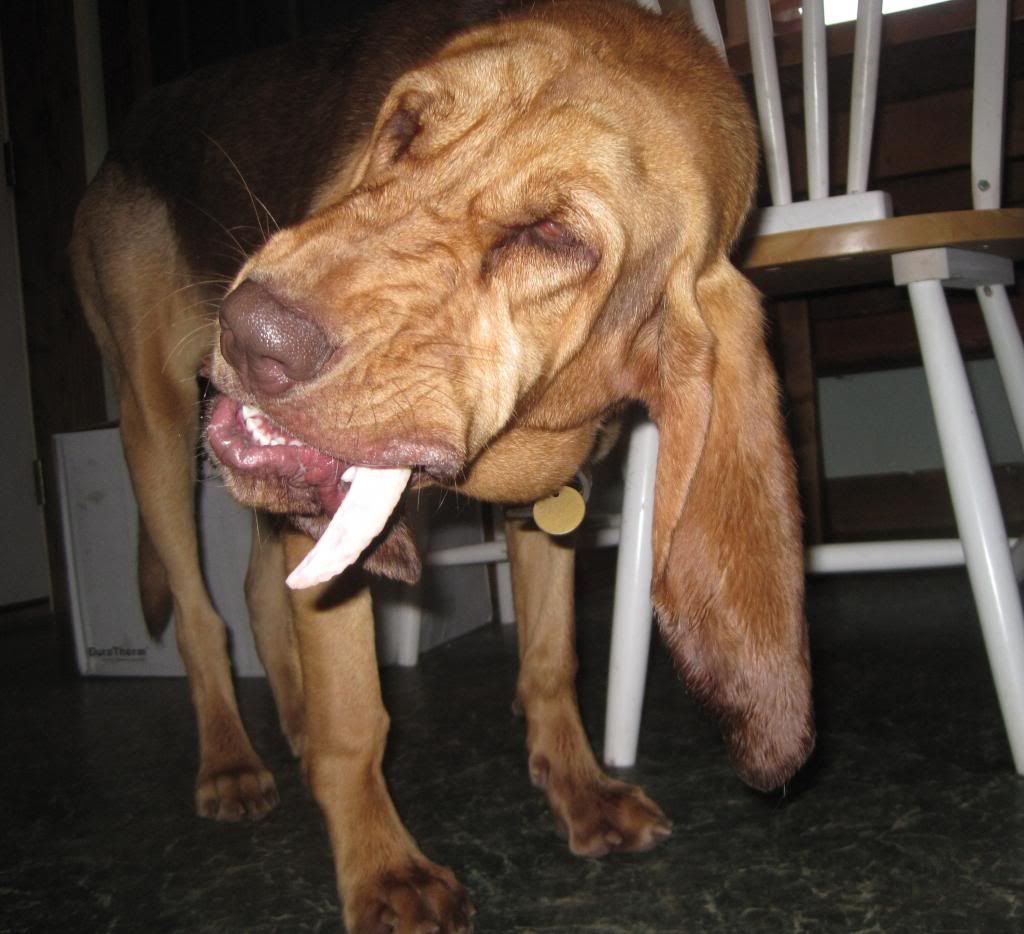
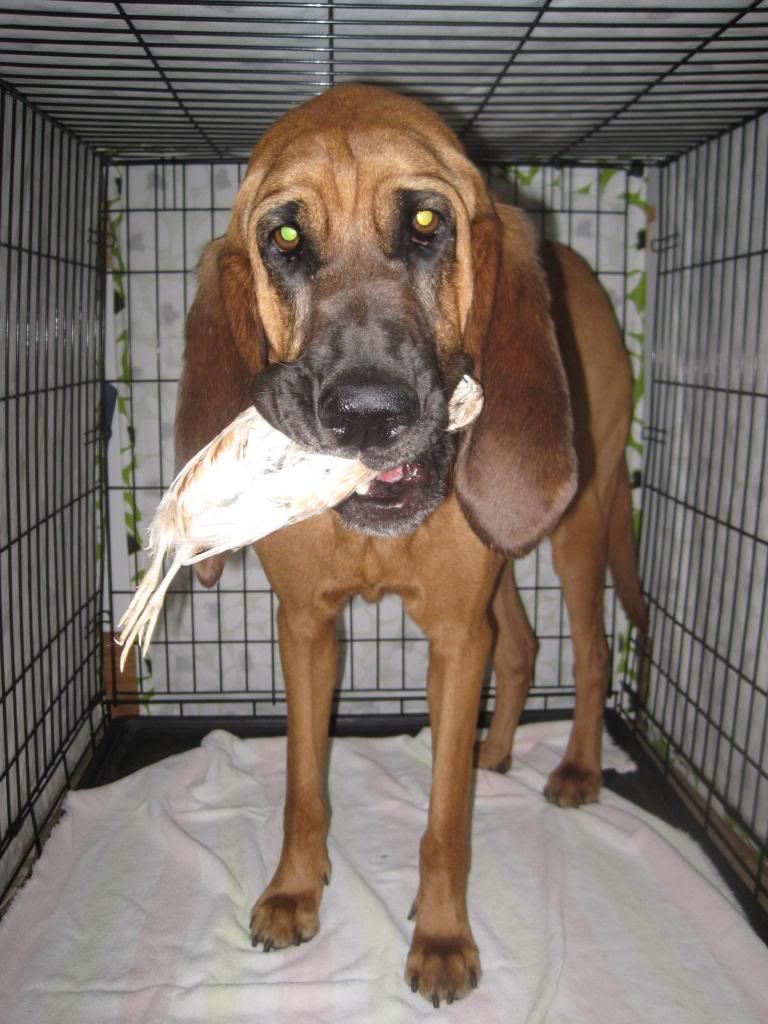
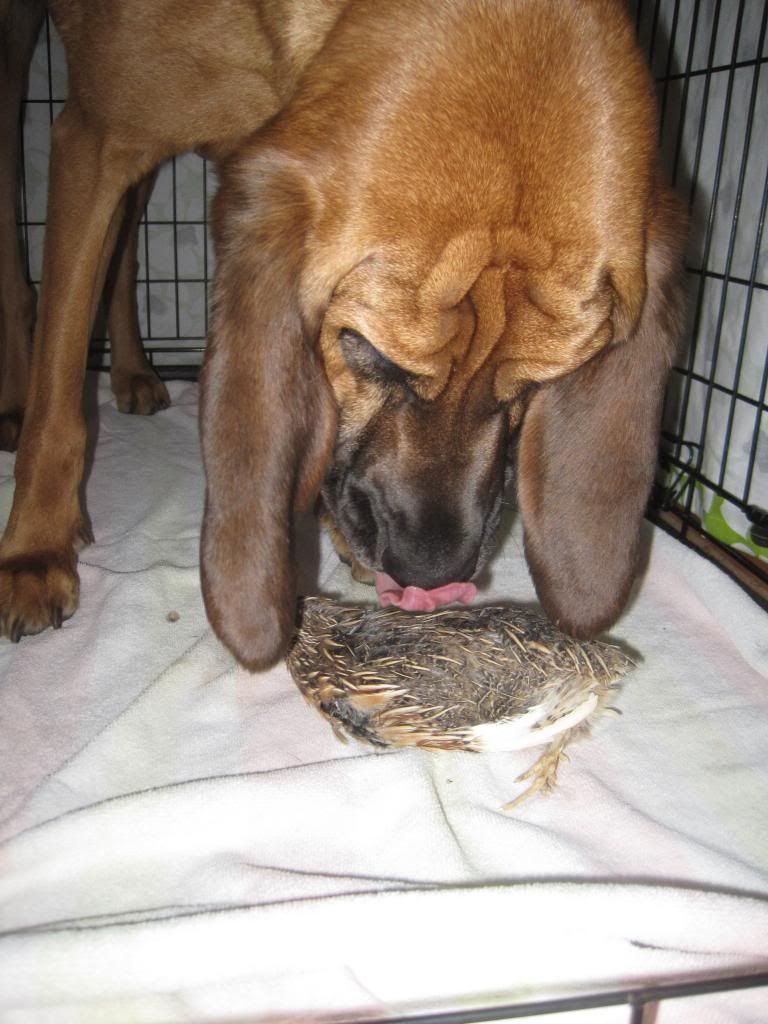
Is that quail from Hare Today?
The longer stool sits in the colon, the more solid it becomes as the moisture is absorbed from it. So frequent poop breaks will result in soft stool. You can not allow him to poop on the off-schedule walks if possible but that might be hard to accomplish. It almost seems to me that they are marking with their poop. They just gotta do it when we’re on the public walking trail in my neighborhood but if I don’t go out there, then they only go 2 times a day in my yard.
I have noticed however that when feeding raw food (either frozen or freeze dried) their poops are always in shape for pickup, no matter when they go. Maybe you can add a few pieces (like Vital Essentials freeze dried nibblets or the new Orijen freeze dried) to his food.
I used the USDA nutrient database and Self Nutrition Data – a few of the ingredients I couldn’t find on these databases (like some of the supplements) and had to do a bit of digging on the internet to find an analysis. Then I just converted everything to a dry matter basis and weighted all the nutrients based on the amount of the ingredient in the recipe. Very tedious and time consuming. If you can find any free software for analyzing recipes let me know!
HDM,
Where did you go to do the nutrient analysis?
Hi Betsy –
I do enjoy the great dane lady’s website and think there is some good information on there, however I don’t agree with her feeding advice for puppies. If her aversion to grain-free and raw foods for large breed puppies was based on some sort of factual research or organized feeding trial I would have more respect for it, but it seems to me it’s solely based on the fact that she’s never tried feeding those foods to her puppies?? I’ve had great lucking feeding high protein grain-free foods to my bloodhound puppies, I’ve just kept calcium levels controlled for the first 8 months.
Hi Idarlin –
I feel that the ideal diet is grain-free/starch free, high in animal-based protein and low in carbohydrates. This is why I personally feed my dogs a raw diet with free of grains and starches (potatoes, legumes, etc.). When it comes to kibble, a starch in some form or another (be it grains, potato, legumes, tapioca, etc.) is necessary to act as a binder. There are many that feel grain-free foods are superior to grain-inclusive foods because grains aren’t a natural part of the canine diet. However, neither are the starches used in grain-free foods – potato, legumes, tapioca, etc. Due to the fact that starch is a necessary evil when it comes to kibble I think the most important thing is to look for a food high in protein with a relatively large percentage of the protein being derived from animal sources. I think people get too caught up in grain-inclusive vs. grain-free and the industry is really playing into this – there are many new grain-free foods hitting the market that are horrible (low protein, loaded with vegetable based protein, etc. etc.) and people are paying big bucks for these foods just because the bag has the new buzzword “grain-free”. There are great grain-free foods and horrible grain-free foods and there are great grain-inclusive foods and horrible grain-inclusive foods. Concerning Innova Large Breed Puppy, it’s not a bad food by any means but it’s lower in protein than anything I’d use or recommend. It has only 24% protein, I wouldn’t use or recommend a kibble with less than 30% protein. I personally feed my crew protein levels in the 45% – 55% range.
If she’s chewing herself it could definitely be a food intolerance, but it could also be something environmental. Grains and common proteins such as chicken and beef are common causes of intolerances so you could certainly try a grain-free food with a more novel protein and see if things clear up.
I would definitely be curious to see what grain inclusive foods you’d recommend, HDM. I still remember being surprised that the Great Dane Lady was strongly opposed to grain free foods for large breed puppies until about 80% of their adult size, due to lack of feeding trials.
Here’s a quote I took from her site:
“I do not recommend as a complete diet for your puppy, any grain free or raw diets, regardless of brand, for large breed growth. Not until they are 8-10 months old or 3/4 of their normal size, just to be on the safe side. No feed trials have been done on large/giant breeds on the grain free or raw diets to date, so I will not recommend them.
We KNOW we can raise them on a quality holistic kibble with a 10% raw component, if you wish, and have no problems, but not a totally raw or grain free diet, please!!”
Has anyone tried Honest Kitchen Invigor and Sparkle and did your pets show improvement with using their products? Looking to try something different and the ingredients look great. Dogs are on a raw diet.
Wrigley is a 6 month old yellow labrador and he is our baby!! After 6 months of taking the little guy to a “traditional” Vet for his stomach issues (we got him at 7 weeks old and he had coccidia from the breeder), we were tired of the constant prescription of steroids, antibiotics and pro-biotics. This little guy has been on some sort of medication since birth. I was fed up with this approach and took him to a holistic vet. She said that his internal terrain was compromised from all the meds, and recommended a RAW diet immediately (along with four supplements- two to aide with the transition). We did a cold turkey switch from his Canidae Grain Free Lamb and Bison to Natures Variety Beef RAW patties. Along with his supplements and a homemade “veggie mash” (spinach, goji berries, cucumbers, carrots and celery) Wrigley loved his new food for the first two days. Now at day three, he won’t eat anything and has been waking up at 4am vomiting a mucus-like bile. I’m reading online that dogs can experience detox symptoms when switching to raw food, especially dogs who have been on steroids or antibiotics (like Wrigley). But he’s never missed a meal and I’m worried about him. My husband wants to take him to the traditional vet, but we know he’ll just go back to antibiotics and want to put him back on dry kibble. After researching RAW diets, I really believe in the nutritional value and have already seen an improvement in my dogs bowls. Has anyone had any experience with “detox” symptoms like this? I’ve been up since 4am with our puppy and crying hysterically! Feeding him brown rice and chicken broth now, hoping he can keep that down.
Thanks for sharing Honeybeesmom, I had a similar experience. 🙂
I’ll have to try Better in the Raw sometime, I’ve checked out their website but haven’t tried it yet.
Just wanted to give my experience on See Spot dinner mix.
I emailed Mr. Steve w/ a question…and within minutes he mailed me back. We mailed each other a few times back and forth – and he always mailed me back within minutes.
I placed my order on June 6th and received it today. Sticker on it is 5/07/13. Guess that’s when it was made?
Also placed an order ( in case anyone is interested) same day to Better in the Raw premix. Complete, balanced, human- grade. Also received today.
Emailed the company and Dana mailed me back within minutes.
Went ahead and made the Better in the raw today…and the doggies loved it.
See spot makes 26 lbs of food for $16.50 free S&H. and better in the raw makes 15lbs of food for $26.50 free S&H.
I have an 11-month old Bouvier who seems to have frequent bouts of diarrhea. He’s been checked by the vet a couple of times and nothing seems wrong with him. Because we’ve been training him with treats, I suspect there’s something there that does not agree with him. The obvious solution is to keep going with experiments, eliminating what could the the possible culprits; however, I was wondering if anyone here has been through the same problem and if they found out the exact treat that should be eliminated from their dog’s diet.
I’ve given my dog all sorts of natural “good brands” (or at least I’ve tried to buy what is deemed to be the best) and I don’t give him rawhide. MIght it be a meat-related issue?
Thanks for any input!
I use Vital Essentials freeze dried nibbletts as treats and food. Be sure to use a recipe book to make sure he is getting all the nutrients he needs. “Unlocking the Canine Ancestral Diet” by Steve Brown or “Real Foods for Healthy Dogs and Cats” by Becker/Shaw and Lew Olsen has books as well.
Another option to homemade is to use a Premix – where you just add meat or meat and oil. Ex: The Honest Kitchen, Urban Wolf, Dr Harveys, Grandma Lucys. These are easy to use until you get the confidence to make your own!
I had my raw recipe book for a few months before I got the nerve to do it. Now I thinks it’s easy.
“I have heard varying opinions in the forums about adding probiotics and enzymes. Someone said there are natural probiotics and enzymes without having to add and pay for supplements.”
There are naturally occurring probiotics in foods like kefir and yogurt and raw goat milk and tripe (which tripe also has enzymes). It really depends on how healthy or unhealthy your dog’s gut is. Has he eaten a variety of foods so that he produces a variety of natural gut flora? Or has he only eaten a few foods for a long period of time? Also yogurt usually only has a few strains of acidophilus. Some store bought probiotics have over 10 strains which I think is ideal. I have both Mercola and Dr Langers probiotics.
“How/when do I do this with a raw diet? How do I do this on his current diet while I’m transitioning to a raw diet? How do I transition to a raw diet?”
You can give probiotics and/or digestive enzymes with meals as you are transitioning and even when he is completely on a raw diet. I still feed kibble and raw so I still use these products. You can transition him to a raw diet in various ways. You can slowly introduce raw (like frozen raw medallions or raw bites like Instinct brand has) a couple times a day as treats to see how he does or you can feed one meal of old food and the next meal of raw food. Or every 3rd meal of raw food. Depends on how his stools are! Also raw foods generally have more fat so you must take that into consideration.
“Are there specific recipes for smaller breeds versus larger breeds, older versus younger dogs, etc.? Is it okay to feed him nothing but raw? Can I freeze/store what I’ve made if I’ll be on vacation?”
A homemade raw diet is good for all breeds and ages (except maybe for breeds prone to pancreatitis) and he can be fed nothing but raw. You can freeze in small batches and pull out what you need for 2 to 3 days worth. For vacation, if you’re taking your dog you might be interested in freeze dried raw as it is shelf stable. Some examples are Stella and Chewy’s, Nature’s Variety Instinct and Vital Essentials, Nutrisca and Primal. I wouldn’t give him marrow bones in the beginning as they are just fat.
Yes, he is an inactive dog. After you start feeding, be sure to weigh and/or monitor “body condition score” so that he is an ideal “shape”. My dogs are heavy but are still of good body condition for their breed. There a several “body condition score” photos you can see online.
Raw food might be much more “real” tasting and satisfying to them, plus, nothing’s better! I don’t blame them being picky about dry food, even the best ingredients turned into a kibble can’t be nearly as awesome as a hunk of meat.
SO. Thanks to HDM, it has come to my attention that making my own raw food for my Louie (10-pound Silky terrier) is actually more cost-effective than buying a high-quality kibble and is obviously much more healthy for my baby.
There are a lot of threads here, obviously, devoted to raw food recipes and diets. Currently my boy is on Earthborn Hollistic Primitive Natural. He’s not doing well on it. I had been feeding him a combination of that and the Earthborn Hollistic tubs (the lamb-based ones), but took those out to see if they were the cause of his upset. I think not. The tubs are expensive and I just have come to the conclusion that I’d rather he be on a raw diet. But, just like everything else, this task of changing his diet (yet again) is so daunting and I am so terrified and essentially stupid and ignorant and I really need you DFA Gods’ help!
I have heard varying opinions in the forums about adding probiotics and enzymes. Someone said there are natural probiotics and enzymes without having to add and pay for supplements. How/when do I do this with a raw diet? How do I do this on his current diet while I’m transitioning to a raw diet? How do I transition to a raw diet? Are there specific recipes for smaller breeds versus larger breeds, older versus younger dogs, etc.? Is it okay to feed him nothing but raw? Can I freeze/store what I’ve made if I’ll be on vacation?
My boy is essentially inactive. We go on walks every day and he gets very excited and runs around the house whether we’re coming home for work or from taking the trash out, but then he calms down and takes a nap. I heard 2% of his body weight for an inactive dog is what I should be feeding him. Is this correct? Does he fit the description of an inactive dog? What is the definition of an inactive dog?
There is so much misinformation out there! So many threads to read through, so much confusion! He’s my first dog and I want to do right by him, he deserves the best.
I always do these posts and I’m always very anxious about finding out how best to serve my canine baby because I know how important diet is, and I want him to have those perfect, firm stools and not feel lousy.
I guess I’m just being somewhat lazy to ask for a guide as to how to do this perfectly. I know it’s going to take some time and a lot of effort!
Response #2:
Hi marty0203 –
Calcium and phosphorus levels really only affect the joint health of large and giant breed dogs during the growth phase. By the time a large or giant breed dog reaches two years of age it is either dysplastic or not dysplastic. For all dogs, calcium and phosphorus levels should be in balance with one another (between a 1:1 and 2:1 ratio of C:P) but this is really only a concern for those making homemade food, balanced commercial foods will have a proper ratio of calcium to phosphorus.
I strongly feel that a diet high in protein, moderate in fat and low in carbohydrates is best for most dogs. My three bloodhounds eat between 45% and 55% protein, 30% and 40% fat and <20% carbohydrates at each meal. If feeding a dry food I would search for one with no less than 30% protein.
I feel it’s important to feed a variety of foods. I no longer feed dry dog food, but when I did I switched to a new brand at the end of each bag and added a variety of canned and/or fresh food toppers daily. I would recommend finding at least 3 quality foods (preferable different brands with different protein sources) and switching every so often. If you can mix in canned or fresh food occasionally this is great too and canned and fresh foods are much more species-appropriate than dry food. Patty had a wonderful suggestion with recommending you check out online retailers. I live in a small area with a limited selection of quality pet products as well and, for this reason, do the majority of my shopping online. In addition to the sites she suggested, some others you may want to check out are wag.com, doggiefood.com and naturalk9supplies.com.
Some supplements that promote joint health are glucosmaine, chondroitin, MSM, esterified fatty acids (such as cetyl myristoleate) and hyaluronic acid. Some who foods supplements that promote joint health are sea cucumber, green lipped mussel, eggshell membrane, shark cartilage and velvet antler. Raw meaty bones (especially those high in cartilage such as trachea, gullet and chicken feet) and naturally rich in joint health promoting compounds such as chondroitin. Turmeric, tart cherry, boswellia, yucca, white willow, bromelian and high doses of omega 3 fatty acids (up to 300 mg. per 10 lbs.) all help to manage pain and inflammation. If your dogs don’t have any orthopedic issues, a basic glucosamine/chondroitin supplement would be fine for maintenance. If your dogs have any symptoms of pain and inflammation you may want to consider a combination of some of the joint health supplements listed in addition to one of the natural anti-inflammatories.
Hi Marty –
Calcium and phosphorus levels are really only a concern for joint health during the growth phase. Once large/giant breed dogs reach two years of age their joints are fully developed and at this point they’re either dysplastic or not dysplastic. Calcium and phosphorus levels obviously need to be in balance with each other (between a 1:1 and 2:1 ratio of C:P) but this is true for all dogs, not just large/giant breeds, and isn’t a concern as long as you’re feeding a balanced commercial food (where balancing C:P ratios come into play are with homemade diets). I personally feel that a diet high in protein, moderate in fat and low in carbohydrates is healthiest and most species-appropriate for healthy dogs. My three bloodhounds eat between 45% and 55% protein, 30% and 40% fat and <15% carbohydrates at each meal. If feeding a dry food, I would search for one with no less than 30% protein. I also would not limit yourself to only one brand – variety is important. I no longer feed dry dog food, but when I did I switched brands and protein sources at the end of every bag and I added different canned and/or fresh food toppers daily. I would recommend finding a minimum of three foods your dogs can eat (preferably different brands with different protein sources). Patty had a wonderful suggestion with online ordering if selection is limited where you live – some other sites that have a big selection and offer free shipping in addition to the two she posted are Wag.com, Doggiefood.com and NaturalK9Supplies.com. There are several supplements you can give your dogs that help to promote joint health and/or have anti-inflammatory properties. If your dogs don’t have any orthopedic conditions or arthritis a basic glucosamine, chondroitin, MSM supplement would be fine to start off with. Some other supplements good for joint maintenance are hyaluronic acid and esterfied fatty acids (like cetyl myristoleate). Some whole food supplements that are beneficial for the joints are eggshell membrane, velvet elk antler, sea cucumber, green lipped mussel and shark cartilage. Raw meaty bones (especially those high in cartilage such as trachea, chicken feet and gullets) are very rich in naturally occurring chondroitin. For dogs experiencing pain/arthritis some natural anti-inflammatories include high doses of omega 3 fatty acids (up to 300 mg. per 10 lbs.), turmeric, boswellia, tart cherry, yucca, bromelian and white willow. Generally human supplements are cheaper and higher quality than supplements marketed to dogs, adjust the dosage accordingly (a good rule of thumb is a 25 lb. dog would get about 1/4 of the recommended human dose, 1/2 the human dose for a 50 lb. dog, 3/4 the human dose for a 75 lb. dog and full human dose for dogs >100 lbs.). Also – as you may already know – the most important factor to maintaining healthy joints and staving off arthritis in large and giant breed dogs is maintaining a healthy body weight, it’s very important that large/giant breeds don’t become overweight as this adds a lot of stress to the joints.
It looks like my options in this sprawling metropolis are 1. Wellness Core and 2. Infinia. From DFA’s review and ratings the two look pretty comparable. Does anyone have advice either way on these two specific brands for my Adult English Mastiff and Adult Great Dane/Lab?
Thanks!
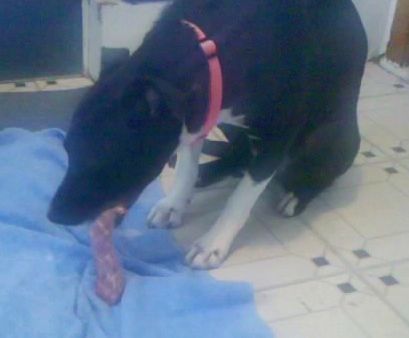
Bailey eating a turkey neck!
-
This reply was modified 12 years, 9 months ago by
 Cyndi.
Ok, now how do I get the picture to post in the comment?
Not sure if this will work or not. This isn’t a great picture, but I took a still frame from the video I have of Bailey eating a turkey neck. http://i168.photobucket.com/albums/u182/Sidney0805/061113082412.jpg
The chicken feet photos are priceless 🙂 Wish my crew could eat those.
Nice pics Sandy and NectarMom 🙂
I forgot about this thread – I’m going to have to try and get some more pictures of my three.
DieselJunki,
Dogforums(dot)com has a thread just for raw feeding pictures as well. Just search for “raw feeding picture thread” there. There’s a dog eating a goat head and a deer head on page 12.
I’d get the food that the pup was weaned on and then start transitioning a short while later after she gets acclimated to her new environment. Sometimes the stress of going to a new home and a whole new routine is enough to stress them out and give them GI issues and you won’t know if it’s the new food or just stress. Get some probiotics and start her on that to help strengthen her gut/immune system before changing foods. You might also want to get a colostrum supplement. I thought my dogs did fine with regular foods but noticed improvement when I introduced grain free foods and even had more improvement with grain free/potato free foods. They are now odor free/yeast free/ear infection free (which alot of pugs are prone to). I feed anywhere from 30% protein to 60% in kibble and also feed raw, and canned foods and freeze dried foods. Just find a couple foods that work well for her and switch it up every now and then. You can even rotate with every feed.
Patty,
The cow heads were wrapped in white plastic. Couldn’t see inside.
My calf is only 6 months old and his head is pretty big. I think that would be 3 days worth of food for a BIG dog.
Hey Sandy, was it skinned? They didn’t skin my goat head, just froze it and sawed it apart. The half closed eye was freaky.
-
This reply was modified 12 years, 9 months ago by
 theBCnut.
Oh man… I want to get a whole cow head and have Moose eat it on the walk outside. That’ll freak the neighbors in my apartment out! Hahahaha.
With their tiny size, I can see why that would be WWWAAAYYYY too much fat for them.
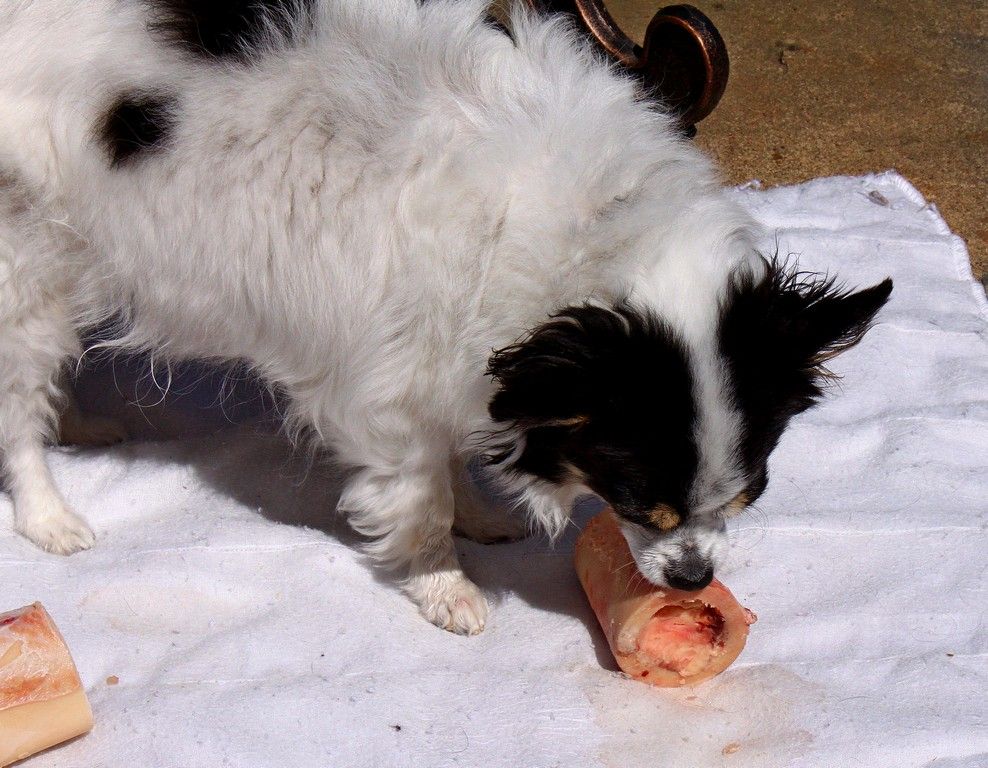
Sally enjoying her marrow bone. These photos are a bit old and we learned a hard lesson on giving marrow bones.

 2 months, 1 week ago