
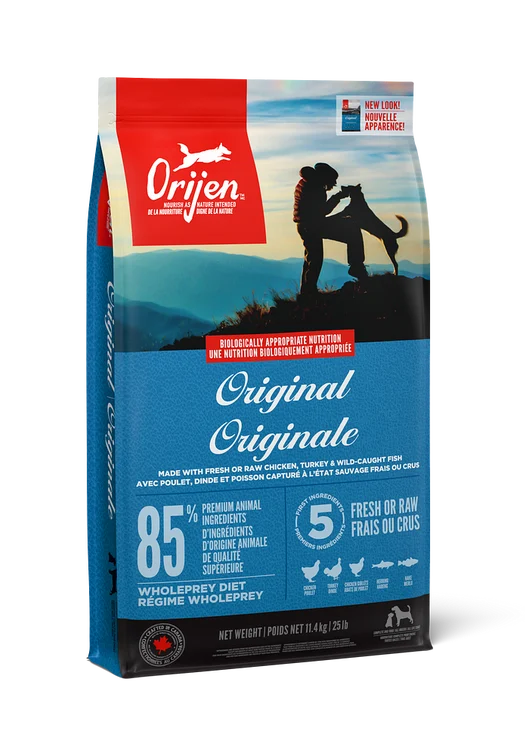
Orijen Dog Food (Dry)

Share

Rating: ★★★★★

Orijen dry dog food receives the Advisor’s top rating of 5 stars.

The Orijen product line includes six dry dog foods, five claimed to meet AAFCO nutrient profiles for all life stages and one (Senior) for adult maintenance.

The following is a list of recipes available at the time of this review.

  • Orijen Adult
  • Orijen Puppy
  • Orijen Senior
  • Orijen Six Fish
  • Orijen Puppy Large
  • Orijen Regional Red

Orijen Adult dog food was selected to represent the other products in the line for this review.

Orijen Adult Dog

Dry Dog Food

Estimated Dry Matter Nutrient Content

Protein = 42% | Fat = 20% | Carbs = 30%

Ingredients: Boneless chicken, chicken meal, chicken liver, whole herring, boneless turkey, turkey meal, turkey liver, whole eggs, boneless walleye, whole salmon, chicken heart, chicken cartilage, herring meal, salmon meal, chicken liver oil, red lentils, green peas, green lentils, sun-cured alfalfa, yams, pea fibre, chickpeas, pumpkin, butternut squash, spinach greens, carrots, red delicious apples, bartlett pears, cranberries, blueberries, kelp, licorice root, angelica root, fenugreek, marigold, sweet fennel, peppermint leaf, chamomile, dandelion, summer savory, rosemary, Enterococcus faecium, supplements: vitamin A, vitamin D3, vitamin E, niacin, riboflavin, folic acid, biotin, vitamin B12, zinc proteinate, iron proteinate, manganese proteinate, copper proteinate, selenium yeast

Fiber (estimated dry matter content) = 5.6%

Red items when present indicate controversial ingredients

Estimated Nutrient Content
MethodProteinFatCarbs
Guaranteed Analysis38%18%NA
Dry Matter Basis42%20%30%
Calorie Weighted Basis35%40%25%

The first ingredient in this dog food lists chicken. Although it is a quality item, raw chicken contains about 80% water. After cooking, most of that moisture is lost, reducing the meat content to just a fraction of its original weight.

After processing, this item would probably account for a smaller part of the total content of the finished product.

The second ingredient is chicken meal. Chicken meal is considered a meat concentrate and contains nearly 300% more protein than fresh chicken.

The third ingredient is chicken liver. This is an organ meat sourced from a named animal and thus considered a beneficial component.

The fourth ingredient lists herring. Herring is a fatty marine fish naturally high in protein as well as omega 3 fatty acids, essential oils needed by every dog to sustain life.

The fifth ingredient is turkey, another quality raw item. After processing, this item would probably account for a smaller part of the total content of the finished product.

The sixth ingredient includes turkey meal, another protein-rich meat concentrate.

The seventh item is turkey liver. This is an organ meat sourced from a named animal and thus considered a beneficial component.

The eighth ingredient is whole eggs. Eggs are easy to digest and have an exceptionally high biological value.

The ninth item is walleye, a freshwater fish native to the northern region of the United States and much of Canada.

The tenth ingredient includes salmon. Salmon is an oily marine and freshwater fish not only high in protein but also omega 3 fatty acids, essential oils needed by every dog to sustain life.

The next ingredient is chicken heart. Although it doesn’t sound very appetizing to us humans, heart tissue is pure muscle — all meat. It’s naturally rich in quality protein, minerals and complex B vitamins, too.

Next on the ingredient list is chicken cartilage, a source of both glucosamine and chondroitin sulfate — natural substances believed to support joint health.

After chicken cartilage we find herring meal and salmon meal, yet two more high protein meat concentrates.

We are pleased to report that, unlike other fish meals, the salmon and herring meals used in this product1 are ethoxyquin-free.

From here, the list goes on to include a number of other items.

But to be realistic, ingredients located this far down the list (other than nutritional supplements) are not likely to affect the overall rating of this product.

With three notable exceptions

First, this recipe contains selenium yeast. Unlike the more common inorganic form of selenium (sodium selenite), this natural yeast supplement is considered a safer anti-cancer alternative.

Next, the company appears to have applied friendly bacteria to the surface of the kibble after cooking. These special probiotics are used to enhance a dog’s digestive and immune functions.

And lastly, this food also contains chelated minerals, minerals that have been chemically attached to protein. This makes them easier to absorb. Chelated minerals are usually found in better dog foods.

Orijen Dry Dog Food
The Bottom Line

Judging by its ingredients alone, Orijen dry dog food looks like an above average dry product.

But ingredient quality by itself cannot tell the whole story. We still need to estimate the product’s meat content before determining a final rating.

The dashboard displays a dry matter protein reading of 42%, a fat level of 20% and estimated carbohydrates of about 30%.

As a group, the brand features an average protein content of 42% and a mean fat level of 19%. Together, these figures suggest a carbohydrate content of 30% for the overall product line.

And a fat-to-protein ratio of about 46%.

Above-average protein. Above-average fat. And below-average carbs when compared to a typical dry dog food.

Even when you consider the protein-boosting effects of the red and green lentils, green peas and chickpeas, this looks like the profile of a kibble containing a significant amount of meat.

Bottom line?

Orijen dry dog food is a meat-based kibble using an abundance of named meats and organs as its main sources of animal protein, thus earning the brand 5 stars.

Enthusiastically recommended.

Please note some products may have been given higher or lower ratings based upon our estimate of their total meat content.

Special Alert

Rice ingredients can sometimes contain arsenic. Until the US FDA establishes safe upper levels for arsenic content, pet owners may wish to limit the total amount of rice fed in a dog's daily diet.

A Final Word

The descriptions and analyses expressed in this and every article on this website represent the views and opinions of the author.

Although it's our goal to ensure all the information on this website is correct, we cannot guarantee its completeness or its accuracy; nor can we commit to ensuring all the material is kept up-to-date on a daily basis.

Each review is offered in good faith and has been designed to help you make a more informed decision when buying dog food.

However, our rating system is not intended to suggest feeding a particular product will result in specific health benefits for your pet.

For a better understanding of how we analyze each product, please read our article, "The Problem with Dog Food Reviews".

Remember, no dog food can possibly be appropriate for every life stage, lifestyle or health condition. So, choose wisely. And when in doubt, consult a qualified veterinary professional for help.

In closing, we do not accept money, gifts or samples from pet food companies in exchange for special consideration in the preparation of our reviews or ratings.

To learn how we support the cost of operating this website, please visit our public Disclosure and Disclaimer page.

Have an opinion about this dog food? Or maybe the review itself? Please know we welcome your comments.

Other spellings: Origen, Orijin

Notes and Updates

01/24/2010 Original review
08/27/2010 Review updated
11/17/2010 New recipe
08/18/2012 Review updated
02/17/2013 Review updated
02/17/2013 Last Update

  1. Orijen website FAQ, 8/27/2010
  • tadbubs

    Update Folks!

    Just thought I’d show y’all the latest from ZP.

    This might be helpful for anyone going this weird journey.

    BTW, switched back to THK 3-days ago and BJ’s poops are a perfect #3.

    Now, as to ZP reply…hmmm?

    Hi Bill,

    As
    promised I have had a chat to my colleagues about the soft stools issue
    and we have also talked to our consulting holistic vet Dr Peter Dobias
    who we refer difficult issues to.

    Peter is based in Vancouver and has been a holistic vet for ages and is very well respected. Please refer to http://www.peterdobias.com

    Peter Dobias has made a strong point that soft stools could be caused by a myriad of issues the least of which may be food.

    I copy below his response on this.

    What
    I recommend is that you have a direct chat to Peter Dobias about Billy
    Junior as this way he & you can converse directly on the issues and
    likely causes as we feel that the change to ZiwiPeak should not be
    causing this to recur as we don’t get this issue arising in other dogs.

    Peter has a conference call booking system – refer to his email below to schedule a time that works for you both.

    Kimberly
    is one of the founders of ZiwiPeak and she is based in the USA and has a
    direct relationship with Peter on behalf of ZiwiPeak.

    Bill could you please confirm you have received my email and please keep me appraised of your communication with Peter Dobias.

    Kind regards, Nigel

  • Tracy

    I disagree with you. I looked at the ingredients and I’m shocked about the amounts of white potatoes or corn. I’m not saying Farmina is a bad food, however, i’m not sure where it is produced, it seems not in the USA and it is sold world-wide,they are pretty large. It has alot of dehydrated ingredients, which are not fresh. What concerns me most that it has Psyllium in it, you are not supposed to give that over long terms, better are probiotics, and I don’t see any in the food. I have studied many european foods out there, but in my opinion they can’t hold a candle to the foods in the US, which for the most part these days are free of corn, wheat or things like Psyllium.

    Orijen I give my dogs as a snack, but even in low amounts they seem to have issues with the digestive tract. So Vet Pref/Health extension grain free are similar kibble in taste and shape, without any digestive issuesI will finish my bag, then switch again to that other food. I also add Horizon, Fromm and Annaemat-all excellent companies. This food I would only add as a topper.

  • tadbubs

    cool…

  • tadbubs

    haha,

    Yep, Czech on that.

    Or maybe Got-it?

    nite folks, dog-gone-it its comin’ on 2am here.

  • http://www.facebook.com/profile.php?id=1140685339 Betsy Greer

    Wait, shouldn’t that be gotit? You’re such a nice man, tadbubs, I hate to tease you, but couldn’t resist. You reminded me of the time Melissandcrew was in the midst of changing her moniker and briefly landed on Melissascrew. ; )

    Czech me if I’m wrong and lemmeno what you think. : )

  • tadbubs

    Excellent.

    Gottit.

  • barb

    Thanks Sisu, all make sense!

  • Hound Dog Mom

    I’ve been using Swanson’s Organic Extra Virgin Coconut Oil – it’s way cheaper than the other organic, extra virgin oils. I can get a 54 oz. container for $19.99 (I go through a lot of it between myself and the dogs).

  • Storm’s Mom

    Looks like it’s not in ALL the Instinct formulae …all the Limited Ingredient Instinct ones have it, but not regular Instinct Chicken, Rabbit or Duck & Turkey

  • tadbubs

    Thanks Alex’

  • Alexandra

    Hi Tadbubs,

    The salmon oil is a higher fat. It can be harder on dogs sensitive to high fats.

    You want to use extra virgin coconut oil. It works very well.

  • tadbubs

    Gottit, no overkill.
    And your recommended coconut-dosage?

    I’m off to bed y’all. Thanks for the valuable insight and support.

  • Hound Dog Mom

    Okay. The salmon oil contains omega 3 fatty acids (EPA and DHA) – coconut oil has MCTs. So they provide 2 different types of fatty acids, you wouldn’t want to substitute one for the other. However, if you’re feeding Zeal the food contains a balanced omega 6 to omega 3 ratio so I wouldn’t see a need for additional omega 3′s.

  • Melissaandcrew

    I never noticed that! Its a bit high in fat -22% foe schnauzers, iimo, but its a really decent food imo.

  • tadbubs

    tks Storm. unfortunately i cant get NV here.

  • tadbubs

    Grizzly Salmon Oil All-Natural Dog Food Supplement in Pump-Bottle Dispenser

  • Storm’s Mom

    Nature’s Variety has coconut oil in their Instinct formulae.

  • Hound Dog Mom

    1/2 squirt per day of what?

  • Hound Dog Mom

    You know, that’s a good question. I’m not sure why more dog food companies don’t use coconut oil in their foods. It’s not heat sensitive and has a long shelf life so I’d be a great addition. I give my dogs anywhere from a teaspoon to a tablespoon each per day. The higher end of the recommended dosage is usually 1 tsp. per 20 lbs. Most sources I’ve read recommend introducing coconut oil in the following dosages: 1/4 tsp. for small dogs, 1/2 tsp. for medium dogs and 1 tsp. for large dogs. So – for your little guy I’d say start with 1/4 tsp. per day and if he’s tolerating it well you would probably be safe bumping it up to 1/2 tsp. per day.

  • tadbubs

    One more thing, Hound D. I bought and use this 1/2 squirt per day (Grizzly Salmon Oil All-Natural Dog Food Supplement in Pump-Bottle Dispenser)–as prescribed–. What’s the difference from the coconut oil? Would I cease using this if I’m using the coconut oil?
    And do I get cold pressed coconut oil?

  • tadbubs

    Really?

    So, now I’m thinking why the heck don’t dog food companies put coconut oil in?

    I’m jogging down to the village mart and getting this tomorrow.

    How much would be “a small amount”?

    He’s active
    He’s 6.0kg
    He eats 2x per day

    Oh, and THAT post will log in under your table of contents:
    ‘Essentials for Dog Supplementation They don’t tell You’

  • Hound Dog Mom

    Given the fact that Schnauzers are prone to pancreatitis and that your dog is active – I think Zeal would be a wonderful choice. If you wanted to up the fat level/caloric density a bit it would probably be safe to add a small amount of coconut oil to his meals. Coconut oil is rich in medium chain triglycerides which are broken down very quickly by enzymes in the saliva and gastric juices and thus don’t require pancreatic fat-digesting enzymes. For this reason, MCT’s don’t strain the pancreas of pancreatitis-prone dogs the way that some other fats do.

  • tadbubs

    Gottit, thanks Sandy.

  • tadbubs

    Well-said patty. And the note on keeping them fit with optimal pancreas function is a good point to note…I do hope every-other-dog is reading all this wonderful knowledge from y’all.

  • tadbubs

    Dog–or as Randy J. would say: “Dawg”. You KILLED this post. Brilliant research, illustration, and scientific support. That should be a chapter in your next book…brilliant.

    So, THK sets well with your findings?

    THK Zeal:
    Protein, 35.50%
    Fat, 8.50%
    Fiber, 5.80%
    Moisture, 8.90%
    437 calories per cup

  • Pattyvaughn

    Gotcha!!

  • Hound Dog Mom

    I think he means a larger percentage of the meat can be fresh versus meal.

  • Pattyvaughn

    How does that work? 84% protein and more meat also means more fat so 40% fat. Even if they have no carbs that’s 124%. Full vacuum infusion sure is impressive.

  • Root

    I was on a business trip to Italy recently and brought back Farmina N&D. Orijen can’t compare to Farmina N&D. N&D is a pretty spectacular product and the technology behind the production, full vacuum infusion, allows the company to use twice as much fresh protein as Orijen. Farmina N&D is several grades higher than anything Champion sells.

  • Pattyvaughn

    Optimal fat level for a schnauzer depends on whether or not he can handle it. If you haven’t had pancreatitis issues with him, you might not ever have problem, or as he ages he could become more sensitive. If he has been doing fine at those fat levels then it is probably not a problem for him, but be careful changing him from lower fat to higher fat levels as that could be a triggering event. Keeping him slim helps the pancreas to function at its peak.
    You’ve got quite as neat pup there!

  • Hound Dog Mom

    The fat levels a canine athlete will require vary based on the intensity and duration of the activity being performed.

    At one end of the spectrum – true sprint athletes (think racing greyhounds), do best on a diet low in fat (8 – 10% DM) and moderate in protein and carbohydrates. At the other end of the spectrum – true endurance athletes (think sled dogs), do best on a diet high in fat, moderate in protein and low in carbohydrates. Intermediate athletes would fall between the two extremes.

    Fat is important for highly active dogs because provides 8.5 g. of metabolizable energy per gram – nearly twice as much energy as either carbohdyrates or protein. For this reason, increasing the level of dietary fat is the only feasible way of increasing the energy (calorie) density of a food – because most working/highly active dogs have difficulty ingesting adequate amounts of energy to maintain body condition, caloric-density is important. It’s also believed that fat has a positive effect on endurance. Studies have shown that dogs under extreme physical stress have an elevated carbohydrate threshold and the amount of energy provided by free fatty acid oxidation is increased. Increasing the level of dietary fat consumed may enhance free fatty acid availability. A study done which monitored beagles running on a treadmill found that time to exhaustion was directly related to energy density, digestibility and digestible fat intake. Sprint exercise is almost entirely dependent on carbohydrates for energy, which is why sprinters don’t require elevated levels of fat and require higher levels of carbohydrates in the diet.

    My three hounds are very active – they get a minimum of 2 hours of moderate (long walks, hiking) to heavy (running) physical activity a day. I’ve found that they do best on a diet that’s high in protein (45% – 55%), moderately high in fat (30% – 40%) and low in carbohydrates (<20%). Of course, it's trial and error and considering your dog's breed it may be wise to keep fat on the low side despite the fact that he's highly active.

  • http://www.dfwpugs.com/ sandy

    Really active/working/sledding/hunting dogs, etc…if you look at some of the foods for sporting dogs, they have high fat as this is used for energy. Ex: Inukshuk has 32 % protein and 32% fat! But I think your breed of dog will limit the fat content you feed. You will just have to experiment with the numbers and see what works for him.

  • tadbubs

    Thanks Mel. Wow, yours get a veritable buffet of deliciousness.

    THK has only as low as 18% fat. Wondering if that’d be okay being that he’s active and all? His poos are now becoming as perfect as they were on his THK Embark. I’m changing to THK Zeal as it has a lower fat and fiber content than Embark. I’ll still do Embark but, just periodically. You are correct, the fat perecent is extremely high on ZiwiPeak, Orijen and Acana. Guess that’s to make up for the calories that are lost due to the lower fiber in their products.

    Anyone know anything about whether a slightly higher fat would be okay for a rather active dog vs. sedentary?

  • sisu

    Natural Balance Original Ultra has 3670 kcal/kg, 350 kcal per cup. Orijen Adult has 3980 kcal/kg, 478 kcal per cup. 128 more calories in each cup of Orijen.

    Your dog will be going from an average kibble to a high protein, high fat brand. Make the transition very gradual to avoid digestive upset. This is especially important if your dog has only been fed Natural Balance with no rotational feeding with other brands. If at any time the dog has soft stool or there is an indication of digestive problems feed less of the Orijen for several days. Proceed with the transition when the stool returns to normal. The goal is to reach the 2 cups per day as recommended by Orijen. You may need to increase or decrease the amount of Orijen being fed depending on the metabolism and activity level of the dog.

    http://www.naturalbalanceinc.com/product.aspx?ProductId=7&product=Original+Ultra%26reg%3b+Dry+Dog+Formula

    http://www.orijen.ca/products/dog-food/dry-dog-food/adult-dog-dry/

  • Barb

    Hi everyone,

    I will be starting my basset hound on the Orijen, but I was wondering how much food I should be feeding him. I currently feed him 4 cups a day on Natural Balance, and Orijen recommends 2 cups a day for a dog of his size and his level of activity. Burton is very fit and slim, he weigh 45lbs and he is 3 years old.

    Any thoughts?

    Thank you!

  • Patty

    Both of my dogs are doing great with Orijen Adult. I add a tablespoon of pumpkin to their bowl at each serving and they gobble it down like candy. They now run to the kitchen when it’s time to eat. Their stools are normal and not mushy.
    I should have started with this food right from the start.

  • tadbubs

    Yep, I’m all over that one. Used it for starters beginning of the year. Thanks

  • tadbubs

    Well said Law.

    Thanks again for the valuable resource information and your expert advice.

    Much more than I could have hoped for.

    Great to see Billy Junior has folks in his corner.

  • tadbubs

    Thanks Law. Your observations are spot on. I’ve ruled out all of what you mentioned. I’ve now got him back on THK. I will see how his poos are doing in 48-houts time. As HD and Mel mentioned I probably should have stuck with what worked and not moved over so quickly to a new premium blend…no matter how “perfect” it is. Every-dog is different, something I did not consider carefully enough.

    Yep the egg shells is good and will incorporate if needed. In the meantime I’m gonna give the wings, backs or raw chicken a try.

    Really appreciate your ringing-in.

  • LawofRaw

    Raw bones with surrounding meat such as chicken wings, frames, turkey same, lamb and pork ribs, rabbit carcasses, etc etc are highly unlikely to break or chip the teeth of a carnivorous designed set of teeth. Unless they’re already decaying and in poor condition. Harder or denser bones such as knuckle and soup bones are ones to avoid. As well as cooked bones. The matrix of cooked bones is dramatically changed making them more friable and flakey which means they can easily splinter and cause blockages.

    Having said this, I sometimes give my dogs soup bones for extra stimulation as they love gnawing on them and retrieving the delicious marrow, But with these bones, I started off by supervising them years ago, until they now know how to handle them and don’t seem to need any supervision anymore.

    Basically, there is simply no substitute for Mother Nature’s design. There are only second, third, and so forth alternatives.

    You have some good responses and can easily heed some of them should you be too afraid or hesitant regarding Mother Nature’s raw intention.

    Here is a pdf link to good information providing a 3 page summarised diet guide feeding the raw way for domestic dogs and cats. http://www.rawmeatybones.com/diet/exp-diet-guide.pdf. The only thing with it I disagree with, is that garlic is not toxic in moderation for our dogs. It is only “toxic” if given in excessive doses to dogs. Otherwise it can provide some of the very same health benefits and antioxidants it does for us humans.

    Anyway, all this is just another perspective and offer of suggestion to consider. Best of luck! :)

  • LawofRaw

    Just chiming in late, Has your but have you considered any parasitic issues your dog may be suffering in silence other than giving signs in its stools? Could the Orijen bag have been inadvertently left open and or contaminated? Or the fats become rancid as air got into the bag for longer than normal and oxidised the fats? And was the Orijen bag closer to its expiry date than the Acana. Not saying any of the above is the case, but just bringing to your attention some other possible scenarios.

    I’m a raw feeding fanatic but have and do on occasion, feed high protein kibbles as treats in Buster Cubes, and very occasionally as main meals topped with organic yoghurts. I have had my JRT in particular, transform into a beam of health after transitioning her to Artemis Maximal kibble from Pedigree and Purina Pro Plan, some years ago when I was just realising how bad the results of feeding the likes of Mars and Nestle pet foods, were. Having said this, my JRT started producing similar issues you’re referring to with Orijen, after a bag of Artemis Maximal I had was approaching close to its expiry date. I always had the bags resealed and kept in cool dry place after each use, but for some reason I suspected the Artemis kibble was becoming rancid by the deteriorating smell, if ever so a minute change, and put 2 and 2 together hence blamed the rancidity factor of my JRT’s ensuing looser and more frequent stools at the time.

    About bone meal, I agree with Hound Dog Mum about crushing raw egg shells and sprinkling such calcium rich food on your dog’s meals as a good natural calcium supplement. I normally don’t feed that to my dogs after they eat raw eggs and leave the shells behind, because my dogs get a lot of raw meaty bones (RMB’s), a perfect balance of calcium to phosphorous ratio as Mother Nature provides. So my dogs get a good majority of calcium from such as well as getting their teeth naturally flossed and cleaned, while gnawing on RMB’s.

    Is your Schnauzer on some type of worming med or control mechanism? Parasites are also another source of intestinal disruption. That’s where DE or Diatomaceous Earth also comes in handy as a food supplement.

  • LawofRaw

    I personally, don’t believe the protein in Orijen has anything to do with questionable stool. tadbub’s dog’s direct ancestor (as is any dog’s), the wild grey wolf (never mind that it’s much smaller in size and looks different) is feeding on an almost exclusive protein nutrient diet, followed by fat, then only an occasional small amount of carbohydrates and so the high levels of meat based amino acids (much higher than what Orijen offers) is not a sole or direct cause of stool problems. It’s more likely that something else or interactions of a few different ingredients, or just the fact that that, and the fact that kibble is processed and therefore unnatural and therefore not as naturally digestible, that despite protein levels high or low, are not the cause of poor stool results, in my genuine opinion.

  • LawofRaw

    Yes yes, DE is one supplement in food that I do endorse! Great cleanser and worm controller for dogs. Even we humans can ingest it. I have a life time supply (5kg bag purchased a couple of years ago, and it sure feels like a life time supply). Worth every penny.

    I don’t have a farm or crops, but I know it’s very useful in those cases as well, in the containment of bugs.

  • Paige S

    orijen can sometimes be to rich for some dogs, its a fantastic food, but sometimes just to rich or to high in protein for some pups. acana is from the exact same company but just lower protein. this can affect the poop consistency. feel free to email me directly if you like, i work at a global pet foods, and help people out and see ALOT of issues, and can tell you what is common, what works, what doesnt work, suppliments, bones, you name it. paige.stefanidis@gmail.com

  • paige

    excellent product !! DE is fantastic :)

  • paige s

    Acana is an amazing food. try to stay away from chicken (ear infections can be a sign of a chicken allergy) if that doesnt help, stay away from potatoe (sometimes what looks like an allergy can be a yeast problem). if acana duck doesnt help (it did with my pup) then try a chicken free, grain free, potatoe free diet, rulling out alot of common allergens – canine caviar works great for this! you can try the venison or fish one. I have one dog on acana duck and another on canine caviar

  • sandy

    I just saw his list of activities!! That’s amazing!

  • tadbubs

    oh, you didn’t see Billy junior in action?
    I put video urls in a previous post here. have a look. he’s super active AND super lazy when he wants to be.

  • http://www.dfwpugs.com/ sandy

    Not sure how active your dog is but mine are lazy so they eat less than the recommended amount of foods. 2 of mine are 23-24 lbs but only eat 2/3 cup of kibble. And they aren’t wasting away. I call one of them tubby!

  • http://www.dfwpugs.com/ sandy

    You’re welcome. I dog-sit a mini schnauzer sometimes and her stool is always weird! It might be because her mama doesn’t bring food with her and she is just having to cope with eating my dog’s food.

  • tadbubs

    That was a diary of really valuable information. Thanks Sandy. I’m gonna order ProDen now on Amazon.

  • http://www.dfwpugs.com/ sandy

    The amount depends on how many calories your dog needs. Feeding way less of THK may mean not getting enough calories unless you supplement the smaller amount with an egg or sardine which would still keep the volume eaten down. I feed Sojo’s and kibble to one of my fosters so he does have larger stool than my other ones which is ok with me. He’s 14. I ran out of Sojo’s so he just had kibble for a whole day and his stool was quite smaller. I think larger poop is just normal for THK and Sojo’s as these are the only ones I’ve fed.
    For RMB, I give necks and feet and drumsticks and thighs and wings (chicken) and pork ribs. I feed with skin on but you might want to remove it. I don’t have a schedule for RMB but for dental health I believe at least 3 times a week. I give ProDen Plaque Off with their meals. It’s a certain type of seaweed that helps fight/prevent buildup.

  • tadbubs

    That’s terrific turd.

    Thanks for obliging my spaced-out request. BJ’s are nothing like that consistency. Gotta work on some food combos as Mel mentioned.

  • tadbubs

    Oh, I never thought of that. So, I should probably feed much less? And the enzymes I’d forgotten about. I have them in frig. I’ll add that. Great advise. And Sandy–Mel too if you’re reading–do you feed yours RMB? If so which kind/size/amount per week? Since ours are small-dudes/dames.

    And teeth. What are your thoughts on residue/plak build-up on Orijen/Acana?
    I brush BJ’s teeth after both his two meals.

    I give him one bully stick (from USA) twice per week but, still see a bit of brown near the gums.

  • losul

    just saw your post and Shawna’s too. Thanks for the replies. I’ll probably experiment with it, see what happens.

  • LabsRawesome

    Really sick! That is why I won’t link to my Facebook.

  • Pattyvaughn

    That’s exactly right. My creeper went through my old posts and followed me to a different website. How sick is that!

  • LabsRawesome

    I don’t think it’s anything that either one of us is saying. We just have a creeper on this site.

  • losul

    I hear you, and feel you too.

    No doubt some of my posts deserve a downvote, but many times, I’ve been left scratching my head, wondering what i could have possibly said.

  • LabsRawesome

    Hey losul, I have no problem with getting a legitimate down vote. Of course someone might disagree occasionally. But for someone to go thru and down vote every single post of mine? Well all I can say is, it speaks volumes on that persons mental state.

  • losul

    I know the feeling. seems to be alot of that happening lately, sheesh.

    edit: I just upvoted the 2 of yours I see here

  • LabsRawesome

    To the person that is down voting all of my posts- good job, stalker. If you have something to say to me, why don’t you just say it? You big baby.

  • Shawna

    I have a different experience than isyourcaronfire.. All eight of my dogs (including the five that are raw fed) will have bits of carrot in their stool. Audrey even vomitted undigested vegetable matter the other day. NO meat at all just lots of veggies — about six hours after eating.. AND I give digestive enzymes with EVERY meal (less than recommended though). Not sure if the enzyme has cellulase in it though.

    If I rehydrate the Sojo’s veggie/fruit mix and pulverize in the food processor before adding to the meat I don’t see any bits of orange in the poo of any of the dogs. The last batch did not get pulverized because I couldn’t find the blade to my food processor :( .

  • isyourcaronfire

    It depends on the dog’s digestive health. I feed Sojos and I never find any undigested bits in the fecal matter, but I did find it back when the dogs were younger and more recently rescued. Now that they’ve been on good food for awhile they seem to digest everything just fine.

  • Pattyvaughn

    Angel is getting raw and kibble made soupy.

  • InkedMarie

    Gemma eats ground raw, to which I add some water to. She just got spayed in January, at age nine.

  • Pattyvaughn

    I add a ton of water to my senior girl’s food, because she doesn’t drink enough on her own to pee often enough to suit me. She was spayed way too young and has an infantile vulva, which means she is prone to vaginitis, but if I keep her water intake up she doesn’t have any problems with it.

  • InkedMarie

    I’m sure there are people here who do this but I often wonder about people who just let their dogs out to potty and don’t go with them. How do you know if a dog even goes to the bathroom? A friend of mine is having issues with her lab. She squats as if to pee but is not passing urine. She wouldn’t know if she wasn’t out there, watching. Right now, Gemma is driving me nuts with her peeing or lack of it. She peed last night at 10pm and its 7am and she hasn’t peed yet. I’m glad I’m not a working woman, this could be a problem! I wouldn’t know she wasn’t going if I wasn’t out there. Boone had worms a couple years ago; if I wasn’t out there knowing for sure it was him who had the rice like looking thing in his poop, I would have had to treat all the dogs.

  • http://www.dfwpugs.com/ sandy

    Do you think it could be the volume of THK? It has alot more volume when rehydrated than dry kibble. And do you give digestive enzymes with THK since it has veggie matter?

  • Tadbubs

    Perfect. Tks. I just tried going back to THK Zeal. My Kidd was fine yesterday but, up-chucked it last night. I remember that used to happen sometimes when he was on THK Embark. Oddist thing is he STILL had stuff to poo out afterwards. My goodness, that’s a lot of substance in his system. He should’ve emptied when vomited. It was quite substantial. Afterwards (morning) his poo wasyxh nicer but, now I’m totally confused. Any shout-outs?

  • HanaBear

    clarify – I was tired of the recalls of the other dog foods – Champion is _not_ recalled and makes Adult & 6 Fish – poor choice of wording above

  • beaglemom

    I do the same thing! :) For all the effort I put into getting “perfect poops” I’m always keeping an eye on what’s coming out in the yard, haha… oh the life of a dog parent.

  • Pattyvaughn

    Poop absolutely tells a lot about what is going on with your dogs. When I was working I was dumbfounded by the number of people who had absolutely no idea how long their dog had been having abnormal poop and therefore no idea how long it had been having a problem.

  • losul

    Shawna, off topic here, but I see you mentioned Sojos. I have a bag of the Sojos grain free ordered to add some times to meat mixes.

    Do you think just pulverizing the larger veggies will suffice? I really didn’t want to get into enzymes, but i don’t want it just going wasted out the other end either.

  • Hound Dog Mom

    My crew usually has #2 or #3 – however if they get a bone heavy meal they may have #1s or a fatty meal they may have #4s. My mom calls me the poop patrol – I have to examine every poop, if something looks weird I’ll take a stick and poke around. I just feel like poop tells a lot about what’s going on with a dog lol

  • Shawna

    You actually wouldn’t NEED to give cellulase with Darwins foods because the vegetable and fruit matter is already broken down by processing. The only time cellulase would need to be added is the veggies/fruit were still in larger pieces – like you would find in SoJo’s foods.

    If Vital Essentials has not vegetable and fruit matter where does the fiber come from? Bone is one source of course but a wolf consumes a significant amount of hair (another fiber) and a small amount of digested plant matter stuck to the stomach wall of the ungulate.

    Additionally, the good bacteria in the gut NEED fermentable fiber to reproduce. Yes, you are adding more bacteria in daily by giving tripe but there is a great deal of benefit from the gut bacteria consuming fiber. For example, it helps clean the blood and creates lactic and butyric acids which help keep the colon healthy.

    There are two types of yeast and both are “normal” constituants on/in the canine body. The one on the skin only becomes problematic if the immune system is weak. The one internally only becomes problematic if the good bacteria are killed or die off.

    I see on their website that they are USDA certified – NICE. But I don’t see anything about them being AAFCO compliant? I’d also be concerned about a lack of antioxidants on this diet? With the pollutants that our modern dogs live with I think extra antioxidants supplied by fruits and veggies is an absolute must… It’s really sad how bad things have got… :(

  • LabsRawesome

    My dogs have # 3 poops. Yeah! Lol.

  • LabsRawesome

    sandy, can I borrow some change? Um never mind. Haha.

  • Mia

    I would say, no kibble.

    I think dogs that eat kibble have systemic yeast issues sometimes. Your vet will not agree, unless it is severe, but I think it is a low grade condition in most dogs actually… I don’t think its normal to get an infection just because water got in your ear… but it seems to be for dogs. I switched my dog to vital essentials raw frozen and her “allergy” disappeared mysteriously. I think it is actually a reaction to the yeast that makes them appear to be allergic to lots of things. Anyway, when my dog was still eating kibble, I used this integrative therapeutics product from onlynaturalpet.com that was supposed to kill off yeast, and it worked, but only as long as I used it regularly and gave probiotics. I don’t see it on their site anymore though. The results were better when I stopped with the kibble entirely. It may be easier, since you have a large dog, to try a prey model raw diet yourself, I have to go with a ground up AAFCO certified diet because my dog is 6lbs, and feeding the right amounts, and good variety is difficult and time consuming, if I had a big dog, and could just give a large portion that I didn’t have to rip up somehow- it would be different. My dogs have all grown more coat on raw meat with no veggies (the vital essentials raw). I fed darwinspet before, and it was better than kibble, but I had to give digestive enzymes like cellulase with it.

  • Pattyvaughn

    I love it!!

  • http://www.dfwpugs.com/ sandy

    We discuss all aspects of the pugs in pugvillage which includes poop and lots of pictures of other health related issues!!

  • http://www.facebook.com/profile.php?id=1140685339 Betsy Greer

    LOL! Oh no you di’int!

  • http://www.dfwpugs.com/ sandy

    You asked for it! This is pug poop on raw food and kibble. That snout belongs to an English bulldog.

  • Melissaandcrew

    I actually rotate foods periodically. For example this month is Orijen 6 fish and heartland select for the kibble. Today was commercial raw topper, yesterday was Grandma Lucy pureformance chicken topper. You can feed whatever you want..I just make sure the overall fat stays at 15-16.5 percent and the kibble protein around 33 percent