
Not Recommended


DogFoodAdvisor is reader supported See how
All reviews are 100% impartial but if you buy using links on this page, we may earn a referral fee.
Our Verdict
Pedigree Pouch product range consists of 11 recipes, each receiving the Dog Food Advisor’s rating of 1.5 stars.
An affordable wet range, offering a good source of hydration for dogs. However, it is unfortunate that the company chooses to include several lower-quality ingredients such as corn, meat by-products, and added colour. We would prefer to see ingredients with higher nutritional value.
Pros
- Affordable
- Supports hydration
- Widely available
Cons
- Contain controversial ingredients
The table below shows each recipe in this range including our rating and the AAFCO nutrient profile: Growth (puppy), Maintenance (adult), All Life Stages, Supplemental or Unspecified.
| Product line | Rating | AAFCO |
|---|---|---|
| Pedigree High Protein with Chicken and Turkey Cuts in Gravy | 1.5 | M |
| Pedigree High Protein Beef and Pork Tenderloin Flavor Cuts in Gravy | 1.5 | M |
| Pedigree High Protein with Chicken and Beef Cuts in Gravy | 1.5 | M |
| Pedigree Puppy Morsels in Sauce with Beef | 1.5 | G |
| Pedigree Puppy Morsels in Sauce with Chicken | 1.5 | G |
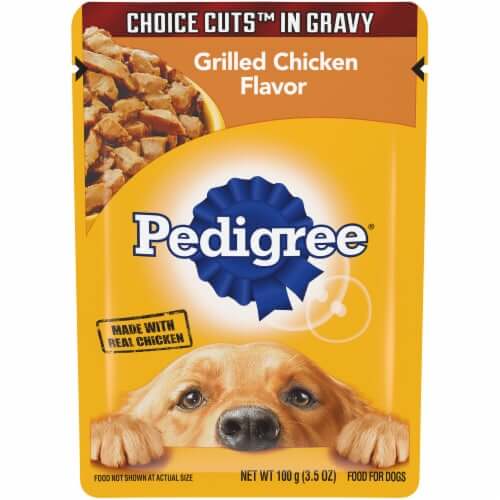
| Pedigree Choice Cuts in Gravy Grilled Chicken Flavor | 1.5 | M |
| Pedigree Choice Cuts in Gravy Hickory Smoked Chicken Flavor | 1.5 | M |
| Pedigree Choice Cuts in Gravy Chicken Casserole | 1.5 | M |
| Pedigree Chopped Ground Dinner Bacon and Filet Mignon Flavor | 1.5 | M |
| Pedigree Chopped Ground Dinner with Hearty Chicken | 1.5 | M |
| Pedigree Chopped Ground Dinner with Slow Cooked Beef | 1.5 | M |
Recipe and Label Analysis
Pedigree Choice Cuts in Gravy Grilled Chicken Flavor was selected to represent the other products in the line for detailed recipe and nutrient analysis.
Pedigree Choice Cuts in Gravy Grilled Chicken Flavor
Estimated Dry Matter Nutrient Content
Protein
Fat
CarbsCarbohydrates
Sufficient water for processing, chicken, animal liver, meat by-products, poultry by-products, wheat flour, wheat gluten, dried plain beet pulp, corn gluten meal, corn starch, animal plasma, soybean oil, calcium carbonate, sodium tripolyphosphate, salt, natural grilled chicken flavor, choline chloride, potassium chloride, xanthan gum, added color, ascorbic acid (preservative), minerals (magnesium oxide, zinc oxide, copper sulfate, calcium iodate), vitamins (vitamin E supplement, thiamine mononitrate [vitamin B1], pyridoxine [vitamin B6], vitamin D3 supplement, folic acid)
Fiber (estimated dry matter content) = 1.5%
Red denotes any controversial items
| Estimated Nutrient Content | |||
|---|---|---|---|
| Method | Protein | Fat | Carbs |
| Guaranteed Analysis | 8% | 3% | NA |
| Dry Matter Basis | 44% | 17% | 31% |
| Calorie Weighted Basis | 38% | 35% | 27% |
Ingredients Analysis
The first ingredient in this dog food is water, which adds nothing but moisture to this food. Water is a routine finding in most canned dog foods.
The second ingredient is chicken. Chicken is considered “the clean combination of flesh and skin… derived from the parts or whole carcasses of chicken”.1
Chicken is naturally rich in the 10 essential amino acids required by a dog to sustain life.
The third ingredient is animal liver. This is an organ meat sourced from a named animal and thus considered a beneficial component.
The fourth ingredient includes meat by-products, an item made from slaughterhouse waste. This is what’s left of slaughtered animals after all the prime striated muscle cuts have been removed.
With the exception of hair, horns, teeth and hooves, this item can include almost any other part of the animal.2
What’s worse, this particular item is anonymous. So, the meat itself can come from any combination of cattle, pigs, sheep or goats -which can make identifying specific food allergies impossible.
Although most meat by-products can be nutritious, we do not consider such vaguely described (generic) ingredients to be as high in quality as those derived from a named animal source.
The fifth ingredient is poultry by-products, or slaughterhouse waste. This is what’s left of slaughtered poultry after all the prime cuts have been removed.
In addition to organs, this item can also include feet, beaks, undeveloped eggs and almost anything other than prime skeletal muscle.
The quality of this ingredient can vary, depending on the caliber of the raw materials obtained by the manufacturer.
Although this item contains all the amino acids a dog needs, we consider poultry by-products slightly lower in quality than a single species item (like chicken by-products).
The sixth ingredient is wheat flour, a highly-refined product of wheat milling. Like corn, wheat is an inexpensive and controversial cereal grain of only modest nutritional value to a dog.
For this reason, we do not consider wheat a preferred component in any dog food.
The seventh ingredient is wheat gluten. Gluten is the rubbery residue remaining once wheat has had most of its starchy carbohydrate washed out of it.
Although wheat gluten contains 80% protein, this ingredient would be expected to have a lower biological value than meat.
And less costly plant-based products like this can notably boost the total protein reported on the label – a factor that must be considered when judging the actual meat content of this dog food.
The eighth ingredient is beet pulp. Beet pulp is a controversial ingredient, a high fiber by-product of sugar beet processing.
Some denounce beet pulp as an inexpensive filler while others cite its outstanding intestinal health and blood sugar benefits.
We only call your attention here to the controversy and believe the inclusion of beet pulp in reasonable amounts in most dog foods is entirely acceptable.
The ninth ingredient is corn gluten meal. Gluten is the rubbery residue remaining once corn has had most of its starchy carbohydrate washed out of it.
Although corn gluten meal contains 60% protein, this ingredient would be expected to have a lower biological value than meat.
And less costly plant-based products like this can notably boost the total protein reported on the label – a factor that must be considered when judging the actual meat content of this dog food.
From here, the list goes on to include a number of other items.
But to be realistic, ingredients located this far down the list (other than nutritional supplements) are not likely to affect the overall rating of this Pedigree product.
With four notable exceptions…
First, we’re always disappointed to find artificial coloring in any pet food. That’s because coloring is used to make the product more appealing to humans – not your dog. After all, do you really think your dog cares what color his food is?
Next, corn starch, a starchy powder extracted from the endosperm found at the heart of a kernel of corn. Corn starch is most likely used here to thicken the broth into a gravy.
Corn starch isn’t a true red flag item. Yet we’ve highlighted here for those wishing to avoid corn-based ingredients.
Also, animal plasma. Plasma is what remains of blood after the blood cells themselves have been removed. Plasma is high protein and is highly digestible. Inclusion of animal plasma is often done for binding or improving the texture of wet foods, but plasma is highly palatable and improves the digestiblity of foods. It supports immunity, digestion, joint health, as well as the skin and coat health. We consider animal plasma as a nutritious addition.
Usually, animal plasma is from pork or beef, however, since the declaration of animal plasma does not specify this, it can make accommodating particular ingredient sensitivities or allergies very difficult.
And lastly, this food contains chelated minerals, minerals that have been chemically attached to protein. This makes them easier to absorb. Chelated minerals are usually found in better dog foods.
Nutrient Analysis
Based on its ingredients alone, Pedigree Choice Cuts in Gravy Grilled Chicken Flavor looks like a below-average wet product.
The dashboard displays a dry matter protein reading of 43.2%, a fat level of 18.2% and estimated carbohydrates of about 25%.
As a group, the brand features an average protein content of 45.9% and a mean fat level of 21.4%. Together, these figures suggest a carbohydrate content of 20.8% for the overall product line.
And a fat-to-protein ratio of about 49%.
Which means this Pedigree product line contains…
Near-average protein. Below-average fat. And above-average carbs when compared to a typical wet dog food.
Pedigree Dog Food Recall History
The following automated list (if present) includes all dog food recalls related to Pedigree through March 2026.
You can view a complete list of all dog food recalls since 2009 here.
Our Rating of Pedigree Dog Food
Pedigree in pouches is a grain-inclusive moist dog food using a notable amount of named meats and unnamed meat by-products as its dominant source of animal protein. All recipes also contain added colour, thus earning the brand 1.5 star.
About
Pedigree is owned by Mars, the same parent company behind M&Ms, Twix, and various pet food brands such as Royal Canin and Whiskas.
In 2008, Pedigree established its non-profit organisation, The Pedigree Foundation, which supports shelters across the US. By 2024, the foundation will have donated over 12 million pounds to shelters, helping to house and rehome 800,000 homeless dogs.
Compare Pedigree Dog Food
How does Pedigree compare with The Dog Food Advisor's most recommended brands?
A Final Word
The Dog Food Advisor does not accept money, gifts, samples or other incentives in exchange for special consideration in preparing our reviews.
However, we do receive a referral fee from online retailers (like Chewy or Amazon) and from sellers of perishable pet food when readers click over to their websites from ours. This helps cover the cost of operation of our free blog. Thanks for your support.
For more information, please visit our Disclaimer and Disclosure page.