
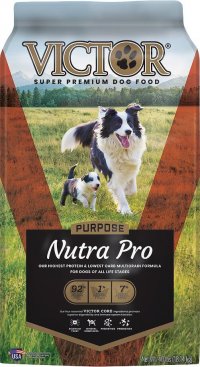
Victor Grain Free Dog Food (Dry)

Share

Rating: ★★★★★

Victor Grain Free dry dog food receives the Advisor’s top rating of 5 stars.

The Victor Grain Free product line includes 3 dry dog foods… two meeting AAFCO nutrient profiles for all life stages and the other for adult maintenance (Joint Health).

The following is a list of recipes available at the time of this review.

  • Victor Grain Free Ultra Professional
  • Victor Grain Free All Life Stages
  • Victor Grain Free Joint Health

Victor Grain Free All Life Stages was selected to represent the other products in the line for this review.

Victor Grain Free All Life Stages

Dry Dog Food

Estimated Dry Matter Nutrient Content

Protein = 36% | Fat = 18% | Carbs = 38%

Ingredients: Beef meal, sweet potato, chicken meal, peas, chicken fat (preserved with mixed tocopherols), pork meal, alfalfa meal, dried egg product, flax seed (source of omega 3 and 6 fatty acids), potassium chloride, dried kelp, natural chicken flavor, alfalfa nutrient concentrate, montmorillonite, salt, vegetable & fruit pomace (carrot, peas, tomato, celery, beet, parsley, lettuce, watercress, spinach, cranberries, blueberries), pumpkin seed, blueberries, apple, spinach, monosodium phosphate, yeast extract, dried chicory root, yeast culture, vitamins ( vitamin E supplement, vitamin B12 supplement, niacin supplement (source of vitamin B3), vitamin A supplement, d-calcium pantothenate (source of vitamin B5), thiamine mononitrate (source of vitamin B1), biotin (source of vitamin B7), riboflavin supplement (source of vitamin B2), vitamin D3 supplement, pyridoxine hydrochloride (source of vitamin B6), ascorbic acid, folic acid (source of vitamin B9), minerals (zinc sulfate, calcium carbonate, ferrous sulfate, zinc amino acid chelate, iron amino acid chelate, copper sulfate, copper amino acid chelate, manganese sulfate, manganese amino acid chelate, magnesium amino acid chelate, cobalt carbonate), l-lysine, selenium yeast, lecithin, choline chloride, hydrolyzed yeast, dried Enterococcus faecium fermentation product, dried Lactobacillus acidophilus fermentation product, dried Aspergillus niger fermentation product, dried Bacillus subtilis fermentation product, Yucca schidigera extract, taurine, mixed tocopherols and citric acid (preservatives), rosemary extract

Fiber (estimated dry matter content) = 4.2%

Red items when present indicate controversial ingredients

Estimated Nutrient Content
MethodProteinFatCarbs
Guaranteed Analysis33%16%NA
Dry Matter Basis36%18%38%
Calorie Weighted Basis31%37%33%

The first ingredient in this dog food lists beef meal. Beef meal is considered a meat concentrate and contains nearly 300% more protein than fresh beef.

The second ingredient is sweet potato. Sweet potatoes are a good source of complex carbohydrates in a dog food. They are naturally rich in fiber, beta carotene and other healthy nutrients.

The third ingredient is chicken meal. Like beef meal, chicken meal is also considered a high protein meat concentrate.

The fourth ingredient mentions peas. Peas are a quality source of carbohydrates. Plus (like all legumes) they’re rich in natural fiber.

However, peas contain about 25% protein… a factor that must be considered when evaluating the total protein reported in this food.

The fifth ingredient is chicken fat. Chicken fat is obtained from rendering chicken… a process similar to making soup in which the fat itself is skimmed from the surface of the liquid.

Chicken fat is high in linoleic acid… an omega-6 fatty acid essential for life. Although it doesn’t sound very appetizing, chicken fat is actually a quality ingredient.

The sixth ingredient is pork meal. Pork meal yet one more protein rich animal-based component.

The seventh ingredient is alfalfa meal. Although alfalfa meal is high in plant protein (about 18%) and fiber (25%), this hay-family item is not as commonly associated with pet foods as it is in horse feeds.

The eighth ingredient lists dried egg product… a dehydrated form of shell-free eggs. Quality can vary significantly. Lower grade egg product can even come from commercial hatcheries… from eggs that have failed to hatch.

In any case, eggs are easy to digest and have an exceptionally high biological value.

The ninth ingredient is flaxseed… one of the best plant sources of healthy omega-3 fatty acids. Provided they’ve first been ground into a meal, flax seeds are also rich in soluble fiber.

From here, the list goes on to include a number of other items.

But to be realistic, ingredients located this far down the list (other than nutritional supplements) are not likely to affect the overall rating of this product.

With five notable exceptions

First, montmorillonite… a naturally occurring clay rich in many trace minerals. Montmorillonite has been approved for use in USDA Organic Certified products.

Reported benefits include the binding of certain mold-based toxins and even controlling diarrhea and irritable bowel syndrome (IBS).

Next, chicory root is naturally rich in a substance called inulin… a starch-like compound made up of repeating units of carbohydrates and found in certain roots and tubers.

Not only is inulin a natural source of soluble dietary fiber, it’s also a prebiotic used to promote the growth of healthy bacteria in a dog’s digestive tract.

Thirdly, this recipe also contains selenium yeast. Unlike the more common inorganic form of selenium (sodium selenite), this natural yeast supplement is considered a safer anti-cancer alternative.

Next, the manufacturer appears to have applied friendly bacteria to the surface of the kibble after cooking. These special probiotics are used to enhance a dog’s digestive and immune functions.

And lastly, this food also contains chelated mineralsminerals that have been chemically attached to protein. This makes them easier to absorb. Chelated minerals are usually found in better dog foods.

Victor Grain Free Dog Food
The Bottom Line

Judging by its ingredients alone, Victor Grain Free looks to be an above-average dry dog food.

But ingredient quality by itself cannot tell the whole story. We still need to estimate the product’s meat content before determining a final rating.

The dashboard displays a dry matter protein reading of 36%, a fat level of 18% and estimated carbohydrates of about 38%.

As a group, the brand features an average protein content of 40% and a mean fat level of 20%. Together, these figures suggest a carbohydrate content of 33% for the overall product line.

Above-average protein. Above-average fat. And significantly lower carbs when compared to a typical dry dog food.

Even when you consider the protein-boosting effect of the peas, this looks like the profile of a kibble containing a generous amount of meat.

Bottom line?

Victor Grain Free Dog Food is a meat-based dry kibble using an abundance of beef, chicken and pork meals as its main sources of animal protein… thus earning the brand 5 stars.

Enthusiastically recommended.

A Final Word

This review is designed to help you make a more informed decision when buying dog food. However, our rating system is not intended to suggest feeding a particular product will result in specific health benefits for your pet.

For a better understanding of how we analyzed this product, please be sure to read our article, “The Problem with Dog Food Reviews

Remember, no dog food can possibly be appropriate for every life stage, lifestyle or health condition. So, choose wisely. And when in doubt consult a veterinarian for help.

Have an opinion about this dog food… or maybe the review itself? Please know… we welcome your comments.

Notes and Updates

06/06/2011 Original review
06/13/2011 Review updated (added Ultra Professional recipe)
06/13/2011 Last Update

Dog Food Advisor IconThe Dog Food Advisor publishes independent reviews to help pet owners make better choices when shopping for dog food.


  • Dane Lover

    p.s. Vets get very little training in nutrition.  They are not the best qualified when it comes to food consultation.  Most push certain brands because they get BIG kickbacks.  ”Prescription” foods and over use of vaccines are the proverbial “meat and potatoes” for most vets.  

  • Dane Lover

    It’s the calcium to phosphorus ratio; it has NOTHING to do with “high” protein.  Fresh meat naturally has less of everything (except water) compared to concentrated meat meals so manufacturers need to be more careful keeping the ratio balanced. Remember that protein builds lean muscle mass.  It’s the starch (i.e. sugars) in carbs. that can cause too quick weight gain in dogs, inluding pups, and that’s regardless if it’s grains, potatoes, tapioca, garbanzo beans, lentils, etc. You CAN feed high protein food to pups no problem AND to diabetics dogs AND to dogs with kidney problems.  The “too much protein” argument needs to die once and for all.
    I feed both my Danes Orijen which, in my experience, is the best commercial food out there today.  That company only sources locally, includes a lot of fresh meats, uses only animal fat and, in light of the recent recalls, only makes their own food in their own manufacturing plant unlike 99% of all other companies out there.  However, raw is superior to all.

  • Shawna

    Protein causing problem in large breed puppies has been disproven…  They now know that it isn’t protein that is the problem but rather the over consumption of calories in general — eating too much…  Foods too high in calcium (even if correctly balanced to phosphorus) are problematic as well.  Protein is not an issue though :) ..

  • http://www.southernrebelskennel.com/ Southern Rebels Kennel

    Be careful using a high protin food on a very large breed puppy.  The protin can make thier muscles grow really well but thier bones can have a hard time catching up to the muscle mass and cause very painful bones and joints.  Talk to you vet about it before putting the puppy on a high protin food.  Hope this helps.

  • gaffagirl

    Thank you! That natures select looks interesting too!

  • http://www.dfwpugs.com/ sandy

    Try finding the calorie counts for each food and start with the same amount of calories. 

  • gaffagirl

    I can’t find feeding guidelines on their website. If I am feeding 1 cup per day of diamond naturals to a 14 lb dog, how much should I feed grain free? I’m thinking it shout stay the same. Its going to be a long hot summer here in East Texas. She doesn’t need to lose weight. She is perfect.

  • http://www.dfwpugs.com/ sandy

    I have plenty of small dogs and change their flavor of food every bag and mix 2 together frequently. And I also feed canned foods and raw.  They are used to frequent changes and variety and have no problems eating one kind of food one day and a different food the next.  Nature’s Select is also made in Texas and have a food similar to the Victor Grain Free (sweet potato based). I’m not familiar with the price of Victor’s or Solid Gold. Adding in 20% of fresh foods can also help stretch out the bag of kibble and give them better nutrition. Additions like fresh meats and fish, canned fish, eggs, small amount of cooked veggies and small amounts of fruit.

    http://www.naturalpetfooddelivery.com

  • gaffagirl

    Would it be inadvisable to mix two different kibbles such as Solid Gold Just A Wee Bit and Victor Grain Free?

  • gaffagirl

    I’m glad to see that this food has such good reviews. I had my cairn terrier on nutro natural choice before finding this site. Then I tried a 4 lb bag of Solid Gold Just a a Wee Bit which she loved and gave her a nice wiry coat. I would have no problem continuing to feed it if it wasn’t so pricey. We are now trying to finish a 20 lb bag of Diamond Naturals Lamb and Rice. It’s not a bad food but I’ve noticed more stool in the yard. And these recalls have me panicking! Even though the feed shop i bought it from assured me none of her bags were recalled. I think Victor Grain Free will be next! Much more reasonable than Solid Gold and since I’m in Texas, I love the fact that it’s a company near home. I’m trying to find a food we are both happy with. Is there any harm that can come from changing her food this often? I always use the 10 day transition. Anyone have small, 20 lb and under dogs on this food?

  • Wendt Worth Corgis

    I’ve been wanting this food for sometime now. I live in Ohio and the one distributor the Victor site has I contacted and is not selling the food any longer just because he wasn’t getting the demand for it but he sounded Amish so might of had issues distributing or marketing the product. I’ve spoken with Kevin from Victor who said he could sell me a pallet of 50 40lb bags of food for $1100 and shipping would cost $600 and thats a one time fee per delivery so more pallets ordered would lower the cost per bag. I would love to find others who would be interested in going in on this and ordering a few pallets. If 3 pallets ordered and split 3 ways..it would cost $1300 making each bag only $26.00!!!! 

  • Carleen

    I have been feeding Victor Professional to my 4 yr old Great Dane. I am getting a new Great Dane puppy in a few weeks and was thinking of going to the Grain Free for both of them. Thoughts???

  • Rebecca Holt

    I have been using Victor dog food for almost 3 weeks now and love it.I am switching to the Victor grain free dog food this week.My dogs love it and it is very affordable

  • Pingback: Victor dog food?

  • Cry300

    I just started feeding my dog this and its Great food he eats it all up he seems much more energetic and hes getting some nice muscle tone.

  • Jgreen205

    Does anyone know digestability percentage for the Grain- Free All Stages??

  • melissa

    Antonio here feeds this and has reported only good. I would give it a try, but can’t get in NY. I could probably order online and have shipped, but I refuse to ship foods as I prefer to have a local return “center” in case there is something wrong. I am a little weird like that -I do not want “short dated food” nor will I accept torn packages due to the risk of contaminant.

  • Dave’s Hounds

    looks like a good food

  • Jan_Mom2Cavs

    This food looks good, wish I could get it here in Ohio! And I do agree with you about companies sacrificing quality for money and using their marketing to “lure” in the innocent, naive shopper.

  • Animalatlanta

     I have been selling dog food for 23 years now and think it is wonderful how the public has educated themselves and made the decision to reward companies who continue to invent and improve the current state of dog foods available. I watched helplessly as Science Diet, Iams, Nutro, Blackwood and many others “sold out” and the new owners were only interested in maximizing ROI (return on investment). …This causes companies to re-evaluate their products not to make them better but to make them produce more money with smaller costs. At some point the emphasis goes toward marketing and poor quality ingredients because hype often outsells quality. I consider VICTOR to be one of the best today.ANIMAL ATLANTA animalatlanta.com6449 BELLS FERRY ROAD WOODSTOCK GEORGIA 30189 770-591-0007

  • Shawna

    Beagleman,

    Thought you might find this one interesting too.

    “In this study, an increased value of glutamate or aspartate was found in the CSF of some epileptic dogs. Therefore, excitotoxic neurotransmitters, such as glutamate and aspartate, may be a contributing factor for the pathogenesis of the acute brain damage observed in our epileptic dogs.” http://www.ncbi.nlm.nih.gov/pmc/articles/PMC226980/

  • Shawna

    PS — problem with excitotoixins — damage is not always clear right away or even associated with excitotoxins. Seizures as an example is listed as a side effect of the damage done in one of the above studies. Alzheimers is one listed for humans and doesn’t show up for years after the damage begins..

  • Shawna

    Hey Beagleman,

    We’ve been discussing this on another thread as well so I’m kinda on a role… ;)

    Here’s several — the testing was done on dogs and brain injury was the outcome. :(

    “These results represent the first direct evidence of a role for glutamate excitotoxicity in the development of hypothermic circulatory arrest-induced brain injury and suggest that selective glutamate receptor antagonists may have a neuroprotective capacity in prolonged periods of hypothermic circulatory arrest.” http://www.ncbi.nlm.nih.gov/pubmed/8127107

    my google criteria was “canine glutamate excitotoxicity”.

    This one doesn’t display the data but they are testing “retinal vulnerability”

    “Retinal vulnerability to glutamate excitotoxicity in canine glaucoma” http://www.ncbi.nlm.nih.gov/pubmed/9836292

    “Excessive synaptic accumulation of glutamate can cause neuronal overactivation, precipitating a cascade of cellular events that lead ultimately to cell death, a phenomenon termed glutamate excitotoxicity” http://jtcs.ctsnetjournals.org/cgi/content/full/107/3/776

  • Beagleman

    Thank you Shawna. I did realize that we were limiting the discussion to the concentrated form. I did find alfalfa nutrient concentrate listed in some supplements for raw feeders and performance dogs. I talked with a friend who does lure coursing that uses one of the one products I saw it in and he’s used it on 12-15 dogs for as he puts it, “years” with no problem. I am still trying to find more information and will let you know what I am able to turn up.

  • Shawna

    Beagleman,

    Just to clarify — “alfalfa” and “alfalfa meal” are okay.. Its specifically the “alfalfa nutrient concentrate” that concerns me. I feed my dogs (in rotation) Honest Kitchen Preference which has alfalfa as an ingredient.

    Unfortunately I don’t have anything that identifies the risks of free glutamic and asparatic acids in dogs.. It was hard enough to find the data for humans (and one regarding horses). These products are used in so many foods — they trick the brain into thinking the food tastes better then it does. That is not always the reason used btw.. Because they are used in so many products I imagine it would be a nightmare for industry to start eliminating. What they have done however is to find other sources — example, you rarely see “MSG” on the label any longer. Instead they now use “hidden sources” and can label their product as MSG free but still have the bad parts of MSG in the food.

    Anyhoo, here are links to the research material I posted here on DFA regarding the diseases linked to MSG and other excitotoxins. http://www.dogfoodadvisor.com/dog-food-reviews/purina-veterinary-diets-ha/comment-page-4/#comment-35091 and http://www.dogfoodadvisor.com/dog-food-reviews/purina-veterinary-diets-ha/#comment-35158

    This website gives a list of the hidden and other possible sources of free glutamic and asparatic acid. http://www.truthinlabeling.org/hiddensources.html

  • Beagleman

    Shawna- Thanks for pointing this possible risk out. Not even my holistic DVM knew much about excitotoxins and alfalfa, and he regularly uses alfalfa with wonderful results. I do realize that concentrated forms of anything increase both the positive and negative elements at the same time. Excitotoxins were something that I had only heard of a time or two before and never with alfalfa. I’ve not been able to find much information about them in canines. Do you have any clues on where to find more information. Thanks.

  • melissa

    Michelle-

    I have found it online for as little as $39 a bag-just can’t remember where, lol, and do not know what the shipping would add on top of that-

    They told me they are working to widen their distribution, so hoping they make it to NY or at least within driving distance

  • Antonio

    Michelle,

    I think it depends on which formula you get. But currently pending the formulation I’ve been paying between $43.99-$46.99 here in my area. But I’ve saw prices range a little lower in some areas and a little higher in some areas when having some online discussions about the pricing. I guess it depends on the distributor in the area and how much he’s charging the dealers.

  • Michelle

    Hi Antonio :) Can you please tell me how much Victor’s grain free costs, and for what size bag? Thanks. :)

  • Michelle

    Beagleman, I would like to apologize to you, for calling you the a word. I am sorry :) Also, I shouldn’t have let myself become upset, because reading one post of mine doesn’t give you enough information about me to quantify my intelligence. :)

  • Gordon

    Beagleman – I understand where your posts are coming from and agree that I too, do not totally agree with the Great Dane Lady. I also understand that none of us is perfect and we all have a strengths and weaknesses. If you say you’re much older than Michelle, then you should truly be wise enough to use better diplomacy in your innuendo of your judgement toward Michelle’s slight pointed out error(s).

    Remember that one should try and calm the other or maintain civility when correcting someone and not infer someone else as “stupid” as I too felt the that same impression or innuendo inferred, when reading that post.

    Just suggesting…that’s all. Be nice. Michelle’s just a cheeky bugger. She can’t help it. :P Kidding

  • Shawna

    Beagleman,

    You wrote “It’s way to far down the list to be considered a “protein source,” in my opinion”. Not trying to dissuade you from your decision but did want to clarify my “protein source” comment if you will allow…

    Its not actually a “protein” source but rather a source of the amino acids that make up protein. This is not in and of itself bad however there are two amino acids (glutamic and aspartatic) which can be excitotoxic (kill cells in the body) when consumed in this manner.. Because there is a cumulative effect they can, over time, start to build up in the body and this is when symptoms start to appear.. This is also why small amounts can be problematic. MSG and other excitotoxic additives are usually further down on the human products lists too but still cause problems.

    I developed symptoms at 12 years old — “eye migraines”. I would COMPLETELY lose my vision in both eyes for 30 seconds to several minutes. I was seen by multiple doctors and neurologists and never diagnosed. In my early 30′s I had a scary episode (brain wise) and was sent to a neurologist who suggested MRI. The MRI found “brain lessions” (aka brain cell death). LONG story short — the small amounts of MSG etc in human foods was causing me lots of problems (brain damage was not my only symptom). When I eliminated as much of the excitotoxins my symptoms ceased — including the blackouts.

    Again, not trying to get you to switch foods but did want to mention that even small amounts can be disasterous. Neurosurgeon Dr. Russell Blaylock wrote a book on these to acids called “Excitotoxins: The Taste that Kills”