
Acana Regionals Grain-Free (Dry)

Share

Rating: ★★★★★

Acana Regionals Grain-Free dog food earns the Advisor’s top rating of 5 stars.

The Acana Regionals grain-free product line includes four dry dog foods, all claimed to meet AAFCO nutrient profiles for all life stages.

The following is a list of recipes available at the time of this review.

  • Acana Pacifica
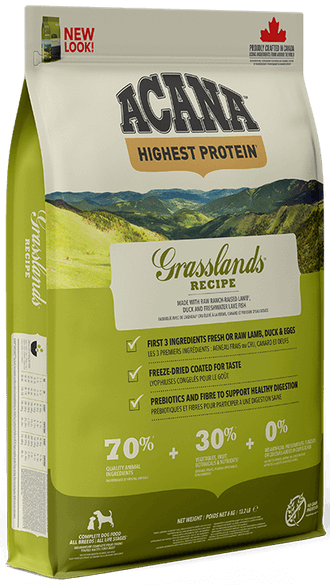
  • Acana Grasslands
  • Acana Wild Prairie
  • Acana Ranchlands

Acana Grasslands was selected to represent the other products in the line for this review.

Acana Grasslands

Dry Dog Food

Estimated Dry Matter Nutrient Content

Protein = 34% | Fat = 19% | Carbs = 39%

Ingredients: Deboned lamb, lamb meal, duck meal, whitefish meal (whitefish meal contains wild-caught flounder, halibut and alaskan cod), whole peas, red lentils, field beans, whole potato, deboned duck, whole eggs, deboned walleye, duck fat, herring oil, lamb liver, herring meal, sun-cured alfalfa, pea fibre, whole apples, whole pears, sweet potato, pumpkin, butternut squash, parsnips, carrots, spinach, cranberries, blueberries, kelp, chicory root, juniper berries, angelica root, marigold flowers, sweet fennel, peppermint leaf, lavender, rosemary, vitamin A supplement, vitamin D3 supplement, vitamin E supplement, niacin, riboflavin, folic acid, biotin, vitamin B12 supplement, zinc proteinate, iron proteinate, manganese proteinate, copper proteinate, selenium yeast, dried Enterococcus faecium fermentation product

Fiber (estimated dry matter content) = 5.6%

Red items when present indicate controversial ingredients

Estimated Nutrient Content
MethodProteinFatCarbs
Guaranteed Analysis31%17%NA
Dry Matter Basis34%19%39%
Calorie Weighted Basis29%39%33%

The first ingredient in this dog food is lamb. Although it is a quality item, raw lamb contains about 80% water. After cooking, most of that moisture is lost, reducing the meat content to just a fraction of its original weight.

After processing, this item would probably account for a smaller part of the total content of the finished product.

The second ingredient lists lamb meal. Lamb meal is considered a meat concentrate and contains nearly 300% more protein than fresh lamb.

The third ingredient mentions duck meal, another protein-rich meat concentrate.

The fourth ingredient is whitefish meal, yet another high protein meat concentrate.

Fish meal is typically obtained from the “clean, dried, ground tissue of undecomposed whole fish and fish cuttings” of commercial fish operations.1

We are pleased to note that, unlike many fish meals, this particular item appears2 to be ethoxyquin-free.

The next two ingredients are peas and lentils. Peas and lentils are quality sources of carbohydrates. Plus (like all legumes) they’re rich in natural fiber.

However, peas and lentils contain about 25% protein, a factor that must be considered when judging the actual meat content of this dog food.

The seventh ingredient includes field beans, another fiber rich item with nutritional qualities similar to peas and lentils.

The eighth ingredient is potato. Potatoes can be considered a gluten-free source of digestible carbohydrates. Yet with the exception of perhaps their caloric content, potatoes are of only modest nutritional value to a dog.

The ninth ingredient is duck. Although it is a quality item, raw duck contains about 80% water. After cooking, most of that moisture is lost, reducing the meat content to just a fraction of its original weight.

After processing, this item would probably account for a smaller part of the total content of the finished product.

The next ingredient is whole eggs. Eggs are easy to digest and have an exceptionally high biological value.

After eggs, we find walleye, a freshwater fish native to the northern region of the United States and much of Canada.

Then we come to duck fat. Duck fat is obtained from rendering duck, a process similar to making soup in which the fat itself is skimmed from the surface of the liquid.

Duck fat is high in linoleic acid, an omega-6 fatty acid essential for life. Although it doesn’t sound very appetizing, duck fat is actually a quality ingredient.

Next, herring oil is naturally rich in omega-3 fatty acids, essential nutrients needed by every dog to sustain life.

From here, the list goes on to include a number of other items.

But to be realistic, ingredients located this far down the list (other than nutritional supplements) are not likely to affect the overall rating of this product.

With four notable exceptions

First, we find chicory root is rich in inulin, a starch-like compound made up of repeating units of carbohydrates and found in certain roots and tubers.

Not only is inulin a natural source of soluble dietary fiber, it’s also a prebiotic used to promote the growth of healthy bacteria in a dog’s digestive tract.

Next, we note the use of dried fermentation products in this recipe. Fermentation products are typically added to provide enzymes to aid the animal with digestion.

Thirdly, this recipe also contains selenium yeast. Unlike the more common inorganic form of selenium (sodium selenite), this natural yeast supplement is considered a safer anti-cancer alternative.

And lastly, this food also contains chelated minerals, minerals that have been chemically attached to protein. This makes them easier to absorb. Chelated minerals are usually found in better dog foods.

Acana Regionals Grain Free Dog Food
The Bottom Line

Judging by its ingredients alone, Acana Regionals appears to be an above-average dry dog food.

But ingredient quality by itself cannot tell the whole story. We still need to estimate the product’s meat content before determining a final rating.

The dashboard displays a dry matter protein reading of 34%, a fat level of 19% and estimated carbohydrates of about 39%.

As a group, the brand features an average protein content of 35% and a mean fat level of 19%. Together, these figures suggest a carbohydrate content of 38% for the overall product line.

And a fat-to-protein ratio of about 54%.

Above-average protein. Above-average fat. And below-average carbs when compared to a typical dry dog food.

Even when you consider the protein-boosting effects of the peas, lentils and field beans, this looks like the profile of a kibble containing a notable amount of meat.

However, there appears to be slightly more protein attributable to plant-based sources than to meat – compared to the most recent version of this recipe.

Bottom line?

Acana Regionals is a grain free kibble using a notable amount of named meats and meat meals as its main sources of animal protein, thus earning the brand 5 stars.

Enthusiastically recommended.

Special Alert

Rice ingredients can sometimes contain arsenic. Until the US FDA establishes safe upper levels for arsenic content, pet owners may wish to limit the total amount of rice fed in a dog's daily diet.

A Final Word

The descriptions and analyses expressed in this and every article on this website represent the views and opinions of the author.

Although it's our goal to ensure all the information on this website is correct, we cannot guarantee its completeness or its accuracy; nor can we commit to ensuring all the material is kept up-to-date on a daily basis.

Each review is offered in good faith and has been designed to help you make a more informed decision when buying dog food.

However, our rating system is not intended to suggest feeding a particular product will result in specific health benefits for your pet.

For a better understanding of how we analyze each product, please read our article, "The Problem with Dog Food Reviews".

Remember, no dog food can possibly be appropriate for every life stage, lifestyle or health condition. So, choose wisely. And when in doubt, consult a qualified veterinary professional for help.

In closing, we do not accept money, gifts or samples from pet food companies in exchange for special consideration in the preparation of our reviews or ratings.

To learn how we support the cost of operating this website, please visit our public Disclosure and Disclaimer page.

Have an opinion about this dog food? Or maybe the review itself? Please know we welcome your comments.

Notes and Updates

01/26/2010 Original review
09/02/2010 Review updated
06/29/2012 Last Update

  1. Association of American Feed Control Officials
  2. “Preservative-free” per Acana Website
  • Pattyvaughn

    I don’t see a problem with doing that if your dog doesn’t have a problem with grains. Transition at a speed that keeps your dogs stool good.

  • Strey

    Is it okay to rotate my dog from grain free food to not grain free food.?

  • Pingback: Good Dog Food Each Day, Keeps the Vet Away! | And Foster Makes Five

  • Guest

    Can I ask a question? Are the leafy plants young or old that she eats? And what does her stool look like? I have a reason for asking. :)

  • Hound Dog Mom

    Could it be bone? I believe Acana had some issues with bone in their kibble a few years back. I would contact the company – they have great customer service and I’m sure they’d like this issue brought to their attention.

    If your dog is a healthy weight according to the vet, keep her at that weight. Most people don’t know what a healthy weight looks like and when dogs are at a healthy weight will comment that they’re too skinny. My whole family tells me my dogs are too thin but I think they look great and my vet says they’re in perfect body condition. Being overweight is very unhealthy. If you wanted you could try a more calorie-dense food (although Acana is fairly calorie-dense) – the only problem is most higher calorie foods are also higher in fat and probably wouldn’t work for a dog prone to pancreatitis. I would say a better option would be to add a wet food or raw food to her kibble to entice her to eat on the days she’s not showing interest in her food (just watch the fat levels, as many wet and raw foods are high in fat).

  • Hound Dog Mom

    Hi khloepup –

    Grass fine, my dogs sometimes eat grass, but I wouldn’t let her eat leafy plants unless you know exactly what it is and that it’s safe to eat. Many plants are poisonous. Sometimes the consumption of grass is behavioral and sometimes it’s nutritional. Some things you could try would be adding a green supplement to your dog’s food (look for one with any combination of things like wheat grass, barley grass, alfalfa, sprouts, etc.) or there are kits to grow grass for pets, you can find them online or in pet stores.

  • Khloepup

    Or leaves. My vet also said this was normal unless she was vomiting which she isn’t I just find it concerning that she loves eating grass or leafy plants. Any help is much appreciated!!!

  • Khloepup

    Hi everyone,

    I may be over paranoid and have no idea what I’m talking about but have noticed some odd sharp looking pieces of some sort in the kibble of the acana ranch lands. They almost looked like sharp grains of rice, but they visibly stuck out of the kibble and were concerningly sharp. Has anyone ever looked at the kibble up close and noticed something Iike this???
    Also on a different note, my old English bulldog is at a healthy weight according to my vet but she is 44 lbs and you can noticeably see her ribs. People make comments all the time about her being too skinny but she has never been a big eater and has separation anxiety which I think definitely affects her appetite as well. I get excited when she eats, and she is a very active dog, any recommendations on supplements or possibly a different food? Her stomach is sensitive ( had pancreatitus when she was 1 ) and she is constantly wanting to graze on grass

  • sandy

    I called Acana in regards to this because I was also concerned with the canola in the ingredients list. They assured me the Canola they were sourcing is GMO free. Their ingredients are strictly regulated when they export to Europe, where GMO’s are not allowed.
    I am very strict with avoiding gmo’s and feel confident in buying their food.

  • aimee

    Shawna,

    Based on the only study that I could find that evaluated this very issue I’d disagree that there is enough biotin in the egg yolk to offset the avidin in the egg white.

    Chicks grew poorly and had signs of biotin deficiency when raised on a diet with uncooked whole egg. The effect was worse when fed egg white without yolk and didn’t occur when fed egg yolk without white. This doesn’t mean I think the occasional raw egg will cause biotin deficiency in dogs though.

    As a side note, in several papers now I’ve read in humans the bioavailability of AA is quite poor in uncooked egg vs cooked egg. Haven’t found ileal digestibility studies in dog with raw egg so don’t know if same effect is seen. But I think it would be.

    I found small differences in vit and mineral in cooked vs uncooked egg but considering all the anti nutrients in uncooked egg and poor protein availability what are the real advantages of eating eggs uncooked?

  • Brinny

    I give my puppy a raw egg on top of his kibble every few days. I use eggs from a friend who has some hens. He loves it!

  • Shawna

    Hi crazy4cats :)

    There is a type of protein in egg whites called avidin that binds with the B vitamin Biotin. There is ample biotin in the yolk however to compensate for what is bound to avidin IF the whites and yolk are fed together. If feeding whites only (say to a dog that has pancreatitis and can’t handle the higher fat content of the yolk) it is best to lightly cook the whites til just opaque, which deactivates the avidin..

    As far as salmonella or bacterial contamination — that is generally believed to only be a concern in lower quality eggs. Lots of people including Dr. Joseph Mercola, Dr. Josh Axe, body builders all across the world etc eat raw eggs regularly without issue. And dogs handle bacteria better than humans.

    Dr. Axe has a Berry Smoothie recipe on his website that calls for two raw eggs per cup of smoothie. That’s about the only way I could eat a raw egg — not fearful of contamination but the slime factor gets me :) .. http://www.draxe.com/recipe/berry-smoothie/

  • crazy4cats

    Hi Shawna-
    So, you think it is fine to give dogs raw eggs? I’ve been giving my two a couple of eggs lightly cooked once a week. I’m nervous about giving them raw eggs. But, if it is more beneficial and not risky, I’ll try it out! Thanks.

  • Shawna

    Thought this info on Dr. Fosters and Smith website might be helpful in understanding omega 6/3 needs.

    Linoleic Acid is referred to as LA

    “LA is important because it optimizes water permeability in the skin. AA, on the
    other hand, in increased amounts, is the troublemaker among the fatty acids….

    Dull and Dry Hair Coats: Haircoats which are dull, brittle, and dry often respond to supplementation with essential fatty acids,
    especially LA. It has also been found that in some cases of seborrhea, there is a deficiency of LA in the skin. In these cases, supplements high in LA are useful. The addition of EPA and GLA is also beneficial in that it would help
    negate the release of AA from cells damaged because of this skin condition.” http://www.peteducation.com/article.cfm?c=2+1659&aid=666

    The article mentions the high LA amounts in sunflower and safflower oils. These are inexpensive oils but the kind we buy at the supermarket are HIGHLY processed and cause more harm than good — hydrogenated..

  • Shawna

    Hi Megan,

    Do you by chance poor the kibble out of the bag and into something else to store it? Or do you free feed? This exposes the omega fats in the food to air and light, both of which degrade the omega oils and make them rancid.

    I agree with Emilythevet. Poor coat and skin quality can helped by adding oils to the diet — organic/extra virgin coconut oil, omega 3 fish oil etc. But, it is linoleic fatty acids (a “good” omega 6) that is most beneficial for skin and coat. Most manufacturers use chicken fat, sunflower or safflower oil or canola oil for linoleic acid but depending on manufacturing, storage before you purchase it etc the fats can degrade. Linoleic acid is the only omega fatty acid required by AAFCO in dog foods however some manufacturers may use the minimum amount while others may use a little more.. It’s important not to add too much linoleic acid to the diet without the inclusion of omega 3 though so as not to create an imbalance.

    Protein is necessary for good skin and coat but TotW, at 36% protein, has enough for coat and skin health needs. Zinc is also important for skin/coat health. However TotW doesn’t have grains that bind with zinc and it must at least meet the minimum AAFCO requirements. Maybe it has the minimum but not as much as Acana?

    I like Patty’s suggestion to add probiotics and enzymes however quality counts with probiotics.. An easy way to make a very nutritious, inexpensive source of probiotics is to ferment (aka culture) vegetables (recipes online) or to add unsweetened kefir to the diet several times per week. Goat kefir is better than cow kefir but harder to find.

    Organic, free ranging eggs are a bit more expensive than regular eggs but adding one a few days per week to the kibble can greatly improve the overall nutrition by adding high quality protein and fats. The yolks are high in B vitamin biotin which is also good for the coat. DON’T cook the yolk or you damage the fats. Canned sardines can be added once a week too. I haven’t done the math but the eggs and sardines may be cheaper than the TotW canned and are definitely more nutritious.

    If you decide to add an omega 6 or 3 (or a combo) it is best not to skimp on price as the lower grade ones can be contaminated with mercury, can be rancid etc. Quality, and therefore usually price, counts with omegas.

    Nutrisource may resolve the coat issues you’re seeing but if not I hope I’ve given you some things to think about :) ..

  • Megan

    How do you think that sounds? What would you change or modify? I am attempting to keep them all healthy, lean, satisfied with a special emphasis on GREAT skin/coat health as all 3 dogs’ coats quickly turn dull and rough on a poor diet.

  • Megan

    Thanks for all of the replies, guys! It was a pleasant surprise to log in and see how many people were offering their advice.

    I don’t believe I have ever seen nutrisource in my area, does anyone know of the common stores it is carried in? How much is the largest bag where you find it and do they have any grain free options? Also, how would you say it stacks up against taste of the wild? I noticed it got 1 star less here on advisor.

    Before I saw the nutrisource recommendation, here’s what I was thinking: taste of the wild wetlands with the occasional bag of high prairie and southwest canyon mixed in. Wet the kibble daily, but not letting it sit. Add fish oil daily. Allow then to have southwest canyon CANNED once a week.

  • Guest

    I wouldn’t waste your limited funds on pumpkin. Try the omega 6-9 oil which is the oil that canines can digest. You can pick some up at any natural health foods store (any brand will do). It won’t cost more than $10 for the bottle I assume.

  • EmilytheVet

    Add an omega 6-9 oil to her meal 1X/day. Prick the capsule and squeeze it over her food. You should see a definitive difference within 4 weeks. If no change, check her TSH and T4 levels at your DVM to rule out thyroid issues.

  • http://www.facebook.com/profile.php?id=1140685339 Betsy Greer

    I agree with Patty on this. NutriSource is a great, budget friendly option. It does seem to be very well tolerated as well. I switched my new Golden pup to it without any transition (he was having lots of digestive issues and loose stool on the food the breeder had him on) and he did great on it.

  • http://www.facebook.com/profile.php?id=1140685339 Betsy Greer

    Hi Megan,

    You’re hardly a bad pet parent. You’re, no doubt, making sacrifices to buy the highest quality food for your pet that you can. : )

    Lots of people, myself included, add supplements, either occasionally or regularly, to their dog’s food to help them derive maximum benefit from what they’re being fed.

    It’s definitely worthy of your concern that your pup seems to be in so much distress. I don’t want to be an alarmist, and I’d be curious as to what others who have far more experience than I would have to say about the possibility of bloat. Is your pup doing anything else unusual; ie: vomiting, salivating, lip-licking? Is her belly distended or is she passing gas in addition to the irregular bowel movements?

    After ruling out other, more serious, problems, I would definitely add probiotics and digestive enzymes. I use Mercola (healthypets.mercola.com)… they’re expensive, but worth it. You might also try adding a spoonful of Greek yogurt or some kefir or the canned pumpkin Patty mentioned. My dogs don’t do great with dairy,but some people swear by it for their dogs.