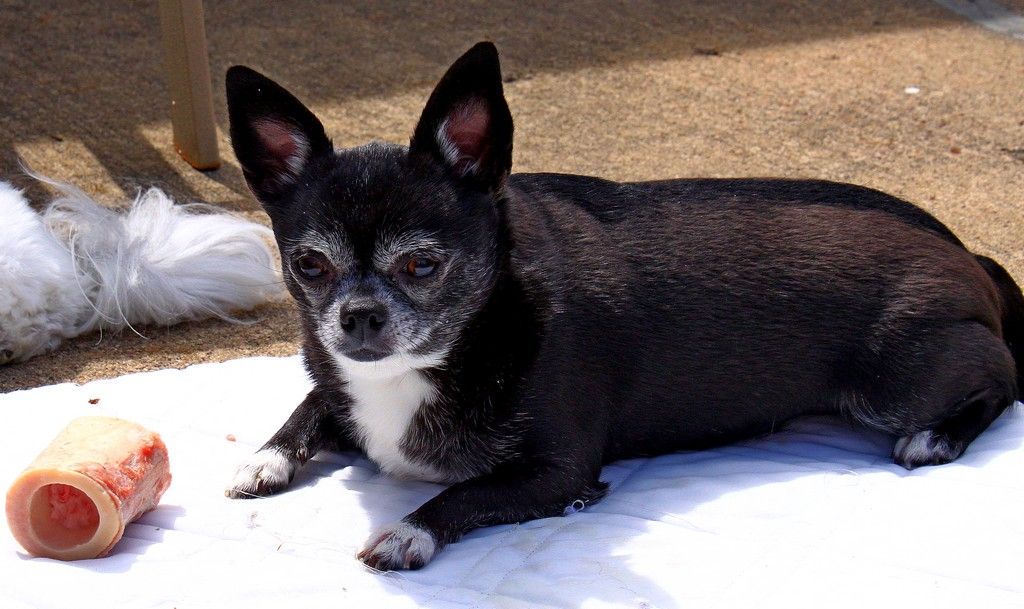
GiGi watching everyone else eat and wanting theirs….My sweet baby. Shes my baby that is allergic to insect bites and they are deadly to her 🙁
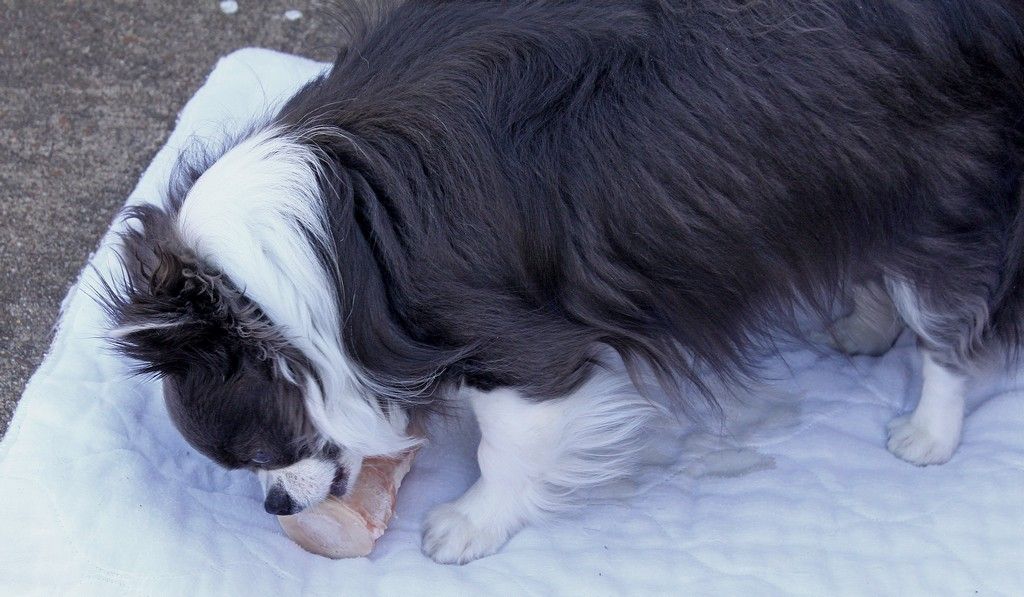
Emma eating her Marrow bone.
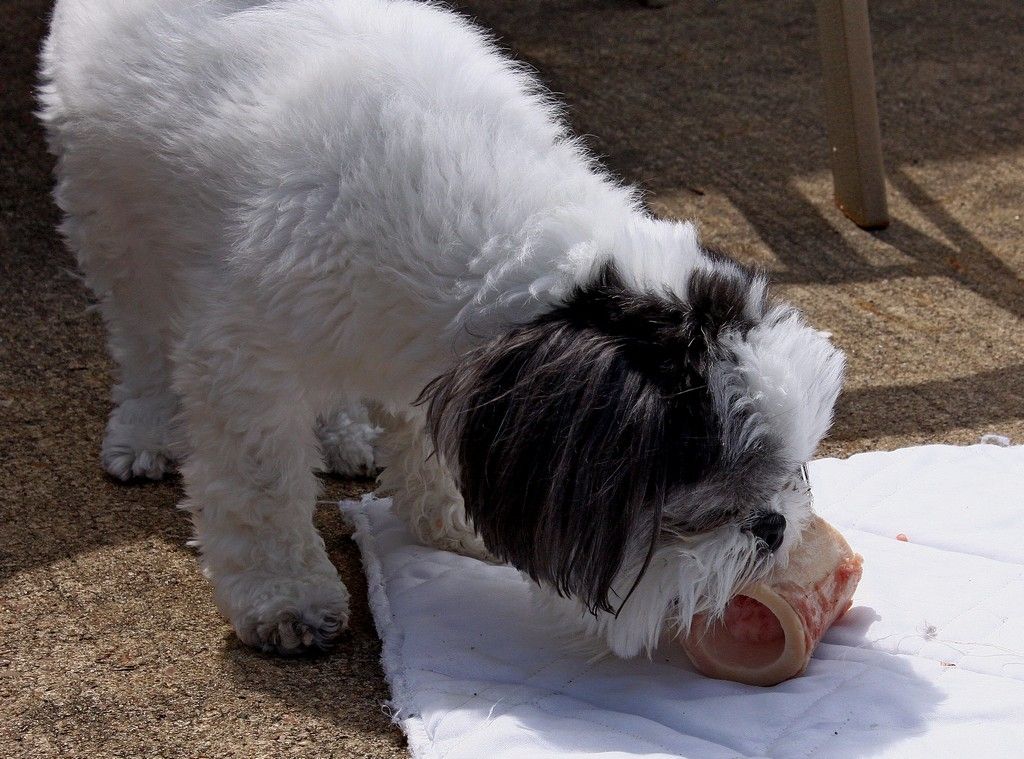
Oh it worked…..This is Tootie eating a Marrow bone.
-
This reply was modified 12 years, 9 months ago by
 NectarMom.
I thank you for that Patty! Lol! I have a video of Bailey eating a turkey neck, no pics though. I would have no clue how to post anything.
Nectarmom,
I can load pictures in the forum through photobucket.
Patty,
I saw whole cow head at the Mexican supermarket!
I did all of you a favor and didn’t get pictures of my dogs eating a chunk of goat head with eyeball. That was pretty gross, but they loved it.
Awe nice pictures everyone. I have some but I have no clue how to post them on here??
You can feed raw trachea or chicken feet and perna (green lipped mussel) for natural joint support. I believe omega 3’s are given in a higher dose for joint support. You can also try products like Actiflex 4000 (I give the horse product, 1/4 teaspoon to my small dogs), Wysong’s (human products) Joint Complex and Arthegic. I do like products with eggshell membrane and cetyl-myristoleate (esterified fatty acid).
The oatmeal, rice, and pasta may be feeding the yeast in his ears. That’s why all the different kibbles didn’t work either as they are high in carbs too.
If you are going to home cook, you should invest in a couple books on preparing balanced meals for dogs. Steve Brown has “Unlocking the Canine Ancestral Diet” It isn’t even a very big book, but it is packed with good info for understanding how to fix your dogs food. It was written primarily for people interested in feeding raw, but if you want to cook the meat then just make sure you use boneless meat and then add back 800-1000mg of calcium per lbs of meat. Cook the meat about as rare as you can stand. Raw meat is better, but I can understand wanting to kill off any contaminants on the surface.
-
This reply was modified 12 years, 9 months ago by
 theBCnut.
hi guys i am new to the site…debating raw…we have three hunting dogs (lab, english and german pointers ) i have been doing a cooked diet for them to date as my Mr is a hunter and we use game for the dogs. i have cooked because i don’t know the parasite status of the animals. i have been looking through the recipes (thank you everyone for posting tis site is wonderful :)….does any one have info or links to if i want to cook instead of raw? and maybe know how cooked would compare to raw? i do supplement weekly with a raw meal of ground bone to get that in but i am still fairly new to this so need to make sure my babies are getting all they need.
thanks 🙂
If you want to make meat organ grinds a larger portion of your dogs’ diet without balancing the meal with whole foods Sandy recently made me aware of a supplement designed to balanced meat/organ/bone only diets, might be worth checking out.
http://www.youngagainpetfood.com/10browse.asp?category=raws&ProductCode=92200
Raw ground rabbit bones and organs with spirugreen definitely isn’t a balanced diet on its own, but it will probably be fine as long as you continue to feed at least one meal of kibble daily.
Hi lauriesten –
The himalayan salt is to add some sodium – I prefer using himalyan or sea salt over regular table sale as these salts also provide some trace nutrients. Sodium is actually an essential mineral, many people know that it’s harmful in excess but it’s also harmful to be deficient and most homemade diets are rather low in sodium. I order the fruit concentrate capsules from Swanson’s Vitamins sold under “Super Concentrated Multi Fruit Concentrate.” Fresh fruit could definitely be utilized and I occasionally do add fresh fruit, although I’ve found that this supplement provides my dogs with some of the antioxidant benefits of fresh fruit without as much of the carbohydrates and sugars.
What is the Himalayan salt for? Where do you get your juice concentrate?
At first, you may have to make a gradual switch, but as your dog gets used to the process and his gut becomes healthier, you won’t have to anymore. I used to have to take a month to transition with one of my dogs, now I just switch.
There is no one way to do a rotational diet. Some people switch bag to bag, some weekly, and some, like me, every meal. I have multiple dogs and go through a bag fairly quickly so I started having four bags open at once and as one gets empty I rotate in something else. I also feed some raw and change that every day too.
Since I have small dogs that cannot handle higher fat Raw meat right now I have started out with feeding Raw in the morning and kibble in the evening. Here is what I feed now
My dogs are 6,6,8,10 lbs. My shihtzu is the only one that requires more food because her metabolism is quite a bit faster than the other 3 Chihuahuas. So she 6lbs and could stand to gain a pound so she gets 1/2 cup of Raw Rabbit with bone and organs in the morning and in the evening we feed Brothers Turkey and Egg and she gets 1/4 cup a day of that and sometimes more if she acts still hungry. The others get 4oz of Raw Rabbit with bone and organs in the morning and 1/8 cup of kibble in the evening. We are going to slowly build up to higher Raw fats but for now we will be on Raw Rabbit for a month and then try young beef and then maybe Raw Turkey. Should I still add a Tsp of Raw sardines with the Raw meal once or twice a week since they are still on kibble too? So far this is working out but I am not holding my breath since its only been three days back on Raw but I hope it works out.
Please feel free to let me know if I need to change something I thought about adding green beef tripe too.
PS I am still giving Mercola probiotics and Enzymes and glucosamine tabs and spirugreen.
Yes, I’ve heard that too. I think that, generally speaking, smaller dogs require more calories per pound of body weight. However, this isn’t always the case (in fact, concerning my hounds I’ve found it to not be the case). Gertie eats 4-4.5% of her body weight daily in meat/organs/bone alone. In his old age Gus has slowed down on his eating, but as a young adult (2 – 4) he ate over 3,000 calories per day (generally 1.5 – 2X the recommended upper range on the kibble feeding charts). Some large/giant breeds are known for sluggish metabolisms (like Newfies and Saints) however others, like bloodhounds, are known for having very high energy requirements. I know that DieselJunki has been having issues keeping weight on Moose, so he should probably be fed at or above the recommended upper percentage recommended for his weight. Concerning both raw percentage guidelines and feeding charts for commercial foods, because I’ve always found myself typically needing to feed much more that what’s recommended I don’t pay too much attention to feeding recommendations. Feeding recommendations are useful as a starting point but not good for much more than that (imo). I much prefer calorie-counting as it’s accurate with any method of feeding (raw, kibble, etc.) and accounts for changes in energy density. If you know your dog needs 2,500 calories per day the dog will need 2,500 calories regardless of whether it’s eating a kibble or a high fat raw or a low fat raw, etc. It just doesn’t make sense to me to recommend that a dog eats a percentage of their body weight – some raw foods have as few as 30 kcal. per oz. while others have as much as 70 – how could a dog need the same amount of both foods?
Have to respectfully disagree, as Pudge Bear had way more energy after getting his annual cut. But Bongo doesn’t need a cut, his fur is just normal thickness & the heat doesn’t slow him down. So for me, it’s situational.situated
Double coated dogs are meant to have their fur to protect them from the sun. Shaving their fur off just exposes them to other things. After shaving a double coated dog several time you will notice his fur will not ever grow back properly. I try to tell people ahead of time at work but they never listen and feel they should shave the dog due to him or her walking around panting constantly but that is normal and how dogs release heat. shedding is also the reason why people do it so why not get a non shedding breed and leave dogs how mother nature intended them to be since they were born like that?
Hi Mylo,
You said he’s not outside much, but does he swim at all? My last dog, Pudge Bear a golden, suffered thru 3 summers of hot spots. Once he got his summer puppy cut he never got another hot spot. His undercoat took so long to dry that it resulted in hot spots. My current golden Bongo at 3 just got his 1st hot spot; his coat isn’t as thick so no summer cut yet.
So in all my research about raw food I can’t believe I haven’t caught this until just now. I was reading a forum when all of a sudden I caught “You must feed your growing puppy 2-3% based on his/her adult weight.”. This was in response to a new raw feeder that was asking exactly how much to feed.
Is this so? If so I have made some seriously calculation issues on how much I was planning to feed Moose when I started him on raw. I expect him to be around 100lbs ish since his mom was 90 and his dad was 120.
Sorry, but we enjoy talking about dog food. One topic often leads to another. “Just say’n.”
To get back to the topic of Bravo – My dogs just ate some Bravo Balance beef formula about two weeks ago with no issues (mixed 5 lbs. Bravo Balance Beef with 5 lbs. Green Tripe and 2 lbs. Bravo’s frozen vegetables). I also used some of their boneless salmon last month with Dr. Harvey’s Veg-to-Bowl and it was fine. Didn’t happen to check to see if the nutrient analysis on my food matched what was on the Bravo website. I don’t feed Bravo or commercial raw in general enough to care.
@Patty My old vet suggested the same thing bc he thinks I coddle her. I didn’t mention when she does eat, I have to hand feed her. She went over 3 days without eating and I switched vets. I’m not saying some of this couldn’t be behavioral, it could. I have no kids so, she’s it but, the dog isn’t giving herself loose stools. She may be throwing a fit and not eating tho, agreed. She hates that LID NV Turkey. So, now I have a new small bag of the lamb. We can do the kibble only pick it up after 15 mins again thing but I know this dog. She’ll walk Away with no problem and go to sleep. Then get up couple hrs later and puke. I adore her but this is really testing my patience. It may sound bad but her skin isn’t near my concern as the stools. I’ve got to get the loose stools fixed before I worry about her skin. That is secondary in urgency. Probiotics and enzymes should help with that tho I suppose.
@NM Well shoot! I just opened a new bag of NV LID Lamb and bought Stella and Chewys lamb fd raw to go w it. If lamb could be an allergen I could exchange it if there is any chance that’s the issue. Before I saw your post I ordered some of Brothers samples. I agree. It can’t hurt at this point. I’m just frustrated.
Really appreciate the insight! (:
Yes my dogs got Pancreatitis on the Duck from Darwins because Darwins told me and it states on their website that duck is lower in fat than Turkey. We were on their turkey meals for 6 weeks without any issues and then when we fed the duck meals BAM Pancreatitis. I am not saying that Darwins is a BAD Company and it may agree with some others dogs but trying the duck with 2 of mine caused Pancreatitis. I was only feeding Darwins and nothing else so I know it was the duck in their meals.
The customer service is not up to par and everytime I eventually got someone on the phone ( very rare) they were very short with me. When you own a business and want to sell your product you have to please the customer to some extent. If I call you and leave a message on your answering service I expect a call back and when I don’t get that then it is horrible customer service to me and then that proves to me that they are not in it for the animals but to make a damn buck.
Hare Today called me back the same day and even though she was busy she answered all my questions in a pleasant manner and to me this does matter when purchasing from a Company.
Today is our first Day trying Hare Todays Rabbit and so far no reactions except one of mine would not eat it but we are still going to do Raw part time and Brothers Turkey and egg part time and see where we go from there but we are in no rush.
-
This reply was modified 12 years, 10 months ago by NectarMom.
Hi HDM
That sounds like as good an explaination as any I have heard for what I have seen, I just don’t know how they could “know for sure” and apparently they don’t. Whatever the mechanism is, I believe fasting works and that it is as good for us as our dogs. Like everything else in a biological system, I don’t think we will ever know all the whys and wherefores, but we can know what works.
Hi Patty –
A study on fasting was conducted at the National Institute of Aging. The study was done on mice – the mice were fed nothing every other day and allowed to eat a much as they wanted on opposite days. The study concluded: “We think what happens is going without food imposes a mild stress on the cells, and cells respond by increasing their ability to cope with more severe stress.”
Whew! 🙂 Thank you so much!! I will be introducing more organ meat. Probably might get an organ grind from Hare Today. Just taking it slow though introducing that stuff. I’m also phasing out the Deli Fresh completely, because I have a feeling that might be causing Bailey’s ear problems, not sure though. & I watch her stools like a hawk, lol! & I have been very happy with them. I was just curious if I was doing everything else right.
Thanks so much, again, for all your help! 🙂
Hi Cyndi –
Looks good. 🙂
That Dr. Harvey’s wholefood supplement and 1/2 tablet one a day multi should take care of the gaps and account for the lower organ meat content. I don’t think it looks like too much bone. The Deli Fresh, beef grind and tripe all fed in the a.m. will have balanced calcium to phosphorus ratios. The turkey necks and chicken backs fed in the evening technically should be within the “safe” 1:1 – 2:1 C:P ratio but on the high side, with the addition of the gizzards the meat to bone ratio should be spot on. My rule of thumb when feeding RMBs is 2:1 RBM to boneless ratio – so if my dogs get 1 lb. turkey necks they’d get 1/2 lb. gizzards/hearts/etc. If you were feeding too much bone you’d probably know it, just watch the stools.
Thanks for your explanation too Patty. That makes sense as well. I just do what I’m told, lol! Ha ha!
I don’t know whether that is an apt discription of the benefits of fasting on the immune system or not. I don’t know if fasting actually puts mild stress on the immune system, but fasting does allow the secreting glands of the digestive system to have some down time and it allows the intestines and stomach time to completely empty anything that has been mixing around in there but hasn’t exited, before adding something new. It probably starves some of the bacteria that feed off sugar, if they have short life spans. And as was previously said it is natural for dogs to eat this way, so it probably does help to keep their system balanced.
Thanks for explaining that, HDM…..way better than I ever could. When you get a sec, can you take a look at my question to you a few posts up?
Hi NectarMom –
Fasting is beneficial for the dog’s immune system. I fast my dogs once a week. Feeding dogs daily or twice daily is a complete human invention – dogs are designed to live a lifestyle of feast and famine (this is why their stomachs are so large compared to their bodies and they can consume such a large amount of food in one sitting). The way fasting was explained to me was by comparing the effects of fasting on the dog’s immune system to the effects of weight lifting on muscles. When you lift weights you actually damage the muscles by creating microscopic tears, but when the muscles recover and heal they are stronger than they were before. Because about 70% of the dog’s immune system is in the gastrointestinal tract – when you fast a dog you put a mild stress on their immune system (a level of stress healthy adult dogs are able to handle). This mild stress in a sense “exercises” the immune system and leaves it stronger than it was before. It also allows for some of the energy that was normally be used for digestion to be used for healing.
It’s just what I’ve learned to do from people on here and reading elsewhere. Makes sense, in the wild, wolves don’t make a kill and eat every day. Sometimes they go days without eating. Also, I guess it’s good to give their body a chance to get rid of everything in it every once in a while. I guess the same reason some people fast sometimes.
The carbs from the fruits and veggies in Darwins are still much lower than any kibble and many other raws. And I, fortunately, have had the opposite experience with their customer service as HDM, because that would frustrate me to the point of being a deal breaker, too.
-
This reply was modified 12 years, 10 months ago by theBCnut.
I’m with you NectarMom, I’m not a Darwin’s fan either but not because of the fruits and vegetables (I think fruits and vegetables in small quantities are a VERY important part of a balanced raw diet). The reason I don’t like Darwin’s has nothing to do with their food really, I just found them to have extremely poor customer service. I had to call about 4 or 5 times on two different days during their business hours before someone answered my call – unacceptable imo. My favorite commercial raw foods and what I’d recommend are Aunt Jeni’s or Answers. I also recently tried a brand called HPP (it’s not high pressure processed, the HPP just stands for healthy pet products or something like that) and it was really fresh looking and reasonably priced (similar price to Bravo Balance).
My guys love little bits of raw sweet potato and apple. Also – sweet potato jerky – slice ti really thin and cook on racks in a low oven for an hour or two. Unfortunately they are so good last time I made it I ate most of it.
The thing with Darwins is that the website is misleading or misprinted , its a known fact that Duck is higher in fat than turkey but thats not what they say on their website or on the phone. I have gone to 5 legit people asking them about duck being as lean as they say and no one agreed and this is why my dogs got Pancreatitis. Plus I am not a fan of veggies and fruits in a raw mixture, especially when you have yeast build up. But thats just my opinion and my unfortunate experience.
Why do you fast? Honestly I see no reason for it other than getting your dog use to Raw from the beginning? Just curious
Oh & I forgot to mention, I do fast Bailey every Sunday evening. She gets her food Sunday a.m., and then doesn’t eat again til Mon. a.m.
I’ve spent about 2 hours reading dozens and dozens of reviews and q&a on this site. None seem to fit my situation so I’m posting it. Please forgive me if I missed a thread. My dog Josie is a 4 year old terrier mix. She’s a rescue so, that’s all we know. While I don’t have a lot of money, I would and have spend just about anything to get and keep her healthy.
She seems to have major diet, digestive, allergy issues. I don’t say I’ve tried “everything”. I surely haven’t. The short and skinny is, allergies have always been an issue. Flaky coat, itchy ears, scooting, ugh. Always with the scooting!! Anyway always been an issue. Then she got a hold of an ibuprofen bottle a year after I got her (I know, I’ll never forgive myself. I was gone 15 minutes and she got it off the table). She almost died, went to the ER, etc but all tests after that were normal and they said she was “fine and would have no long term damage”. Well I call bs on that. She has been a ridiculously finicky eater ever since. One day it’s fine, next day it’s not. If she doesn’t eat for 12 hours or more she’s throwing up bile everywhere. Not to mention her stools. She either strains to go and it’s tiny, it is super loose and smelly, completely loose, can’t go at all, I mean, it’s awful. You’ve never seen someone so excited when their dog has a normal stool. I’m jumping around the backyard, “good girl!” as if she controls it.
She’s recently been diagnosed with hypothyroidism so she’s on meds for that and now her left elbow is making a popping noise when she walks sometimes. Oh, and she’s overweight at least 5 lbs. The vet is so fed up bc we have wormed her twice, blood work, xrays, etc. Nothing. He says she’s fine. She’s not fine. I spend you can’t imagine how much time trying to get her to eat (so she won’t vomit) and coming home to let her out bc her her bm are so inconsistent. I can list all food she’s been on over the years but that would make this post too long. Currently, she is on (and refusing to eat) NVI LID LAMB.She was on the turkey, hated that too. I top it with with NVI canned. Hates that for the most part. Gave in and started topping it with NVI raw bites. Tried to pick out the raw and eventually refused it too. Stella and Chewys freeze dried she likes but will spend an enormous amount of time picking it out of her kibble. Even moistened I don’t think that’s enough moisture and due to cost, I’d really like to use kibble as a base. NV is not the issue issue don’t think but I don’t know. She did worse on other foods but I’m happy to switch her again. Considered Brothers but their use of turkey, beef etc concerns me since these are known allergens.
What a mess. And poor Josie. I’m a vegetarian and really don’t want to do full raw unless I have to. (Plus, she seems to have little interest in raw.) Sorry the post is so long. Thanks…
Some of the hard core raw feeders in my group avoid chicken during the summer months. They say it really helps with allergies/itchiness. They will feed duck instead as it is suppose to be a cooling meat. Although some sources say it is neutral or damp, I’m not knowledgeable on the Chinese theory of warm/neutral/cool meats). Not sure if this will help with the ear infections.
Henry is doing better. Eating chicken breast and vegetables and loves it. He has lost a little weight. For a treat we got a soup marrow bone and gave it to him raw. He has been busy all evening. Hopefully this will all agree with him. Also bought chicken hearts and livers. Don’t know how I will feed them–raw or cooked or use as treats. Welcome comments and suggestions. We take walks each evening and he is doing great on them. Thanks for your suggestions and support.
HDM or anyone else, I’d like to run down what I’ve been feeding Bailey on a regular basis to see if I’m doing ok & she’s on 13 days of solid, perfect stools, so that’s a plus.
I balance her days meals out to be about 1 1/2 pounds, what she’s supposed to be eating and I don’t do exactly 3/4 lb. for each meal, but I do get pretty exact for the day.
A.M.: about 1/4 Deli Fresh (working on phasing that out), 1/4 lb. Ground beef grind (from Hare Today)(Beef, organs, tripe and bone), & I just started mixing in more ground green tripe, every other day I give her either 1/2 pouch of sardines in water or 1 cage free egg w/shell, I scoop yogurt (usually every other day) & every day she gets Dr. Harvey’s Multi Vitamin Mineral & Herbal Dog Supplement, 1/2 tablet one a day vitamin & 1/4 tsp. coconut oil.
P.M.: Turkey neck & gizzards or 2 small chicken backs and a chicken foot and chicken livers & gizzards.
I think I got everything. I’m wondering if I’m giving her too much bone. Her poop is solid and not coming out white and powdery or anything. Do you think I’m doing ok? It’s been exactly a month since I started her on raw. I think I might have moved along too fast introducing new stuff, but Bailey’s been doing great as of late…
http://www.congoraw.com/products.html
Complete Dinners consisting of Meat, Bone, Organ and a Vegetable/Fruit Blend which is comprised of organic celery, blueberries, romaine lettuce, radicchio, banana and parsley.
He doesn’t stay outside a lot and he’s brushed everyday, the problems are in his inner back legs, not much hair there, it’s very fine.
I wonder if adding fish oil will help.
He’s getting heartworm/flea pills.
thanks for your comments, appreciate them
I don’t think Boone can have raw chicken; he hasn’t had any ear issues in years but in the past few months, he’s had two. For kibble, he did best on turkey or fish. For THK, he ate Embark & Zeal (turkey and fish). When he ate half Darwin’s, it was turkey, beef and duck. I think we had much less duck. On Hare, it’s beef, duck, chicken & turkey.
Ear issues back. He’s had more duck and chicken lately; is duck that closely related to chicken? I’d really like to have him never have another ear infection.
I personally wouldn’t bother with allergy testing. When my now 7 yr old dog was four months old, he started ith ear infections. An online friend gave me a list of ingredients to keep away from: chicken, corn, wheat, soy, rice & flax. I found out that he can have organic flaxseed, none of the rest but no yeast. Its lol trial and error.
He eats half raw and I was hopeful that raw chicken would be fine but its not. Oh, well.
Hot spots are not caused from diet. It can be caused from fleas and also double coated dogs are prone to hot spots if you do not keep the under coat brushed out. Does he stay outside a lot?
What is Congo Dinners? Whatelse is in it besides the proteins listed above?
-
This reply was modified 12 years, 10 months ago by NectarMom.
It could be due to an imbalance in the raw. It might need fish oil added to it and if you aren’t feeding some tripe, I would add probiotics too. You’re dog could be sensitive to one of those protein sources. Chicken is a commonly allergenic food. Try putting him on just one protein source for a month and see how he does, then switch him to another and so on until you know if it is a particular one he is having a problem with.

 2 months, 1 week ago


