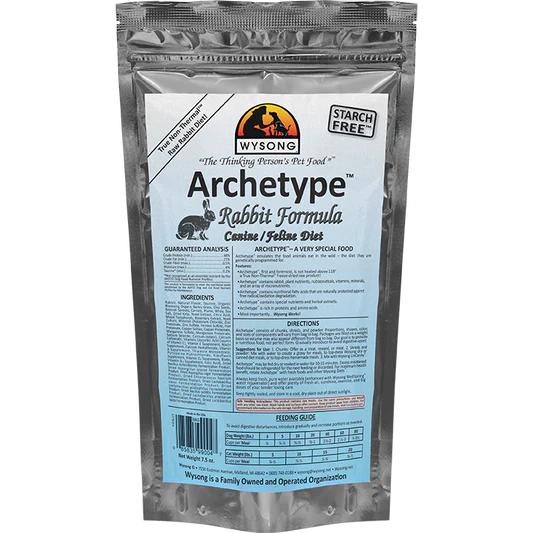
Wysong Archetype (Dehydrated)

Share

Rating: ★★★★★

Wysong Archetype Canine Diet Dog Food earns the Advisor’s top rating of 5 stars.

Wysong Archetype is a dehydrated raw dog food product intended for intermittent or supplemental feeding only.

The company recommends “for maximum health benefits, [users] rotate Archetype with fresh foods and other Wysong Diets”.

Wysong Archetype Canine Diet

Raw Dog Food

Estimated Dry Matter Nutrient Content

Protein = 46% | Fat = 36% | Carbs = 10%

Ingredients: Chicken, chicken hearts, chicken livers, ground chicken bone, grass powders, apple, blueberry, cranberry, plums, flax seed, fish oil, lecithin, seaweed, grape skin and seed extract (source of resveratrol), mixed vitamin E tocopherols, citric acid (antioxidant), oregano, rosemary, and sage extracts (herbal antioxidants and preservatives), inulin (source of prebiotics), probiotics (dried Bacillus subtilis fermentation product, dried Enterococcus faecium fermentation product, dried Lactobacillus plantarum fermentation product, dried Lactococcus lactis fermentation product, dried Lactobacillus casei fermentation product, dried Lactobacillus acidophilus fermentation product, dried Lactobacillus lactis fermentation product), dried yeast culture (source of vitamins, enzymes, prebiotics), dried Aspergillus oryzae fermentation product (source of enzymes), dried Aspergillus niger fermentation product (source of enzymes), choline chloride, ascorbic acid, zinc proteinate, iron proteinate, vitamin E supplement, niacin supplement, manganese proteinate, calcium pantothenate, thiamine mononitrate, copper proteinate, pyridoxine hydrochloride, riboflavin supplement, vitamin A acetate, folic acid, biotin, vitamin B12 supplement, vitamin D3 supplement

Fiber (estimated dry matter content) = 2.9%

Red items when present indicate controversial ingredients

The first ingredient is chicken. Chicken is considered “the clean combination of flesh and skin… derived from the parts or whole carcasses of chicken”.1

The second ingredient is schicken heart. Although it doesn’t sound very appetizing to us humans, heart tissue is pure muscle — all meat. It’s naturally rich in quality protein, minerals and complex B vitamins, too.

The third ingredient is chicken liver. This is an organ meat sourced from a named animal and thus considered a beneficial component.

Chicken meats and its associated organs are naturally rich in the ten essential amino acids required by a dog to sustain life.

However, even though they’re all considered quality items, raw chicken contains about 80% water. As a result of dehydration, most of that moisture is lost, reducing the meat content to a fraction of its original weight.

So, after processing, these items would probably account for a smaller part of the total content of the finished dry product.

The fourth ingredient is ground chicken bone, an excellent source of natural calcium.

The fifth ingredient mentions grass powders. Is this wheat grass, barley grass or something else? Without knowing more, it’s difficult to accurately judge the nutritional content of this component.

The next four items are all nutritious fruits and vegetables

  • Apple
  • Blueberry
  • Cranberry
  • Plums

From here, the list goes on to include a number of other items.

But to be realistic, ingredients located this far down the list (other than nutritional supplements) are not likely to affect the overall rating of this product.

With four notable exceptions

First, we find flaxseed, one of the best plant sources of healthy omega-3 fatty acids. Provided they’ve first been ground into a meal, flax seeds are also rich in soluble fiber.

Next, we note the inclusion here of fish oil. Fish oil is naturally rich in the prized EPA and DHA type of omega-3 fatty acids. These two high quality fats boast the highest bio-availability to dogs and humans.

Depending on its level of freshness and purity, fish oil should be considered a commendable addition.

Thirdly, the company appears to have applied friendly bacteria to the surface of the kibble after cooking. These special probiotics are used to enhance a dog’s digestive and immune functions.

And lastly, this food also contains chelated minerals, minerals that have been chemically attached to protein. This makes them easier to absorb. Chelated minerals are usually found in better dog foods.

Wysong Archetype Dog Food
The Bottom Line

Judging by its ingredients alone, Wysong Archetype appears to be an above-average dry dog food.

But ingredient quality by itself cannot tell the whole story. We still need to estimate the product’s meat content before determining a final rating.

The dashboard displays a dry matter protein reading of 46%, a fat level of 36% and an estimated carbohydrate content of 10%.

Above-average protein. Above-average fat. And below-average carbohydrates as compared to a typical dehydrated dog food.

Free of any plant-based protein boosters, this looks like the profile of a dehydrated raw food containing a significant amount of meat.

For those looking to mimic a dog’s natural ancestral diet, Wysong Archetype makes an excellent choice.

Bottom line?

Wysong Archetype is a meat-based dehydrated raw dog food using a significant amount of chicken as its main source of animal protein, thus earning the brand 5 stars.

Enthusiastically recommended.

For even more raw diet suggestions, be sure to visit the Advisor’s Recommended Raw Dog Foods summary page.

A Final Word

This review is designed to help you make a more informed decision when buying dog food. However, our rating system is not intended to suggest feeding a particular product will result in a specific health benefit for your pet.

For a better understanding of how we analyzed this product, please be sure to read our article, “The Problem with Dog Food Reviews

Remember, no dog food can possibly be appropriate for every life stage, lifestyle or health condition. So, choose wisely. And when in doubt consult a veterinarian for help.

Have an opinion about this dog food brand? Or maybe the review itself? Please know we welcome your comments.

Notes and Updates

12/13/2009 Original review
07/08/2010 Review updated
01/26/2012 Review updated (new recipe)

  1. Association of American Feed Control Officials
Dog Food Advisor IconThe Dog Food Advisor publishes independent reviews to help pet owners make better choices when shopping for dog food.


  • http://DogFoodAdvisor.com Mike Sagman

    Hi Christina… When I wrote this review, the company marketed Archetype as meeting AAFCO profiles “for all life stages”. If this food is indeed for all life stages, it should be OK for routine feeding.

    However, Wysong recommends Archetype as well as many of its products be fed in a diet rotation format (which I personally recommend for most dog foods). For more information about this feeding method, please visit our FAQ page and look for the topic, “Diet Rotation for Dogs”.

    Wysong has information about diet rotation on its own site, too. Hope this helps.

  • http://Www.youthfulhomemaker.com Christina

    Hi,
    I was looking a the Wysong website and reading the product label, and I noticed that the Archetype food said it was for “supplemental feeding”. This seems like a great food, but that troubles me some. Is this food not sufficient for dog’s nutrition?
    Thanks!

  • Pingback: Science Diet n/d, Supplements and Recommended Foods for Cancer Dogs | Tripawds Nutrition | Best Canine Cancer Dog Amputation Diet Supplements Health Help

  • Shawna

    Yes and no Richard.

    ANYTHING that can cause inflammation of the digestive tract wall can allow “undigested proteins” into the blood where they are not recognized by the immune system and attacked. IF the proteins are digested properly to amino acids there is nothing for the immune system to react to. The other side of the picture here is —- the undigested protein has to get through AND the immune system has to “over-react” to the antigen / protein.. We are ALWAYS subjected to antigens (pollen, dander etc) but only when the immune system over-reacts do we develop an allergy. The health of the liver can cause the immune system to be over-reactive as can over-vaccinating, chemicals (like heartworm and flea/tick meds etc — which in and of themselves stress the liver), inadequate nutrient intake plus…..

    With colitis the colon can be inflammed but possibly not to the point of permeability. And if to that point, if digestion is proper or the immune system is not over-reacting then the allergy does not happen.. Dr. Jean Dodds and other vets I have read material from feel that “true” allergies are not very common and that much of the symptoms we see are actually intolerances or sensitvities (like gluten “intolerance”). No IGa/IGe response. However, symptoms can manifest in the same manner.

    Once the “inflammation” (if permeability didn’t occur) is controlled the food can be added back in to the diet AS LONG as it does not cause re-inflammation. Chicken and NSAIDS will cause colitis in Gizmo every time if given more then a few days. Because I already rotate proteins every other day — I’ve never tested turkey longer. It may be that I can now feed turkey to her as well as the other four proteins but it did take much longer before she didn’t react to it then it did the four other foods. AND, it might very well be that if I didn’t rotate and fed exclusively duck she would eventually react to it as well.. Don’t know??

  • http://brotherscomplete.com Richard Darlington

    Shawna

    Am I correct in thinking the NSAID will compromise the colon wall much like Candida rhizomes do allowing partially digested pieces of protein to escape into the blood stream where the body will react to it as though it’s an antigen and become allergic to the protein? Eventually once the permeability of the colon lining is repaired by eliminating the irritant and taking lots of probiotics, then slow reintroduction of the protein after about 6 months or so can successfully allow the dog to eat the protein without the allergic reaction?

  • Shawna

    Couldn’t agree more Richard…

    In Gizmo’s case — I believe it was NSAID’s that caused the initial inflammation and she was being fed a chicken based kibble while at her former home. She was a pup and broke her leg trying to climb a rock wall.. Given Metacam for the inflammation and pain of the broken leg.

    Because I raw feed, as you know, and rotate foods she had continual colitis symptoms but they were not severe. After several weeks I took her to my holistic vet and she gave me the homeopathic phosphorus (based on Gizmo’s EXACT symptoms — urgency, explosiveness, degree of diarrhea, blood present etc). Gizmo would also get a gurgly tummy several hours before the diarrhea would begin. AND all this generally started up to 6 – 10ish hours after eating or longer and would last for days so I had a hard time making a connection to a particular food.

    The phosphorus would stop the colitis symptoms IMMEDIATELY.. Once on the phosphorus I was able to determine it was the chicken and eliminated all chicken (raw, dehydrated, cooked etc) from her diet.. No more colitis UNTIL.. About two months goes by and she hurts her back. Holistic vet was closed and I felt it was a bit of an emergency so took her to my allopathic vet. They gave her a metacam SHOT and the next day she had full blown colitis again. Within two months of this happening she develops a hypersensitivity to five more foods (six all together including the chicken). As you know, I don’t feed ANY grains or potato. All of her triggers were animal proteins.. I eliminated them as I identified them and got to where I had to feed the exotics (ostrich, elk etc) just to get food down her. In addition to the phosphorus I started her on SeaCure and upped her probiotic intake.. After two months the SeaCure, slippery elm, food eliminations etc had done the trick and the inflammation was going away. After about six months I could routinely feed her four of the offending animal proteins. After about a year I could also include turkey. Still to this day however (about five years later) if I feed her chicken OR give her an NSAID like Metacam or Rimadyl for more then two days straight she will develop colitis with gurgly tummy and bloody diarrhea…. Avoid over-feeding and over-use of those two and no issues at all…

    I carry the homeopathic phosphorus with when we travel with her.. :)

  • http://brotherscomplete.com Richard Darlington

    Shawna

    I have seen actual cases where a bloody stool was resolved by changing diet. Not sure of the mechanism but since we switched them on all three occasions to a grain free and potato free diet and the bloody stools stopped within a few days I suspected it had to do with food sensitivities.

    I also know that Candida overgrowth can cause IBS and then any irritant could potentially cause a bloody stool. The Candida is fed by grain or potato or sugar of any type.

  • Shawna

    I respectfully disagree with Dawn. Anything that can cause inflammation to the digestive tract, including food allergies or intolerances, can potentially trigger IBS/IBD.

    My Pom gets colitis (a form of IBS/IBD) whenever she eats chicken more then two days in a row.

    Dr. Karen Becker DVM lists three causes of IBD in her video/article on Mercola Healthy Pets

    1. parasites
    2. sterioids and antibiotics
    3. food sensitivities

    “Many animals (including humans) develop hypersensitivity to a food they eat over and over again. Inflammation is the result and can lead to IBD.” http://healthypets.mercola.com/sites/healthypets/archive/2010/11/02/inflammatory-bowel-disease-in-pets.aspx

  • Dawn Leder

    J—IF..THERES MUCUS AND BLOOD IN THE STOOL…THAT IS NOT…FOOD…RELATED! YOUR BABY EITHER HAS WORMS..PROB WHIP WORM THAT ONE IS KNOWN TO CAUSE SEVERE MUCUS BLOODY STOOL..OR YOUR POOR BABIES HAVE IRRITABLE BOWEL (WHICH FOOD CAN INTENSIFY BAD STOOL) BUT…IS NOT THE CAUSE…THE CAUSE MUST BE FIXED BEFORE…TRYING ALL DIFF FOODS. I PRAY YOU TAKE YOUR DARLIN COMPANION IN AND GET TESTED FOR WORMS OR PARASITES…SO EASY JUST BRING IN A STOOL SAMPLE YOULL KNOW THE NEXT DAY AND..IF..WORMS..OR PARASITES…1-3 DAYS OF MEDS GETS RID OF IT….IF NOT EITHER OF THAT THEN..I WOULD BET..WELL I DONT REALLY BET…YOUR LITTLE ONE HAS IBS OR ANOTHER PROB BUT FOOD DOES NOT..CAUSE YOUR SYMPTOMS!

  • J

    Tried Wysong, slowly introduced. The dog couldn’t tolerate it. Can’t recall the specifics, but it did not help her with the mucous/bloody stools, and it increased gas. This was carefully observed with as many variables taken into consideration as possible.

  • http://DogFoodAdvisor.com Mike Sagman

    Hi Sandy… That is a very good question. Grape skins and grape seeds exhibit a notable anticoagulant (anti-clotting) and antioxidant effect on the blood and blood vessels of both humans and dogs. Unfortunately, I’m unable to explain why these very same ingredients are considered safe (by Wysong) to use in dog food when they are known to be toxic to a dog’s kidneys. You may need to contact Wysong to get a better answer to your question.

  • sandy

    Hi,
    The ingredient list on the Wysong website is slightly different. It only contains chicken. But I had a question regarding grape skins. I thought grapes and raisins are on a “do not feed to your dog” list.

  • http://DogFoodAdvisor.com Mike Sagman

    Hi Nadine… Much of what you say is certainly true. But unfortunately I must place this disclaimer on each and every review I write. That’s because many folks mistakenly assume they can treat their dogs for virtually any condition simply by choosing the right dog food.

    To prevent our readers from making dangerous errors we are ethically (and legally) obliged to place these disclaimers on each article.

    Thanks for your well-presented and thoughtful comment.

  • Nadine

    Mike, I love your analysis reviews and had just used them to show my boss how Chef Michael was not a good dog food for his dog! However, I have a problem when you state “when in doubt, consult a veterinarian for help.” I would never consult a vet as to which food to feed my dogs, as most vets are not taught nutrition in school. They are taught nutrition by the sales reps who come in to their practice to get them to sell their particular brand of food. In or around 2007 a class action lawsuit was filed against the makes of most of the pet food you find in a grocery store. Paragraph 81 of the third amended complaint talks about vets and food:

    81. Nowhere on its website does Colgate disclose that it has spent millions marketing
    its Science Diet® pet foods and/or treats to veterinary students and veterinarians in order to get
    an edge over its competitors by having veterinarians endorse and recommend these brands to
    consumers who Colgate knows will rely upon them and that they will trust Colgate with their
    cats’ and dogs’ health and well being. Colgate funds veterinary schools, provides stipends for
    and discounts its pet food to veterinary students, and arranges for veterinarians to have financial
    incentives to sell its pet food. The average consumer has no idea that the veterinarian is profiting
    from the recommendation and is boosting Colgate’s profits in the process. The conflict of
    interest, created and encouraged by Colgate, is patent.

    I know of many people whose vets recommended Science Diet for their pets, when in fact Science Diet is just plain old garbage food! Also, a friend of mine has a a good friend who is a vet and he confirmed that they were not taught nutrition in school. It is up to us, as responsible pet owners, to do our own research for the best possible food for our pets, and this includes learning about the ingredients and looking into what type of diet is the best. I’ve done much research into this over the past 2 years, which ultimately lead me to put my 2 Chihuahuas on The Honest Kitchen as I know this food contains the best possible, and healthiest, ingredients for my dogs.

  • http://DogFoodAdvisor.com Mike Sagman

    Hi Greg… Wheatgrass does not contain the berry of the wheat plant. So, it is considered gluten-free. As I mention in my reviews, wheatgrass is prized by many for its unusually high vitamin and mineral content. However, allergies and intolerances are two different issues. Even though your dog may be safe from gluten intolerance, he can still be allergic to a specific allergen (like wheatgrass, though his is unlikely). Hope this helps.

  • Greg Lucas

    I do not understand the ingrediant wheat grass? I do not Know if it is good or bad. Wheat is an ingreadiant that many/most dogs are allergic to. Many people switch from dry foods to raw or homecooked diets to avoid wheat, yet in an article avout homemade cooked diets and homemade raw diets by one of my local vets he recommneds a supplement (Call of the Wild) by Wysong that contains wheat grass and barley grass. Is it bad, likely to triger allergies, because it is wheat, or is it okay because it is a grass and not really in hte grian stage? I wonder if wheat grass contains wheat gluten.

  • Diane Knight

    My dog, Chase the Boxer, had mast cell cancer twice as a very young dog. I switched his food to Wysong supplemented by some people food such as green beans and chicken breast. After surgery to remove the cancer and a change in diet and exposures, he has been cancer free now for years. I also believe that this is an excellent product. The company is willing to work with people to help select their product that would be best for the animal. Diane