

Rating: 


Kirkland Dog Food receives the Advisor’s second-highest rating of four stars.
Currently, the Kirkland Dog Food product line includes six kibbles… one designed for puppies, one for seniors, three for adults and one for adult weight loss.
- Kirkland Signature Puppy Formula
- Kirkland Signature Small Dog Formula
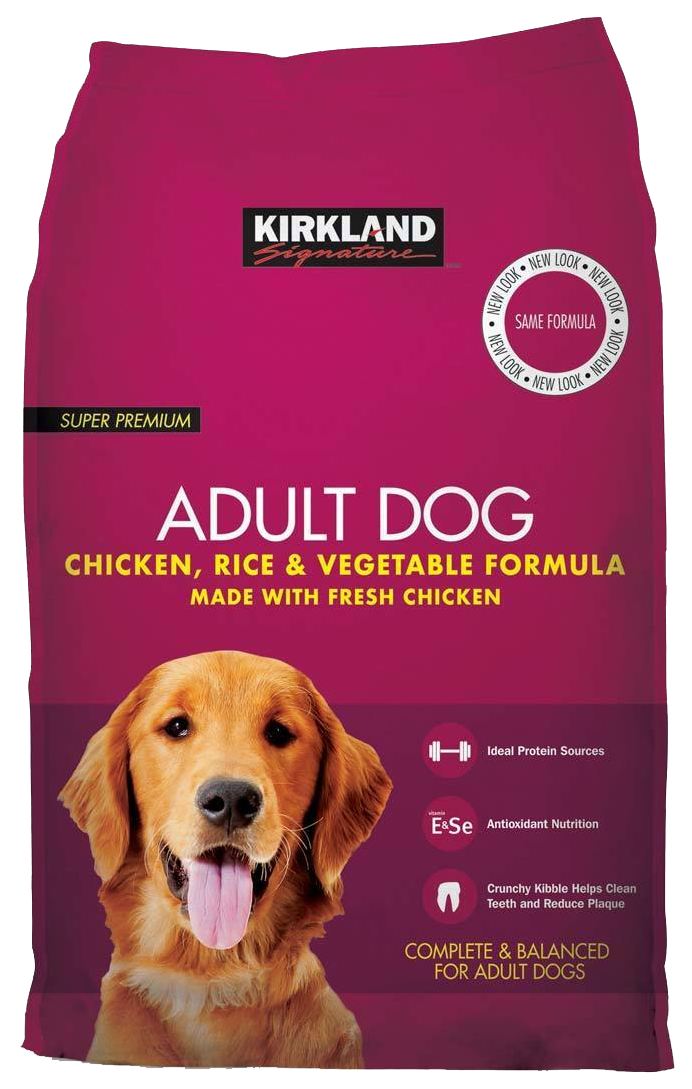
- Kirkland Signature Adult Dog Formula (Chicken)
- Kirkland Signature Adult Dog Formula (Lamb)
- Kirkland Signature Mature Dog Formula
- Kirkland Signature Healthy Weight Formula (3 stars)
Kirkland Dog Food Small Dog Formula was selected to represent the others in the line for this review.
Kirkland Signature Small Dog Formula
Dry Dog Food
Estimated Dry Matter Nutrient Content
Ingredients: Chicken, chicken meal, whole grain brown rice, cracked pearled barley, chicken fat (preserved with mixed tocopherols and vitamin E), egg product, beet pulp, potatoes, fish meal, flaxseed, natural flavor, brewers dried yeast, millet, dried chicory root, potassium chloride, salt, choline chloride, carrots, peas, kelp, apples, cranberry powder, potassium chloride, salt, choline chloride, rosemary extract, parsley flake, taurine, yucca schidigera extract, vitamin E supplement, iron proteinate, zinc proteinate, copper proteinate, ferrous sulfate, zinc sulfate, copper sulfate, potassium iodide, thiamine mononitrate, manganese proteinate, manganous oxide, ascorbic acid, vitamin A supplement, L-carnitine, biotin, calcium pantothenate, manganese sulfate, sodium selenite, pyridoxine hydrochloride (vitamin B6), vitamin B12 supplement, riboflavin, vitamin D supplement, folic acid
Fiber (estimated dry matter content) = 4.4%
Red items when present indicate controversial ingredients
The first ingredient in this dog food includes chicken. Raw chicken contains about 80% water. After cooking, most of that moisture is lost… reducing the meat content to just 20% of its original weight.
That’s what makes any uncooked meat a much smaller contributor to the overall protein content of a dry dog food than its equivalent and comparable meat meal.
So, don’t be influenced by chicken’s first-ingredient status here. To reflect its lighter weight, this item should more accurately occupy a much lower position on the list.
The second ingredient is chicken meal. Chicken meal is considered a meat concentrate and contains nearly 300% more protein than fresh chicken.
The third item is brown rice. Brown rice is a quality ingredient… a complex carbohydrate that (once cooked) is fairly easy to digest.
The fourth ingredient is barley. Barley is a starchy carbohydrate supplying fiber and other healthy nutrients. Unlike grains with a higher glycemic index (like rice), barley can help support stable blood sugar levels in dogs. This is a quality grain ingredient.
The fifth ingredient is chicken fat. Chicken fat is obtained from rendering chicken… a process similar to making soup in which the fat itself is skimmed from the surface of the liquid.
Chicken fat is high in linoleic acid… an omega-6 fatty acid essential for life. Though it doesn’t sound very appetizing, chicken fat is a quality ingredient.
The sixth item mentions dried egg product… a dehydrated form of shell-free eggs. Quality can vary significantly. Lower grade egg product can even come from commercial hatcheries… from eggs that have failed to hatch.
The quality of this item all depends on the caliber of the ingredient purchased by the manufacturer (you get what you pay for).
In any case, eggs are easy to digest and have an exceptionally high biological value.
The seventh ingredient is beet pulp. Beet pulp is a controversial ingredient… a high fiber by-product of sugar beet processing.
Some denounce beet pulp as an inexpensive filler while others cite its outstanding intestinal health and blood sugar benefits.
We only call your attention here to the controversy and believe the inclusion of beet pulp in reasonable amounts in most dog foods is entirely acceptable.
The eighth item lists potato. Assuming they are whole, potatoes are a good source of digestible carbohydrates and other healthy nutrients.
The ninth ingredient includes fish meal. Like chicken meal (already discussed), fish meal is also considered a meat concentrate. So, fish meal contains much more protein than fresh fish.
Unfortunately, this particular item is anonymous. The term “fish” does little to adequately describe this ingredient. What species? What parts?
Fish meal is commonly made from the by-products of commercial fish operations.
And by the way, the controversial chemical ethoxyquin is frequently used as a preservative during the transport of raw fish products.
But because it’s usually added to the raw fish before processing, ethoxyquin’s presence does not have to be reported to consumers.
Based upon the published ingredients list, there’s no way to know whether or not ethoxyquin is present in this product.
Fortunately, items located this far down the list are not likely to have much of an effect on the overall content of this food.
The next item is flaxseed… one of the best vegetable sources of healthy omega-3 fatty acids. And the seeds are naturally rich in both soluble and insoluble fiber.
However, we find it strange to see flaxseed here in its whole seed form. Whole flax seeds are almost impossible to digest (at least for us humans) unless they are first ground to a usable powder before they are consumed.
This dog food also contains chelated minerals… minerals that have been chemically attached to amino acids. This makes them easier to absorb. Chelated minerals are generally found in better dog foods.
Kirkland Dog Food… the Bottom Line
With the sole exception of the generic fish meal, Kirkland Dog Food looks like a quality dry product.
But for a completely fair analysis, it’s still important to consult the product’s protein, fat and carbohydrate numbers.
The dashboard displays a dry matter protein reading of 30%, a fat level of 18% and an estimated carbohydrate content of 44%.
Above-average protein. Moderate fat. And below-average carbs (a good thing)… compared to the typical dry kibble.
OK, admittedly, these numbers represent just the small dog recipe.
However, all five products in this Kirkland Dog Food line contain similar quality ingredients… and generate dry matter protein figures ranging from a low of 26% for the adult lamb formula to a high of 31% for the puppy recipe.
Above-average numbers? Sure. But especially impressive when you consider this is a value-priced brand.
Bottom line?
Kirkland Dog Food is primarily a grain-based dry kibble using a protein-rich meat meal as its main animal component… thus earning the brand a solid four-star rating.
Highly recommended.
Some Final Thoughts
Remember, no dog food can possibly be appropriate for every life stage, lifestyle or health condition. So, choose wisely. And when in doubt consult your veterinarian for help.
Have an opinion about this dog food brand… or maybe the review itself?
Please feel free to share your comments below.

{ 33 comments… read them below or add one }
Mike, thanks so much for your analysis of this food that I have found to be a better than average kibble for my labs. After feeding this diet for about a year now I have had no issues with my dogs with respect to reproduction, coat, teeth, digestion, weight and overall health that I can directly relate to Kirkland brand foods.Not to mention that they all love it!!!! Am curious though as to which “huge dog food manufacturer” produces this food, just curious and kudos to them for making such a wonderful fair priced kibble. We can’t tell who actually makes it, right? Anyway, thanks again for confirming what I thought to be true. FYI, the “healthy weight” formula has chicken meal as the first ingredient, hmmmm, wondering what you think about that, has lower protein, but is an even better food for maintenance or overweight dogs, right?
Hi Terri… Diamond Pet Foods manufactures the Kirkland Signature brand. So far, I’ve been unable to find any specific data on the “Healthy Weight” product you speak of. I plan to contact Diamond and find out.
It’s an okay food. I’m not crazy about the rice and barley ingredients which are up fairly high on the list. I prefer Bil-Jac which replaces grains with natural meat by-products, that are an important part of a dog’s natural diet in the wild.
Rob… Bil-Jac uses corn and chicken by-products in place of the cracked pearled barley used by Kirkland. By-products are made from slaughterhouse waste… what’s left of a chicken after all the good cuts have been removed. Basically, this is the stuff classified “unfit for human consumption”.
Plus Bil-Jac uses allergy-prone corn compared to the nutritionally richer whole grain brown rice used by Kirkland. And Bil-Jac even contains the controversial ingredient menadione which has been linked to liver toxicity, allergies and the abnormal breakdown of red blood cells.
Most pet owners prefer to avoid having these inferior ingredients in their dog food. That’s why we rate Kirkland much higher than Bil-Jac.
Hey Mike,
I have Labs and Small Munsterlanders (sporting breeds). My dogs are very active with hunting,trials and dock dogs etc. I am wondering if the Kirkland puppy would work better for a higher protein requiremnt during their active times. Or maybe a blend of premium signature adult and puppy. I really like the Kirkland premium chicken and my dogs are doing well with it !! Thanks
Hi Ron… You have proposed a most interesting solution to your problem. Because of the high protein/high energy design of most puppy formulas, your suggestion makes reasonable sense. However, none of the dog foods marketed by Kirkland appear to meet the established AAFCO profiles for active or working dogs. So, I cannot (with scientific confidence) comfortably endorse your idea.
Ron. cook your self a whole chicken (67c/lb yesterday) and add your own protein.Much better quality and low price. thats what i do for my setters.
actually i have recently learned that some would advocate just feeding your dog the whole chicken raw,bones and all. i cant quite believe that is a good idea,but it sure would eliminate the prep work
I have been feeding Kirkland premium chicken to my sporting breeds for a several months and I am very impressed- good stools,coats are beautiful with minimal shedding and no eye boogers. The whole chicken idea sounds great. I have been supplementing during active times with CPN vertex supplement. I previously fed Eukanuba sporting for many years, recently having several issues made me switch and I havn’t looked back !! Bonus that the Kirkland food is less than half of the cost !!
I am very curious to hear from more people who are using the Chicken/Rice/Veg. formula Kirkland food for working dogs.
I have hounds that use an incredible amount of energy a few times a week. In the past I have fed Black Gold and currently feed Loyall (Active Adult formula 26/19) I liked the Black Gold better but its too hard to get ahold of. I had to feed less Black Gold in the winter than Loyall.
This is recorded value and the ingedient list for Loyall Active Adult;
Protien 26%, Fat 19%, Fiber 3%, Moisture 9%, Ash 5.5%
Poultry by-product meal (natural source of glucosamine and omega-6 fatty acids), whole wheat, wheat flour, poultry fat (naturally preserved with mixed tocopherols), brewers rice, corn gluten meal, beet pulp, natural chicken flavoring, flaxseed (natural source of omega-3 fatty acids), spray-dried egg, aspergillus meal (natural source of glucosamine), bentonite, potassium chloride, menhaden fishmeal (natural source of glucosamine), sodium hexametaphosphate, calcium propionate (a preservative), dried brewers yeast, salt, yucca schidigera extract, vitamins (vitamin E supplement, vitamin A supplement, vitamin D3 supplement, vitamin B12 supplement, niacin supplement, riboflavin supplement, calcium pantothenate, pyridoxine hydrochloride, biotin, thiamine, menadione sodium bisulfite complex, folic acid), minerals (zinc amino acid complex, ferrous sulfate, zinc sulfate, iron amino acid complex, copper sulfate, manganese amino acid complex, manganese sulfate, ethylenediamine dihyroiodide, sodium selenite)
It seems like the Kirkland food has better ingredients and the protien/fat is not a huge difference AND my dogs seem to keep weight on with the Loyall which is not that much ‘hotter’, so considering this how do these two foods compare? And if my dogs are doing alright hunting on Loyall would the Kirkland with its possibly more digestible ingedients do just as well? I am thinking about switching as we use a lot of food and Loyall is now close to $35 a bag – and the Kirland seems like good food. I wish they would make a perfomance blend I am pretty darn sure they could sell it by the truckload if they did. I am currently starting the Kirkland food with some of the dogs to see how they do.
Hi Maidu Lady… I believe you’re taking an acceptable approach, here. As you’ve probably noticed, I haven’t yet reviewed Loyall Dog Food. True, the nutrient percentages are quite similar… but ingredient quality looks much better on the Kirkland product. I’ll be reviewing Loyall in the very near future so stay tuned.
I have a rescue dalmatian who I’ve tried on the Kirkland Lamb & Rice for about 2 weeks but he goes from a moderately soft stool on the first mornin poop to a slushy second poop. When he came to me he had lots of skin problems, was rubbing his face badly, had ear gunk and eye discharge on one eye. My Vet gave me Hills ID which calmed the stomach but seemed to get the allergic reaction aggravated, also an ointment for the eyes and otomax for the ears. But then the Vet said to go with Eukanuba or Hill’s Maintenance diets — neither of which I think are great foods. What do you recommend for this guy? Should I hang in there with the Kirkland and add some probiotics or other supplements? How long do you wait to make a switch? He’s 8 years old and has been through a lot — I’m thinking of Innova or Wellness because 1. Dal’s have cyst-forming tendencies with high prurine proteins so I want to stay away from the really high protein foods; 2. He’s got allergies or a yeast problem so needs to stay away from corn & wheat and could use the probiotics and Omega 3s; 3. I’ve seen recommendations for these foods on sites that focus on sensitive stomachs/skin. Your input would be appreciated.
Hi Bette… you may want to read my article “Dangerous Canine Diseases Linked to Grains in Dog Foods“. If you feel your dog may have had a problem with a previous (lower quality) dog food, it can take a while for her to begin to recover from her condition. Find a good 4 or 5-star food (maybe a grain-free product).
And you may find support for healthy stools with a reasonable amount of dietary fiber, too… which by the way, can be too low in many high-meat products. After all, fiber can only be found in plant-based ingredients… never in meat.
And of course, don’t forget to consult with your vet.
My dogs have been on Kirtland Signature for Mature Dogs. One is a mix/German Shepard. For the last 5 years it has been hard for her to get around and we just attributed to old age and her breed. I just always bought the cheapest dry dog food and also fed the her table scraps. I was ignorant I will admit. The dog is now active and playful after switching to the Kirtland brand. She still wants table scraps but we will not give into her anymore. We are glad we found this brand and promise never again to rely on the popular cheap dog foods.
For some people, it’s nothing but the best and money is no object. For the rest of us mere mortals, there’s Kirkland.
It’s amazing what marketing and advertising do to perception. So many foods are marketed (and even sold by vets!) as “premium” foods when they are primarily grain-based (and worse yet, usually corn and/or wheat). They convince many well-meaning buyers to go to the “big box” pet stores and buy their more costly brands. After all, the marketing has them convinced this is the best for their dog — and it’s usually 1-star or 2-star junk.
Which brings me to Kirkland. There’s no fancy ad campaign, no slick marketing during commercials of a dog show, none of it. All there is here is a solid (if not spectacular) food which, combined with its rock-bottom price (about half the price per pound as those big-name so-called “mainstream” foods), makes it the best “value” dry kibble on the market for cost-conscious consumers. As someone who once fell for the marketing before becoming educated, I can only kick myself for giving my dog food that gave her skin allergies (corn and wheat, probably) for so many years — and wasted hundreds of dollars in the process.
If the allergies (which are now much better but not completely gone) don’t completely go away, we may go 100% grain-free with foods like Orijen and Acana. We’re blessed to be able to afford that if need be, but that doesn’t change the fact that Kirkland is the best low-priced food out there, and by a wide margin. With meat being the primary ingredient and the use of better quality grains (no corn or wheat), it has a leg up on most the well-marketed big names costing twice the price.
In Costa Rica, Central America, where I live most of the US brand super premium dog foods are very expensive. For example, I had been feeding my 5 yr old female golden retriever Innova Large Breed Adult formula priced here at about $75USD for a 33lb bag.
Kirkland Signature Chicken, Rice and Vegetable Formula recently became available and is sold by Costco affiliate Pricemart at less than $40USD for a 40lb bag.
I was previously unfamiliar with the brand but after reviewing the ingredients list and guaranteed analysis, and reading your review and comments on your website, I made the switch about a month ago and am glad I did. Many thanks for your information.
I should note that even though I made the switch gradually, my dog has a very delicate stomach and I still had a problem with loose stools, which I solved it by mixing boiled chicken, white rice and pumpkin with the kibble for a week or so.
I agree with most all of the positive comments in your review and those of other users on your webite. Although it may not be the VERY best super premium food on the market, it truly is a super premium and a very good one at that. For the price, it’s certainly the best food available in my country and I suspect the same to be true in the US.
I do have a couple of remarks. First, as you point out in your review, you really can’t tell how much the whole chicken contributes to the overall formula because of the water content lost in processing. However, reading between the lines, the 26% minimum protein content obviously comes primarily from from chicken and this indicates that the overall mix of whole chicken and chicken meal is quite high.
Secondly, based on my own research and years of experience with beet pulp in premium horse feed, any controversy or concern about its use in dog food is misplaced. In my opinion, the moderate amount of beet pulp included in this formula is not only unobjectionable, it’s a desirable, beneficial source of insoluble fiber and other trace elements.
Also, even though the ingredients list doesn’t state that the flaxseed is gound, out of curiousity I dissolved some of the kibble in water and found no signs of whole flaxseed. I admit that my test is unscientific but I buy whole flaxseed and grind it myself for my personal use as a fiber supplement. Even though the seeds are small, I know how to recognize them and it appears to me that the flaxseed is almost certainly ground.
Overall, I really like this food particularly for the price and highly recommend it as a lower cost alternative to other super premium brands.
Thank you Jim S! Your comments were very insightful. You put to rest the couple of reservations I had about trying this food.
My 18 month golden and his buddy a 20 month golden lab ( identical coat color, different length) are often together @ mealtime. Mine (on Kirkland lamb & rice) his buddy (on Blue) ALWAYS eat eachother’s food no matter what bowls we put it in. Should we provide variety of food brands to our guys or just let them enjoy an occasional taste treat?
Hi Tom… Dogs love variety and an occasional treat just as much we do. Both dog foods you guys feed are very nice products. Your dogs are very lucky, indeed
.
Thanks for the insight on this food! I have a pit mix with allergies and trying to find an alternative to the high priced food that my vet recommened. I had my reservations about a Costco brand dog food, but after reading this and going to give it a try!
I have a 15-month old boxer who, through her first year, ate the Kirkland Puppy formula. I have switched her to the Kirkland Adult dry formula, but she seems to have lost weight, down 4 pounds in 2 months. I am wondering if there is a specific Kirland band to buy for her, as I like the value, however, even the Vet was concerned about her weight loss as her ribs are showing and she needs a little more weight. Thank you for any suggestions!
Hi Lisa… both foods are designed for all life stages. In a healthy dog, weight loss is most likely related to serving size than anything else. You may be feeding your boxer too little. As your dog gets bigger, so should the serving size.
I note that the caloric content of the adult Kirkland products is significantly different when comparing the chicken product with the lamb.
If your dog is healthy but still losing weight, try increasing the serving size.
I am wondering if you have fed this brand? In my experience (both personal and antecdotal) with myself and my customers I have found this reads much better than it feeds. Granted, it is a good value and certainly better than many main stream more expensive brands; however I don’t feel this feeds as any better than a 3 star, and have had many customers whose dogs have had problems on this but not on other brands with a seemingly similar grain content and ingredient list. Reading between the lines there with the price of this food, I wonder if it comes back to what you talk about in your “Dangerous Canine Diseases Linked to Grains in Dog Food (Part 1)” article about the quality of grains and the number of inhabitants in it.
Just my 2 cents!
Hi Roger… We rate foods on just two parameters… the nature of the listed ingredients and our estimate of the amount of meat present in a food. There are simply so many other ways one can rate a dog food.
With only myself doing all the writing and reviewing for hundreds of dog foods it would be impractical to test every one of them on my poor little Bailey
.
I would tend to agree with your suggestion that although we may point a finger at cheaper cereal grains (like corn or wheat) I would imagine contamination is a real possibility with virtually any grain. It all probably boils down to the quality of the ingredients purchased by the manufacturer.
Thanks for the response. Sounds like you just need to get more dogs!
One other comment on the comment of the bill-jac. Alot of brands I see are using the “meat and organ only” by-product. The problem I see there is that a discriminate meat meal must come from a healthy slaughtered animal, where the by-product or indiscriminate meat sources can come from animals that are sick, dying, or found dead that may have been diseased and even treated with numerous medications before being used in the food.
I hadn’t seen that covered on this site and it is something that I think is somewhat deceptive by many of these food companies.
Thanks again
Hi Roger… Your comment here regarding the use of discriminate vs indiscriminate meat meals is very interesting. Your suggestion sounds quite plausible. So, I would appreciate it if you could tell me where I might go to confirm this concept?
Thanks for leaving such an interesting and provocative comment.
Mike,
I really appreciate the time and effort you’ve taken to compare and rate all these dog foods. Our family has just welcomed a 10 week old Shih-tzu into our home. The breeder had her on Purina Puppy Chow. I definitely wanted to change that, but I’ve had a really hard time finding the right food. She is white and brown. I wanted a good quality food that would keep her coat shinny and whiter, as she has some staining in her under coat from farm life. I went out and bought the Kirkland brand today. She seemed to like it mixed with her Puppy chow. Is Kirkland the right food for her breed and size? I love the price and the quality ingredient. My friend has a Shih-tzu puppy and the vet told her to give her Science Diet. I didn’t think the ingredients in that looked very good. Anyway, thanks for any advice you could give.
Hi Aimee… Although there are many ways to grade a dog food, we rate products based upon only two parameters: (1) the nature of the product’s ingredients and (2) the estimated meat content. We do not take into account things like the appropriateness of a particular food for a specific condition, lifestyle or life stage. We leave that to your vet.
By those standards, Kirkland (which is made by Diamond Pet) is a major improvement over Purina Puppy Chow as well as many of the Science Diet products. Hope this helps.
Wow…I’m glad I found this thread. I recently adopted a yellow lab (9 weeks). Based on what I’ve read and recently heard about Kirkland, I think I’m sold. My one question though…I’ve read that larger breeds should not be fed “puppy” forumla because it will make them grow too quickly making them susceptible to hip displasia, etc…is this accurate? Should I feed my pup the adult formula??? Thanks in advance!
Hi Rick… Although somewhat controversial, it appears high calorie diets (and not high protein content) fed to genetically susceptible dogs plays an important role in the development of hip dysplasia (particularly in large breeds). Since puppy foods usually contain more calories, it’s important to follow the manufacturer’s feeding guidelines.
What’s more, feeding too much (or too little) calcium, phosphorous and other minerals can also be detrimental to hip development. Thankfully, today’s “complete and balanced” commercial dog foods make mineral imbalances rare.
In any case, you’re probably safe in feeding most quality puppy foods until your dog reaches adulthood. If you have any doubts (and because diet can be crucial in dysplasia-prone animals), why not discuss this subject with your vet. Or call Diamond Pet (the makers of Kirkland) at 800-442-0402 for more specific advice.
I have a 13yr. old Golden Retriever who has been on Hills Science diet his whole life and recently switched to the mature savory chicken both dry and canned. He likes the canned but not the dry. Any suggestions for an adult dog with spine issues that would not create complications from changing food at this point. He is well taken care of and sees his Vet regularly and that is why he is on Science Die. I would like his last few years to be as happy as possible. Great Dog
Hi Jay… I wish I could prescribe a particular food to help your dog. But since I’m not a veterinarian, I’m not sure which food would be best for him. However, senior dogs are commonly afflicted with dental problems. So, in general, canned foods are a lot easier and more palatable. That may explain why your dog favors “wet” foods. Hope this helps.