

Recommended


DogFoodAdvisor is reader supported See how
All reviews are 100% impartial but if you buy using links on this page, we may earn a referral fee.
Our Verdict
Hill’s Science Diet Adult dry product range is made up of 48 recipes with ratings varying from 1 to 3.5 stars. The average rating of the whole range is 3 stars.
Pros
- Budget-friendly
- Shelf stable
- Recipes for adult dogs of all breeds and sizes
Cons
- Controversial or low in nutritional value ingredients
The table below shows each recipe in this range including our rating and the AAFCO nutrient profile: Growth (puppy), Maintenance (adult), All Life Stages, Supplemental or Unspecified.
| Product line | Rating | AAFCO |
|---|---|---|
| Hill's Science Diet Adult Chicken and Barley | 2.5 | M |
| Hill's Science Diet Adult Large Breed Chicken and Barley | 2.5 | M |
| Hill's Science Diet Adult Oral Care Small and Mini Chicken, Rice and Barley | 2.5 | M |
| Hill’s Science Diet Large Breed Adult 6+ Chicken Meal, Barley and Rice | 1 | M |
| Hill's Science Diet Adult Small Bites Lamb Meal and Brown Rice | 2.5 | M |
| Hill's Science Diet Adult Light Small and Mini with Chicken Meal, Barley and Brown Rice | 3 | M |
| Hill's Science Diet Adult 7+ Senior Vitality Chicken and Rice | 3 | M |
| Hill's Science Diet Adult 7+ Senior Vitality Small and Mini Chicken and Rice | 3 | M |
| Hill's Science Diet Adult 6+ Large Breed No Corn, Wheat, Soy | 3 | M |
| Hill's Science Diet Adult Perfect Digestion Large Breed Chicken and Barley | 2.5 | M |
| Hill's Science Diet Adult Sensitive Stomach and Skin Small Bites Chicken and Barley | 3 | M |
| Hill's Science Diet Adult Sensitive Stomach and Skin Chicken and Barely | 3 | M |
| Hill's Science Diet Adult 7+ Perfect Digestion Chicken and Brown Rice | 2 | M |
| Hill's Science Diet Adult Perfect Digestion Small and Mini Chicken and Brown Rice | 3.5 | M |
| Hill's Science Diet Adult Sensitive Stomach and Skin Pollock Meal and Insect | 3 | M |
| Hill's Science Diet Adult Perfect Digestion Salmon, Whole Oats, and Brown Rice | 3 | M |
| Hill's Science Diet Adult 7+ Perfect Digestion Small Bites Chicken and Brown Rice | 2 | M |
| Hill's Science Diet Adult 7+ Small Bites Chicken Meal, Barley and Rice | 1 | M |
| Hill's Science Diet Perfect Digestion Small Bites Chicken, Brown Rice and Whole Oats | 2.5 | M |
| Hill's Science Diet Adult Perfect Weight and Joint Support Large Breed Chicken and Brown Rice | 3 | M |
| Hill's Science Diet Adult Perfect Weight and Joint Support Chicken and Brown Rice | 3 | M |
| Hill's Science Diet Adult Light Large Breed Chicken Meal and Barley | 2.5 | M |
| Hill's Science Diet Adult Large Breed No Corn, Wheat, Soy Chicken and Brown Rice | 2.5 | M |
| Hill's Science Diet Adult Light Chicken Meal and Barley | 2.5 | M |
| Hill's Science Diet Adult Healthy Mobility Small Bites Chicken Meal, Barley and Brown Rice | 2 | M |
| Hill's Science Diet Adult Small and Mini Chicken and Brown Rice | 2.5 | M |
| Hill's Science Diet Adult Oral Care Chicken, Brown Rice and Barley | 2.5 | M |
| Hill's Science Diet Adult Perfect Weight Chicken and Brown Rice | 3.5 | M |
| Hill's Science Diet Adult Large Breed Lamb Meal and Brown Rice | 2.5 | M |
| Hill's Science Diet Adult Lamb Meal and Brown Rice | 2.5 | M |
| Hill's Science Diet Perfect Digestion Small Bites Chicken, Brown Rice and Whole Oats | 3 | M |
| Hill's Science Diet Adult 11+ Small and Mini Chicken, Brown Rice and Barley | 2 | M |
| Hill’s Science Diet Adult 7+ Small Bites Chicken Meal, Barley and Rice | 1 | M |
| Hill’s Science Diet Adult 7+ Chicken Meal, Barley and Rice | 1 | M |
| Hill's Science Diet Adult Perfect Weight Small Bites | 3.5 | M |
| Hill's Science Diet Adult Perfect Weight Small Bites Chicken and Brown Rice | 3 | M |
| Hill's Science Diet Adult Small and Mini Lamb Meal and Brown Rice | 2 | M |
| Hill's Science Diet Adult Light Small Bites Chicken Meal and Barley | 2.5 | M |
| Hill's Science Diet Adult 7+ Small and Mini Chicken and Brown Rice | 2 | M |
| Hill's Science Diet Adult No Corn, Wheat, Soy Chicken and Brown Rice | 3 | M |
| Hill's Science Diet Adult Salmon and Brown Rice | 3 | M |
| Hill's Science Diet Adult Perfect Digestion Chicken, Barley and Whole Oats | 3 | M |
| Hill's Science Diet Adult Healthy Mobility Large Breed Chicken Meal, Barley and Brown Rice | 3 | M |
| Hill's Science Diet Adult Perfect Weight Small and Mini Chicken and Brown Rice | 3 | M |
| Hill's Science Diet Adult Sensitive Stomach and Skin Grain Free Chicken and Potato | 3 | M |
| Hill's Science Diet Adult Sensitive Stomach and Skin Small and Mini Chicken | 3 | M |
| Hill's Science Diet Adult Sensitive Stomach and Skin Chicken and Barley | 3.5 | M |
| Hill's Science Diet Adult Small Bites Chicken and Barley | 2.5 | M |
Recipe and Label Analysis
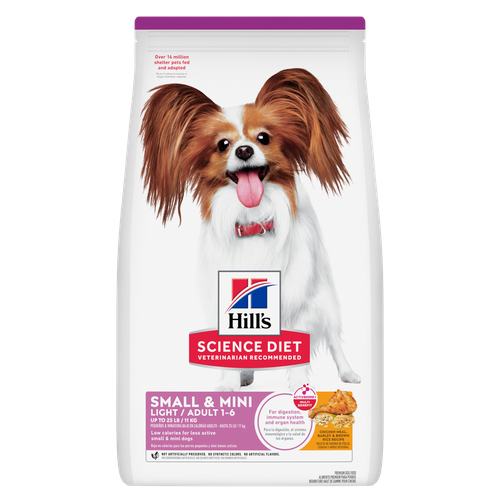
Hill’s Science Diet Adult Light Small and Mini with Chicken Meal, Barley and Brown Rice was selected to represent the other products in the line for detailed recipe and nutrient analysis.
Hill's Science Diet Adult Light Small and Mini with Chicken Meal, Barley and Brown Rice
Estimated Dry Matter Nutrient Content
Protein
Fat
CarbsCarbohydrates
Chicken meal, cracked pearled barley, pea fiber, brown rice, whole grain corn, corn protein meal, powdered cellulose, whole grain oats, soybean meal, whole grain sorghum, brewers rice, chicken liver flavor, soybean oil, pea protein, dried beet pulp, flaxseed, lactic acid, pork liver flavor, potassium chloride, calcium carbonate, iodized salt, fructooligosaccharides (fos), vitamins (vitamin E supplement, l-ascorbyl-2-polyphosphate (source of vitamin C), niacin supplement, thiamine mononitrate, calcium pantothenate, vitamin A supplement, riboflavin supplement, biotin, pyridoxine hydrochloride, vitamin B12 supplement, folic acid, vitamin D3 supplement), choline chloride, l-lysine, minerals (ferrous sulfate, zinc oxide, copper sulfate, manganous oxide, calcium iodate, sodium selenite), taurine, mixed tocopherols for freshness, natural flavors, l-carnitine, beta-carotene
Fiber (estimated dry matter content) = 14%
Red denotes any controversial items
| Estimated Nutrient Content | |||
|---|---|---|---|
| Method | Protein | Fat | Carbs |
| Guaranteed Analysis | 21% | 6% | NA |
| Dry Matter Basis | 23% | 6% | 63% |
| Calorie Weighted Basis | 23% | 15% | 62% |
Ingredients Analysis
The first ingredient in this dog food is chicken meal. Chicken meal is considered a meat concentrate and contains nearly 300% more protein than fresh chicken.
The second ingredient is cracked pearl barley, which is a starchy carbohydrate supplying fiber and other healthy nutrients. However, aside from its energy content, this cereal grain is of only modest nutritional value to a dog.
The third ingredient is pea fiber, a mixture of both soluble and insoluble dietary fiber derived from pea hulls. Aside from the usual benefits of fiber, this agricultural by-product provides no other nutritional value to a dog.
The fourth ingredient is brown rice, a complex carbohydrate that (once cooked) can be fairly easy to digest. However, aside from its natural energy content, rice is of only modest nutritional value to a dog.
The next two items are corn meal and whole grain corn, an inexpensive and controversial cereal grain. And aside from its energy content, this grain is of only modest nutritional value to a dog.
For this reason, we do not consider wheat a preferred component in any dog food.
The seventh ingredient is powdered cellulose, a non-digestible plant fiber usually made from the by-products of vegetable processing. Except for the usual benefits of fiber powdered cellulose provides no nutritional value to a dog.
The eighth ingredient is whole grain oats. With the exception of their caloric content and the fact they’re also gluten free, oat can be considered average in nutritional value.
The ninth ingredient is whole grain oats. Oats are rich in B-vitamins, minerals and dietary fiber.
From here, the list goes on to include a number of other items.
But to be realistic, ingredients located this far down the list (other than nutritional supplements) are not likely to affect the overall rating of this Science Diet product.
With six notable exceptions…
First, soybean oil is red flagged here only due to its rumored (yet unlikely) link to canine food allergies.
However, since soybean oil is high in omega-6 fatty acids and contains no omega-3’s, it’s considered less nutritious than flaxseed oil or a named animal fat.
This recipe contains fructooligosaccharides, an alternative sweetener1 probably used here as a prebiotic. Prebiotics function to support the growth of healthy bacteria in the large intestine.
Next, we find flaxseed, one of the best plant sources of healthy omega-3 fatty acids. Provided they’ve first been ground into a meal, flax seeds are also rich in soluble fiber.
However, flaxseed contains about 19% protein, a factor that must be considered when judging the actual meat content of this dog food.
In addition, we note the use of taurine, an important amino acid associated with the healthy function of heart muscle. Although taurine is not typically considered essential in canines, some dogs have been shown to be deficient in this critical nutrient.
We also find no mention of probiotics, friendly bacteria applied to the surface of the kibble after processing to help with digestion.
And lastly, the minerals listed here do not appear to be chelated. And that can make them more difficult to absorb. Chelated minerals are usually associated with higher quality dog foods.
Nutrient Analysis
Based on its ingredients alone, Hill’s Science Diet Adult Light Small and Mini with Chicken Meal, Barley and Brown Rice looks like an average dry kibble.
The dashboard displays a dry matter protein reading of 24.9%, a fat level of 8.2% and estimated carbohydrates of about 48.5%.
As a group, the brand features an average protein content of 24.1% and a mean fat level of 14.1%. Together, these figures suggest a carbohydrate content of 51.1% for the overall product line.
And a fat-to-protein ratio of about 59%.
Which means this Science Diet product line contains…
Below-average protein. Below-average fat. And above-average carbs when compared to other dry dog foods.
When you consider the protein-boosting effect of the soybean meal, flaxseed and peas in this recipe, and the corn gluten meal contained in other recipes, this looks like the profile of a kibble containing just a moderate amount of meat.
Hill's Dog Food Recall History
The following automated list (if present) includes all dog food recalls related to Hill's through October 2026.
No recalls noted.
You can view a complete list of all dog food recalls since 2009 here.
What do pet parents think?
Our Rating of Hill's Science Diet Adult Grain-inclusive Dog Food
Hill’s Science Diet Adult is a grain-inclusive dry dog food using a moderate amount of named meat meals as its dominant source of animal protein, thus earning the brand 3 stars.
Who owns Hill's Science Diet and where is it made?
Hill’s Pet Nutrition is an international pet food brand that’s known for selling scientifically developed foods.
In 1948, Hill’s officially went into business. Dr. Mark Morris Sr. teamed up with Topeka-based Hill Packing Company to can his recipe, Canine k/d, and produce new pet food formulas.
In 1968, Hill’s launched its Science Diet range under the guidance of Mark Morris Jr. In 1976, Colgate-Palmolive Co. purchased Hill’s Pet
Nutrition. Today, Hill’s products are available in 86 countries worldwide.
It now employs a team of more than 220 veterinarians, nutritionists, technicians, and food scientists to develop pet foods in the Hill research facility that’s still located in Topeka.
Compare Hill's Science Diet Adult Dog Food
How does Hill's Science Diet Adult compare with The Dog Food Advisor's most recommended brands?
- Best Dog Foods
- Best Puppy Foods
- Best Dry Dog Food
- Best Wet Dog Foods
- Best Senior Dog Food
- Best Dog Foods for Dogs With Allergies 2026
- Best Grain-Free Dog Foods
- Best Dog Food With Grain
- Best Dog Food for Small Dogs 2026
- Best Budget-Friendly Dog Foods 2026
- Best Dog Food for Shih Tzus
- Best Dog Food for Picky Eaters 2026
A Final Word
The Dog Food Advisor does not accept money, gifts, samples or other incentives in exchange for special consideration in preparing our reviews.
However, we do receive a referral fee from online retailers (like Chewy or Amazon) and from sellers of perishable pet food when readers click over to their websites from ours. This helps cover the cost of operation of our free blog. Thanks for your support.
For more information, please visit our Disclaimer and Disclosure page.