
FirstMate Grain-Free (Dry)

Share

Rating: ★★★★☆

FirstMate Grain-Free Dog Food earns the Advisor’s second-highest tier rating of 4 stars.

The FirstMate Grain-Free Dog Food product line includes seven kibbles, five claimed to meet AAFCO nutrient profiles for all life stages, one for growth (Puppy) and one for adult maintenance (Senior/Weight Control).

The following is a list of recipes available at the time of this review.

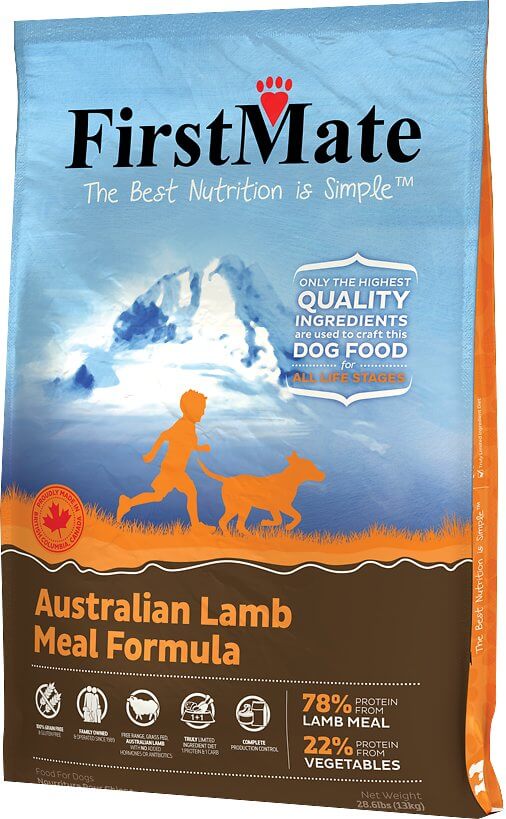
  • FirstMate Grain Free Australian Lamb
  • FirstMate Grain Free Pacific Ocean Fish
  • FirstMate Grain Free Chicken with Blueberries
  • FirstMate Grain Free Pacific Ocean Fish Puppy
  • FirstMate Grain Free Pacific Ocean Fish Large Breed
  • FirstMate Grain Free Chicken with Blueberries Small Bite
  • FirstMate Grain Free Pacific Ocean Fish Senior/Weight Control (3 stars)

We review the company’s grain-inclusive FirstMate Classic product line in a separate report.

FirstMate Grain-Free Pacific Ocean Fish Large Breed was selected to represent the others in the line for this review.

FirstMate Grain-Free Pacific Ocean Fish Large Breed

Dry Dog Food

Estimated Dry Matter Nutrient Content

Protein = 28% | Fat = 13% | Carbs = 51%

Ingredients: Potato, wild herring meal and/or wild anchovy meal and/or wild sardine meal, tomato pomace, chicken fat (preserved with mixed tocopherols), fish oil, dicalcium phosphate, choline chloride, calcium propionate, Yucca plant extract, minerals (zinc proteinate, iron proteinate, manganese proteinate, copper proteinate, iodine, cobalt, selenium), vitamins (vitamin E, riboflavin, niacin, dpantothenic acid, thiamine, vitamin A, pyridoxine, folic acid, biotin, vitamin B12, vitamin D3), glucosamine

Fiber (estimated dry matter content) = 8.9%

Red items when present indicate controversial ingredients

Estimated Nutrient Content
MethodProteinFatCarbs
Guaranteed Analysis25%12%NA
Dry Matter Basis28%13%51%
Calorie Weighted Basis25%29%46%

The first ingredient in this dog food is potato. Assuming they’re whole, potatoes are an excellent source of digestible carbohydrates and other healthy nutrients.

The second ingredient is herring and/or anchovy and/or sardine meals. Because they’re considered a meat concentrate, fish meals contain almost 300% more protein than fresh fish itself.

Fish meal is typically obtained from the “clean, dried, ground tissue of undecomposed whole fish and fish cuttings” of commercial fish operations.1

We are pleased to note that, unlike many fish meals, this particular item appears2 to be ethoxyquin-free.

The third ingredient includes tomato pomace. Tomato pomace is a controversial ingredient, a by-product remaining after processing tomatoes into juice, soup and ketchup.

Many praise tomato pomace for its high fiber and nutrient content, while others scorn it as an inexpensive pet food filler.

Just the same, due to its prominent position on this dog food’s ingredients list, tomato pomace plays a notable role in this food’s nutrient content. This is confirmed by its reading of nearly 9% fiber.

The fourth ingredient is chicken fat. Chicken fat is obtained from rendering chicken, a process similar to making soup in which the fat itself is skimmed from the surface of the liquid.

Chicken fat is high in linoleic acid, an omega-6 fatty acid essential for life. Although it doesn’t sound very appetizing, chicken fat is actually a quality ingredient.

The fifth ingredient is fish oil. Fish oil is naturally rich in the prized EPA and DHA type of omega-3 fatty acids. These two high quality fats boast the highest bio-availability to dogs and humans.

Depending on its level of freshness and purity, fish oil should be considered a commendable addition.

The sixth ingredient is dicalcium phosphate, likely used here as a dietary calcium supplement.

From here, the list goes on to include a number of other items.

But to be realistic, ingredients located this far down the list (other than nutritional supplements) are not likely to affect the overall rating of this product.

With two notable exceptions

First, we find no mention of probiotics, friendly bacteria applied to the surface of the kibble after processing to help with digestion.

And lastly, this food also contains chelated minerals, minerals that have been chemically attached to protein. This makes them easier to absorb. Chelated minerals are usually found in better dog foods.

FirstMate Grain-Free Dog Food
The Bottom Line

Judging by its ingredients alone, FirstMate Grain-Free Dog Food appears to be an above-average kibble.

But ingredient quality by itself cannot tell the whole story. We still need to estimate the product’s meat content before determining a final rating.

The dashboard displays a dry matter protein reading of 28%, a fat level of 13% and estimated carbohydrates of about 51%.

Due to its apparently lower meat content, we have downgraded the Senior product to three stars.

As a group, the brand features an average protein content of 27% and a mean fat level of 14%. Together, these figures suggest a carbohydrate content of 52% for the overall product line.

And a fat-to-protein ratio of about 53%.

Near-average protein. Below-average fat. And above-average carbs when compared to a typical dry dog food.

Free of any plant-based protein boosters, this looks like the profile of a kibble containing a moderate amount of meat.

Bottom line?

FirstMate Grain Free Dog Food is a potato-based kibble using a moderate amount of chicken, lamb or herring meals as its main sources of animal protein, thus earning the brand 4 stars.

Highly recommended.

Special Alert

Rice ingredients can sometimes contain arsenic. Until the US FDA establishes safe upper levels for arsenic content, pet owners may wish to limit the total amount of rice fed in a dog's daily diet.

A Final Word

The descriptions and analyses expressed in this and every article on this website represent the views and opinions of the author.

Although it's our goal to ensure all the information on this website is correct, we cannot guarantee its completeness or its accuracy; nor can we commit to ensuring all the material is kept up-to-date on a daily basis.

Each review is offered in good faith and has been designed to help you make a more informed decision when buying dog food.

However, our rating system is not intended to suggest feeding a particular product will result in specific health benefits for your pet.

For a better understanding of how we analyze each product, please read our article, "The Problem with Dog Food Reviews".

Remember, no dog food can possibly be appropriate for every life stage, lifestyle or health condition. So, choose wisely. And when in doubt, consult a qualified veterinary professional for help.

In closing, we do not accept money, gifts or samples from pet food companies in exchange for special consideration in the preparation of our reviews or ratings.

To learn how we support the cost of operating this website, please visit our public Disclosure and Disclaimer page.

Have an opinion about this dog food? Or maybe the review itself? Please know we welcome your comments.

Notes and Updates

05/08/2010 Original review
12/08/2010 Review updated
09/02/2012 Last Update

  1. Association of American Feed Control Officials
  2. FirstMate Pet Foods FAQ Page, 5/8/2010
  • Shawna

    How is high protein detrimental to a small dog? I have eight dogs ranging in size from 4 to 14 pounds. All of them get a very high protein diet. The four pound dog is 16 years old by the way.

  • PetFoodGuy

    Potato is very, very tricky to cook properly for nutrient liberation. Second, slippery protein labeling “and/or” is suspect rather than fixed. Not professional at all. Unspecified “fish oil” is weak and the caliber of minerals is second rate (out of five). Do some more research on potato as your primary carb source and you will question this rating. Finally, glucosamine listed last is simply window dressing and could not possibly be of any benefit. Too many IFS and “and/or” questions to take this food seriously.

  • InkedMarie

    I disagree with your post, especially the part about senior dogs.

  • Pattyvaughn

    You need to go back to the drawing board when it comes to learning about dog nutrition. High protein is in no way detrimental to a healthy dogs health and is necessary to bring a debilitated dog back to health. High protein gives them all the amino acids they need to repair and regenerate tissue. The most important antioxidant in the body is made from animal proteins. And seniors need every bit as much protein as younger dogs but have more difficulty using the protein in their diet, so they need QUALITY protein(read meat) and more of it just to get the same amount. Small dogs take many more steps to go the same distance as large dogs or humans, simple activities are a real work out for their little bodies, so they do very well when fed like the little athletes that they are. If you only want a couch potato instead of a healthy vibrant pet, then keep feeding the way you are. But if you want your dog in the best health instead of just good enough, feed foods that are high in meat protein and less processed.

  • newmama32

    Hi protein is only necessary for high energy or performance dogs. A small dog that plays in the yard, goes for walks, or to the park every so often does not need a high protein dog food and in fact, may be detrimental to their health. High protein = better health is a myth! Senior dogs typically do not need a high protein diet either.

    I recently bought the fish recipe and my dogs starved themselves and would not go near it. So I switched to the chicken/blueberry and noticed my dogs acting odd, sleeping a lot! loud gurgling stomachs, and not nearly as energetic and excited about their usual activities (going to the park, car rides, etc). So I’m switching again to a different brand. Dog food is a nightmare.

  • Hound Dog Mom

    It’s too low in protein.

  • Randy

    Why does their senior weight control brand rate only 3 stars – I just bought that!!!!

  • Shawna

    Yeah!!  You are already way ahead of the game!!!  Jasper is a lucky boy!!!!!!!!!!!!!!

    My vets are pro vaccine but they didn’t even flinch when I requested the rabies exemption..  I already don’t give the other vaccs so that was a non issue. 

    They know that (at least rabies) vaccines can “cause” kidney disease…..

    If you ever want to talk behind the scenes :0), or vent or whatever — you can reach me at shawnadfaemail (@) yahoo (dot) com

  • Lilah+Jasper

     Thank You!!! Thank You!!! Thank You!!!  You are so kind to give me all of that information.  Unfortunately, I’ve been down this road before with my late Standard Poodle Sasha – she passed at age 5 from acute kidney failure.  The silver lining here is that I can be proactive with Jasper.  With Sasha, time was not on my side.  I am in love with a breed that is riddled with numerous genetic diseases.

    I already give Jasper Milk Thistle on occasion.  I did try a raw diet with him, but it did not agree with his system.  He is able to have the occasional raw meal and treats daily.  I have a lot to think about…

    I put my foot down with the vet about additional vaccines.  Even though they don’t agree with me, the staff is respectful of my decision.

    For now, Jasper doesn’t seem to urinate more than my other Standard.  I do think that he drinks a lot of water though.  Our water source is double filtered well water.  At work ,they both get distilled as my office has city water.

    It seems like I have started down the right path but still have a way to go yet :)

    Thanks again…

  • Shawna

    Ohhh, I’m so sorry to hear that..  Standard Poodles are predisposed to congenital kidney disease :(

    Here’s some suggestions for Jasper.

    1.  Give Jasper only filtered water (reverse osmosis is good).  Tap water will only contribute to his toxic load.  Good quality well water is good too.  Once a month or once a quarter, give him distilled water – believed to help flush out toxins.

    2.  I haven’t tried but have spoke with others who have tried and had excellent results with Five Leaf Pharmacy products.  http://caninekidneyhealth.com/

    3.  I use (and have since diagnosis 5 years ago) Standard Process Canine Kidney Disease for Audrey.  It helps reduce inflammation to the kidneys and prevents the immune system from attacking them.  Also supplies a source of nutrients to the kidneys.  I highly recommend it. :)

    4.  NO more vaccinations (including rabies — you should be able to get a medical exemption if your state allows).  NO more flea/tick and if able NO more heartworm.

    5.  Give a liver support product as the liver has an extra workload.  I give Audrey Standard Process Canine Hepatic Support.  At the very least I would give milk thistle off and on and especially if you have to continue heartworm meds.

    6.  Continue the enzymes :) .. 

    7.  Give the BEST probiotic you can find and afford.  Mercola Healthy Pets has a good one.  I also like Garden of Life Primal Defense.  Probiotics, when fed, will actually help clean the blood of BUN.  It is referred to as “nitrogen trapping”.  When probiotics eat prebiotics it causes blood to flow to the colon.  With the blood is BUN etc.  The bacteria/yeast then consume some of the BUN.  When the blood is reabsorbed it is minus some BUN — which is then excreted in the feces.  I’m guessing that not all probiotics consume BUN so giving a product with one or two strains may provided no nitrogen trapping benefits. 

    8.  Give a prebiotic — garlic is a good prebiotic as it has inulin and FOS in it.  If Jasper tolerates it I would give him some 3 or 4 days on then 3 or 4 days without.  Or give it every other day.  Not only will it feed the bacteria but it will help the immune system and help prevent bacterial infections etc..  I also use the human product Fiber 35 Sprinkle Fiber (which is acacia fiber and a good prebiotic).  When I notice signs of toxic blood (like bad breath) with Audrey I give her the Sprinkle Fiber (with the probiotics) for several days to a week.  Works like a charm. :)

    9.  If you haven’t already, read the info on Mary Straus’ website on kd.  http://dogaware.com/health/kidney.html

    10.  Because he is stable now I’m not sure messing with the diet is a good idea but I’m not at all fond of kibble for kd dogs..  Kibble is dehydrating which is damaging to the kidneys.  The protein in kibble is not as utilizable as other foods — causing increased BUN.  The body uses amino acids in pairs and groups.  Lysine is damaged at temperatures as low at 110 degrees.  ALL kibbles are cooked at temps higher then 110.  Since lysine (and likely others) is missing or in lower amounts the amino acids that would be used with lysine aren’t used and become waste — BUN.  You hear people discuss “high quality proteins” — high quality proteins will have most of their amino acids available and utilizable by the body leaving less to become BUN.  Again, since this diet plan is working may want to stick with it but keep that info in the back of your head for later.

    11.  If Jasper urinates excessively, consider adding a whole food source of water soluble vitamins.  I give Audrey Standard Process Cataplex B and Garden of Life RAW C (she is allergic to an ingredient in Standard Process’ Cataplex C product).  I also give Audrey a whole food mulit — Standard Process Whole Body Support or Catalyn.  PetGO is another good one.

    I think that’s it..  Feel like I’m forgetting something but not coming to me so.. ;)

    Audrey has lived with the disease for 6 years and is still in EXCELLENT health.  Jasper could have a very long and healthy life ahead of him despite this disease :) ….

    Oh, just thought of something else — if able, eliminate ALL toxins from the home.  I found that clorox (including clorox products like Clorox Cleanup), Swiffer style mops, fragrances (like candles, air freshners etc) etc etc etc can contribute to the illness as they too have to be filtered out of the body by the kidneys.  I looked at MSDS and the CDC for different products and found I had to eliminate most everything I was using — and I was using a lot of “clean” stuff already.

    Hope something above is helpful to you and Jasper!!

    Best of health to you both!!!!!!!!!!!!!!

  • Lilah+Jasper

    Thanks a bunch Shawna – I really appreciate your reply.  I switched one of my Standard Poodles over to First Mate Pacific Ocean Fish as it has lower ash and phosphorus levels.  Jasper is in the early stages of kidney failure at age 3.  I have been adding Animal Essentials Plant Enzymes & Probiotics to each meal along with a generous amount of green tripe (Vital Essentials (frozen patties and treats), Ziwi Peak or different Tripett flavors.  Jasper’s BUN (now 27) and Creatinine (2.8) had been steadily increasing until I made these dietary changes.  For now, he is stable.

    Should I be adding or doing anything else?

  • Shawna

    Hi Lilah+Jasper :)

    Not sure if you were asking me or just asking in general but I have an opinion so here goes :) ..

    No, the addition of a probiotic and enzyme supplement is not “required” but I do think it is very healthful to do so.  However, I would say the same about all kibbles —- even those that have added enzymes an probiotics. :)

    I raw feed and I add probiotics and enzymes to the raw meals too.

    I think FortiFlora has a very specific use — plus, I’m not at all fond of the ingredient “animal” digest.  It is one of the ingredients known to be contaminated with pentobarbitol (the euthanasia drug) per the FDA’s website.  Also only has one probiotic but dogs are known to have at least fourteen.

    There is also no enzymes in FortiFlora — unless there are enzymes in “animal digest”?

  • Shawna

    :)   Our dogs are all small (from 5 to 14 pounds) but yeah, we fork out quite a bit of money each month to feed them..  All my dogs are rescued, rehomed or came from the breeder (with kidney disease) and most were ill when they came to us..  So, we feed them the best we can.  I have a pup that was born with kidney disease and she has been on a raw, high protein diet since weaning.  She just turned 6 years old and is still in excellent health :)

    Raw doesn’t really supply enough enzymes to break down all the food.  The enzymes present in any food are only in quantities enough to break down that particular food — except green tripe.  I supply a supplemental source of enzymes to my raw fed dogs.  Metabolic enzymes trigger apoptosis (cell suicide) which prevents the formation of tumors..  Many feel that by adding a supplemental source of enzymes it allows the body to use the resources (amino acids from protein) to build more and healthier metabolic enzymes.  The enzyme bromelain (from pineapple) has been studied for its anticancer affects.  Some feel that giving enzymes BETWEEN meals allows those to be utilized by the body versus being used for digestion.

    I wanted to mention again — enzymes are made from amino acids from the proteins we eat.  In my opinion — the lower the protein in the food the less “building blocks” the body has to make more enzymes for both digestive as well as metabolic needs.  Protein is the one nutrient that I would never short change in the diet.

  • Shawna

    I’m so sorry for your loss :(  

    Yeah, Goldens are predisposed to cancer..  There’s a good website all about Goldies and cancer called Land of Pure Gold.  I don’t agree with everything on the site but I do like it a lot..  http://landofpuregold.com/home.html

    I also like a lot of the information in the newsletter that Dr. Demian Dressler DVM puts out.  His website is dog cancer blog.  He discusses how dog food (kibble) can be a carcinogen as an example.  http://www.dogcancerblog.com/dog-food-is-there-a-cancer-risk/

    You can also feed anti-cancer foods as a supplement to whatever base diet you feed.  Some anti-cancer foods that are acceptable (in smaller amounts) for dogs are garlic, blueberries, strawberries, the spice turmeric (a really good anti-cancer food), certain mushrooms, pumpkin etc. 

    Human doctor, Dr. William Lee discusses how these foods and others prevent blood from reaching the tumor.  Without the blood (and nutrients in the blood) the tumor starves.  This is referred to as antiangiogenesis.  Here’s a list of antiangiogenic foods  (some are not appropriate for dogs) http://blog.ted.com/2010/02/10/dr_william_lis/  and in this video, Dr. Lee discusses how it works.  The video title is “Can We Eat to Starve Cancer”  http://www.ted.com/talks/william_li.html

  • Bruce

    How do you afford 8 dogs on 100% raw.  Looked like about $200 a month to feed my dog 100% raw. 

    Like with most information, source is a problem.  But I have a good trainer who seems to know his stuff.  For the balance, I wanted to add raw for emzines, etc.  If I hunted, I could have a reasonable source of meat.

    I will have a look at the Bravo line. I have like 4 specialty stores in my area. Thanks for the feedback and info. 

    I lost my last Goldie mix about 2 years ago and she had a rapidly advancing Ilium cancer that took her out in 4 weeks.  She was only just shy of 10.  I have heard that Goldies and prone to caner and I want my new girl to have the best shot at a long and healthy life.

  • Lilah+Jasper

    Any thoughts on my previous post:
    It is noted in the review: “no mention of probiotics… friendly bacteria
    applied to the surface of the kibble after processing”.  If I fed this
    kibble, would it require an additional product added such as FortiFlora,
    etc? 

  • Shawna

    Hi Bruce :)

    “high in protein and disproportional development of platelets”  I’ve NEVER heard this.  Do you know what they meant by this?

    Since you are planning on adding raw meat I’m assuming it is the protein in kibble that your trainer is concerned with?  Is this a fair statement?

    I’m a raw feeder and have 8 dogs.  Five are exclusively raw fed and three get a combo of kibble and raw.  All get a little canned actually.

    The rule of thumb is that extra food (that is not complete and balanced) that is added to a balanced diet should not be more then 20% of the diet or it can unbalance the balanced diet.

    Free Range Buffalo is GREAT..  So is deer heart/meat, free range eggs, grass fed beef heart (heart can be fed as a muscle meat) etc.. 

    I’d do a variety instead of just focusing on one source.

    If you have a specialty store near you, look for the Bravo line of foods.  The red meats are from New Zealand and are raised organically/grass finished (from what I’ve been told).  They have buffalo, salmon and venison.  These are all boneless meats.  They also have rabbit and duck with bone but the bone content is a bit high so I would feed these less often.  Of course, you can certainly get your meats fromt he grocery store too.  Another good, and inexpensive, source is any hunting buddies.  I get all my deer heart for free :) ..  I imagine you might have access to elk too if you ask around..?

  • Bruce

    Switched to First Mate from Origin for by 5 month old Golden on advise of my trainer who suggested that Origin was very high in proteen and this might promote disproportional development of plateletes.  The vet was vague.   Hard to find any consensus. At least First Mate is local (I live real close to Canada) and (who knew) Canadian standards are higher.  Being a U.S. Citizen I have always been disappointed in our stanards and offended by our home grown hype.  Hope we don’t drag the Canadians down to levels. And I plan to intoduce raw my dogs diet this month for at least 25% of her diet to start.  That is if I can find some honest advise.  Thinking free range Buffolo.   

  • Pingback: When High Protein Dog Foods Just Aren’t Working. @ For Other Living Things

  • Lilah+Jasper

    It is noted in the review: “no mention of probiotics… friendly bacteria applied to the surface of the kibble after processing”.  If I fed this kibble, would it require an additional product added such as FortiFlora, etc?

  • Muddie

    The
    reason that First Mate’s minerals are not chelated is because they use
    vacuum infusion to add them fresh to the product after it is already
    cooked. Vacuum infused vitamins and minerals are considered to be
    higher quality and more easily digestible than chelated minerals.
    Another point that you failed to mention is that they do all of their
    processing in their own processing facility, something that is
    extremely rare in the pet food industry today. Due to owning their own
    facility they have also not had any recalls to date. Since they are
    based in Canada they have to follow the British standards of food
    processing, which are much higher than the American standards of food
    processing. They also boast that all of their ingredients are locally
    sourced and the fish in their fish formula is caught in the Pacific
    Ocean. I also posted on the other First Mate review so sorry if this is redundant, I just thought you should know.


  • Pingback: Dog Food company donates $1 million to US rescues | brendaleehaines

  • Pingback: FirstMate Dog food

  • http://DogFoodAdvisor.com Mike Sagman

    Hi Mike… After mentioning iron, zinc, manganese and copper, you asked, “Are these the only minerals that need to be chelated?”

    Actually, no mineral “needs” to be chelated to be usable by an animal. It’s just that chelation does increase the nutritional availability (to a varying degree) for some of their respective elements.

    Other minerals may also benefit from chelation, too. For example, chromium or selenium. In any case, not all chelates are as beneficial to an animal as others. Unfortunately, I cannot supply you with a source for which ones are most effective for a dog’s diet. Hope this helps.

  • Mike

    According to their web site (Pet Food Education), in the “Ingredient Explanations” section they appear to have chelated minerals. Those being Iron, Zinc, Manganese, and Copper.

    My question is: Are these the only minerals that need to be chelated?

    Reference link: http://www.firstmate.com/pet_food_education.aspx

    Anyhow, great site you have. Thanks for your hard work and all your effort.

    Mike

    ps My older dog really like First Mate Grain free. But I think it’s the canned Wellness 95% that really draws her in.