

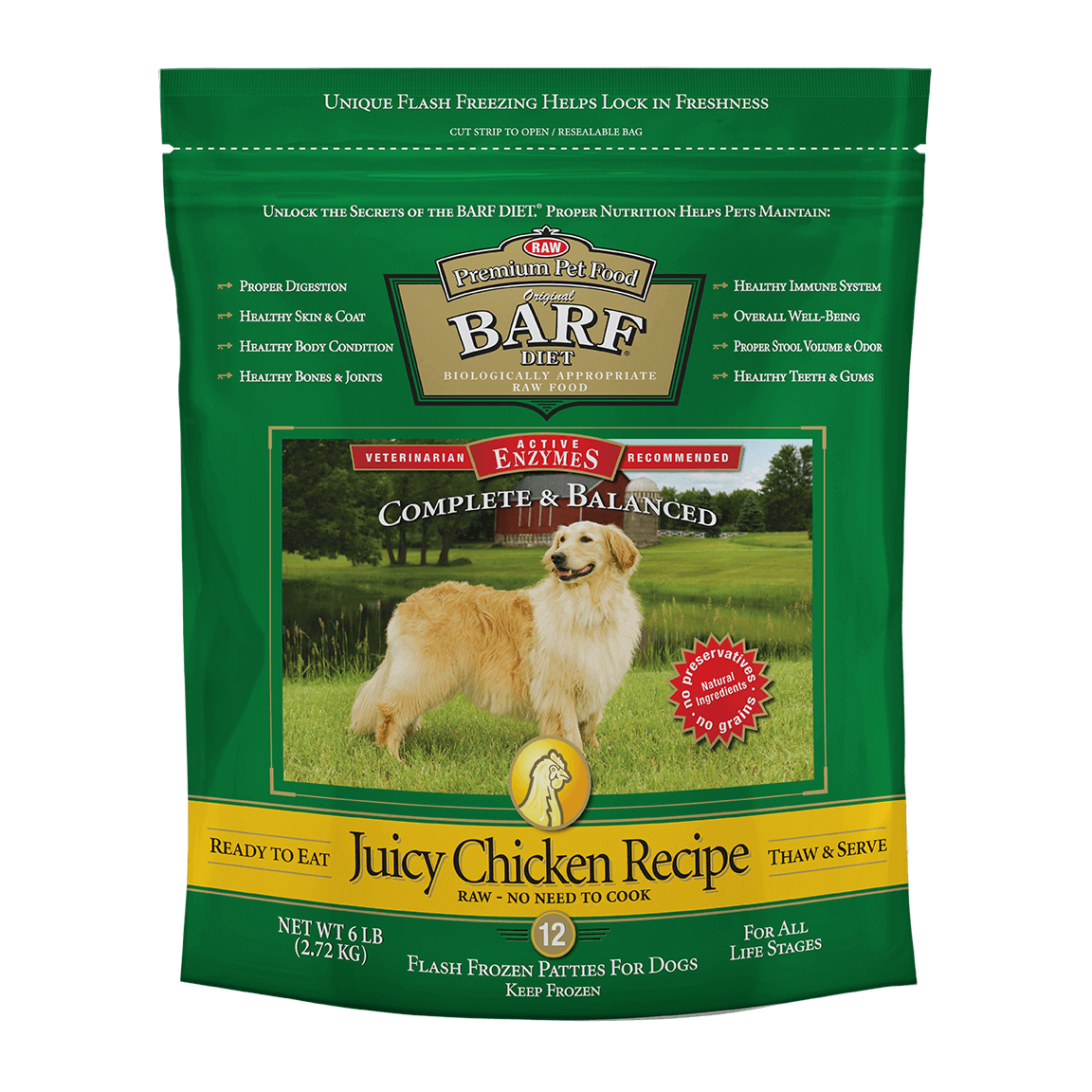
BARF Dog Food (Raw)

Share

Rating: ★★★★☆

BARF Dog Food receives the Advisor’s second-tier rating of 4 stars.

The BARF1 Dog Food product line includes four frozen recipes, each claimed to meet AAFCO nutrient profiles for all life stages.

  • BARF Juicy Beef Recipe
  • BARF Juicy Lamb Recipe
  • BARF Juicy Chicken Recipe
  • BARF Juicy Combination Recipe

BARF Juicy Chicken Recipe was selected to represent the others in the line for this review.

BARF Juicy Chicken Recipe

Raw Dog Food

Estimated Dry Matter Nutrient Content

Protein = 43% | Fat = 36% | Carbs = 13%

Ingredients: Chicken, finely ground bones, chicken liver, egg, broccoli, celery, spinach, carrot, ground flax seed, dehydrated alfalfa meal, apple, pear, grapefruit, orange, dried kelp, cod liver oil, garlic, cayenne pepper, vitamin E supplement, zinc oxide, manganous oxide

Fiber (estimated dry matter content) = 17.9%

Red items when present indicate controversial ingredients

Estimated Nutrient Content
MethodProteinFatCarbs
Guaranteed Analysis12%10%NA
Dry Matter Basis43%36%13%
Calorie Weighted Basis30%61%9%

The first ingredient in this food is chicken. Chicken is considered “the clean combination of flesh and skin… derived from the parts or whole carcasses of chicken”.2

Chicken is naturally rich in the ten essential amino acids required by a dog to sustain life.

The second ingredient is finely ground bone, an excellent source of natural calcium and other healthy minerals.

The third ingredient is chicken liver. This is an organ meat sourced from a named animal and thus considered a beneficial component.

The fourth ingredient includes egg, a desirable addition. Eggs are easy to digest and have an exceptionally high biological value.

The fifth item is broccoli. Broccoli is a healthy green vegetable and a member of the kale family. It is especially rich in vitamin C and fiber and numerous other nutrients. Broccoli is known to provide potent anti-cancer benefits.

After the celery, spinach and carrots, we find flaxseed… one of the best plant sources of healthy omega-3 fatty acids. Provided they’ve first been ground into a meal, flax seeds are also rich in soluble fiber.

From here, the list goes on to include a number of other items.

But to be realistic, ingredients located this far down the list (other than nutritional supplements) are not likely to affect the overall rating of this product.

With three notable exceptions

First, we find the inclusion of cod liver oil, a type of fish oil rich in omega-3 fatty acids as well as vitamins A and D.

Next, garlic can be a controversial item. Although the majority of experts favor the ingredient for its numerous health benefits, garlic (in rare cases) has been linked to Heinz body anemia in dogs.3

However, the limited professional literature we surveyed provided no definitive warnings regarding the use of garlic, especially in small amounts (as it is here).

And lastly, the vitamins and minerals listed here are not detailed sufficiently to allow us to judge their quality or completeness.

BARF Dog Food
The Bottom Line

Judging by its ingredients alone, BARF raw frozen patties appears to be an excellent dog food.

But ingredient quality by itself cannot tell the whole story. We still need to estimate the product’s meat content before determining a final rating.

The dashboard displays a dry matter protein reading of 43%, a fat level of 36% and estimated carbohydrates of about 13%.

As a group, the brand features an average protein content of 41% and a mean fat level of 36%. Together, these figures suggest a carbohydrate content of 15% for the overall product line.

And a fat-to-protein ratio of about 88%.

Above-average protein. Above-average fat. And below-average carbs when compared to a typical wet dog food.

Free of any plant-based protein boosters, this looks like the profile of a raw frozen product containing an abundance of meat.

Bottom line?

BARF Dog Food is a grain-free raw frozen formulation using a generous amount of meats from named species as its main sources of animal protein, thus earning the brand 4 stars.

Highly recommended.

For even more raw diet suggestions, be sure to visit the Advisor’s Recommended Raw Dog Foods summary page.

A Final Word

This review is designed to help you make a more informed decision when buying dog food. However, our rating system is not intended to suggest feeding a particular product will result in specific health benefits for your pet.

For a better understanding of how we analyzed this product, please be sure to read our article, “The Problem with Dog Food Reviews

Remember, no dog food can possibly be appropriate for every life stage, lifestyle or health condition. So, choose wisely. And when in doubt consult a veterinarian for help.

Have an opinion about this dog food? Or maybe the review itself? Please know we welcome your comments.

Notes and Updates

01/04/2010 Original review
02/24/2012 Lower rating due to new DFA analysis of fat content
01/04/2011 Last Update

  1. BARF: Biologically Appropriate Raw Food
  2. Association of American Feed Control Officials
  3. Yamato et al, Heinz Body hemolytic anemia with eccentrocytosis from ingestion of Chinese chive (Allium tuberosum) and garlic (Allium sativum) in a dog, Journal of the American Animal Hospital Association 41:68-73 (2005)
Dog Food Advisor IconThe Dog Food Advisor publishes independent reviews to help pet owners make better choices when shopping for dog food.


  • Jen CB

    IS the fiber content really over 17%?  On the BARF website, it lists the crude fiber as 5%.  I’m looking for a HIGH fiber food to supplement what I already use, as my dog’s poops always seem to be on the soft side.

  • Syn C

    My boys have special diets to each dog. Kaoss tends to get more Chicken, Fish, Beef, pork and sometimes Deer. Because he’s growing I want to get the best proteins to ensure he grows slowly plus bone/organ. Leonidas because he’s a older guy with a lot of energy and a show dog he gets more “natural” canine meats that a wolf would eat. He gets Rabbit, Deer, Boar, Fish, quail, Chucker, Pheasant & Lamb. Every once in a blue moon I’ll give him chicken because he loves it so but we hunt a lot and in my area boar is a huge issue and deer are abound (esp fresh road kill) it’s easy to feed my dog stuff he enjoys. We also have a farmer close to us who will sell us goat for a good price and they’ll both get that. A lot of our dogs meat comes from farmers in the area so sometimes i’ll pay 75 cents a lb for meat that costs 3-4 dollars in super markets 

  • Syn C

    yeah, originally i was doing Orijien dog food which is around 80 a bag and that stuff is around 29lbs and it would last me a week a bag to feed leonidas and my pit bull (he passed away rip buddy) Leonidas would eat 9cups a day to help him gain some weight and Mayhem my pit would eat 7cups a day to keep him where he should. thats almost 20 cups a day to keep my dogs okay. it would cost me around 320 a month to feed two dogs. Mayhem weighed i wanna say 92lbs. it costs me 3 a day each dog to feed them, Kaoss and him both eat 3lbs each and once kaoss is older he’ll be eatting 2lbs so 5 a day to feed my dogs who weigh around 300lbs together. its crazy to think i spent so much money on kibble for so long. Nothing against orijien my pit bull did well on it but he did better on raw. Even my cats are fed raw lol 

  • Threenorns

    oh – the kibble?  the cheapest i could bear to give him ran $45 a bag.  it was supposed to last a month but he was running through it in 10 days.  the whole time he was on it, he had the runs and mucous shrouds in his poop.  i tried a more expensive brand, same thing. even the BARK didn’t work (it’s supposed to be basically a dehydrated raw diet kibble).

    on natural food, he’s fabulous.

  • Threenorns

    if that’s what it would cost, holy yikes!  no wonder you’re getting scared off!

    i have a 70lb border collie mix – uber-high-energy.  he eats about 14oz/day of meat, bone, etc.  i feed him from the discount bin at the grocery store and it costs me about $3/day and it’s meat we can all eat (i HATED it when the freezer was packed full with the meat from the butcher at 75c/lb but nothing for humans in the house to eat!).

    when he was a puppy and eating like crazy, he still only had a pound and a half a day – still very affordable.

    my dog is incredibly healthy and this is what he eats:  beef, chicken, goat, rarely pork, sometimes lamb, and in the hunting season, moose and deer.  he also eats sweet potato, raw carrots (hates them cooked – they make him gag), egg (raw and cooked), eggplant, broccoli stems, cauliflower, green beans.
    i don’t puree them – i toss it to him and let him have at it.  and no, there’s no huge chunks of undigested vegetable matter in his poop – it’s all pretty homogeneous.

  • Syn C

    my 2 boys (black russian terrier & Belgian Malinois both intact) do best on raw, when i got Leonidas (the brt) he was on kibble and couldnt hold weight to save his life. we did tests on him to see if there was any issues with him and he checked out fine, this it absolutely the best way to keep a dog healthy seeing it’s a natural diet intended for canines. Leonidas when i got him weighed in a 130 odd lbs and is now at a healthy weight of 145 without being over weight. He was a rescue dog and not treated right by the original owners. My malinois has never seen kibble in his life and at 9mths old is the healthiest malinois ive seen in the working world when looking at kibble fed dogs. I find it to be cheaper than kibble by a lot seeing i have a 145lb dog and a malinois we’re expecting to be around 95lbs as i crunched the numbers i realized kibble would cost me 100 dollars more over raw feeding. Most people would tell you its not safe but it is. my dogs are healthy, lean, muscular, shed little, poo less and have no teeth/gum issues (my brt is 7.5yrs) the only thing i hate is the burps lol that stuff stinks!

  • Mike P

    I believe I read somewhere that adding fresh meats twice a week helps dogs by leaps and bounds.That is if you feed a high quality kibble.I add real food 3 days a week and all is well.I wish I had the courage and smarts to make my own raw from the supermarket but I know I can’t.Kibble is just easier during the work week and that’s my lazy side talking.

  • Shawna

    Hi Karen ~~ lots of questions :)

    Raw feeding can be very expensive for large dogs — absolutely.  There are ways to help with the costs (for some).  Making your own using bargain meats, bulk meats, meat from hunting friends/relatives etc. 

    Raw is better for several reasons but if its not affordable I wouldn’t worry about it.. :)   What you can do is add raw foods to the kibble diet. 

    A lot of raw feeders, myself included, do add about 20 to 25% of the diet as veggies and fruits.  Dogs do not make the enzyme cellulase to break down the cellulose fiber in veggies.  However, by fermenting, steaming and/or grating the veggie you can break down the cellulose for them.  There are lots of nutrients in veggies and fruits that can benefit dogs.  Especially dogs living in the toxic environment we expose them too (gasoline fumes, fluorinated water and many many more).  Fermenting the veggies is a way of mimicing the veggies that would be found in smaller prey animals digestive tracts (which I’m told wolves do eat).

    Honest Kitchen uses high quality ingredients (they are one of only two companies that can legally claim they are human grade — the food is processed in a human grade facility).  However, the meats in the foods are actually cooked — as they use heat high enough to cause enzyme loss when dehydrating.  The veggies/fruits are dehydrated in a way so as not to damage enzymes (and vitamins).  My main concern with Honest Kitchen is that they are too low in protein as compared to truly raw diets on the market.

    Kibble isn’t “so bad” but IS different then raw.  In raw you will find natural vitamins.  In most kibbles the vitamins added are synthetic.  And not all are added back in.  Ex – in nature there are 8 kinds of vitamin E.  Kibbled foods, as most, only add 4 of those back in — at most.  Raw has natural enzymes that help digest the food etc… 

    Some kibbles are better then others — some are heated at high temperatures which can create carcinogens within the food — HCA’s as an example.  Some amino acids (what the proteins break down to) are damaged by heat.  Some kibble manufacturers add them back in while others do not.  If they are not added back in the proteins in the food are less utilizable by the body at a cellular level.

  • Kluce51

    Hi, my name is Karen.  Noone answered the gal that asked one of the most important and blatantly obvious concerns about RAW – inparticularly BARF brand raw regarding qty and cost for larg(er) dogs?  Is it true that it would run someone close to $500 a month for a 90lb lab?  This is what I calculated too when I considered buying this.  The BARF (for instance) largest size is sold in a case of 24.  It was referenced that a 40lb dog needs about 1lb (2 patties each feed) of meat so my dog at 90lb would qualify for 2lbs a day (4 /5 patties each feed -) that would be equal to 9/10 patties a day, right?  With that quantity a CASE of 24 would barely last me a few days?  A huge bag of kibble lasts me a month.   I started raw with my lab when he was a puppy.  At that time I bought whole chicken from my supermarket and added Embark.  It was close to $400 a month so had to stop.  This is for a dog  that doesnt hesitate to scoop up deer/duck poop and anything else that sways that nose of his without regard.   Labs in particular are scavengers.  They eat anything.  All this moneyI cant see how “balanced” anything makes sense to animals that eat first, dont care later.   And, my other question, if kibble is so bad (which I dont disagree by the way just can’t afford this RAW the way I calculate it) – why then do dogs “thrive” on it.  My lab is gorgeous despite the crap he is eating now.  I buy EVO now (since I had to get off the raw before I went bankrupt).  Also, I read that veggies are NOT good for dogs either so all these home made recipees I would question would poison him as dogs dont digest many raw veggies.

    At any rate. that is my largest question on cost for a 90lb lab.  I also question if the BARF store bought raw is nothing more than lunchmeat?  I know deli meat in a roll is crap.  How is this not any different?  How do you know?

    And, does anyone out there use EMBARK dehydrated food?  I have yet to find anyone /anywhere giving what I feel an honest review.  It is all the company promoting the product or general dog food marketing saying how great it is but I actually bought it a few years back and can’t see how that is any good.  The meat pieces are barely detectable to the human eye and it is filled with “fruit” which in my opionion is not normal for dogs..come on, blueberries for dogs?  At any rate, I question how it is so good because insnt it very close to ‘instant oatmeal”…instant oatmeal is not good for humans because it is “instant”.  Not sure what makes it instnat but I felt like the Embark was very similar to human “instant” anything..just add water?

    Is EMBARK a good product? 

  • http://www.facebook.com/Toxed2loss Toxed2loss

    Hey Godon,

    I wasn’t Even aware there was a manufactured BARF food. I’m with you. When I say BARF diet, I’m talking about Biologically Appropriate Raw Foods. You know how I feel about flax!

  • Gordon

    Yeah Shameless. That is also the very reason that any commercial raw brand still contains some ash (Not much at and even less than kibble) because of the meat and bones being grounded in the process of making them.

  • http://www.whosyourvet.com Sandi

    Mike P – You’re funny.

    “recalled from the Minnesota-based company Cargill”.

    I would think you’re safe but you can always call Wellness and ask where they source the turkey from. I’m waiting for a call back from Earthborn. Better safe than sorry.