Dry Dog Food and the Myth of Cleaner Teeth

Share

Imagine going to your dentist and being told to forget using your toothbrush — because all you really need for good dental health is to simply eat a few crunchy tortilla chips every day.
The Truth About Dry Dog Food and Dental HealthAnd like magic, your teeth will be sparkling clean.

Sound absurd?

Well, you’re right. It’s utterly ridiculous.

But that’s precisely what most of us have been told about the magical tooth-cleaning power of dry dog food.

Well, now it’s time to separate the science from the myth.

Why Tooth Debris
Is So Difficult to Remove

There are three kinds of dental debris…

  • Food particles
  • Plaque
  • Tartar (calculus)

Food particles are easy to remove. Just drinking water can even remove much of the free-floating fragments from around a dog’s teeth.

However, plaque and tartar are different.

Plaque is the sticky biofilm that adheres tightly to every tooth surface. It requires physical scrubbing to remove it.

What’s worse, once cleaned away, plaque returns again within just 24 hours.

Left along the gumline long enough, plaque slowly and inevitably turns into a rock-hard, barnacle-like crust referred to as calculus, more commonly known as tartar.

Plaque is what you remove with your toothbrush. Tartar is the hard stuff your dentist scrapes away when you get your teeth cleaned.

Dry Dog Food Causes More Dental Problems
Than It Solves

Sure, crunchy kibble can remove some of the plaque near the tops of a dog’s teeth. But it’s completely ineffective within the critical zone near the gumline.

And that’s where plaque and tartar do their ultimate damage — causing cavities and gum disease.

Even industry watchdogs look the other way when products claim to cleanse or whiten teeth. They simply avoid the issue altogether by labeling these unscientific claims as “not objectionable”1.

In plain English…

Dry dog food does not help create healthier teeth and gums

In fact, since most are loaded with a much higher refined carbohydrate content, dry dog foods can actually increase plaque and tartar levels — and thus cause more dental problems than they supposedly prevent.

So, when choosing between canned or dry dog food, it’s OK to choose dry kibble. But don’t choose it because you believe it’s better for your dog’s teeth.

A Much Better Way
to Clean Your Dog’s Teeth

Although it’s not perfect, there’s a simple and more natural way to improve a dog’s dental health without resorting to less effective kibble.

And that’s using raw meaty bones.

Because of their mildly abrasive texture and their ability to flex around the teeth, raw meaty bones can help remove plaque without using harsh toothpastes and chemicals.

These bones (typically from poultry) are generally considered safe and digestible for most dogs.

However, because they can splinter, never use cooked bones of any kind. And for the same reasons, avoid weight bearing leg bones from larger animals.

In addition, although the risk is small, uncooked meat can carry bacteria that can be hazardous to both pets and humans. So, use caution and common sense when handling these natural tooth-cleaning treats.

The Most Reliable Way
to Prevent Dental Disease in Dogs

The only scientifically proven way to decrease plaque and tartar is the same for dogs as it is for humans — daily brushing combined with routine tartar removal by a health professional.
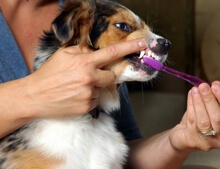
Brushing Dogs TeethAnd I can personally confirm, brushing a dog’s teeth can be one of the most challenging tasks of dog guardianship you can ever undertake.

Penny was the only dog in my last thirty years who actually allowed me to clean her teeth.

Unfortunately, without daily care and regular professional cleanings, canine dental disease is a near certainty.

So, give it a try. Notice how it’s done here in the photo — using a baby-soft toothbrush. Or you can add a special food-flavored canine toothpaste.

The Bottom Line

Dry dog food is probably not the best way to keep your dog’s teeth clean and free from dental disease. For better results, use a toothbrush. Or raw meaty bones.

You’ll be adding comfort and years of better health to your dog’s life.
  1. Official Publication 2008 Edition, Association of American Feed Control Officials, p. 128
Dog Food Advisor IconThe Dog Food Advisor publishes independent reviews to help pet owners make better choices when shopping for dog food.


  • Mike P

    I give my dog meaty beef leg bones .She can chew for hours on one 6′” bone . Her teeth look amazing .

  • sandy

    I see that chicken necks/wings/backs are given alot through these posts. What about chicken drumsticks or thighs? I wanted to start my pugs on raw bones. Thanks.

  • Mike P

    As I justed started feeding raw meaty bones for the last two weeks , I learned a little something . Gordo is right , you have to adjust the main meals . My Boxer gained 5 lbs before I noticed . I cut her food back and increased her walks a bit and she is getting back to her weight . Now on bone night I feed her less . Crazy how fast a dog can put on and lose pounds so quickly .

  • Gordon

    J.J. – IMO, arising from that dog trainer’s advice to me re this question some time ago, and Dr.s Billinghurst’s and Lonsdale’s opinions, especially pups, should get such raw bones once a day. Too often would be more than once a day. Some people give these every second day, like my own Vet. Keep in mind that raw meaty bones are not served as a full meal, but as a healthy daily snack, providing Nature’s balance of calcium, phosphorous, taurine, glucosamine, and protein, with the added benefit of daily teeth cleaning.

    So one raw chicken wing, or 2 or 3 chicken necks, or a piece of lamb chop or brisket, is great to give a dog including your 15 week old pup of 13.5lbs, on a nightly or daily basis, in addition to (Not in place of) their normal meal of whatever you give, such as kibble (Hopefully good quality grain free one) or quality canned or commerical raw balanced meal serving, etc. Even when your Aussie becomes fully grown at which it would reach around a weight of 22lbs, the above would suffice. When your Aussie reaches adulthood, you will also probably be able to give it a small lamb shank from time to time.

    With my own 2 dogs, who are each around 8.5kgs (18lbs), they get their raw meaty bones around an hour to 2 hours after their main dinner (I slightly adjust their main dinner in decreasing a serve from the brand’s recommended, to compensate for the fact that they’ll be getting a raw meaty bone each, that 1 or 2 hours later).

    Hope this helps.

  • ShamelessRawFoodie

    J.J. – For all your questions about puppy feeding, probably best to do some internet searches so you can figure out raw food variety for balanced diets, especially for calcium and phosphorus ratios. Raw fed puppies and dogs generally get raw meat and bones every day. Many also get a raw bone to gnaw on every day. Some people regularly alternate raw protein sources, including whole eggs and fish. For puppies, I’d probably not give a bone that was too dense until the teeth and mouth have matured. If I knew better when my dog was a puppy, he would sure get a raw meaty bone every day!
    Like Mike P says, teeth are whiter and cleaner and there is no mouth odor. Breath is fresh!

  • Mike P

    I just picked up 6 meaty raw leg bones 6 inches long from the meat locker . I got 2 a couple of weeks ago and let her go at it 3 times a week . I let her clean the bone then get rid of it . My 70 lb boxer has about 3 sessions with the bone before she cleans it . I can swear her teeth are so much whiter and no mouth odor . I just had to adjust her food intake as she gained a few pounds since I started her on the bones . I can’t wait until friday when she gets her new bone . Very cool to watch …

  • J.J.

    No problem Gordon, no offense taken. Thanks for asking the trainer. We are still working on it. I was able to give her some cooked lamb and some browned nature’s variety raw frozen medallions, which were clearly no longer raw at that point. But the point is to try to get her interested in the taste & texture of real meat, then I can hopefully give it to her more rare each time until we get to raw.

    The puppy on the other hand loves everything raw she’s tried, raw lamb, raw meaty lamb chop bone, nature’s variety raw frozen medallions, she can get enough. I’m hoping her enthusiasm will rub off on the 3.5 year old.

    Gordon & Shameless – How often is too often to give the puppy a raw meaty bone? Or, is there no such thing? I still have some lamb chop bones and also have some chicken wings in the freezer. Is once a day too much for her age or am I just paranoid. Also, how much is a good amount for her? She’s 15 weeks and about 13.5 lbs. So, would 1 chicken wing or one lamb chop bone be enough for her dinner or not enough? I know “it’s not rocket science”, but since I’m new to this I’m pretty clueless on the raw meaty bone feeding amounts. But she’s totally into it so, I’d really like to keep her on the right track from the beginning.

  • Gordon

    Oh yeah, my apologies to J.J. as I incorrectly referred to you as a he, and your dog as 4 years old in quoted question to that dog trainer. instead of 3 1/2, because at the time of writing that email to him (yesterday), I’d confused you with someone else in another forum. Too much brain overload and my memory’s starting to play up on me.

  • Gordon

    Just to clarify…re his answering my 2nd question, was in relation to me asking him about another source of mine who told me that dog trainers won’t tell the public that pups should not be exposed to others before the age of 6 months.

    Chris is way more reliable and pretty much has dismissed my misinformation as ridiculous myth. So pups should definitely be socialised as much as possible as soon as they’re weened off their mothers.

  • Gordon

    With regard to my recent questions via email to the dog trainer I often refer to, is as hereunder:-

    My question to him:
    “I wanted to ask, in all your years of dog training experience, have you ever seen an adult dog who had always had processed foods, and at the age of 4, the owner decided to present his dog with a raw meaty bone for the first time ever, but that the dog wasn’t interested? I’ve never seen
    or heard of this before, as most dogs as far as I understand it, will instinctively jump at the chance over a raw meaty bone despite never been given one before. But your day in day out experiences may have revealed such behaviour?”

    Hi answers:-

    Hi Gordon,

    Good to hear from you.

    In response to question one – seen it thousands of times. Commercial food, dopey rearing by breeders, then useless input from vets consigns these dogs to having no teeth and an early grave.

    In regards to the second, I don’t think he was pulling your leg, I think he is genuine in his stupidity!

    Sounds like most of the “dog experts” I’ve run around after cleaning up their mess.

    I think “bad” socialising is bad at any age – sounds like he was either just a wannabe or a in the security dog field.

    Ignore all dog “experts” (except me!).

    Chris

  • Mike P

    Thanks J.J.

  • J.J.

    Nature’s Variety Instinct $3.00 off to try their product, then they will send you future coupons via email if you check the box.

    http://www.naturesvariety.com/tryit

  • Mike P

    J.J. who has the coupon ?? Which company ?

  • J.J.

    Mike P. –
    They have a 5 star canned food. You can choose which product you would like to try and they will send you the coupon for whatever product you’re interested in: kibble, raw frozen, dehydrated, or canned.

  • J.J.

    Aimee –
    Thanks for sharing your training technique for tooth brushing, I really appreciate it.

  • Gordon

    With regard to leads and collars, the 6 month stage and beyond is the safest period of handling pups and dogs on a leashed collar.

    The actual dog trainer I’ve spoken with (The one who’s worked as one for 15 years and 60,000 homes – probably an exaggeration) states that for training and walking purposes, a buckle type collar is what should be used and keep the harness ones for car traveling use only. He never spoke of the choke holder collar types, but my conclusion on these are to never use them unless they are intended for bigger breeds and when being further developed in guard dog training beyond 6 months of age. But a harness type collar/restraint should definitely be used for pups under 6 months of age and for any dog of any age when traveling in a vehicle.

    I use the buckle type collars on my dogs with out a problem, and the harness type when in the car. Although the latter is a problem because they can’t sit still enough for me to put the damn things on when they know they’re going somewhere, lol.

    With what aimee explained about the process in teaching dogs to accept their teeth being brushed, and what was stated is text book stuff, and I totally agree. Text book stuff, as in, when conducting training sessions keep them short and don’t over do it. Take it slow and be patient. The virtue of patience will pay off. In modern dog training techniques, the term “positive reinforcement” is often used to convey exactly that. Unlike the old days where it was incorrectly thought and adapted, that physical punishment went hand in hand with dog training. All this causes is for your dog to become less trusting of you, and more scared.

  • Gordon

    J.J. – Likewise. I mean it is also contrary to everything I’ve read about raising pups and general canine behaviour. When this person (Not a dog trainer himself but has worked with them), said this to me, I replied by asking something along the lines of, “You mean for pups that will be raised then trained as guard dogs?”, and he replied, no. He said this is the case for all pups no matter for what reason.

    I did some hard thinking about this, and analysed it with everything I’ve read and learned and I can possibly see some possible validity behind this theory for pups of the German Shepherd, Rottweiler, or Doberman variety, and similar that would be trained as commercial guard dogs. But I can’t see it having any benefit, psychologically or otherwise for pups who would be just a warm and loving additional member of a family.

    Meagan, if I lead you astray, forgive me, and disregard the nonsense about the ‘wait till 6 months of age to socialise your pup with others’ in my last post under this thread. It wouldn’t apply to your situation despite what the particular source told me. He’s usually reliable but even I have to question that theory. He’s not the dog trainer I’ve spoken to before that knows Dr. Billinghurst. He’s unrelated in anyway and used to work for a mob who specialised in commercial guard dog training.

    However, even if there was some truth to it (I’m skeptical), when a pup reaches 6 months of age, it is still a pup and can still be trained to be well adjusted via socialising.

    I’m also wondering if it is something that particular guard dog training centre experimented with, over the course of their very long history. Who knows?

  • http://brotherscomplete.com Richard Darlington

    Aimee – WOW! Very impressive training technique and I would imagine very successful as well. Well done for figuring that out on your own because I’ve yet to find a trainer who is that knowledgeable about successfully getting a dog to enjoy tooth brushing. Healthy teeth and gums are EXTREMELY important to overall health in my opinion – in dogs and humans…and I speak from painfully acquired experience as usual.

    Mike P – sorry about those Cubs. When I lived in Philadelphia, for 25 years we couldn’t get a winning team to save our lives. Then I moved to Florida and in 2010 they had all 4 teams in the finals together in one year plus the Phillies went on a total hot streak and I missed it all.

  • Mike P

    Thanks J.J. ,I like coupons . I try to get them for canned food . Richard , yes I root for the Cubs But that is very difficult these days . Have you looked at the standings ??

  • aimee

    Richard is on the right track when he said to use beef broth on the brush. I start off many steps removed from actually brushing the dog’s teeth. First I want to condition a positive emotional response to handling the mouth. You know how a dog responds with “yippee!!” when you handle the leash because that predicts a walk? THAT’S the response I’m after.

    The dog dictates the pace of training and is free to leave the training situation at any time. I never use any type of force when training my dogs. I do use high value food rewards when training which means boring dull food in the bowl. The dog decides what a high value treat is, not me. I have used liverwurst, chicken baby food, tiny pieces of hot dog, cooked chicken breast, blue cheese etc. I train when the dog is hungry.
    I start slow… then go slower. I watch the dog to know when to proceed. If I see any avoidance behaviors (turning head away, leaving, closing eyes, tensing face, dropping ears) I know I went too fast. All my dogs I started at the neck, pairing food reward with touch, only moving forward when I was consistently getting a “yippee” response. I gradually move forward to the lips. Laying a strong foundation is critical I can’t emphasize enough, go slow. Only when the dog comes running for lip touches do I lift lip and touch teeth. Lift lip, smear food from finger onto canine tooth, praise and repeat. Over time I work into the back of the mouth. When the dog is ready, I switch to using a gauze square wrapped on my finger and wetting it with water. Using baby food, liverwurst, peanut butter .. what ever the dog likes on the gauze I start rubbing the teeth in a circular pattern and getting the dog accustomed to having the gums touched. Be brief and “reload” the gauze after each touch. From the dogs point of view you are simply smearing yummy food in his mouth. Several short training sessions I found work better than one long one. End the session with the dog wanting more. Once I had a good conditioned response I added the spin brush. At first I got the dog use to the sound by pairing with food, than to the vibration touch starting at the neck and moving forward, and eventually into the mouth. I used the same steps with the brush as I did with my finger. Over time I added more behaviors to the sequence, laying on her side, flipping to the other side and belly up for molars.

    I don’t know of any good web resources for teaching teeth brushing but the principles used are the same for nail trimming so here are a few links for that. http://www.peaceablepaws.com/articles.php?subaction=showfull&id=1282180770&archive=&start_from=&ucat=1&type=Pat
    http://www.lincolnlandac.com/site/view/190693_TrainingEverydayBehaviors.pml
    Good Luck

  • http://Brotherscomplete.com Richard Darlington

    Mike P
    Got to agree with you 100% regarding the raw meaty bones being best for the teeth and guns.

    Do you live near Chicago – or do you root for the Cubs from far away?

  • J.J.

    Mike P. –
    I know you like coupons, just thought you might be interested, you can sign up for a $3.00 off coupon to try Nature’s Variety and future promotions by email as well.

  • Mike P

    Had my rescue’s teeth cleaned about 3 months ago by our vet . Prior to the cleaning we brushed her teeth every day and there was a whole lot of improvement . I have to say now with the raw bones , her teeth are so very bright white . I am a huge believer in the real bone thing .

  • http://brotherscomplete.com Richard Darlington

    JJ
    One of the ways I have used successfully is to make a beef broth from a beef bullion cube and keep the broth in the fridge. Keep dipping the toothbrush in the broth as you brush the dogs teeth because the dog will love the taste and be more inclined to let you brush. Be sure to brush the gums just as you do with yourself.

  • J.J.

    Aimee –
    Thanks for the link one of the articles I read in the puppy magazine I referred to was by Dr. Dunbar. I will definitely check out the site. How did you condition your dogs to love “tooth time” I could really use some tips with my 3.5 year old, she hates having her teeth brushed, which is one of the reasons I’m trying to get her to eat raw meaty bones.

    I will check out the harness situation tomorrow based on yours & Gordon’s comments.

  • aimee

    Hi J.J.
    Congrats on your baby. You might like this site http://www.dogstardaily.com. It is run by Dr Ian Dunbar who is known for making lure reward training for puppies mainstream. His motto for puppies is something like 100 people in the first 100 days!
    Top notch trainers, vets, and PhD’s blog there. The site is a wealth of information on raising and training dogs.

    Just to tie into this topic… using the training techniques of desensitization and counterconditioning all of my dogs are trained for teeth care. I use a crest spin brush. The dogs come running to me for “tooth time”. They lay on their sides and allow me full access to their mouth. My Lab will roll onto her back, belly up and mouth open so I can access the molars when I say “molars”

    I agree with Gordon no pulling on necks. My pups were always in harness and trained in harness using techniques as you’ll find on dog star. As adults they have continued in harness. I always keep pressure off of the neck

    Good Luck!

  • J.J.

    Gordon –
    As I believe you already know, we have a 14 week old Aussie, and as may be evidenced by my questions & comments on this site, I’m pretty anal about my dogs’ health and well being. So, when we got the puppy, I did a lot of research on raising a puppy, as I had never done so before. Everything I’ve read has been contrary to what you have heard regarding socializing puppies. My research has indicated that once they are weaned and have bonded with their owners, the more new experiences, people, places, and dogs that you can expose them to, the better. If they are too sheltered when they are young they can develop behavioral problems as a result (ie, fear of humans, fear of other dogs, other places, etc.) which can also lead to fear aggression. I have also read that you should spend as much time with your puppy as possible for the first several weeks to develop the bond, but that should include social and alone time to raise a well rounded dog.

    My research was neither clinical nor scientific, and I in no way claim to be an expert about dogs in any way, just a very caring owner whose tendency to be a perfectionist spills into all areas of her life. My research sources include “What Your Puppy Needs for a Healthy Start” published by Puppies USA & dogchannel.com, “Australian Shepherds” from the editors of Dog Fancy magazine, Australian Shepherd & Miniature Australian Shepherd forums on the internet, and several other similar internet sources. As well as the dog trainer we used for our malamute mix, who unfortunately I cannot refer you to because he died tragically last year of a brain tumor at 37.

    Based on your comments above, I thought you may be interested in another perspective.

  • J.J.

    Gordon & Shameless -
    As always, thanks for the tips. I seared a few chunks of the lamb meat this am to see if I could get the aroma to entice her, she tentatively ate a couple bites, but didn’t seem to love it. I also didn’t feed her dinner, so she would be extra hungry this morning.

    She’s a picky girl so I have had some challenges getting her to eat since we adopted her when she was 10 months old. Sometimes, she voluntarily skips meals on a regular basis. She’s not being over fed, as I am very vigilant about measurements and my dog’s weight/health. She has a deformed shoulder with no cartilage and we need to keep her lean, as extra weight will cause additional problems. So I’m pretty anal about her health and nutrition. Sometimes she just doesn’t eat.

    She’s already getting canned toppers at every meal at about 30-40% of her meals. She loves canned food (I’ve never met a dog who didn’t). So, I’m thinking maybe I should start integrating some cooked meats in the mix to see what she thinks and maybe I can gradually make them rarer and rarer to see if that works. I’ve tried giving her some Nature’s Variety frozen (beef, she’s partial to red meat) and she would only take a couple bites, then spit out the rest. Maybe it’s the texture of raw that she doesn’t like. She loves dehydrated liver training treats, so I’m also thinking about trying Stella & Chewy’s or ZiwiPeak to at least get some more real food in her. She does like raw eggs, so I try to give those to her on a regular basis. I’ll keep trying with the raw meat and bones. Thanks for your continued encouragement and advice.

  • Gordon

    You’re welcome Meagan. I hope you enjoy your 4th July holiday. That’s strange that your 3 month old pup slept through the fireworks. Pups, and small breeds in particular are notoriously startled by cracking sounds like fireworks and thunder.

    I don’t want to throw any spanner in the works figuratively speaking, but I heard, not read, from someone in the know, that pups should not be exposed to strangers until at least the age of 6 months. Apparently, dog trainers don’t tell us this and it has something to do with the pup, becoming better adjusted psychologically and become more loyal to its owner if it only spends time with its owner for the first 6 months of its life. Now I don’t know how much truth there is to that, but if there is, and if experienced dog trainers are keeping this a secret, than I’ll bet it would be because they want less well adjusted dogs around so their services could be employed. Means more money for them. Just a theory.

    Also be aware (apparently a fact), that your 3 month old pup’s neck has obviously not grown to full strength, and therefore when you might have a collared lead attached, to walk it or train to walk it and become used to leads, that you should never pull on your pup’s neck via the lead, to reprimand it, until at least the age of 6 months, when most dogs’ necks have become properly developed to full strength. After that, it is quite safe to pull on their lead.

  • Meagan

    Thanks Gordon! Today will be a great day to get our 3 month old puppy around some different people other than us and our families. She has been around fireworks once already and slept through them. She is so great!

  • ShamelessRawFoodie

    J.J. – Ditto to Gordon’s comment. My dog was almost 4 years old before he got his first meaty bone – because I didn’t know better. Up until then, I had just ‘followed the crowd’ with dog feeding choices. I can still remember handing the first bone to him and the gleam in his eyes. It was almost as if he was saying “It’s about time I finally get Real Food!”

    That is funny that your dog tried to bury the bone with “imaginary crate dirt”. Another thing to consider is that maybe your dog wants to bury the bone, in real dirt, and then dig it up later.

    My dog is very consistent with ALWAYS burying large bones, but rarely buries medium size bones. I usually give my 80# dog gnawing bones that are 4″ or smaller. The first time I gave him a large bone, about 8″, I was stunned that he immediately pranced around our yard searching for the perfect spot to bury it. Then he dug it up later to gnaw on it, dirt and all. I occasionally give my dog a big bone, just to see if he will gnaw on it right away, and he never does. He always buries the large bones.

    So, maybe try a smaller bone, but not so small that it could be swallowed whole (most dogs know better than to swallow it whole). Or maybe your dog is the type who will want to bury every bone and then dig it up later.

  • Gordon

    Oh yeah, happy 4th of July or Independence Day to you Americans!

  • Gordon

    J.J. – The fact that your hoarder isn’t coming to the party wouldn’t be because she’s 3 1/2 years old and ate just processed food to date. At least not in my opinion. Dogs are individuals and have specific personalities just like us humans, and it’s possible that your hoarder, could just be the exception when it comes to a dog’s enthusiastic and instinctive appetite for raw.

    What you could also try, is a tactic used to get cats to eat raw, and that is, transition your dog from kibble to canned first (Can’t recall whether you do already top or provide canned?), then to raw in the form of a suitable raw meaty bone. But because your case is unique, I would place the raw meaty bone in the bowl with a canned food serving topped over it.

    Hope this helps.

  • J.J.

    Good news, raw meaty bone success tonight with the puppy. Bad news, continued raw meaty bone failure with the adult dog. I couldn’t fine any turkey necks at my grocery store, but was in a hurry because I had forgotten about an appointment, so I didn’t have time to ask the butcher. So, I picked up a couple lamb chops, since our adult dog has a chicken intolerance. Cut off most of the meat and used Gordon’s tong method in case of attempted gulping. The 13 week old Aussie pup is thrilled with her dinner tonight and is still happily gnawing away at a slow but steady pace. The adult dog (also known as the hoarder) does not seem to want anything to do with raw meat or bones, she just sniffs around and then leaves it be. I tried to feed her a couple small pieces of lamb meat to entice her, but she only sniffed them. Same with the raw meaty lamb bone. I even had the tongs ready so she couldn’t sneak off with it and try to hide it. After about 15 minutes, I put her in her crate with nothing but the bone and she just sniffed it for a couple seconds, then tried to bury with imaginary crate dirt. She hasn’t eaten since this am, so she should be hungry. But she won’t even lick or bite it. Usually, she will at least lick a raw item before rejecting or hoarding it. I assume part of the problem has to do with the fact that she’s 3 1/2 and has only had processed food her entire life & just needs a little extra time to get the hang of it. She did seem to drool a lot when she was watching the puppy eat hers so enthusiastically, so I think that’s a good sign. I’ll keep trying. Any additional advice from Shameless, Gordon, or other experienced raw meaty bone feeders would be appreciated. I’ll try to post the video of the puppy’s first raw meaty bone, it’s pretty cute.

  • ShamelessRawFoodie

    Hey Mike P – Is Jubilee enjoying her raw meaty bones this weekend?

  • ShamelessRawFoodie

    Sandy – You can get raw chicken necks and turkey necks from most grocers that have a full meat department. If they cut/trim their own meat, they generally have poultry necks that are packaged and sold for cheap.

    I want meat/bones/organs from animals that are grass-fed, pasture-raised and not given hormones, steroids or regular doses of antibiotics. So my standard source for raw meaty bones is my local organic/natural grocery market. They pre-package chicken necks by the dozen for $.99/#. They have fewer turkey necks and sell those for $.50/#. I also purchase a lot of chicken backs for $.50/#, but these aren’t offered in their meat case. They save them for me in a back freezer. Most of their chicken backs get thrown in the garbage because there aren’t enough people yet purchasing them for raw pet feeding. And most people who make soup broth use chicken necks instead of hassling with fitting a large chicken back in their cooking pot!

    My dog gets raw chicken necks, turkey necks or chicken backs almost every day. And he gets a raw beef bone a couple of times each week. The beef bones are pricier – $2.50/# – but they last long, for a good gnawing. I get those from a local grass-fed beef farm which delivers their product to a nearby pick-up location twice per month.

    Some raw pet food co-ops are around, but most get ‘conventional’ meat that is loaded with toxins.
    I use the Eatwild Directory of Farmers as a grass-fed meat resource: http://www.eatwild.com/products/index.html
    There is a state-by-state map and list of local pastured meat and dairy products (as well as some wild seafood, honey, etc.). Some of the farms sell REAL FOOD Pet Food!

  • sandy

    Where do you get turkey and chicken necks? A grocery store? Central Market? Asian market? I’ve never been to an actual butcher shop. And what about CET Hextra chews? Are they safe?

  • http://Brotherscomplete.com Richard Darlington

    Shameless
    Nice videos. The dog in the first video was absolutely gorgeous. I usually give our boys the turkey necks because they gnaw on them in a way that seems to get all their teeth. The other great advantage is that the cartilage in the neck is about the most concentrated source of glucosamine / chondroitin available for their joint health. If anyone wants to see a vision of pure happiness just feed a turkey neck to your dog and enjoy the show. If you haven’t been giving your dog any raw at all I would suggest cutting off small sections of the neck and giving your dog a slightly bigger piece each day to get them used to the added fat. For those of you who feed a dry kibble I feel it is very important to include a raw meaty bone or turkey neck on a regular basis to ensure dental health. Dental health is more connected to overall health than most people realize – just ask Mike S.

  • http://www.organic-pet-foods.com/watch-video/Rb2ODFpBPas/rescuerescuerescue/feeding-raw-dog-food.html ShamelessRawFoodie

    This video looks more like how my dog eats (with gusto). After patiently waiting for permission, the dog chomps on a raw chicken leg quarter on the grass. You can hear the crunching of the chicken leg bones which are harder than the neck bones in the video referenced in my last comment.
    http://www.organic-pet-foods.com/watch-video/Rb2ODFpBPas/rescuerescuerescue/feeding-raw-dog-food.html

  • http://www.organic-pet-foods.com/watch-video/P6MtYXu6j0Q/alissaz3/foxie-eating-a-raw-turkey-neck-sad-dog-sushi.html ShamelessRawFoodie

    I found this excellent close-up video of a dog chomping on a raw turkey neck:
    http://www.organic-pet-foods.com/watch-video/P6MtYXu6j0Q/alissaz3/foxie-eating-a-raw-turkey-neck-sad-dog-sushi.html
    I regularly feed my dog turkey necks, which my dog quickly devours in less than 30 seconds. The dog in this video really seems to savor his raw meat!

    There are more interesting videos at this link:
    http://www.organic-pet-foods.com/video-theme/feeding%20raw%20dog%20food.html