DogFoodAdvisor is reader supported See how
Dog Food Advisor is 100% impartial and is never paid to promote any brand. But if you buy using links on this page, we may earn a referral fee.
Imagine going to your dentist and being told to forget using your toothbrush — because all you really need for good dental health is to simply eat a few crunchy tortilla chips every day.
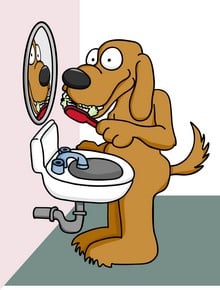 And like magic, your teeth will be sparkling clean.
Sound absurd?
Well, that’s what most of us have been told about the nearly magical tooth-cleaning power of dry dog food.
Is this true? Or not?
To answer that question, let’s take a quick look at the facts.
Why Tooth Debris
Is So Difficult to Remove
There are three kinds of dental debris…
- Food particles
- Plaque
- Calculus (tartar)
Food particles are easy to remove. However, plaque and tartar are different.
Plaque is the sticky biofilm that adheres tightly to every tooth surface. It requires physical scrubbing to remove.
And once cleaned away, plaque can quickly return in just 24 hours.
Left along the gumline long enough, plaque slowly turns into a rock-hard, barnacle-like crust referred to as calculus — also know as tartar.
Plaque is what you remove with your toothbrush. Tartar is the hard stuff your dentist scrapes away when you get your teeth cleaned.
Dry Dog Food Could Contribute to Dental Problems
Sure, crunchy kibble can remove some of the plaque near the tops of a dog’s teeth. But it can also be ineffective within the critical zone near the gumline.
And that’s where plaque and tartar cause their most harm — decay (cavities) and gum disease.
Even industry regulators look the other way when products claim to cleanse or whiten teeth. They simply avoid the issue altogether by labeling these marketing claims as “not objectionable”1.
In fact, since most kibbles contain a higher percentage of refined carbohydrates, dry dog foods could ultimately increase plaque and tartar levels — and thus cause more dental problems than they supposedly prevent.
In a nutshell…
Dry dog foods do not necessarily produce healthier teeth and gums
So, when choosing between canned or dry dog food, it’s OK to choose kibble. However, don’t choose it based solely on the assumption it’s better for your dog’s teeth.
A Much Better Way
to Clean Your Dog’s Teeth
Although it’s not perfect, there’s a simple and more natural way to improve a dog’s dental health without resorting to less effective kibble.
And that’s using raw meaty bones.
Because of their mildly abrasive texture and their ability to flex around the teeth, raw meaty bones can help remove dental plaque.
These bones (typically from poultry) are generally considered safe and digestible for most dogs.
However, because they can splinter, never use cooked bones of any kind. And for the same reasons, avoid weight bearing leg bones from larger animals.
In addition, although the risk is small, uncooked meat can carry bacteria that can be hazardous to both pets and humans. So, use caution and common sense when handling these natural tooth-cleaning treats.
The Most Reliable Way
to Prevent Dental Disease in Dogs
The only scientifically proven way to decrease plaque and tartar is the same for dogs as it is for humans — daily brushing combined with routine tartar removal by a health professional.
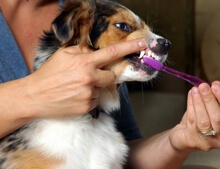 Of course, anyone who has tried it already knows: brushing a dog’s teeth can be one of the most challenging tasks of pet ownership you can undertake.
Unfortunately, without daily home care and professional cleanings, canine dental disease could be a real possibility.
So, if you decide to give it a try, use a baby-soft toothbrush. And maybe one of those food-flavored canine toothpastes. You could be adding years of better health to your dog’s life.
Final word
The Dog Food Advisor does not accept money, gifts, samples or other incentives in exchange for special consideration in preparing our reviews.
However, we do receive a referral fee from online retailers (like Chewy or Amazon) and from sellers of perishable pet food when readers click over to their websites from ours. This helps cover the cost of operation of our free blog. Thanks for your support.
For more information, please visit our Disclaimer and Disclosure page.