
Is It OK to Give a Dog Milk or Dairy Products?

Share

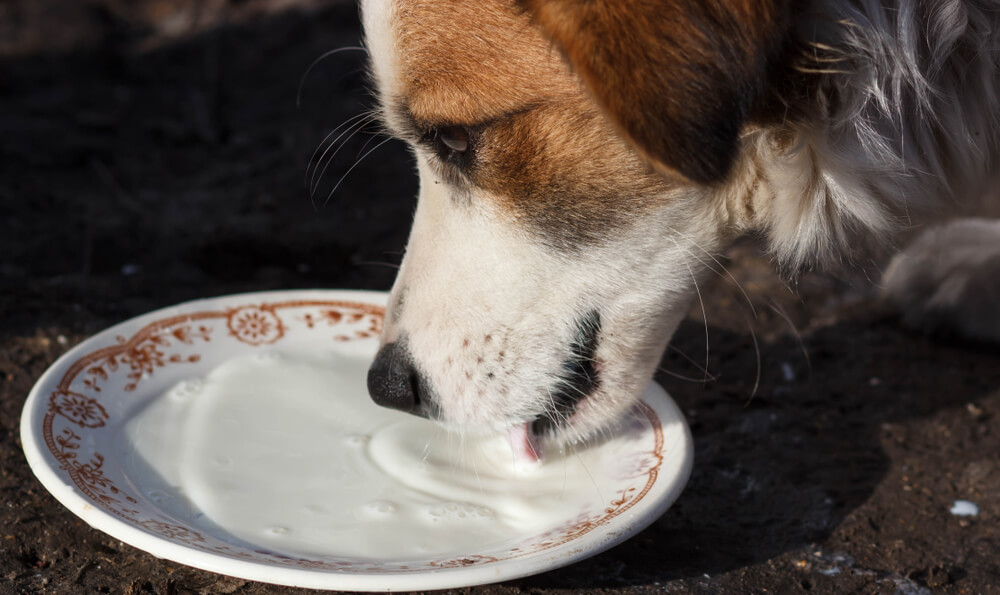
Dog Enjoying Milk Product
Oh, how Penny used to love ice cream. All I had to do was simply open the freezer door, and in a flash, she’d be there. Looking up at me. Wagging her tail in utter anticipation.

Well, that was before I’d heard that dogs weren’t supposed to have milk or dairy products.  When I asked why, I was simply told that milk was “bad for dogs”.

Until then, I’d never given the subject much thought. After all, Penny’s vet used to suggest hiding her pills inside a slice of cheese.

So, what’s all this fuss about giving dairy products to your dog?  Is it OK. Or not?

Well, that all depends on your dog’s particular body chemistry.

Milk’s Most Disagreeable Feature

Some dogs have no problems digesting dairy products. Yet others experience acute intestinal distress like gas, diarrhea or vomiting.

It all comes down to how your dog handles a specific nutrient found in milk. A nutrient known as lactose.

I know you’ve probably heard of lactose before. But what exactly is it?

Well, lactose is actually a kind of sugar. Not just one single sugar, but two sugar molecules chemically linked together.

In order for a dog to digest milk, the lactose must first be broken apart into its two more basic, easy-to-absorb sugars.

And that’s just it. You see, a dog’s body must be able to produce its own special lactose-splitting enzyme. An enzyme known as lactase.

And that’s one thing very few dogs can reliably do.

Like Humans… Dogs Can Also Suffer
from Lactose Intolerance

Without lactase, a dog simply cannot digest dairy products. And acute intestinal symptoms nearly always arise. This inability to digest milk is infamously known as lactose intolerance.

The same lactose intolerance so many humans suffer from every day.

So, if you’ve ever noticed your dog tends to develop gas or loose stools after having milk, there’s a good chance she may be suffering from lactose intolerance.

Knowing a Food’s Lactose Content
Can Help Your Dog

To be fair, I do have to mention (in rare cases) a dog can be allergic to the protein in milk1.

Other than that, milk shouldn’t be considered toxic for a dog. And no, it doesn’t cause worms either (no kidding, I’ve actually heard that silly rumor myself).

Yet for dogs that are lactose intolerant (as so many actually are), dairy products can present a real problem.

For those pets, there’s still hope.

That’s because a dog’s reaction to lactose can be directly related to the “dose”. The higher the lactose content, the greater the likely response.

Thankfully, not all dairy products contain the same amount of lactose.  Many kinds of cheese and yogurt contain considerably less than milk.

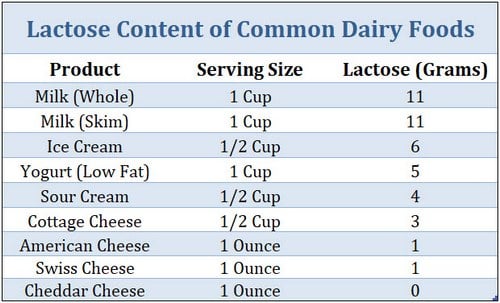
Take a look at this table. Notice that certain fermented milk products contain only minimal amounts of lactose per serving.

Lactose Content of Common Dairy Foods

For example, notice how most cheeses contain very little lactose. About a gram per serving. Sometimes less. Now, compare that quantity to whole milk, which clocks in at a whopping 11 grams.

So, if your dog can’t handle milk or ice cream, why not try one of these low lactose products?

Three Ways to Ease Milk Problems

If your dog seems to be able handle dairy products, then feel free to offer her milk-based foods. Of course, in moderation.

If not, try one of these three simple ideas…

1. Decrease the serving size. Try a spoonful instead of a scoop

2. Choose dairy products with lower lactose content

3. Offer lactose-free milk products

And remember, when in doubt, consult your veterinarian for professional advice.

  1. Wills J, Harvey R, Waltham Centre for Pet Nutrition, “Diagnosis and management of food allergy and intolerance in dogs and cats”, Australian Veterinary Journal, 1994 Oct; 71(10):322-6
Dog Food Advisor IconThe Dog Food Advisor publishes independent reviews to help pet owners make better choices when shopping for dog food.


  • John

    Good article. Some science and common sense.

    My dog LOVES milk, and has exhibited none of the symptoms of lactose intolerance.

    I had stopped giving it to her for years – mainly because I stopped drinking it and didn’t keep it around.

    Recently, she’s been in pain while defecating and has problems with anal fissures.

    I’ve started giving her some milk, with metamucil mixed in – to soften her stool.

    I read a vet comment on another site that milk may be used therapeutically as a stool softener, which confirmed my thinking on it.

  • http://DogFoodAdvisor.com Mike Sagman

    Hi Anais… I’d be more concerned about the injury to his mouth. His signs and symptoms appear to include pain, salivation and discomfort probably associated with his dental injury. And not likely lactose intolerance. In any case, since I’m not a veterinarian, it would be inappropriate for me to provide specific health advice. Please visit your vet as soon as possible. Dental infections can be serious.

  • Anais

    My dog is 5 years old. He’s a Shih Tzu and is 19 lbs. Last night he lost a touth in a very small fight (no real fight) but it bled a lot so I gave him half a McDonalds ice cream cone. He was fine and ate dinner after that normally.

    Then today around 5pm I gave him another ice cream cone thinking it would reduce the swelling and pain of his lost tooth (that wasn’t really ready to come out) and now 3 and a half hours later when we returned to the park to run, he wouldn’t get out of the car, he’s salavating excessively and he never does that, he’s starting to shake, he’s keeping his head down, and he has a light wimper with every breath. Could it be pancreatitis or something else? Is this just a really bad stomach ache?

    I know for sure he ate nothing else. He didn’t get into anything. He’s been with me all day. There was no injury from the fight. Does this sound like lactose intolerance?
    I will never give ice cream again!
    Please tell me your opinion.
    Thanks

  • http://DogFoodAdvisor.com Mike Sagman

    Hi Jessica… When used in dog food, tapioca is a natural (non-dairy) extract made from the root of the cassava plant. Tapioca pudding is made with milk. I’m not aware of any dog foods made with tapioca pudding. Hope this helps.

  • Jessica

    I was just wondering if there is other words in products that can mean diary Example Tapioca Starch is made with milk …. Didnt know that until 4years later so is there any other words I should look out for? Thank You for your time. :) Jessica

  • Gordon

    Shameless – This thread has slipped out of the right recent comments list but I remembered that maybe you may have responded so I’ve checked, and thanks for the links.

  • ShamelessRawFoodie

    Gordon – Here is some information about kefir -
    http://www.raw-milk-facts.com/kefir_T3.html

    and purchasing kefir grains –
    http://www.culturesforhealth.com/milk-kefir-grains.html

    People share their grains (they continually ‘grow’) so if you find a Kefir Friend, they will usually share their grains:
    Real Live Kefir Grains shared by members worldwide
    http://www.torontoadvisors.com/Kefir/kefir-list.php

  • Gordon

    Shameless – I’m thinking of “killing 2 birds with one stone and using goats milk, as its also agrees with human skin in healing certain itches, and minor dermatological skin issues. Great for a soothing bath.

    Anyway, this is not my strong area of knowledge and am happy for any advice or tips, Shameless re kefir.

    Anyway, I’ve got to go for now, so I’ll read your response tomorrow, is there is any. Cheers.

  • Jonathan

    We are the only animal that intentionally drinks another animal’s milk. We are also the only animal that drinks milk after weaning. I am of the impression that, while occasional dairy may be fine, the constant use of milk and milk products is both unnatural and unnecessary for both man and mutt.

  • ShamelessRawFoodie

    Gordon – You are “on the verge of making kefir” according to your comment today on the Brothers thread. (I thought I’d get the topic over to this more applicable page.)

    How will you make your kefir? Kefir grains? Raw milk? Cow milk? Goat milk?

    We have serious kefir’ers in our raw food co-op. My husband and I have learned a lot from the REAL FOOD purists.

    Also, I’ve learned that the ‘lactose intolerant’ problem that many allude to (for dogs and humans) doesn’t typically apply to raw milk products. Pasteurization alters (adulterates) nutrients and therein lies most problems.

  • Pingback: Greek yogurt for puppies ok? - Golden Retrievers : Golden Retriever Dog Forums

  • arlin ayeras

    how to treat a bad fell puppies to make them feeling well??

  • arlin ayeras

    what are the common sickness of a puppy?

  • http://DogFoodAdvisor.com Mike Sagman

    Hi Arlin… One month old puppies have very special needs. There’s nothing on this website to address the nutritional requirements of puppies this young. Please contact a vet or a knowledgeable breeder for help immediately.

  • arlin ayeras

    hi’i have 2 puppies and their both 1month old’i try to drink them a powdered milk everyday’my problem is’after 4 hours drinking their milk’ 1 of them was vomiting a worms and i think it a roundworms.i need you help…

  • andrew ricky

    My dog Shelly had a gallstone removed. vet said it was due to calcium deposit. Shelly loved milk and ice cream. symtems of the gallstone was trouble urinating and latter blood in urine. after the gallstone was removed she was like a puppy again. Shelly is 15 years old. Aloha

  • Pingback: Is It Fine to feed a Dog Cow Milk or Dairy Products? | www.HallRoad.pk

  • Mike

    My dog is now three. He has been fed Milk, Cheese, Yoghurt, Raw Eggs (though these do seem to give him a little wind, really smelly bad wind) and various other dairy products ever since he was old enough to be weaned from his mother. Never had any problems at all, period.

    The only foodstuffs I have found make him a little loose is when we used to feed him the leftovers from curry night!!!! Made him smell pretty bad as well if I am going to be honest.

    Rule of thumb I tend to go by, if it makes him ill, don’t give it him again. Kind of like small children in that respect!!

  • http://DogFoodAdvisor.com Mike Sagman

    Hi Lynne… Milk itself contains the highest amount of lactose which for many dogs can be very difficult to digest. What’s more, due to the biological uniqueness of each pet, it would be impossible for me to assure you one form of milk would be any safer for your dog than another. Wish I could be more help.

  • lynne

    hi!
    my dog is an adult dog and loves milk, he doesnt seem to have any problems with it but i know its not the best for him, could i feed him puppy formula milk, even tho he is an adult? i would quite like to give him milk every other day as he is only fed once a day in the evening and i feel that feeding him 2 meals a day would be too much for him. he is a small jack russell.
    thanks

  • Jonathan

    That’s great Liz! Milk and meat from grass-fed cows is superior in every way to store bought grain fed junk. Do you feed them raw food, too?

  • liz

    Hello …I give my dogs raw milk from grass fed cows. They also eat yogurt and kefir from the same source. Not being pasturized and being from organic grass fed cows none of the dogs have diarrhea or loose stools. Also get a raw egg from organic free range chickens on a daily basis. Thanks, just thought I would share.

  • Melissa

    Rick Abrams-

    We give our dogs the occassional dairy treat as well, w/out issue-cottage cheese, milk leftover from cereal, ice cream et and have never had a problem either. Its all about the individual dog and knowing what he/she can tolerate.

    If your dog has thin bones and requires calcium supplement however, I would ask the vet about a supplement as I don;t think a dog(like a person) could get enough calcium from just drinking limited amounts of milk.

  • http://www.drianbillinghurst.com/ Gordon

    Personally, I don’t see any reason or benefit in feeding dogs any dairy products apart from yoghurt as a topping from time to time, which hasn’t caused any lactose intolerance to my dogs anyway.

    I’ve also heard, that cottage cheese with its low lactose level is an excellent dairy product to feed a dog. I haven’t personally offered this to my dogs.

    I think it’s all about using common sense. If your dog sees you putting some cottage cheese on toast for breakfast and it wags its tail, and its facial expression is one that would suggest heaving, with anticipation in getting some, then why not trial giving it some cottage cheese, with out the toast?

    I doubt it would die, and if it had a negative reaction, then common sense would tell you, not to give it cottage cheese anymore.

  • Bill

    According to DR. BECKER, a “holistic vet” on the web, “canines are lactose intolerant”, period!

  • Rick Abrams

    We take care of several dogs. Three of them love milk and I have watched them carefully. My main concern was loose bowels, but if anything unusual had occurred, we would have noticed it and stopped. Our dogs are not lactose intolerant and one has thin bones and needs extra calcium.

    I do not see how one can find out if his dog is lactose intolerant by stopping milk. If one wants to find out, I suggest one start with just a little and watch the dog for the symptoms of intolerance.

    This is only speculation, but I would tend to think that dogs which have a genetic history of living on farms may not be lactose intolerant.

  • http://DogFoodAdvisor.com Mike Sagman

    Hi Jaqueline… Milk can be a problem for many dogs. I’d recommend you stop feeding your dog milk until you know for sure.

  • jaqueline

    hi,
    So after my dog eats his food i give him some milk and it looks like he enjoys drinking it but lately i have noticed that a couple hours later hes vomiting the food from earlier. i dont know if it is because of the milk or if there is something wrong with him but im not sure if milk can do that?

  • http://DogFoodAdvisor.com Mike Sagman

    Hi Louise… Soy milk is lactose free. And fro humans, it can be a healthy choice. But it’s a plant-based source of protein. And from a canine standpoint, it is a food I (personally) know little about. For that reason, it would be misleading for me to comment here on soy milk or to assure you it is good choice for your dog.

    I any case, your dog’s digestive system appears to be sending you a very subtle message. And one I would be inclined not to ignore.

  • louise

    Hi

    I have been giving my border collie soya milk .It has made im ”looser” and he hasnt been for days..Is this harming him in any way, like he might not be able to digest it..He loves licking my soya yogerts pots, and it seems ok, cos i been giving the yogert pots for ages now, and he has not symptoms..He is 14 years old, so perhaps thats got summat to do with him being off his food..He does eat a little if i put ham, plain pasta or bit of rice in his bowl,but he doesnt eat much.. He does drink loads of water and had no problems going for a wee.. Any ideas, thanks

  • http://DogFoodAdvisor.com Mike Sagman

    Hi Toni… I’m sorry your dog doesn’t feel well. And I would imagine your dog will probably be fine within a few hours. However, since I’m not a veterinarian, it would be inappropriate for me to provide specific health advice. If the situation doesn’t improve or if it looks like your dog is getting worse, you may need to visit your vet. Sorry I can’t be more help.

  • Toni S

    Mike,
    I have a 2 yr old Shih Tzu. We recently moved in with my husbands grandfather to help take care of him. He also has a dog that is severly obese. He has always fed animals whatever HE thinks they should eat. I have asked him repeatedly not to give my dog any food. Today he gave her 2 bowls of milk. Now she is walking around acting strange. she keeps acting like she wants to vomit but is not really gagging. I am assuming this means she lactose intolerant. What do i do? Does she need to go to the vet or will it pass on its own? any info would be great.
    Toni

  • http://DogFoodAdvisor.com Mike Sagman

    Hi Rania… Of all the different types of dog food available, kibble is the most unlike “real” food you can get. You may wish to start with a tasty canned food first and then gradually introduce a kibble. Hope this helps.

  • Rania

    Hi Mike,

    I am a first time dog owner and recently rescued a female 2-yr old chihuahua. The previous owners fed her only human food. It’s been just over a week and I’ve tried several different brands of dog food, but she refuses to eat. To top it all off, she has Lyme disease and must take antibiotics to quash it, so her starvation is becoming a serious concern. I’ve tried weaning her off human food but she just refuses to eat. Any suggestions?

  • http://DogFoodAdvisor.com Mike Sagman

    Hi Nick… As long as your dog is not allergic to milk and is able to adequately digest it, I wouldn’t expect any long term effects. But consult with your vet to be sure.

  • Nick

    I started giving my dog vanilla ice cream and he has been fine, german shepherd boarder collie mix. No diarrea, vomiting ect ect. I started giving him 1% milk, a good bit of it to see what would happen and again, his poo is normal, no vomiting no problem peeing or gas issues. Ive given him milk every other day and sometimes every day and he loves it and it dosent effect his bathroom breaks at all. Just wanted to know if my dog is superhuman, because everyone says dogs cant break it down, but I have yet to see any issues, and every time I bring milk out for a glass, he begs for some. I hope these signs show thats its okay for me to give him milk, expert opinion would be great in terms of long term side effects ect ect.. But he handles it quite well in my opinion!

  • Cathy

    More about RAW DAIRY FOR DOGS :
    http://www.westonaprice.org/health-issues/286-home-prepared-diets-for-pets.html
    The Great Milk Debate
    Should dogs and cats eat dairy products? . . .
    Raw, unpasteurized, unhomogenized milk straight from healthy, organically raised, grass-fed cows or goats is an excellent food for dogs and cats. Unfortunately, America’s supermarkets stopped selling raw, whole milk long ago. Some states allow raw milk to be sold for pet use, and some allow consumers to buy raw milk directly from dairy farms. . .
    When introducing dairy products, feed them once a week to be sure your dog or cat tolerates them well; then use as often as desired.

    Where to find raw dairy products? http://www.realmilk.com/where.html

  • Cathy

    Animals eating exactly what Mother Nature intended. . .
    http://www.westonaprice.org/health-issues/286-home-prepared-diets-for-pets.html
    The Natural Rearing Diet
    During the 1940s and 1950s, while food scientists in England and Europe were developing commercial pet foods, Juliette de Bairacli Levy fed her unvaccinated Afghan hounds raw meat, raw bones, raw goat milk, raw fish, raw eggs and a variety of raw fruits, vegetables, nuts and oils. The only medicines she used were herbs. Supremely healthy and intelligent, her dogs won numerous championships and de Bairacli Levy gained a devoted following around the world. In 1955, she published The Complete Herbal Book for the Dog, which explained the Natural Rearing diet and philosophy. (The book was renamed The Complete Herbal Handbook for the Dog and Cat3 in subsequent editions.)

    The Natural Rearing canine diet is based on raw meat, including bones and organs, from a variety of animals. The meat is never frozen and is served whole or in large chunks, not ground or minced. The diet also includes raw milk, especially goat milk; cereal grains, especially those that have been flaked and soaked overnight in raw milk; small amounts of sprouted seeds; finely grated or baked root vegetables; occasional fruits and nuts; and miscellaneous foods such as honey, eggs, seaweed, carob, coconut, avocados and olives. These items should be organically grown whenever possible.

    One day each week the dinner is meatless, with raw milk, eggs or cheese mixed with slowly cooked whole-grain cereal, rice or lentils. The following day is a fast day, with only water served or, if necessary, a small amount of honey in water, diluted milk or water from flaked oats or barley soaked overnight. In the wild, dogs hunt when hungry, eat when food is available and often go a day or more without a substantial meal. Feeding a light dinner followed by a day-long fast approximates this schedule.

  • Cathy
  • Cathy

    Nikki – I agree with you about raw unpasteurized cow milk being different (better) than processed milk. Beneficial bacteria and enzymes are destroyed by the high-heat processing. I know people who WERE lactose-intolerant when they consumed pasteurized dairy; when they began consuming raw dairy, their lactose-intolerance *magically* disappeared, and they’ve not ever again had lactose problems! It’s amazing how the body knows what to do with Real Food. Dogs are similar in that they will thrive on Real Food.