
Is It OK to Give a Dog Milk or Dairy Products?

Share

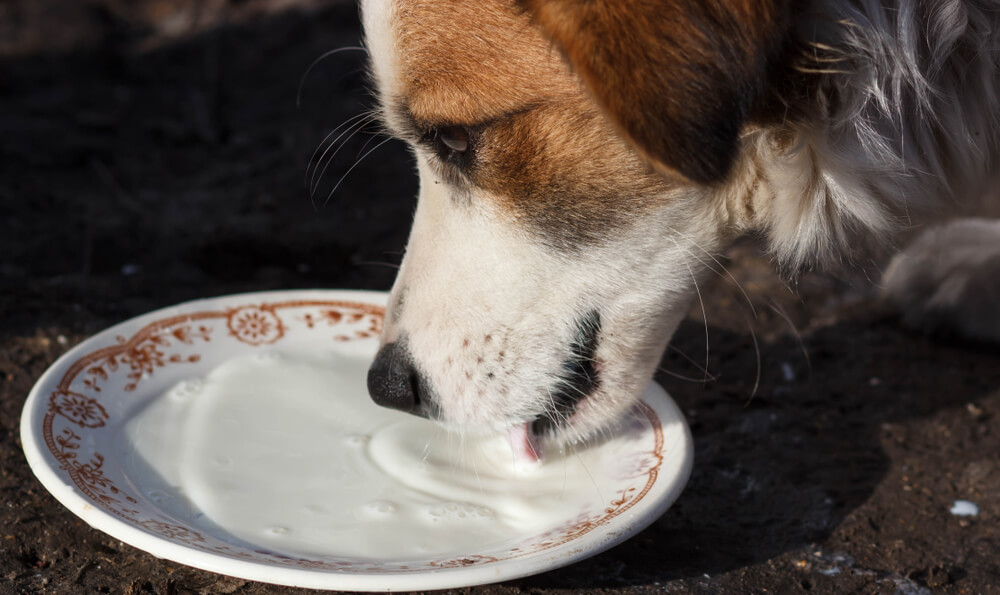
Dog Enjoying Milk Product
Oh, how Penny used to love ice cream. All I had to do was simply open the freezer door, and in a flash, she’d be there. Looking up at me. Wagging her tail in utter anticipation.

Well, that was before I’d heard that dogs weren’t supposed to have milk or dairy products.  When I asked why, I was simply told that milk was “bad for dogs”.

Until then, I’d never given the subject much thought. After all, Penny’s vet used to suggest hiding her pills inside a slice of cheese.

So, what’s all this fuss about giving dairy products to your dog?  Is it OK. Or not?

Well, that all depends on your dog’s particular body chemistry.

Milk’s Most Disagreeable Feature

Some dogs have no problems digesting dairy products. Yet others experience acute intestinal distress like gas, diarrhea or vomiting.

It all comes down to how your dog handles a specific nutrient found in milk. A nutrient known as lactose.

I know you’ve probably heard of lactose before. But what exactly is it?

Well, lactose is actually a kind of sugar. Not just one single sugar, but two sugar molecules chemically linked together.

In order for a dog to digest milk, the lactose must first be broken apart into its two more basic, easy-to-absorb sugars.

And that’s just it. You see, a dog’s body must be able to produce its own special lactose-splitting enzyme. An enzyme known as lactase.

And that’s one thing very few dogs can reliably do.

Like Humans… Dogs Can Also Suffer
from Lactose Intolerance

Without lactase, a dog simply cannot digest dairy products. And acute intestinal symptoms nearly always arise. This inability to digest milk is infamously known as lactose intolerance.

The same lactose intolerance so many humans suffer from every day.

So, if you’ve ever noticed your dog tends to develop gas or loose stools after having milk, there’s a good chance she may be suffering from lactose intolerance.

Knowing a Food’s Lactose Content
Can Help Your Dog

To be fair, I do have to mention (in rare cases) a dog can be allergic to the protein in milk1.

Other than that, milk shouldn’t be considered toxic for a dog. And no, it doesn’t cause worms either (no kidding, I’ve actually heard that silly rumor myself).

Yet for dogs that are lactose intolerant (as so many actually are), dairy products can present a real problem.

For those pets, there’s still hope.

That’s because a dog’s reaction to lactose can be directly related to the “dose”. The higher the lactose content, the greater the likely response.

Thankfully, not all dairy products contain the same amount of lactose.  Many kinds of cheese and yogurt contain considerably less than milk.

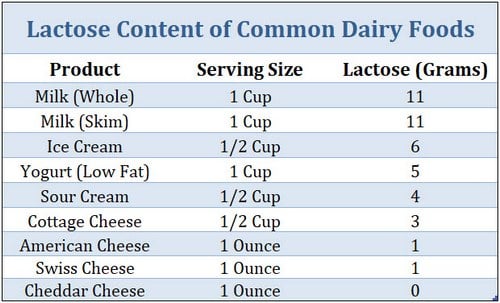
Take a look at this table. Notice that certain fermented milk products contain only minimal amounts of lactose per serving.

Lactose Content of Common Dairy Foods

For example, notice how most cheeses contain very little lactose. About a gram per serving. Sometimes less. Now, compare that quantity to whole milk, which clocks in at a whopping 11 grams.

So, if your dog can’t handle milk or ice cream, why not try one of these low lactose products?

Three Ways to Ease Milk Problems

If your dog seems to be able handle dairy products, then feel free to offer her milk-based foods. Of course, in moderation.

If not, try one of these three simple ideas…

1. Decrease the serving size. Try a spoonful instead of a scoop

2. Choose dairy products with lower lactose content

3. Offer lactose-free milk products

And remember, when in doubt, consult your veterinarian for professional advice.

  1. Wills J, Harvey R, Waltham Centre for Pet Nutrition, “Diagnosis and management of food allergy and intolerance in dogs and cats”, Australian Veterinary Journal, 1994 Oct; 71(10):322-6
Dog Food Advisor IconThe Dog Food Advisor publishes independent reviews to help pet owners make better choices when shopping for dog food.


  • Egerstner49

    I want to start making dog & cat treats, cakes and cupcakes, Can I substitute SOY Milk, or, any other lactose free milk in the recipe??  Also, I have a couple recipes that call for 6 to 8 oz of cream cheese, what can be substituted for that to make is safe for both cats & dogs???

  • kiki

    i love dogs <3 <3 <3 <3

  • kiki

    this is good my dog loves it!!!!

  • kiki

    it helps so much i love you for this thanks <3 <3 <3

  • kiki

    THANKS YOU SO MUCH.

  • Enchantedbuddha

    Thank you very much my Kudos loves a slice of cheese every morning he waits by the refig and loves to lick the stick after we have ice cream and of course no chocolate

  • DEJ

    Most helpful, thanks a bunch!

  • Pingback: Brian’s Treatment Day 2 | fulleer's space

  • COCO

    Thank you , kind soul. Your article was most helpful and my dog thanks you from the bottom of his heart. 

  • Pingback: Are Human Foods OK For Dogs To Eat? - The Fun Times Guide to Dogs

  • Kevin

    My friend bought a boston terrior about 2 years ago. The seller gave my friend a recipe to mix in the dogs food. It consisted of
    plain yogurt, cottage cheese, and pumpkin. This is suppose to be good for their coat and skin. My friend lost the recipe of the amounts to mix together. Do you know of any reliable websites for dog recipes?

  • Shawna

    Michelle,

    They are both an alias.. Both are names from the TV show “The Office”. Michael Scott is the character played by Steve Carell..

  • Michelle

    Mike Sagman, I agree. Also, is this dude’s name dwight schrute or Michael Scott? Well, whatever his name is, if he doesn’t have any useful information, he should just stop trolling. I mean seriously, what a stupid, and annoying comment.

  • http://DogFoodAdvisor.com Mike Sagman

    Michael Scott… I’m sorry you find my use of the ellipsis “annoying”. For it was certainly never my intention in researching this topic and posting this article to displease you (or anyone). So, I promise to give your criticism some thought.

    However, I find it difficult to understand how anyone could possibly avail themselves of content like this and yet somehow manage to focus on such a trivial issue.

  • http://dundermifflin.com Michael Scott

    I am referring to the author, Mike Sagman.

  • Michelle

    dwight schrute, who are you talking to? Also, it is really annoying when someone doesn’t capitalize their name! :)

  • http://dundermifflin.com dwight schrute

    Can you please not use an ellipsis in place of a comma when you type? That’s not correct grammar and it is really annoying.

  • http://en.wikipedia.org/wiki/Ninja Dog Food Ninja

    Carl, the better question might be “why would anyone give a dog soy milk?”. lol

    Really, though, there is no health benefit that a dog would glean from soy milk. And as Mike said above, at least dairy products have very usable animal fat as opposed to plant-based fats which are less productive in a carnivore.

    Might I also paraphrase Lewis Black; there is no such thing as soy milk, because there is no soy teats. It’s soy juice. But they don’t call it that, because when you say “soy juice”, it kind of make you want to throw up a little.

  • http://DogFoodAdvisor.com Mike Sagman

    Hi Carl… Although soy is lactose free (a good thing for a dog), it might be OK. However, since it’s a plant-based food, I’m not so sure it would be as healthy for a dog as a regular lactose-free dairy product (like cheese). In any case, you may wish to check back for a response from one of our other readers.

  • Carl Paul

    is it ok to give dogs soy milk? the pure one :) thanks

  • Pingback: Lactose Intolerant

  • Carolyn

    I have found that when my precious Maddie has hard stools I add fresh pumpkin to her food. Do not give them the pumpkin pie mix just plain pumpkin.It has lots of fiber and they love the taste…

  • http://DogFoodAdvisor.com Mike Sagman

    Hi Harky… If diarrhea symptoms appear whenever you feed a dairy product, you should probably consider eliminating milk from your dog’s diet. If however, you only see the symptoms on rare occasions, it’s not nearly as likely these foods are responsible for the problem.

    Unfortunately, since I’m not a veterinarian and due to the biological uniqueness of each pet, it would be inappropriate for me to provide specific health advice. You may wish to check back for a possible response from one of our other readers.

  • harky

    if my dog is around 5yr old and he had a history of diarrhea (at least every yr) do u think i should stop it?

  • Gordon

    Gabby – Yes, goat’s milk is also extremely favourable to human skin applied directly. I use natural plain unscented goat’s milk soap which has proven skin healing properties. I shower with it every day and it helped clear up some dermatitis I had over a period of weeks.

    I would imagine that you may even benefit your dog by applying raw goat’s milk on a daily basis, directly on the areas of your dog’s skin that has allergies, and rub it over liberally, and see how that goes. You never know, it may just help.

  • Shawna

    Gabby,

    My dog, Audrey, was born with kidney disease and a collapsing trachea. She could not suckle enough milk, due to the trachea, from her mom for proper nutrition. From about 3 or 4 weeks of age til about 6 weeks of age the breeder syringe fed her RAW goat milk and egg whites to keep her alive — the combination saved her life. She is now 5 years old and going strong.

    Answers makes raw pet food and also carries raw goat milk.. I’ve heard A LOT of good things about the product and “RAW” goat milk in general. Here’s some info on the Answers website. http://www.answerspetfood.com/additional.html

    Pasteurized goat milk is no better then any other milk imo..

  • Gabby

    Our local organic pet store had recommended goat’s milk as a remedy for dog food allergies. My bulldog had some pretty bad skin allergies and was thinking about trying it. Has anyone heard anything about goat’s milk and the effects it has on dogs?

  • ShamelessRawFoodie

    jazz – how are your kefir grains activated with using pasteurized (dead) milk?

  • jazz

    I give my dog kefir milk from homemade kefir grain’s.he now has no problem with dairy although use semi skimmed pasturised milk. ;(

  • Jonathan

    “There are calculations which estimate how long it took to increase the gene for adult lactase persistence (ALP) in northern Europeans from a pre-agricultural incidence rate of 5% to its present rate of approximately 70% [Aoki 1991]. (Note: The enzyme lactase is required to digest the sugar lactose in milk, and normally is not produced in significant quantity in human beings after weaning.) In order for the gene frequency to increase from 0.05 to 0.70 within the 250 generations which have occurred since the advent of dairying, a selective advantage in excess of 5% may have been required [Aoki 1991].

    Therefore, some genetic changes can occur quite rapidly, particularly in polymorphic genes (those with more than one variant of the gene already in existence) with wide variability in their phenotypic expression. (“Phenotypic expression” means the physical characteristic(s) which a gene produces.) Because humans normally maintain lactase activity in their guts until weaning (approximately 4 years of age in modern-day hunter-gatherers), the type of genetic change (neoteny) required for adult lactase maintenance can occur quite rapidly if there is sufficient selective pressure. Maintenance of childlike genetic characteristics (neoteny) is what occurred with the geologically rapid domestication of the dog during the late Pleistocene and Mesolithic [Budiansky 1992].”

    Read more here…

    http://www.beyondveg.com/cordain-l/grains-leg/grains-legumes-1a.shtml#intro

    It’s more about grains in the diet than milk, but that snippet was interesting.

  • Gordon

    Why thank you Shameless. For that link that is. I’ve currently found an all organic yoghurt at a particular supermarket for me and my dogs, so I’ve not gone ahead yet to make kefir.

    That is, if I can believe it is fully organic. The label and contents suggest so, but I’m always a little skeptical.

    I could always buy some of that raw goats milk off that site, and bathe in it. Raw goats milk has an added bonus that it agrees with human skin and helps heel many human skin type allergies, including dermatitis.

  • Shawna

    I have a cyber friend on another forum that is a “toxic injury specialist”. She has written a white paper on pasteurized dairy and hopes to publish it soon. She asked me to read and critique… I was SHOCKED as I thought I knew a lot about pasteurized dairy. Nope – not as much as I thought.

    Example — they can add aspartame (without labeling it) to milk. I don’t want to reveal her sources but did find this — obviously it’s, at the very least, being considered in milk if they are studying the stability — http://www.ncbi.nlm.nih.gov/pubmed/8120202

    The material presented in her white paper was so overwhelming, I had to read the paper three times to completely comprehend what she had written (with references—not just her opinion).

    I hope she is able to publish her paper soon!!!

  • ShamelessRawFoodie

    Where to find RAW milk products:
    USA – http://realmilk.com/where1.html
    Other Countries – http://realmilk.com/where-other.html#aus

    For Gordon – Nimbin Valley Dairy (Australia, north of Sydney) appears to have a Sydney distributor:
    http://www.nimbinvalley.com.au/index.php?page=milk

    Mark McAfee – Founder, Organic Pastures, writes “It may seem strange to say or claim this, but Mother Nature is right, her blue print is right on point. It is mankind that has added variables that cause much of the concern for pathogens in our current market systems. Our consumers are made ill by pasteurized milk products and the additives and processing methods.” and “As an American we can buy raw eggs, raw meat, raw fresh juices, so why not raw dairy products?”
    http://www.realmilk.com/safety-raw-milk.html

  • Shawna

    Couldn’t agree more Shameless… Couldn’t agree more. Hee hee hee

  • ShamelessRawFoodie

    Hey Shawna – GREAT MINDS think alike, and post comments within one minute of each other!

  • ShamelessRawFoodie

    John – Pasteurized milk has adulterated lactase enzymes. My dog gets small amounts of RAW cow milk and sometimes raw goat milk. Also raw kefir. Here is some interesting information about milk and ‘lactose-intolerance’:
    “One reason raw milk is so much easier to digest compared to pasteurized milk is due to the presence of lactase, the enzyme that breaks down milk sugar. . . it is the friendly bacteria in raw milk that facilitate the creation of lactase in the intestine where it is needed. That is why lactose-intolerant people can drink raw milk without a problem. Pasteurization kills these friendly bacteria.”
    http://www.realmilk.com/safety-raw-milk.html
    http://www.realmilk.com/rawmilkoverview.html

    For your dog’s constipation, maybe try some canned plain pumpkin instead of Metamucil:
    http://www.care2.com/greenliving/health-benefits-of-pumpkins-for-dogs.html?page=2

    I would avoid artificial color and sweetener that are in most Metamucil ingredients:
    Metamucil Orange Smooth Fiber Supplement Powder Ingredients
    Sucrose, Psyllium Husk, Citric Acid, Natural and Artificial Orange Flavor, Yellow 6
    http://www.metamucil.com/metamucil-orange-smooth.php

    Sugar-Free Metamucil contains Aspartame (controversial chemical sweetener)

    Psyllium
    http://www.ncbi.nlm.nih.gov/pubmedhealth/PMH0000092/

  • Shawna

    Hi all,

    I hope you don’t mind my adding my two cents about dairy — unfortunately, it’s not positive.

    There are two issues with dairy and the digestive tract. The first is lactose intolerance which usually has symptoms appearing in the gut — pain, gas, bloating etc. When milk is pasteurized the heat damages the natural enzymes. Lactase is the enzyme naturally in raw milk that breaks down lactose. The other issue with dairy is an allergy or intolerance to the proteins in dairy (whey or casein — in all cases I’ve read about it was casein).

    Dairy allergies/intolerances don’t always have symptoms that would be associated with the gut. I am intolerant of dairy and my first diagnosed symptom (which at the time was not attributed to the dairy) was iron deficiency anemia in my early 20s. Second symptoms was b12 deficiency anemia in mid 20s. Third symptoms was iodine deficiency hypothyroid in my early 30′s. Dairy can kill the little hairs in the digestive tract (villi) and cause malnutrition without any other symptoms. In my late 30′s I discovered lattes and a specific kind of parmesean and feta cheeses and had a cheese and a latte (no sweetener) every day. Over a years period of time I got sicker and sicker. I saw three doctors including an internal specialist – no diagnosis. I had alternating arthritis like inflammation in both knees, a blister rash off and on on my scalp, swelling of my extremeties, sinusitus, tinitis, rhinitis plus.. I was finally referred to a M.D. that is also a Certified Clinical Nutritionist and she immediately knew what was wrong and put me on an elimination diet.. Sure enough, dairy was the culprit….

    The point I hope you take away from my story —- dairy is one of four foods that can cause digestive damage which can lead to malnutrition without digestive or other recognizable symptoms. If this is true for humans I imagine it is even worse in canines and felines. If you can get “raw” dairy then I say go for it but be very watchful when feeding pasteurized dairy products.

    Dogtor J DVM has some GREAT (imo) info on dairy and other foods that can cause the issues I’ve experienced. http://dogtorj.com/

    Sorry for the length of this… :)