
DogFoodAdvisor is reader supported See how
Dog Food Advisor is 100% impartial and is never paid to promote any brand. But if you buy using links on this page, we may earn a referral fee.

Finding and maintaining your dog’s ideal weight can significantly extend your pet’s life.
A 14-year landmark peer-reviewed study found that…
Dogs fed to ideal body condition lived 1.8 years longer than their overweight litter mates.
That’s nearly 2 extra years of life… just for keeping your dog at her ideal weight.

Which invites the question…
Where Can You Find
Your Dog’s Ideal Weight?
To find out what your dog should weigh, you could simply look it up in a table of suggested weights.
However, nearly every table provides this information in a range of weights.
For example…
For Labrador retrievers, the American Kennel Club suggests a range of 65 to 80 pounds.
That’s a huge difference of nearly 23%.
What’s more…
That figure can vary, depending on whether your pet is a male or a female.
What About Mixed Breeds?
Goldendoodles. Puggles. Cockapoos. And other genetic mixes.
Where do you go to find the ideal weight for non-standard breeds like these?
You certainly won’t find that kind of information on an AKC breed table.

Unfortunately…
There’s no clear reference for every individual dog. Because dogs come in so many builds, shapes and sizes.
The Ideal Weight System
Used by Vets
Here’s a solution that works for all dogs.
The best way to determine your dog’s ideal weight is to use the same method used by vets.
The Body Condition System (BCS).1
The following 2-minute video2 shows how you to evaluate your dog’s current body condition.
Keep in mind…
The vet in this video uses a European 5-point system… whereas the U.S. system rates your dog on a scale from 1 to 9.
Anyway, you’ll get the idea once you watch the video.
Body Condition Score
The Body Condition System uses visual inspection and your sense of touch to rate the state of your dog’s…
- Ribs
- Waistline
- Tummy
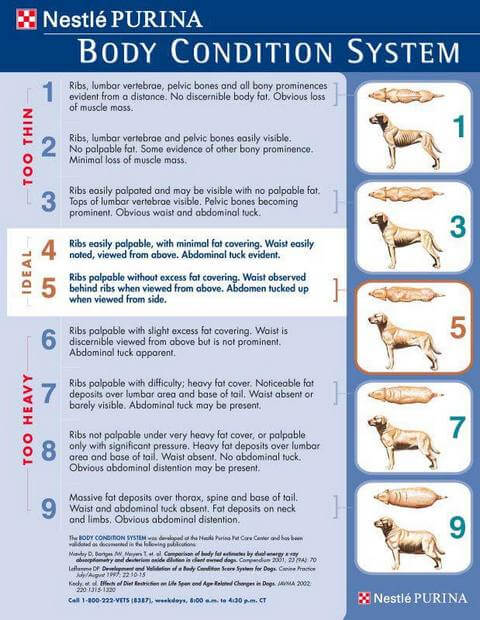
By using your senses of sight and touch, you assign your dog to one of three categories…
- Too Thin (Body Condition Score = 1 to 3)
- Ideal (Body Condition Score = 4 to 5)
- Too Heavy (Body Condition Score = 6 to 9)
Your dog’s BCS score will be based on comparing her appearance to the above diagram…
And by palpating (feeling) the ribs and frame.
Once your pet reaches a body condition score of 4 to 5 on a 9-point scale… be sure to weigh her. You’ve now determined your dog’s ideal weight.
What to Do Now?
Keeping your dog at ideal weight can help her live a longer life.
So…
Start with the suggested serving size printed on the food package. Weigh your pet monthly. Then, adjust that serving size up or down… to keep your dog at ideal body condition.
Feeding Tip
Many fresh dog foods are delivered in pre-measured packages optimized for your particular dog. This can help your pet reach and maintain ideal body condition. View our Best Fresh Dog Foods here.
Our Editor’s Top Picks
October
How does your current favorite recipe compare with The Dog Food Advisor’s most recommended brands?
- Best Dog Foods
- Best Puppy Foods
- Best Dry Puppy Food
- Best Wet Puppy Food
- Best Small Breed Puppy Food
- Best Large Breed Puppy Food
- Best Dry Dog Food
- Best Wet Dog Food
- Best Dog Food for Allergies
- Best Dog Food for Small Dogs
- Best Dog Food for Large Breeds
- Best Grain Free Dog Food
- Best Dog Food with Grain
- Best Fresh Food for Dogs
- Best Raw Dog Food
- Best Organic Dog Food
- Best Senior Dog Food
- Best High Protein Dog Food
- Best Dog Food for Weight Loss
- Best Budget-Friendly Dog Food
- Best Dog Food for Sensitive Stomach
- Best Low Fat Dog Food
- Best Food for Specific Breeds
Final word
The Dog Food Advisor does not accept money, gifts, samples or other incentives in exchange for special consideration in preparing our reviews.
However, we do receive a referral fee from online retailers (like Chewy or Amazon) and from sellers of perishable pet food when readers click over to their websites from ours. This helps cover the cost of operation of our free blog. Thanks for your support.
For more information, please visit our Disclaimer and Disclosure page.