
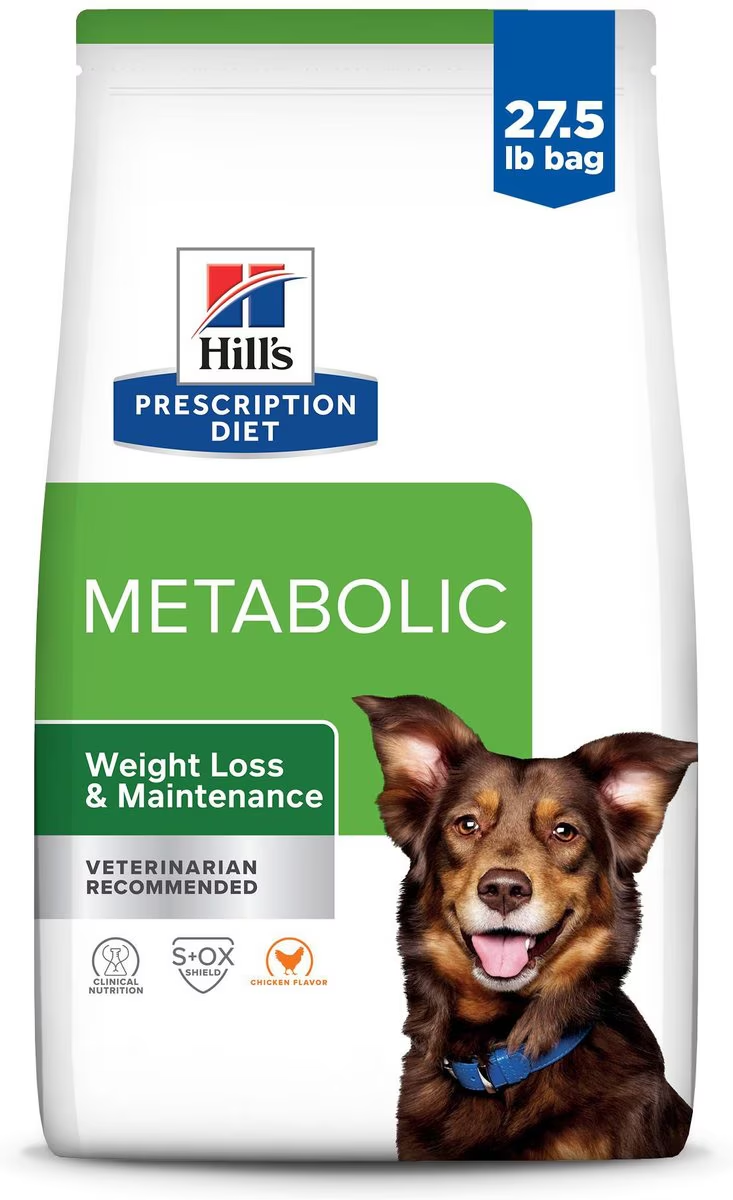
Hill’s Prescription Diet Z/D Canine (Dry)

Share

Rating: ☆☆☆☆☆

Hill’s Prescription Diet Z/D dry dog food is not rated due to its intentional low meat therapeutic design.

The Hill’s Prescription Diet Z/D product line includes two dry dog foods, each designed to prevent “adverse reactions to food and claimed to meet AAFCO nutrient profiles for adult maintenance.

The following is a list of recipes available at the time of this review.

  • Hill’s Prescription Diet Z/D Low Allergen
  • Hill’s Prescription Diet Z/D Ultra Allergen-Free

Hill’s Prescription Diet Z/D Low Allergen dry dog food was selected to represent both products in the line for this review.

Hill's Prescription Diet Z/D Low Allergen

Dry Dog Food

Estimated Dry Matter Nutrient Content

Protein = 21% | Fat = 16% | Carbs = 55%

Ingredients: Dried potato product, hydrolyzed chicken liver, potato starch, soybean oil (preserved with BHA, propyl gallate and citric acid), hydrolyzed chicken, lactic acid, powdered cellulose, calcium sulfate, dicalcium phosphate, glyceryl monostearate, iodized salt, choline chloride, vitamins (vitamin E supplement, l-ascorbyl-2-polyphosphate (source of vitamin C), niacin, thiamine mononitrate, vitamin A supplement, calcium pantothenate, biotin, vitamin B12 supplement, pyridoxine hydrochloride, riboflavin, vitamin D3 supplement, folic acid), calcium carbonate, potassium chloride, minerals (ferrous sulfate, zinc oxide, copper sulfate, manganous oxide, calcium iodate, sodium selenite), dl-methionine, taurine, preserved with mixed tocopherols & citric acid, rosemary extract, beta-carotene

Fiber (estimated dry matter content) = 3.4%

Red items when present indicate controversial ingredients

Estimated Nutrient Content
MethodProteinFatCarbs
Guaranteed Analysis21%16%NA
Dry Matter Basis21%16%55%
Calorie Weighted Basis18%34%48%

The first item in this dog food is potato product, a dried residue of the potato processing industry consisting primarily of potato pieces, peelings and culls.

Potato product is equal to corn in energy value yet contains 50% more protein.1

The second ingredient is hydrolyzed chicken liver, organ meat that’s been chemically broken-down into its component amino acids. Hydrolyzed proteins are considered hypoallergenic.

The third item lists potato starch. Potato starch is a gluten-free carbohydrate of only modest nutritional value to a dog.

The fourth item lists soil oil, red flagged here only due to its rumored (yet unlikely) link to canine food allergies.

However, since soybean oil is high in omega-6 fatty acids and contains no omega-3′s, it’s considered less nutritious than canola or flaxseed oils.

What’s worse, this oil is preserved with butylated hydroxyanisole (a suspected cancer-causing agent) and propyl gallate (a potential reproductive toxin).

This specific oil – especially preserved the way it is – should not be considered a quality component.

The fifth ingredient lists hydrolyzed chicken, another chemically processed meat item notable for its hypoallergenic qualities.

The sixth ingredient lists powdered cellulose, a non-digestible plant fiber usually made from the by-products of vegetable processing. Except for the usual benefits of fiber, powdered cellulose provides no nutritional value to a dog.

From here, the list goes on to include a number of other items.

But to be realistic, ingredients located this far down the list (other than nutritional supplements) are not likely to have much of an effect on the overall rating of this product.

With two notable exceptions

First, we find no evidence of probiotics, friendly bacteria applied to the surface of the kibble after processing.

And lastly, we also note the minerals here do not appear to be chelated. And that can make them more difficult to absorb. Non-chelated minerals are usually associated with lower quality dog foods.

Hill’s Prescription Diet Z/D Dry Dog Food
The Bottom Line

Even though this is a prescription product, we continue to limit our judgment to the estimated meat content of the recipe as well as the apparent quality of its ingredients. And nothing else.

Our ratings have nothing to do with the accuracy of claims made by the manufacturer as to this product’s ability to effectively treat or cure a specific health condition.

So, to find out whether or not this dog food is appropriate for your particular pet, you must consult your veterinarian.

With that understanding…

Judging by its ingredients alone, Hill’s Prescription Diet Z/D appears to be a below-average dry dog food.

But ingredient quality by itself cannot tell the whole story. We still need to estimate the product’s meat content before determining a final rating.

The dashboard displays a dry matter protein reading of 21%, a fat level of 16% and an estimated carbohydrate content of 55%.

As a group, the brand features an average protein content of 20% and a mean fat level of 15%. Together, these figures suggest a carbohydrate content of 57% for the overall product line.

And a fat-to-protein ratio of about 72%.

Below-average protein. Below-average fat. And above-average carbs when compared to a typical dry dog food.

Yet when you consider the plant-based protein-boosting effect of the dried potato product, this is the profile of a kibble containing only a limited amount of meat.

Bottom line?

Hill’s Prescription Diet Z/D is a potato-based dry kibble using only a modest amount of hydrolyzed chicken liver as its main source of animal protein. However, due to its intentional no meat prescriptive design, this dog food is not rated.

Those looking for a wet product from the same company may wish to visit our review of Hill’s Prescription Diet Z/D canned dog food.

A Final Word

This review is designed to help you make a more informed decision when buying dog food. However, our rating system is not intended to suggest feeding a particular product will result in specific health benefits for your pet.

For a better understanding of how we analyzed this product, please be sure to read our article, “The Problem with Dog Food Reviews

Remember, no dog food can possibly be appropriate for every life stage, lifestyle or health condition. So, choose wisely. And when in doubt consult a veterinarian for help.

Have an opinion about this dog food? Or maybe the review itself? Please know we welcome your comments.

Notes and Updates

07/19/2010 Original review
05/09/2012 Last Update

Dog Food Advisor IconThe Dog Food Advisor publishes independent reviews to help pet owners make better choices when shopping for dog food.


  • Gordon

    No worries, Mary Lou. I’ve nothing else to offer other than the fact that Mother Nature heals best. Other than that, if Shawna and Toxed say that it is the liver, then it must be the liver. Good luck and I hope you come to a resolution sooner than later for Dupree’s sake :) .

  • Mary Lou

    Gordon ~

    The food aspect seems to be going extremely well ~ thanks to Shawna!!! Love her!!! :)

    He got into trouble with his immune system a couple weeks ago when he got bit by a flea. He is soo allergic to the saliva. The dermatoligist has stated it messes with his system for a couple of weeks.

    Then when Toxed came on the scene ~ I started really thinking outside the box. That there has to be more too it then just the food issue! Thanks, Toxed???? :)

    So ~ now I want to get to the root of the problem that could be causing the allergies to begin with. Which if I am reading the posts correctly ~ is the liver. I am trying to eliminate whatever toxins are causing the problems, and work on strengthening his immune system.

    I think pre made raw will be as far as we go in this house, Gordon. :) Maybe down the road ~ who knows, but I don’t see that happening ~ by choice. :)

  • Gordon

    Could the chewing issue also be born out of habit? Perhaps something like the chemist Grannick’s Bitter Apple spray help deter self mutilation? I’m sorry if I have misread anything above as I just skimmed through it. I would also stop all food and start with only one type of RMB to feed it with no added carbs what so ever. Dr.Lonsdale’s clinical experience confirms that dogs can also live a healthy life on RMB’s alone! However, you would only want to do this as the start of an elimination dietary program.

    But then I thought you had the problem under wraps weeks ago?

  • Mary Lou

    Toxed ~

    FYI ~ Dupree is a 14 pound Bichon ~ as well as empty nest child. :)

  • Mary Lou

    Toxed & Shawna & anyone with suggestions ~

    I can see I still have lots of reading to do. Trying to grasp all of this scientific aspect is new to me. Dupree has always been fed well, and I am working on possible toxins in the house. His “huge” stressor is separation anxiety. He hates for “me” to leave him. Whenever we go away, he seems to scratch more. It is especially excessive if I take my granddaughter with me ~ jealousy issue there. When we go away for a trip, and family memeber or petsitter move in, he is a mess. Always chews himself.

    Here are his allergies if this helps you help him!! :) It would be beyond appreciated.

    Flea, dog fennel, ragweed, dandelion, goldenrod, plaintain, cypress, melaleuca, pepper, bermuda and johnson grasses. He also tested very low level for these molds ~ aspergillus, rhizopus, phoma, mucor, aureobasidium. Of course, the dermatoligist said you can not test for food allergies unless doing an elimination diet. She did not suggest that at all. With Shawna’s help, we made that decision on our own. I personally think he reacts to chicken, and recently beef. Then, of course, there was the issue of overloading the guy with too much variety. He did not handle that well at all!

    I have also observed (recently with diligent observation) the scratching occurs downstairs, and not much upstairs. Other than being left behind downstairs when we leave, I am trying to determine what is different. Upstairs, other than bathrooms and laundry room, it is carpeted. Downstairs there are wood floors and rugs. He had no reaction to wool, dander or dust mites. I am sooooo open for any suggestions!!!!

    I know when I leave him for 8 days for our grandson’s birth, even though my husband will be here, I will probably come home to a somewhat chewed pooch. :(

    Shawna has helped beyond immensely!!!! :) However, Toxed, or anyone else, please jump in if you have any other suggestions. Thank you soooo much!

  • Gordon

    Darlene – Are you more confused than ever before now? I know I know. Who’s word do you take? That of posts from here, or your trained and licenced vet? Perhaps see another one for a second opinion.

    Meanwhile do feed it a piece of raw chicken something or rather, and do it a few times, and monitor the results.

  • Shawna

    Toxed identifies the connection — glutathione.

    Cysteine, a precursor, is deficient in cooked foods.
    http://www.americanhealthcarefoundation.org/allergy-md/GSH.cfm

  • aimee

    I do think the “Gold Standard” when doing a food trial is home prepared. Even then though you have to be careful in your own kitchen and I wouldn’t use ground meat from the store because who would know if the grinder that ground it was well cleaned between grinding different products.

  • http://www.facebook.com/Toxed2loss Toxed2loss

    Hi Mary Lou,
    Here are a couple of pieces to the puzzle concerning the liver. Turn them over in your mind and see if they fit. The liver is a major player in detox. Toxins filter through here and it’s where the most glutathione is made and stored. Glutathione is the bodies premeir biochemical detoxer. When exposed to stressors like toxins in either diet or environment, physical trauma or stress, glutathione gets used up. If its used up faster than it can be replaced disease occurs.

    Allergies are a sign that glutathione is depleated. When you ask if Dupree has liver issues, I’d say yes, but they may not be recognized as such yet. Feeding Dupree a diet that builds and strengthens the liver is certainly going to help, as is avoiding allergens. Removing toxins will help lessen the burden on the liver.

    Here’s one other piece that I got from my vet, when I told him about my glutathione deficiency, and my suspicions about the chlorothalonil applications effecting my ewes. He said that they had a urine test for selenium deficiency that they routinely ran on stock, as glutathione and selenium are linked. Low selenium indicates low glutathione. He prescribed selenium (its controlledmas too much can kill em) for my ewes. If Dupree’s vet would do a selenium check, and if it’s low adjust it. That will certainly help the liver. Most feed is selenium deficient now due to modern farming practices. Not very many vets check it for dogs. Let me know what he says if you ask him. :-)

  • aimee

    In regards to the development of food allergies .. all I can say is YIKES it is all so complicated. Richard asked some very good questions and I’m trying to sort it all out in my mind. The literature is tedious as so many abbreviations are used GALT and MALT and Th1′s Th2′s CD’4s APC’s HEV’s it is like alphabit soup!

    I can’t say though that after wading though numerous papers I haven’t come across much in the way of a compromised liver contributing to the formation of allergies. But very interesting to me was one line in a paper reporting that if a liver is transplanted from a person that had a history of anaphalactic reactions to say peanuts to a person who didn’t, the transplant recipient would now likely react to peanut with anaphalaxis.

  • Shawna

    Makes perfect sense aimee!!!!

    Evangers did come to mind when I first read your post.. Just didn’t think it was as wide spread as may truly be… Very disturbing. Makes me glad I raw —– hmmmm.. Commercial raw, I suppose, could have the same issues… grrrrr Might have to figure a way to go back to completely home prepared..??

    Thanks for the info.

  • aimee

    Shawna,
    I do believe it! There are several reasons that ingredients as listed on the panel don’t match what is in the bag.

    Substitution at the co packer level is one of them. An example of this was seen when the melamine crisis hit. Blue proudly announced that none of their foods were affected since they didn’t use the offending ingredient. Yet FDA testing confirmed melamine in their foods and Blue later admitted that ingredient substitution at the co packer was taking place. Also brought up in that incident was that the ingredient that companies thought they were buying was in fact from a different source ( wheat vs rice). http://www.usatoday.com/money/industries/2007-05-10-pet-food-cover-usat_N.htm I can’t think that these types of events are isolated. Just recently Evangers was cited by the FDA because their ingredients didn’t match their labels.

    Another reason, one that Dr Spector mentioned, is that the equipment isn’t cleaned between food runs leading to cross contamination. Blue ran into that problem as well which is what initiated their recall for excess Vit D. I imagine breaking down and completely cleaning all the equipment is costly and because OTC diets are not made with therapeutic purposes in mind the step isn’t done.

    Another reason is aerosolization of ingredients. When I’ve talked makers of vet limited diets I was told that the entire plant is cleared/ cleaned and only the ingredients in the diet are in the building to prevent cross contamination. The ingredients are Elisa tested for any source of cross protein before they enter the building and the final product is tested as well. The filtration and ventilation system and air exchanges all pay a role in keeping the sources clean. I’ve called several companies that make LID and asked what measures they take to prevent cross contamination of proteins…. Crickets chirping. Now do I know that the vet companies are actually doing all they told me? No of course not but the fact that they could rattle off a list of precautions means something to me. And if they really do all this it does help explain why these diets are so pricy. Here is a reference of finding additional proteins in OTC diets. http://www.ncbi.nlm.nih.gov/pubmed/21039924

  • Mary Lou

    Thanks, Shawna ~ I started the milk thistle yesterday; so we shall see how that helps. I’ll email you tomorrow.

  • Shawna

    This info is from a licensed acupuncturist and is less sciency then some of the others I’ve found.

    “Liver Support to Target the Systemic Problem

    Many alternative healthcare practitioners are aware of the liver’s role in both allergies and MCS. Many case studies demonstrate that supporting the liver in effectively processing toxins results in reduced allergy and MCS symptoms.” http://www.liversupport.com/wordpress/2007/02/impact-of-allergies-and-chemical-sensitivity-on-liver-health/

  • Shawna

    I honestly think that vets do the very best they have been “trained” to do..

    I know you respect Dr. Becker — her take on allergies (the entire article is really good)
    “Pets tend to develop immune system over-reactions to the foods they have over-consumed!

    Nutritional variety is not only the spice of life, it’s critical for a balanced and healthy immune response — and for keeping your pet allergy-free.

    Giving your pet a 3 month break (minimum) from previously consumed proteins and starches is a terrific way to begin the healing process and reduce inflammation, which leads to annoying symptoms.

    For dogs I suggest you start with a detoxifying dietary elimination diet: stop all foods and treats containing chicken, beef, corn, wheat, rice, soy, millet and oats.” http://healthypets.mercola.com/sites/healthypets/archive/2009/12/16/how-should-you-treat-pet-allergies.aspx

    Dr. Becker doesn’t specifically state the liver BUT what is the major detoxifying organ of the body — the liver (and she does mention “detoxifying”.

    That’s why I keep bringing up Milk Thistle, Spirulina and other things — to help with detoxing.. I’m sure it was (is) beginning to sound like a broken record :) ..

  • Mary Lou

    Wow ~ sure doesn’t say much for vets as a whole. Then there are a great many of us that could be doing an injustice to our dogs, and would have no clue that we are.

  • Shawna

    When Audrey started developing allergies Dr Cameron DVM suggested I give her Canine Hepatic Supper whole foods nutraceuticals (and recommended Enteric Support to help heal her gut but I was already addressing that).

  • Shawna

    Generalizing – allopathic practitioners are trained to treat the symptoms. Prednisone turns off the immune system so it can’t react but does nothing to treat the cause. They are not trained to look at the body as a whole..

  • Mary Lou

    Hmmm ~ so why do the vets put a band aid on his problems rather than addressing issues with his liver? Neither his regular vet, nor the dermatologist, have ever mentioned anything about his liver. Would a holistic vet really be the only one to have this knowledge?

  • Shawna

    Yes Mary Lou.. BUT I am not saying the liver is diseased. Rather just not working up to par. I even had a sluggish liver which caused my dairy allergy. My M.D. (also aclinical nutritionist and treats holistically) put me on a liver cleansing ellimination diet. Now that my liver is detoxing better I don’t have nearly as severe a tearooms to dairy as before the detox diet. She also looked at my environment, suuplements etc for clues to the liver issue. You can’t put in more toxins then your liver can clear and remain healthy.. I have some great (IMO) info from “The Liver Doctor” but am posting from my phone.. Will have to wait til I’m at a PC.

  • Mary Lou

    So are you saying Dupree has issues with his liver?

  • Shawna

    PS this holds equally true for environmental allergies. Dogs are exposed to pollen, molds, grasses etc in a daily basis. Only when their liver is nit functioning effectively and their immune system is overreacting does the allergy occur – from a holistic point of view.

  • Shawna

    I agree with aimee about blood testing not being accurate… False positives and false negatives are apparently quite common.

    Aimee, I had no idea dog food companies could include foods not listed on their ingredient panel? Do you believe this to be true?

    Allergies from a holistic viewpoint —- several things have to happen for allergies to occur.
    1. The proteins in the food get to the colon undigested. The immune system recognizes amino acids but not proteins. If proteins are being digested properly there is less chance that they can trigger an allergy.
    2. The liver has to be stressed which in turn amps up the immune system. The immune systems doesn’t OVER REACT unless it is compromised to begin with.
    3. The gut wall has to be “permeable” for the proteins to get through to the blood. “Proteins” are too large to pass thru the gut wall when the gut is not inflammed.

    It is believed that certain foods can cause gut permeability (leaky gut). These foods are gluten grains (wheat, barley & rye — wheat and barley are the common ones in dog foos but I have seen rye too), dairy products, soy products and corn products. These are the big 4 but nightshade vegetables (tomatoes & potatoes have lectins which can also cause problems).

    In addition to foods, certain drugs can cause gut inflammation and lead to permeability — examples are non-sterioidal anti-inflammatory drugs and steroids. Toxins can also cause gut permeability as can a yeast overgrowth or a giardia infection.

    Food intolerances can also cause inflammation — gluten intolerance as an example. If the same food (NOT just the same protein) is eaten day in and day out AND is causing inflammation, eventually that food will cause enough inflammation that undigested proteins can leak thru and cause an allergie.

    My Pom came to me with an intolerance to chicken.. If I feed her chicken more then 3 days in a row she develops colitis (inflammation of the colon). She also gets colitis from NSAIDs like Metacam and Rimadyl.. She came to me (at 6 months) with a broken leg and horrific colitis. I think the NSAIDs given for the broken leg damaged her colon and she was eating a chicken based kibble at the time.

  • aimee

    Hi Darlene,

    The only accepted way to determine food allergy is through elimination and challenge diets, blood tests are not accurate.

    In regards to your question as to how long does it take to develop an allergy.. I haven’t found any definitive answers. Most of what I have read was based on humans and may or may not apply to dogs.

    From a practical point when I consider that the foods most often cited as causing human food allergies in adults are often consumed only intermittently I get the impression an allergy can develop with very limited exposure.

    I myself, after discussing it with my dog’s internist, have decided it is not in my dog’s best interest to rotate proteins. At this point we don’t know if his GI issues have an immune basis or not. He is currently doing well on a veterinary venison/potato LID

    BTW, in Nov Dog Fancy(??) DFA’s own Dr. Spector has a nice review of food allergies. I don’t recall if she addressed rotation specifically but she did recommend to not expose your dog to numerous protein sources, especially the more “exotic” meats in case you are ever faced with having to do a food trial. She also addressed why OTC LID are not appropriate for food trials as they often contain multiple protein sources that are not listed on the ingredient panel.

  • Gordon

    I see Darlene. So you got it confirmed via veterinary tests.

    OK, what if you don’t feed any eggs, but say, you feed just one raw chicken wing, where you can buy at any butchers, chicken place, or supermarket. Then watch for the allergic symptoms. Should none occur, then you will know that there is no allergy to chicken meat itself, at least. Sometimes vets are narrow visioned in their recommendations because most conventional thinking vets have kibble written all over their brain when it comes to considering diet.

    I always recommend feeding a piece of the very raw meat that it is suspected a dog may be allergic to, as a sure fire way to confirm.

  • Darlene

    Hi Gordon,

    I had my dog blood tested for allergies. Most of his allergies are plant related (pollen), but he has tested allergic to poultry and eggs.

    I’ve asked my vet if there is any information out there about how long it takes for a dog to develop allergies to a particular protein, I will post if I get a response. That may be a good guideline (if such information is available) as to how often I need to rotate foods.

    Darlene

  • sandy

    Darlene,

    Oops! The posts are on the Taste of the Wild review.

  • sandy

    Darlene,

    There are a couple of posts about rotation starting on October 26 10:31 AM. And there is an article in the library on it. http://www.dogfoodadvisor.com/frequently-asked-questions/diet-rotation-for-dogs/

    I’m personally a mixer/rotater. I have a couple flavors at once. Others change flavors one at a time.

  • Gordon

    Darlene – May I ask how you know for certain, that your dog has poultry protein allergies?

  • Darlene

    Thanks Sandy! I’ll check these out.

    Is the idea to rotate on a particular schedule? (Ex: change every month between 3 diets sort of thing?).

  • sandy

    Darlene,

    Here are some foods you might could rotate with (non chicken/poultry/egg):

    Taste of the Wild Pacific Stream and Sierra Mountain
    http://www.tasteofthewildpetfood.com/products/

    Natures Variety LID Lamb
    http://www.naturesvariety.com/Instinct/dog/kibble/LIDlamb

    Core Ocean
    http://www.wellnesspetfood.com/product-details.aspx?pet=dog&pid=72&dm=grainfree

    Great Life: Great Life, Dr E’s and Vet Preferred formulas have salmon, buffalo, pork and venison.
    http://www.doctorsfinest.com/Premium_Dog_Food_Natural_Pet_Dog_Foods_Grain_Free_Food_s/1.htm

    Honest Kitchen: Love (beef)
    http://www.thehonestkitchen.com/products/love/

    Back to Basics Pork: http://www.backtobasicspetfood.com/dog-food-analysis-ingredients

    Dogswell Nutrisca Lamb (has chicken fat) no eggs or chicken
    http://nutrisca.dogswell.com/lamb.html

    Canidae Pure Sea and Pure Land: http://www.canidae.com/dogs/grain-free-salmon/dry-morePURE2.html

    I’m sure there’s more, but I can’t think of any at the moment that is kibble.

  • Darlene

    Hi Sandy,

    My dog has several allergies, food and otherwise. His main food allergy is poultry related (eggs and meat). My thought is to prevent future allergies. He is currently on Orijen 6 Fish.

  • sandy

    Darlene,

    I see you feed an LID currently. Does your dog have allergies now? Or are you saying you want to rotate foods to prevent future allergies/intolerances?

  • Darlene

    Could anyone give me some more detailed information on a LID rotation diet (how to implement, how many foods to keep in rotation and so forth)? Sorry if that information is already elsewhere here. I want to make sure my dog doesn’t develop new food allergies, while benefiting from good quality foods.
    Thanks!

  • Gordon

    Yep, they were in the cage when I took that photo.

  • Michelle

    Gordon, now I can see that they are Parrots. Are they in a cage? The black lines threw me off. The black lines looked like sear marks on meat. lol ;)

  • Gordon

    You could always right click on the image and select ‘Copy Image’, then paste it onto word or paint and enlargen it that way.

  • Gordon

    Michelle, it is a pic of my 2 South American conure parrots. It’s too bad that gravatar don’t enable a pic enlarger when hovering over the pic with the mouse. It looks nothing like what you said to me, but then again, that’s ’cause I know what they are. So I can see why it looks like what you said.

  • Michelle

    Gordon, what is that a pic of? It looks like some colorful ocean fish that have been seared on a BBQ. lol :)

  • Michelle

    Steve, I just took a look at the ingredients in this food. I would not feed this to my dog. If you read Mike’s review of this food, that will explain why. Anyway, if your dog is having a yeast overgrowth problem, instead of a food allergy, all the potato in this food is just going to exacerbate the problem. If I were you, I would buy a grain and potato free food for your dog, and see if that clears up the itches. Two brands I would suggest are Back to Basics, and Brothers complete.