
Highly Recommended

DogFoodAdvisor is reader supported See how
All reviews are 100% impartial but if you buy using links on this page, we may earn a referral fee.
Our Verdict
Blue Buffalo True Solutions Dog Food Review dry product range consists of seven recipes, each receiving the Dog Food Advisor’s rating of 5 stars.
This range of food lists the first ingredient as good-quality animal protein and does not contain any meat by-products. These targeted formulas help you to feed your dog according to their specific health needs — from mobility, skin & coat, to weight management.
Pros
- The first ingredient listed as animal protein
- Targeted formulas for specific dietary needs
- No corn, wheat, or soy
Cons
- Some formulas contain controversial ingredients
The table below shows each recipe in this range including our rating and the AAFCO nutrient profile: Growth (puppy), Maintenance (adult), All Life Stages, Supplemental or Unspecified.
Recipe and Label Analysis
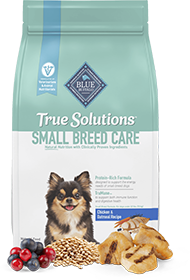
Blue True Solutions Small Breed Care Chicken and Oatmeal Small Breed Adult was selected to represent the other products in the line for a detailed recipe and nutrient analysis.
Blue True Solutions Small Breed Care Chicken and Oatmeal Small Breed Adult
Estimated Dry Matter Nutrient Content
Protein
Fat
CarbsCarbohydrates
Deboned chicken, chicken meal, barley, oatmeal, brown rice, salmon meal (source of omega-3 fatty acids), chicken fat (preserved with mixed tocopherols), flaxseed (source of omega-6 fatty acids), natural flavor, dried plain beet pulp, fish oil (source of DHA–docosahexaenoic acid), calcium carbonate, potassium chloride, salt, direct dehydrated alfalfa pellets, dried tomato pomace, hydrolyzed yeast, fructooligosaccharides, choline chloride, alfalfa nutrient concentrate, L-threonine, DL-methionine, vitamin E supplement, taurine, L-tryptophan, dicalcium phosphate, L-carnitine, L-ascorbyl-2-polyphosphate (source of vitamin C), mixed tocopherols (preservative), dried sweet potatoes, carrots, garlic, zinc amino acid chelate, zinc sulfate, vegetable juice (for color), ferrous sulfate, iron amino acid chelate, blueberries, cranberries, barley grass, parsley, turmeric, dried kelp, yucca schidigera extract, niacin (vitamin B3), calcium pantothenate (vitamin B5), copper sulfate, L-lysine, biotin (vitamin B7), vitamin A supplement, copper amino acid chelate, manganese sulfate, manganese amino acid chelate, dried yeast, dried Enterococcus faecium fermentation product, dried Lactobacillus acidophilus fermentation product, dried Aspergillus niger fermentation extract, dried Trichoderma longibrachiatum fermentation extract, dried Bacillus subtilis fermentation extract, thiamine mononitrate (vitamin B1), riboflavin (vitamin B2), vitamin D-3 supplement, vitamin B-12 supplement, pyridoxine hydrochloride (vitamin B6), calcium iodate, folic acid (vitamin B9), sodium selenite, oil of rosemary
Fiber (estimated dry matter content) = 4%
Red denotes any controversial items
| Estimated Nutrient Content | |||
|---|---|---|---|
| Method | Protein | Fat | Carbs |
| Guaranteed Analysis | 28% | 16% | NA |
| Dry Matter Basis | 31% | 18% | 43% |
| Calorie Weighted Basis | 27% | 37% | 37% |
Ingredients Analysis
The first ingredient is deboned chicken. Chicken is considered “the clean combination of flesh and skin derived from the parts or whole carcasses of chicken”. 1.
Chicken is naturally rich in the 10 essential amino acids required by a dog to sustain life.
The second ingredient is chicken meal. Chicken meal is considered a meat concentrate and contains nearly 300% more protein than fresh chicken.
The third ingredient is barley. Barley is a starchy carbohydrate supplying fiber and other healthy nutrients. However, aside from its energy content, this cereal grain is of only modest nutritional value to a dog.
The fourth ingredient is oatmeal, a whole-grain product made from coarsely ground oats. Oatmeal is naturally rich in B-vitamins and can be (depending upon its level of purity) gluten-free.
The fifth ingredient is brown rice, a complex carbohydrate that (once cooked) can be fairly easy to digest. However, aside from its natural energy content, rice is of only modest nutritional value to a dog.
The sixth ingredient is salmon meal. Because it is considered a meat concentrate, fish meal contains almost 300% more protein than fresh fish itself.
Fish meal is typically obtained from the “clean, dried, ground tissue of undecomposed whole fish and fish cuttings” of commercial fish operations. 2
The seventh ingredient is chicken fat. Chicken fat is obtained from rendering chicken, a process similar to making soup in which the fat itself is skimmed from the surface of the liquid.
Chicken fat is high in linoleic acid, an omega-6 fatty acid essential for life. Although it doesn’t sound very appetizing, chicken fat is actually a quality ingredient.
The eighth ingredient is flaxseed, one of the best plant sources of healthy omega-3 fatty acids. Provided they’ve first been ground into a meal, flax seeds are also rich in soluble fiber.
However, flaxseed contains about 19% protein, a factor that must be considered when judging the actual meat content of this dog food.
The ninth ingredient is dried plain beet pulp. Beet pulp is a controversial ingredient, a high fiber by-product of sugar beet processing.
Some denounce beet pulp as an inexpensive filler while others cite its outstanding intestinal health and blood sugar benefits.
From here the list goes on to include a number of other items. But to be realistic, ingredients located this far down the list (other than nutritional supplements) are not likely to affect the overall rating of the product.
This recipe has five notable exceptions.
Firstly is chelated minerals, minerals that have been chemically attached to protein. This makes them easier to absorb. Chelated minerals are usually found in better dog foods.
Next we find garlic, which can be a controversial item. Some value garlic for its benefits on cardiovascular health from Allicin, and believe it to assist with repelling fleas, ticks and parasites. Garlic is from the Allium or onion family, and contains thiosulfate, which is the compound which causes Heinz body anemia.
Studies have shown that garlic is a cause of Heinz body anemia [Chang et al, 2004; Hu et al, 2002], Another study has shown no clinical signs in 12 weeks of including aged garlic extract liquid in the diet [Yamato et al, 2018]. It is likely that small quantities of garlic are safe for most dogs, but that garlic concentrates and high quantities pose a greater risk of Heinz body anemia.
Dog owners must weigh up the benefits and risks of garlic in the diet.
In this recipe, we also find fish oil. Fish oil is naturally rich in the prized EPA and DHA type of omega-3 fatty acids. These two high-quality fats boast the highest bio-availability to dogs and humans.
Depending on its level of freshness and purity, fish oil should be considered a commendable addition.
Next, dried fermented product. Fermentation products are typically added as probiotics to aid with digestion.
In addition, we find taurine, an important amino acid associated with the healthy function of heart muscle. Although taurine is not typically considered essential in canines, some dogs have been shown to be deficient in this critical nutrient.
We view the presence of taurine in this recipe as a positive addition.
Nutrient Analysis
Based on its ingredients alone, Blue True Solutions Small Breed Care Chicken and Oatmeal Small Breed Adult looks like an above-average dry product.
The dashboard displays a dry matter protein reading of 32.1%, a fat level of 18.5% and an estimated carbohydrate level of 37.2%.
As a group, the brand features a protein content of 29.6% and a mean fat level of 18.5%. Together, these figures suggest a carbohydrate content of 37.2% for the overall product line, alongside a fat-to-protein ratio of 58%.
This means that Blue Buffalo True Solutions contains near-average protein, near-average carbohydrate and near-average fat, when compared to typical dry dog food.
Blue Buffalo Dog Food Recall History
The following automated list (if present) includes all dog food recalls related to Blue Buffalo through October 2026.
- Blue Buffalo Dog Food Recall Event Number 2 of March 2017 (March 18, 2017)
- Blue Buffalo Dog Food Recall of March 2017 (March 3, 2017)
- Blue Buffalo Dog Food Recall of February 2017 (February 14, 2017)
- Blue Buffalo Dog Food Recall of May 2016 (May 31, 2016)
- Blue Buffalo Dog Chews Recall of November 2015 (November 25, 2015)
- Blue Buffalo Dog Food Recall (October 8, 2010)
You can view a complete list of all dog food recalls since 2009 here.
What do pet parents think?
Our Rating of Blue Buffalo True Solutions Dog Food
Although the product range offers a limited selection of animal protein sources, the Blue Buffalo line is still worthy of the 5-star rating it has received in our review. Each recipe is carefully formulated in collaboration with veterinarians and pet nutritionists to address a variety of health concerns.
About
Blue Buffalo was officially launched in 2003 by Bill Bishop, who became frustrated with the lack of transparency and poor ingredient quality in commercial dog food at the time. His inspiration came after his beloved Airedale Terrier, Blue, was diagnosed with cancer. Determined to create a better recipe for his dog, Bishop developed his own formula, and thus Blue Buffalo was born.
In 2018, the brand was sold to General Mills Corporation for $8 billion.
Compare Blue Buffalo True Solutions Dog Food
How does Blue Buffalo True Solutions compare with The Dog Food Advisor's most recommended brands?
- Best Dog Foods
- Best Puppy Foods
- Best Dry Dog Food
- Best Wet Dog Foods
- Best Senior Dog Food
- Best Dog Foods for Dogs With Allergies 2026
- Best Grain-Free Dog Foods
- Best Dog Food With Grain
- Best Dog Food for Small Dogs 2026
- Best Budget-Friendly Dog Foods 2026
- Best Dog Food for Shih Tzus
- Best Dog Food for Picky Eaters 2026
A Final Word
The Dog Food Advisor does not accept money, gifts, samples or other incentives in exchange for special consideration in preparing our reviews.
However, we do receive a referral fee from online retailers (like Chewy or Amazon) and from sellers of perishable pet food when readers click over to their websites from ours. This helps cover the cost of operation of our free blog. Thanks for your support.
For more information, please visit our Disclaimer and Disclosure page.