
Nutro Premium Loaf Dog Food Review (Canned)

Highly Recommended


DogFoodAdvisor is reader supported See how
All reviews are 100% impartial but if you buy using links on this page, we may earn a referral fee.
Review of Nutro Premium Loaf Canned Dog Food
Nutro Premium Loaf Dog Food receives the Advisor’s second-highest tier rating of 4.5 stars.
The Nutro Premium Loaf product line includes the 4 canned dog foods listed below.
Each recipe includes its AAFCO nutrient profile when available… Growth (puppy), Maintenance (adult), All Life Stages, Supplemental or Unspecified.
| Product | Rating | AAFCO |
|---|---|---|
| Nutro Savory Lamb, Carrot & Pea | 4.5 | M |
| Nutro Tender Beef, Sweet Potato & Carrot | 4.5 | M |
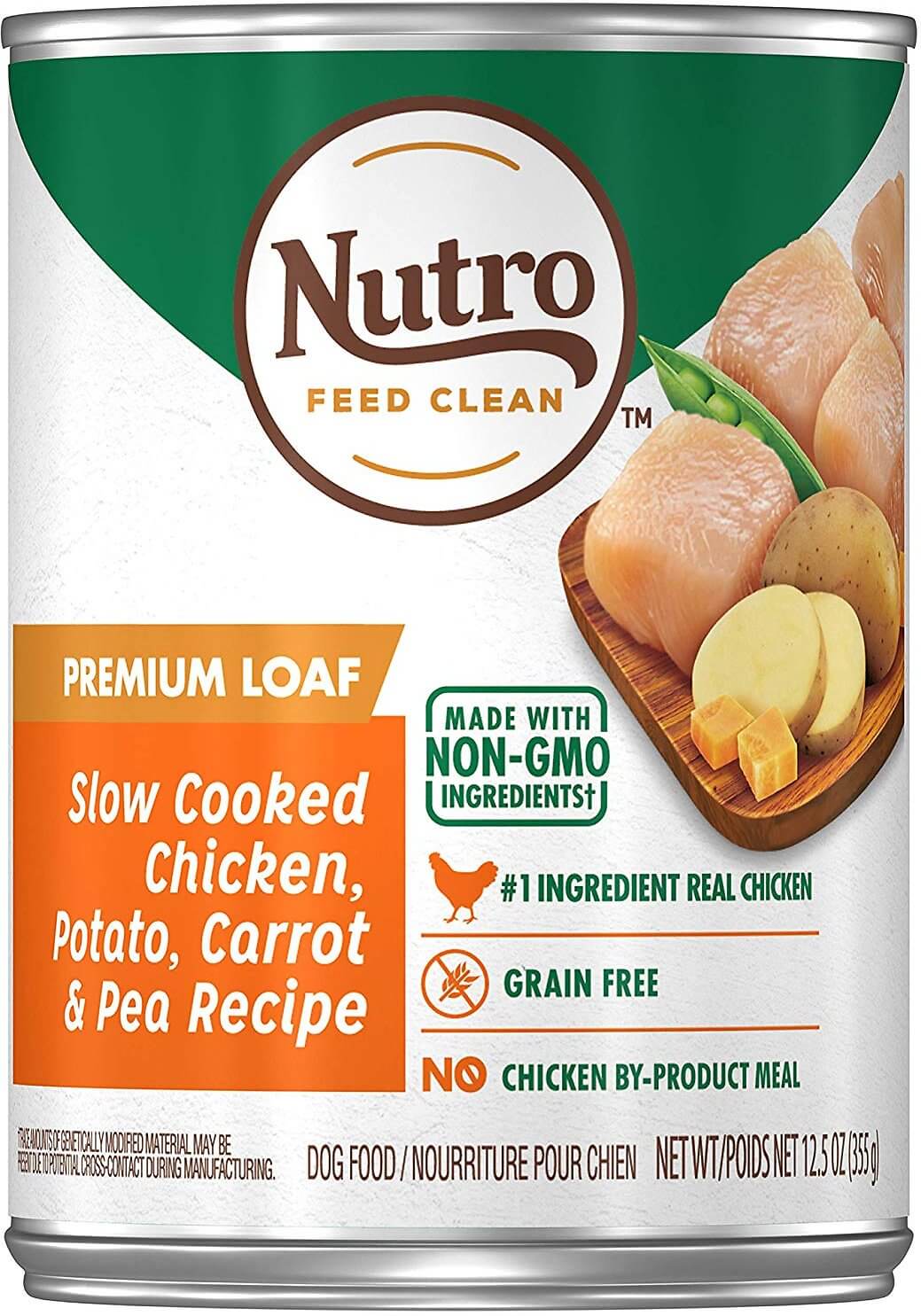
| Nutro Slow Cooked Chicken, Potato, Carrot & Pea | 4 | M |
| Nutro Healthy Turkey, Sweet Potato & Green Bean | 4.5 | M |
Recipe and Label Analysis
Nutro Premium Loaf Slow Cooked Chicken, Potato, Carrot & Pea was selected to represent the other products in the line for detailed recipe and nutrient analysis.
Label and nutrient data below are calculated using dry matter basis.
Nutro Slow Cooked Chicken, Potato, Carrot and Pea
Estimated Dry Matter Nutrient Content
Protein
Fat
CarbsCarbohydrates
Chicken, chicken broth, chicken liver, potatoes, carrots, peas, dried peas, dried potatoes, sunflower oil (preserved with mixed tocopherols), guar gum, flaxseed, salt, dl-methionine, potassium chloride, carrageenan, dried yam, sodium acid pyrophosphate, tetrasodium pyrophosphate, natural flavor, magnesium sulfate, choline chloride, calcium carbonate, sodium hexametaphosphate, ferrous sulfate, thiamine mononitrate, zinc oxide, vitamin E supplement, copper proteinate, sodium selenium, manganese sulfate, d-calcium pantothenate, vitamin A supplement, potassium iodide, biotin, riboflavin supplement, vitamin B12 supplement, pyridoxine hydrochloride, vitamin D3 supplement
Fiber (estimated dry matter content) = 1%
Red denotes any controversial items
Ingredient Analysis
The first ingredient in this dog food is chicken. Chicken is considered “the clean combination of flesh and skin… derived from the parts or whole carcasses of chicken”.1
Chicken is naturally rich in the ten essential amino acids required by a dog to sustain life.
The second ingredient is chicken broth. Broths are of only modest nutritional value. Yet because they add both flavor and moisture to a dog food, they are a common component in many canned products.
The third ingredient is chicken liver, an organ meat sourced from a named animal and thus considered a beneficial component.
The next ingredient is potato. Potatoes can be considered a gluten-free source of digestible carbohydrates. Yet with the exception of perhaps their caloric content, potatoes are of only modest nutritional value to a dog.
The fifth ingredient includes carrots. Carrots are rich in beta-carotene, minerals and dietary fiber.
The sixth ingredient lists peas, which are a quality source of carbohydrates. And like all legumes, they’re rich in natural fiber.
However, peas contain about 25% protein, a factor that must be considered when judging the meat content of this dog food.
The seventh ingredient includes dried peas, which contain about 27% protein.
The eighth ingredient is dried potato, a dehydrated item usually made from the by-products of potato processing. In most cases, dried potato can contain about 10% dry matter protein which can have a slight affect on our estimate of the total meat content of this recipe.
The ninth ingredient is sunflower oil, which is nutritionally similar to safflower oil. Since these oils are high in omega-6 fatty acids and contain no omega-3’s, they’re considered less nutritious than canola or flaxseed oils.
Sunflower oil is notable for its resistance to heat damage during cooking.
There are several different types of sunflower oil, some better than others. Without knowing more, it’s impossible to judge the quality of this ingredient.
From here, the list goes on to include a number of other items.
But to be realistic, ingredients located this far down the list (other than nutritional supplements) are not likely to affect the overall rating of this Nutro product.
With 4 notable exceptions…
First, we find flaxseed, one of the best plant sources of healthy omega-3 fatty acids. Provided they’ve first been ground into a meal, flax seeds are also rich in soluble fiber.
However, flaxseed contains about 19% protein, a factor that must be considered when judging the actual meat content of this dog food.
Next, we note the use of carrageenan, a gelatin-like thickening agent extracted from seaweed. Although carrageenan has been used as a food additive for hundreds of years, there appears to be some recent controversy regarding its long term biological safety.
The article, The Carrageenan Controversy, published in Scientific American, does a good job of addressing this topic.
In addition, with the exception of copper, the minerals listed here do not appear to be chelated. And that can make them more difficult to absorb. Chelated minerals are usually associated with higher quality dog foods.
And lastly, we note the inclusion of sodium hexametaphosphate, a man-made industrial polymer with no known nutritive value.
HMP is used in making soap, detergents, water treatment, metal finishing and most likely here to decrease tartar build-up on the teeth.
Although some might disagree, we’re of the opinion that food is not the place for tartar control chemicals or any other non-nutritive substances.
Nutrient Analysis
Based on its ingredients alone, Nutro Premium Loaf Dog Food looks like an above-average wet product.
The dashboard displays a dry matter protein reading of 39%, a fat level of 30% and estimated carbohydrates of about 24%.
As a group, the brand features an average protein content of 40% and a mean fat level of 31%. Together, these figures suggest a carbohydrate content of 20% for the overall product line.
And a fat-to-protein ratio of about 77%.
Which means this Nutro product line contains…
Above-average protein. Above-average fat. And below-average carbs when compared to other canned dog foods.
Even when you consider the protein-boosting effect of the peas, dried peas, dried potato and flaxseed, this still looks like the profile of a canned dog food containing a notable amount of meat.
Our Rating of Nutro Premium Loaf Dog Food
Nutro Premium Loaf is a grain-free canned dog food using a notable amount of named meats as its primary source of animal protein, thus earning the brand 4.5 stars.
Highly recommended.
Related Topics
Readers interested in Nutro wet dog food may also wish to check out these popular pages, too…
Nutro Dog Food
Recall History
The following automated list (if present) includes all dog food recalls since 2009 related to Nutro.
- Nutro Dog Treats Recall of December 2015 (12/13/2015)
- Nutro Dog Food Recall (10/4/2009)
You can view a complete list of all dog food recalls since 2009 here.
Get Free Recall Alerts
Get free dog food recall alerts sent to you by email. Subscribe to The Advisor’s recall notification list.
More Nutro Brand Reviews
The following Nutro dog food reviews are also posted on this website:
- Nutro Cuts in Gravy Dog Food Review (Cups)
- Nutro Dog Food Review
- Nutro Hearty Stew Dog Food Review (Canned)
- Nutro Limited Ingredient Diet Dog Food Review (Canned)
- Nutro Limited Ingredient Diets Dog Food Review (Dry)
- Nutro Pate Dog Food Review (Cups)
- Nutro Puppy Food Review (Cups)
- Nutro Ultra Dog Food Review (Dry)
- Nutro Ultra Grain-Free Dog Food Review (Tubs)
- Nutro Wholesome Essentials Dog Food Review (Dry)
Compare This Dog Food
How does this brand compare with The Dog Food Advisor's most recommended brands?
A Final Word
The Dog Food Advisor does not accept money, gifts, samples or other incentives in exchange for special consideration in preparing our reviews.
However, we do receive a referral fee from online retailers (like Chewy or Amazon) and from sellers of perishable pet food when readers click over to their websites from ours. This helps cover the cost of operation of our free blog. Thanks for your support.
For more information, please visit our Disclaimer and Disclosure page.
