

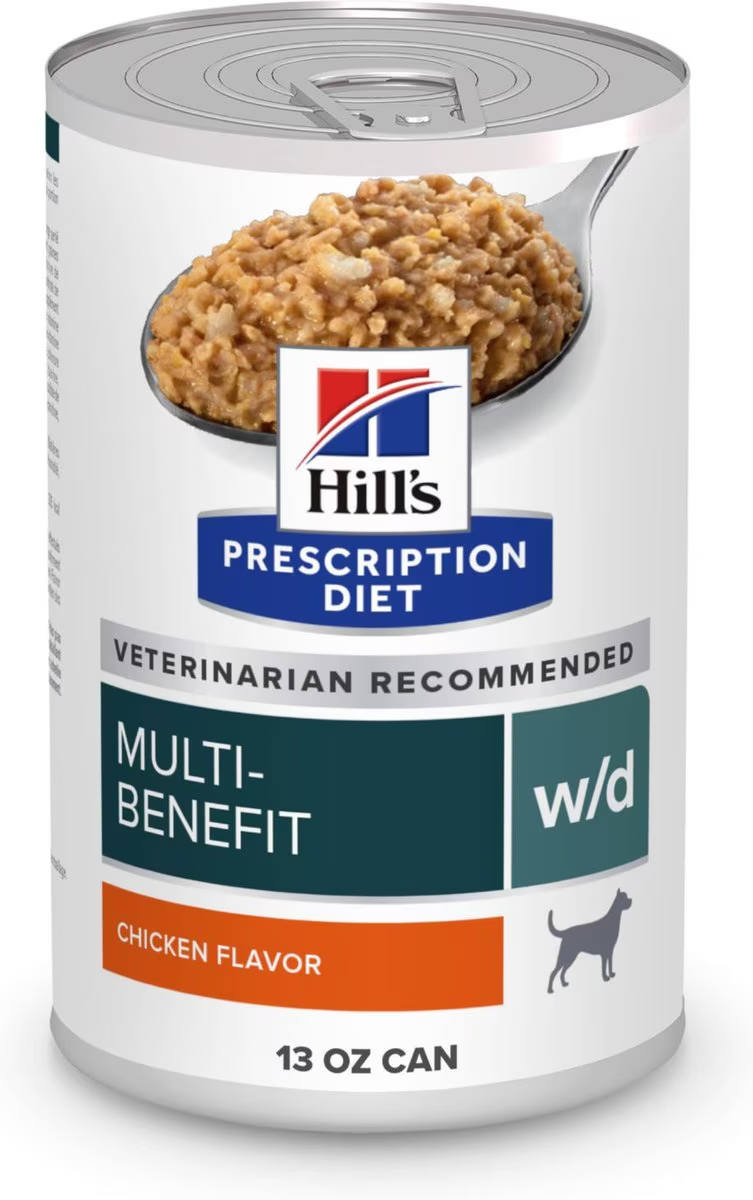
Hill’s Prescription Diet J/D Canine (Canned)

Share

Rating: ★½☆☆☆

Hill’s Prescription Diet J/D canned dog food receives the Advisor’s below-average rating of 1.5 stars.

Hill’s Prescription Diet J/D Canine Mobility canned dog food meets AAFCO nutrient profiles for adult maintenance.

Hill's Prescription Diet J/D Canine

Canned Dog Food

Estimated Dry Matter Nutrient Content

Protein = 20% | Fat = 19% | Carbs = 53%

Ingredients: Water, rice, liver, meat by-products, whole grain corn, lamb, rice flour, flaxseed, fish oil, cracked pearled barley, soybean meal, egg product, powdered cellulose, soybean oil, chicken liver flavor, calcium carbonate, dicalcium phosphate, potassium chloride, iron oxide, l-lysine, iodized salt, vitamin E supplement, choline chloride, glucosamine hydrochloride, l-tryptophan, taurine, soy lecithin, ascorbic acid (source of vitamin C), l-carnitine, l-arginine, zinc oxide, ferrous sulfate, thiamine mononitrate, chondroitin sulfate, beta-carotene, copper sulfate, manganous oxide, niacin, calcium pantothenate, vitamin B12 supplement, pyridoxine hydrochloride, biotin, vitamin D3 supplement, riboflavin, calcium iodate, folic acid, sodium selenite

Fiber (estimated dry matter content) = 3.1%

Red items when present indicate controversial ingredients

Estimated Nutrient Content
MethodProteinFatCarbs
Guaranteed Analysis20%19%NA
Dry Matter Basis20%19%53%
Calorie Weighted Basis16%39%44%

The first ingredient in this dog food is water, which adds nothing but moisture to this food. Water is a routine finding in most canned dog foods.

The second ingredient is lamb liver. This is an organ meat sourced from a named animal. So long as it’s not over-weighted in a dog food, lamb liver is a beneficial component.

The third ingredient is rice. Is this whole grain rice, brown rice or white rice? Since the word “rice” doesn’t tell us much, it’s difficult to judge the quality of this particular item.

The next item includes pork by-products, slaughterhouse waste. This is what’s left of a slaughtered pig after all the prime cuts have been removed.

Basically, pork by-products are the unsavory leftovers of slaughter operations deemed “unfit for human consumption”.

Though it does contain all ten essential amino acids a dog needs for life, we do not consider pork by-products a quality ingredient.

The fifth ingredient is corn. Corn is an inexpensive and controversial cereal grain of only modest nutritional value to a dog.

For this reason, we do not consider corn a preferred component in any dog food.

The sixth ingredient is lamb. Lamb is considered “the clean flesh derived from slaughtered” lamb and associated with skeletal muscle or the muscle tissues of the tongue, diaphragm, heart or esophagus.1

Lamb is considered a quality meat.

The seventh ingredient is rice flour. Rice flour is made from either white or brown rice and is considered a good gluten-free substitute for wheat flour.

The eighth ingredient is dried egg product, a dehydrated form of shell-free eggs. Quality can vary significantly. Lower grade egg product can even come from commercial hatcheries… from eggs that have failed to hatch.

In any case, eggs are easy to digest and have an exceptionally high biological value.

The ninth ingredient is dried whey. Whey is a by-product of the cheese industry. This particular form of whey is high in the milk sugar, lactose (about 70%) but low in protein.

It’s used in canned dog foods as a gelling agent and is an item with little nutritional value to a dog.

From here, the list goes on to include a number of other items.

But to be realistic, ingredients located this far down the list (other than nutritional supplements) are not likely to have much of an effect on the overall rating of this product.

With four notable exceptions

First, powdered cellulose, a non-digestible plant fiber usually made from the by-products of vegetable processing. Cellulose is sometimes added to dilute the number of calories per serving and to give the feeling of fullness when it is eaten.

Except for the usual benefits of fiber, powdered cellulose provides no nutritional value to a dog.

Next, soybean meal. Soybean meal is actually a useful by-product. It’s what remains of soybeans after all the oil has been removed.

Soybean meal contains 48% protein. However, compared to meat, this is an inferior plant-based protein. Soybean oil has been red flagged here only due to its controversial (yet unlikely) link to canine food allergies.

And finally, we note this food contains chelated mineralsminerals that have been chemically attached to protein. This makes them easier to absorb. Chelated minerals are usually found in better dog foods.

Hill’s Prescription Diet J/D Canned Dog Food
The Bottom Line

Even though this is a prescription product, we continue to limit our judgment to the estimated meat content of the recipe as well as the apparent quality of its ingredients. And nothing else.

Our ratings have nothing to do with the accuracy of claims made by the manufacturer as to this product’s ability to effectively treat or cure a specific health condition.

So, to find out whether or not this dog food is appropriate for your particular pet, you must consult your veterinarian.

With that understanding…

Judging by its ingredients alone, Hill’s Prescription Diet J/D canned dog food appears to be a below-average wet product.

But ingredient quality by itself cannot tell the whole story. We still need to estimate the product’s meat content before determining a final rating.

The dashboard displays a dry matter protein reading of 20%, a fat level of 19% and an estimated carbohydrate content of 53%.

Low protein. Below-average fat. And high carbohydrates… when compared to a typical canned dog food.

With no evidence of any plant-based protein concentrates, this appears to be the profile of a wet food containing only a limited amount of meat.

Bottom line?

Hill’s Prescription Diet J/D canned dog food is a grain-based wet product using only a modest amount of lamb liver as its main source of animal protein… thus earning the brand 1.5 stars.

Not recommended.

A Final Word

This review is designed to help you make a more informed decision when buying dog food. However, our rating system is not intended to suggest feeding a particular product will result in specific health benefits for your pet.

For a better understanding of how we analyzed this product, please be sure to read our article, “The Problem with Dog Food Reviews

Remember, no dog food can possibly be appropriate for every life stage, lifestyle or health condition. So, choose wisely. And when in doubt consult a veterinarian for help.

Have an opinion about this dog food… or maybe the review itself? Please know… we welcome your comments.

Notes and Updates

07/26/2010 Original review
11/12/2011 Review updated, no changes
11/12/2011 Last Update

  1. Adapted by the Dog Food Advisor and based upon the official definition for beef published by the Association of American Feed Control Officials, 2008 Edition
Dog Food Advisor IconThe Dog Food Advisor publishes independent reviews to help pet owners make better choices when shopping for dog food.


  • melissa

    Meagan-

    Our problem here is ticks, not fleas and the Frontline Plus every 45 days works just fine-and all my dogs are dosed at that interval from the smallest 10lb dog up to my dobies. : ) I usually start when the weather is warm(march-April depending on the year) and stop after the first good frost(usually around November)

  • Meagan

    I use to stop putting Frontline on them in about november, but then I guess I got to over analyzing things and worried about fleas. Never have had them, knock on wood. So maybe I will start applying it every 45 days and also stopping in november again.

  • Meagan

    So Melissa you use frontline plus and put it on every fourty five days instead of thirty? Does that differ between weights of the dogs or is it good for all, in your opinion? Thanks!

  • Pit Bull Mama

    @Bob : I would switch him to the Previcox. I am a vet tech and the mom to an arthritic 11 year old Pittie. She does well on the Previcox and we were told by our holistic vet that it’s safer for her liver than Rimadyl or Deramaxx. Deramaxx also tends to give the dogs diarrhea. Have you heard of adequan injections? Those might help your dog.

  • melissa

    Lol.. Gordon-the fleas probably jumped off the dog bedding I have not had a problem with fleas in at least 20 yrs-not a single one, however, even in a house, fleas can and will lay eggs deep into the carpeting, only to hatch and reinfest a dog. Warm, moist conditions(and tall grasses) have nothing to do with it-they are not mushrooms : ) Fleas are opportunistic and have nothing to do with being unsanitary(well unless of course you allow your pet and house to be infested and do nothing about it!) I know you are not being arguementative, you are stating your belief or what you have heard. If you really think through your statement rationally, that sunlight can kill parasites(especially those with a hard exoskeleton) think of the various bugs out there, in the sunlight, every day and they are just fine-By the sunlight school of thought, june beetles, crickets, grasshoppers, lady bugs etc should all be dead within 10 mins of the sun coming up every day. Your own comment “bedding does not have a warm blood circulation” hence they die within minutes even contridicts what you have said in the last posting re-living in/under porches etc : )

  • http://DogFoodAdvisor.com Mike Sagman

    Gordon… I’ve noticed you repeatedly advise readers that sunlight eliminates bacteria and (now) fleas. This is simply not true. Unscientific claims like this can be misleading and have dangerous consequences for less informed readers.

    Fact: Food left outdoors in a non-refrigerated state can be exceptionally dangerous (to both humans and pets). In fact, in a warm and moist environment, bacteria replicate and grow into concentrated and pathogenic (disease-causing) concentrations.

    Feeding raw meats isn’t simply a veterinary issue but a potentially hazardous human health issue.

    As a medical professional, I must once again warn readers to treat raw meat with respect at all times. Although not all raw meat is inherently dangerous, much of it can be if not handled with the utmost respect.

  • Gordon

    Melissa – Not to sound argumentative, albeit a civil debate, but all fleas are mostly vulnerable the same way, world wide, unless I’m missing something here. Fleas as you say, do wait for the opportunity to hop onto hosts, and the reason why they live prior to finding a live food source, is because fleas are found mostly in waiting, in long grasses, under houses, and amongst built-up unsanitary conditions, of which all provide some moisture, warmth and cover from direct sunlight. At least that’s the case down under. With regard to dog bedding, and depending on the material, fleas unlike dust mites, bacteria, and molds that can and do burrow with in the bedding itself, fleas don’t do this, since, with out a live host on it, they don’t burrow into the bedding hence are exposed on the surface of the pillow, then die on exposure to direct sunlight, unless they have a surrounding that they can quickly hop into that protect them from same.

    That’s the reason that they can be rid from dog bedding when exposed to direct sunlight. I was first advised this, by my Vet’s Vet nurse, and have regularly practiced this since, with success. What I do is periodically, replace the dog bedding from its kennel onto a non porous surface such as my air conditioner’s outside motor enclosure for about 10 to 15 minutes, during a warm sunny day, and hey presto, on close inspection after a quick pat down, I could never see any visible signs of flea life.

  • melissa

    Hi Gordon-

    In my part of NY, the vets tend to favor Interceptor and Heartgard, although some do recc the combo products for convenience that kill both heartworm and fleas.

    Sunlight , imo, does not kill fleas…at least not those in the good old United States, lol. They can live very adequately for a period of time in the sand, gravel, soil etc. Or in your house if it gets infested. However, simply given the fact that fleas are outside and come inside(via a host) is proof that mere sunlight will not kill these little blood suckers-otherwise, there would be no fleas present during summer months, and that is “our” primary flea season : )

  • Gordon

    Watching The Late Show with David Letterman, right as I make the following comment. Yes we get that show down under, and I’ve watched it for years. I think he’s hilarious, as well as Craig Ferguson. Anyway, I digress.

    I wonder what your local Vets administer for heartworm prevention, instead? My pooches are currently on Frontline Plus and yes, it is apparently meant only to spread all over the skin and its oils. I’m currently looking into natural garlic alternatives for prevention of fleas all year round. Garlic is stated to work against fleas but not ticks. Paralysis ticks are the worrisome ticks to be weary of. I don’t have those around my area, according to my Vet anyway.

    Many people also use chemical and/or natural sprays on dogs’ bedding to keep fleas off. However, just like the sunshine kills bacteria on exposure, it also kills fleas on exposed dog bedding, because fleas left on the bedding don’t have the harbouring protection they do when clung into the fur and skin of dogs, or cats for that matter. Not to mention that the bedding lacks warm blood circulation, hence the fleas die off after a good 10 minutes exposed to sunlight. Just another tip in case you or anyone else is interested.

  • melissa

    I do not know enough about ProHeart to truly comment. What I do know is that it was recalled in the US in 2004-when it was Proheart 6. Apparently it has been re-released as Proheart 12. I can tell you that I have yet to find a vet in our area that uses or reccomends this product.

    I use Frontline after much research and have for years, however, not at the 30 day intervals and not year round. This product is supposed to stay in th skin/hair layer and not be absorbed into the bloodstream. We do not have a flea issue where I live, but rather ticks, and the 45 day dosing seems to work just fine in preventing issues.

  • Gordon

    Yeah, I’m leaning toward using natural alternatives to Frontline and Advantix for flea and tick control, and have a good idea on a several good alternatives.

    However, I’ve just checked my dogs’ Vaccination Record and the injection they’ve received for heartworm prevention is ProHeart® SR-12 which is an annual injection as opposed to 6-monthly. At further investigation it contains Moxidectin at Conc, /g 100mg. It appears to be made by the world wide Pfizer pharmaceutical corporation.

    The above information I retrieved from a data sheet with, mind you, what appears to have many unknowns by using the words “no data” and “not set” next to some headings. To me, that is always a concern. The data sheet I found revised in 2007 can be found at https://www.pfizeranimalhealth.com.au/documents/e/1547/6950,ProHeart%20SR-12%20Injection.pdf

    At any rate it appears to be doing its job, and my dogs have no undesirable or negative reaction, allergic or otherwise. The injection, of course, was administered by my Vet.

    It could perhaps, like poor canine nutrition, result in long term effects. Who really knows? I mean, if Vets like general practitioners (GP’s) or (physicians as Americans refer to) prescribe government approved pharmaceuticals and medications, and we entrust same to administer such for our and our pets’ health and well being, whilst these very same vaccinations and or medications may be toxic and therefore hazardous, then where is the fine line between actual truth lectured by university professors, and those lectures and marketing done by pharmaceutical and pet food companies for that matter?

    All this certainly beggars further investigation and “man” do I like reading! So I, like every person should, given time, perform their own investigations, to seek as much of the truth as possible, behind these types of chemical concoctions used on our pets.

  • Melissa

    Gordon-

    I am not sure what injectable you are referring to? If you mean the Proheart 6, it is only good for 6mths, not one year, and it is moxidectin if my memory serves me correctly. However, Proheart 6 was in fact taken off the market, at least here in the US-though I have heard it did return recently.

    Milbemycin Oxime is the active ingrediant in Interceptor tablets-the once a month oral tablet, amongst others. Gordon-you strike me as a very astute pet owner. May I ask why you would ever inject or allow your dog to be injected with a long term pesticide??? I have a huge problem with these types of products-Several things come to mind immediately-1) what if the dog has a reaction to the meds?? Just how does one get a long term medication out of the sytem? Afterall its meant to slow release/slow act for a full 6mths. 2) Why is there a need to inject a dog with a 6mth supply of pesticide all at once? The oral tablets such as interceptor(at the regular dose, not the Safeheart dosing, were proven to be something like 100 percent effective if given every 30 days, and 95 percent effective at 60 and 90 days. Even if an owner forgets to give the tablet by a few days or week, it should be of no consequence. The Safeheart dose was tested only out to 30 days, so owners who do the lower(and FDA approved) dose, need to be vigilant about giving it exactly 30 days out to be certain.

    These types of preventatives are right up there on my “hate” list as well as those that combine flea control with heartworm preventative. If the flea preventative needs to be on the SKIN, lets put it there-no reason to send a pesticide through the bloodstream first. If I wanted to keep mosquitoes off me, I sure as heck would not swallow the “off” : )

  • Gordon

    Good for you Meagan. I hope you land a job soon as a Vet assistant. I get the vibe that you’re one of those sweet young 20 something year-olds. I think you’ll make a good assistant. I wish I could turn back time and have decided on a different career path. If I could, I would probably strive to become a Vet, as I’ve always loved all animals, and I also have two parrots (1 x sun conure and the other a cinnamon green cheeked conure). But being 39 years of age, I doubt that one should try to get into Vet school. Besides, I don’t think I’d be smart enough to begin with, regarding all the training, studying, and education involved.

    Labradors are loyal dogs. One of my favourite larger breed type dogs. Yours and Jonathan’s both look good from what I can make out from the small pics.

    Melissa – I don’t think we all attribute canine diseases to just poor food. Just like humans, dogs can and do inherit such, from their gene pool. Other factors can be that dogs, especially those mostly kept indoors are just as susceptible to passive smoking as us humans. But I too believe that most canine diseases are derived from long term poor diets. I said “most”, not all.

    Melissa – Without googling it yet, is Milbemycin oxime the active ingredient in the annual injection for heartworm prevention. Or is it administered differently? If the claim that Milbemycin oxime is dosed at 5 times the required amount, does this mean, we don’t have to stick to our dogs receiving the annual injection and if so, does this mean we can postpone such injection for say, another year, with out compromising the active heartworm prevention?

  • Melissa

    Jonathan-

    I think we agree that dogs do better with higher quality ingrediants in their food and its apparent that you dislike many of the “lower rated foods”. That is your right of course, and I can not say that I am partically fond of them either. However,I have to say that with all the dogs I have owned and rescued, I have yet to find the diseases that you speak of in epidemic proportions.

    I have yet to loose a dog under the age of 13(last year to cancer-genetic in his breed) no kidney failures, overweight dogs etc etc. While I do believe that they do better with a better quality food, I can not agree that all the diseases we see are merely from the foods-genetics plays a HUGE role in the health “roll of the dice” -hence why some dogs live to 20,others succomb to disease early. As well, not only have the diets changed as you indicate in the past 70 yrs, but we are using pesticides on and in our pets on a monthly basis, and apparently at 5 times the needed dosage. I have to believe that when we blindly feed our dogs Milbemycin oxime(and at 5 times the needed dose to prevent/control heartworm disease) we are not doing them any favors. Its amazing how we pick apart foods and lay blame solely on them, and yet blindly do other things that I do believe are adding to the problem(For those of interest, please goodle the June 4th 1998 study done by Novartis on a never released product called SafeHeart-which seems to show that dogs actually need 1/5 the dose of medication in Interceptor to prevent heartworm-the rest of the dose appears to be to deworm them) For years we vaccinated them every year for diseases, and now, there are 3 yr vaccines-obviously we were overvaccinating as owners attempting to do the “right” thing.

    My point being, these diseases are a result of many things that we do as owners in the quest to be “good owners” and all our practices should be looked at -not just laying solo blame on the foods that we feed.

  • Jonathan

    He is a handsome boy Meagan!

  • Meagan

    Gordon- I went to school for Vet Assistant, I do not work in a clinic yet, but will and when I do I sure as heck will not believe the boss on what they say about foods like Hill’s and Purina. I didn’t believe it at school because I saw the dogs, that were all fed Hill’s, who cared for there everyday. Half had loose stools all the time and the bigger dogs (Labs, pointer x, catahoula x) were thin. I adopted the catahoula x and I am happy to say my boy has solid stools most the time now, unless I switch foods. He also is a nice 60 lbs and looks rather beautiful to me LOL He’s the boy in my pic.

  • http://DogFoodAdvisor.com Mike Sagman

    Hi Lindsay… Kidney failure is a serious and potentially fatal condition. High protein diets are normally fine for most healthy pets but they’re not appropriate for animal’s in the advanced stages of renal disease. Please do not ignore your vet’s professional advice.

    Unfortunately, since I’m not a veterinarian, it would be inappropriate for me to provide specific health advice or product recommendations. Please see our FAQ page for more information.

  • http://DogFoodAdvisor.com Mike Sagman

    Brenda… Contrary to your accusation, this review is both factual and truthful. And like the more than 500 reviews on this website, it makes no health recommendations whatsoever.

    Since you obviously did not read the review, I’ll repeat its closing words:

    “The veterinary product reviewed here may or may not be suitable for your particular pet. Moreover, it is not our intention to judge the appropriateness of any dog food to treat a specific condition.

    Nor is it our aim to act as a substitute for sound medical advice.”

    Although we make no attempt here to decipher the medical design of these “prescription” products, we do (as consumers) have every right to question our veterinarians regarding the quality and meat content of these costly, professionally dispensed products.

    After all, considering the cost of the finished dog food, what’s the scientific point of using so many inexpensive, generic ingredients? What does saving money have to do with treating and diagnosing disease?

    Like some physicians who routinely receive much of their drug prescribing information from the pharmaceutical industry, many veterinarians get a significant amount of their own pet food education directly from pet food manufacturers themselves.

    For proof, I refer you to this recent comment posted on our review of Hill’s Prescription Diet I/D Canine formula by a practicing veterinarian…

    Hi Mike,

    I am a veterinarian. Though I see that you are not, I share your views regarding the low quality ingredients in Hills’ foods. This was not always the case. Once upon a time, they were a great, much smaller company. However, in veterinary school most of our nutrition education comes from these big companies who “brainwash” us and schmooze us by offering free food for reading their “educational material” and taking quizzes. I think what you have done here is a good thing in trying to make people more aware of these ingredients. I personally try not to recommend any food that I would not feed to my own pets and this includes all of Hill’s diets and most of the other highly commercialized brands. Most holistic veterinarians have taken extra time to become more knowledgeably about food since what an animal eats can have a tremendous impact on their health, much the same as humans.

    Elisa Katz, DVM

  • Gordon

    See, now that’s what I mean. As I stated under Purina Vet HA diet, it’s better that comments are made shorter, with spelling errors and bad grammar. That way it is more believable to the naive that statements like Brenda’s is exactly that.

    In Brenda’s case I actually believe that you’re a Vet Tech. Vet Tech’s will always believe what their bosses tell them. I can’t fault them for that.

    I think even with out websites like this one, the man of average intelligence, can read the concoction of ingredients like this product and arrive to the conclusion that it is a load of trash! I actually don’t need Mike’s rating system to help form my own opinions. But, gee, how could one begin to defend this trash?

  • Jonathan

    Lindsay, don’t just “stop” the K/D. An alternative needs to be discussed with a vet.

    Brenda, how many less dogs do you think would end up with kidney failure if they were all fed natural, raw foods instead of carb-heavy processed trash like all of Hill’s foods? These foods are a Band-Aid on a much bigger problem… and that problem stems from the prolific use of carbohydrates as an energy source rather than the proteins and fats that a dog would naturally eat it’s entire life. kidney failure, in most cases, as well as cancer, diabetes, tooth decay, weight gain, and heart problems exist in our dogs today because of the extremely sudden introduction of calorically dense carbohydrates within the last 70 years. Millions of years of evolution cannot be bested by 70 years of human concoctions. Carbs are unnecessary and potentially deadly to our dogs.

    So, do not take you dog off of K/D if he is in renal failure. No one here suggests that, let alone the creator of the site. But, by all means, you have every right to talk to your vet about a more healthful solution than this medley of crap.

  • Brenda

    Lindsay
    I am a vet tech with over 20 years of experience. I truely believe that Hills K/D is the absolute gold standard for an animal in kidney failure. Minn State University recently completed an study that show animals fed KD lived 2 years longer than animals not fed Kd. This web site is completly without truth. Pet food should be judged on nutients not ingredients. This web site is judgeing foods based on marketing not science. Vets DO NOT make huge money from selling food in fact food is often considered a loss leader. PLEASE PLEASE follow your vet’s suggestions that you have trusted for years. Vet are not in this field to sell dog food, they do thier jos because they animals. Any website that would rate any Hills food with 1 star yet give Cesar dog food 3 stars is crazy listen to your Vet Thankyou

  • http://www.car-pal.com Lindsay Graham

    This is all great and excellent, and I’m ready to stop the K/D diet immediately, however, can someone give me advice. I liked the avoderm suggestion, but that’s for joints. Lu Lu needs something for kidney failure conditions… low protein, etc. would love suggestions as an alternative to the one star Hill’s KD diet, which (the rating) doesn’t surprise me at all!

  • Meagan

    My friend/co-worker adopted a 2 1/2 year old great dane. does he need to give this dog joint supplements?

  • Jill Prescott

    Mike, you are my hero. Your intelligent and unbiased reviews have provided my dogs with a stellar diet. I posted your site on my Facebook as well as my website.

    Warm regards,

    Jill Prescott

  • April

    I was just looking at Cosequin on the Costco website. A few weeks ago I missed out when they had almost 30 off.

    I have a pitt who is only 2 years old and has hip displaysia already.

    Thank for all the great information, everyone…it’s been very helpful!

  • Bob

    Hi everyone, i have a yellow lab and he is 5 years old. he has arthritis in his wrists and hes been on deramaxx for about 8 months. my breeder told me about the hills jd canine mobility food. would he be ok to have the food without the deramaxx? or should he be on both? the vet is also recommending prevocoxx. he is in alot of pain after walks and play. ive been told he could just stay on the food and that would help alot, what do you think?

  • http://DogFoodAdvisor.com Mike Sagman

    Hi Everyone… Actually, what appears to make this “prescription” food supportive of joint health is its (frequently overlooked) quality omega-3 fatty acid content. This product boasts a significant amount of the best kind (fish oil). Unfortunately, it’s a real shame J/D contains so little meat.

    By the way, since glucosamine and chondroitin are both considered food supplements (and not pharmaceuticals), government standards do little to assure consumers the content of these commercial additives contain what the manufacturer says they contain. There’s some real “junk” G & C on the market. So, buyer beware.

    As far as I can tell, the “gold standard” in the glucosamine and chondroitin supplement market appears to be Dasuquin and Cosequin. I normally don’t like to endorse any supplements. But regarding this specific topic, we’re dealing with an active, chronic and debilitating disease (osteoarthritis).

    So, for this reason, I’d be inclined to favor “pharmaceutical grade” chondroitin and glucosamine supplements.

    Unfortunately, the quality of these two items is reflected in their pricing. But when it comes to medications, you usually get what you pay for.

    The article, “Getting Your Glucosamine for Dogs Dosage Right” on the Dog Arthritis Blog. This website is hosted by veterinarian, Dr. Christopher Durin and makes an excellent source of scientific and practical information. Hope this helps.

  • Jonathan

    1000 mg/kg means that the product contains 1000 milligrams of glucosamine PER KILOGRAM… not per feeding.That means for a dog to get 1000 mg in ONE DAY, he would have to literally eat one kilogram of food. I don’t think there are many dogs that eat that much food in one day. A kilogram is about 2.2 pounds. That means the amount of Glucosamine present in the food at EACH MEAL is not 1000 mg, but rather must be calculated based on how much food is fed. If your dog eats about 1 pound of food each day, then he would only be receiving about 450 mg of glucosamine total. That number shrinks big time with the amount that most foods advertise like 300 mg/kg. That would only be 136 mg per pound of food fed. This is the amount in Blue Buffalo. While it is still nice that it’s there, you would have to feed an elderly dog 5 POUNDS of Blue in ONE DAY to get the “therapeutic” amount of 700 total mg of glucosamine.

  • Antonio

    Normally this is where I would sayyy ohhh okay, but I’m totally confused, but I thought a MG was a MG across the board. What’s the difference? I’m confused.

  • Jonathan

    Oh, and a dog needs about 350 mg of G and 50 mg of C per 35-40 lb’s of body weight. So your dog would need, like, two Zukes treats worth (total of 700 mg G and 100 mg C). That means if your dog was to get that amount from this food alone, he’d have to eat, as I mentioned before, about 2 lb’s of this food a day.

  • Jonathan

    Antonio, you have to look at the measurement. 1000 mg/kg means that to get a “therapeutic” amount (how much is needed in one day for a medium size dog), the dog would have to eat almost 2 pounds of food per day! Not even a fairly big dog would eat two pounds of food a day. So, there is a decent “maintenance” amount, but to reach what professionals would consider a daily “therapeutic” level, you would still want to add, like, one Zukes hip-action treat or something similar that contains 300 mg. (note, 300 mg. not 300 mg/kg, which, in a treat, would mean it has only a marginal step above none.)

  • Antonio

    wow, how much glucosamine and chondroitin does a dog need to be theraputic? I was always told that for human 750mg per 50lbs or so was considered ideal. What’s the amount for canines?

  • Roger Prows

    Good interjection Jonathan, highly agree on supplementation.

  • Jonathan

    Roger, I am actually (surprisingly) impressed with how much Glucosamine and Chondroitin are in the food you mentioned…
    1000 mg/kg of Glucosamine and 2000 mg/kg of Chondroitin. But I would still mention, being that it is milligrams per kilogram, that is still on the low side of what would be considered “therapeutic” and I would still suggest a mild supplement along with the food. But for regular maintenance, I am more impressed with the amounts this food contains than I am with what most foods contain (usualy 300 mg/kg of G and 150 mg/kg of C).

  • Roger Prows

    April,

    Mike can’t make a recommendation, but I can :-)

    I have had the best experience with Avoderm Senior for joints. It contains NATURALLY derived (cartilage) glucosamine in extremely high levels. Have switched MANY dogs to this and had better results.

  • sue

    i remember a vet use to go to tried to get me to put my dog on science diet K/d I told her right out i would make his food before i put her on that garbage food, she looked shocked and i said if i want corn as my main ingred i would go by a bag and by product and bht/bha they should not be in our dog food. plus the dog food analyser said short term use only and long term will lead to malnutrition

  • http://DogFoodAdvisor.com Mike Sagman

    Hi April… When it comes to prescription-type foods, there are only a limited number of recipes out there. Unfortunately, since I’m not a veterinarian, I cannot provide specific health advice or product recommendations. You may wish to visit our FAQ page and our reviews for more information. Or check back for a possible response from one of our other readers. Wish I could be more help.

  • April

    My vet just put my pitt on the dry JD yesterday. I’m wondering is there another dry out there that is suppose to do the same thing?

  • http://DogFoodAdvisor.com Mike Sagman

    Hi Jennifer… Hill’s J/D dry is on our To Do list. But due to our current backlog of reviews, it could be a while longer before we get to it. Thanks for the reminder.

  • Jennifer

    Any reviews for the dry kibble version of the Hill’s Prescription Diet J/D?