
Dogswell Dog Food (Canned)

Highly Recommended

DogFoodAdvisor is reader supported See how
All reviews are 100% impartial but if you buy using links on this page, we may earn a referral fee.
Dogswell canned dog food receives the Advisor’s top rating of 5 stars.
The Dogswell product line includes six canned dog foods.
Each recipe below includes its related AAFCO nutrient profile when available on the product’s official webpage: Growth, Maintenance, All Life Stages, Supplemental or Unspecified.
- Dogswell Vitality Duck and Sweet Potato Stew [A]
- Dogswell Vitality Lamb and Sweet Potato Stew [A]
- Dogswell Vitality Chicken and Sweet Potato Stew [A]
- Dogswell Happy Hips Duck and Sweet Potato Stew [M]
- Dogswell Happy Hips Lamb and Sweet Potato Stew [M]
- Dogswell Happy Hips Chicken and Sweet Potato Stew [M]
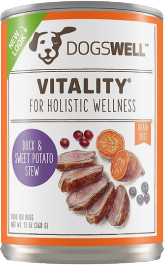
Dogswell Vitality Duck and Sweet Potato Stew was selected to represent the other products in the line for this review.
Dogswell Vitality Duck and Sweet Potato Stew
Estimated Dry Matter Nutrient Content
Protein
Fat
CarbsCarbohydrates
Duck, chicken broth, chicken liver, chicken, dried egg product, salmon, peas, potato starch, sweet potatoes, carrots, red peppers, guar gum, natural flavor, sodium phosphate, cranberries, blueberries, spinach, zucchini, tricalcium phosphate, canola oil (preserved with mixed tocopherols), garlic powder, flaxseed oil, squash, potassium chloride, taurine, iron amino acid chelate, vitamin E supplement, zinc amino acid chelate, choline chloride, cobalt amino acid chelate, copper amino acid chelate, manganese amino acid chelate, riboflavin supplement, sodium selenite, thiamine mononitrate, vitamin A supplement, vitamin B12 supplement, potassium iodide, biotin, vitamin D3 supplement
Fiber (estimated dry matter content) = 1%
Red denotes any controversial items
| Estimated Nutrient Content | |||
|---|---|---|---|
| Method | Protein | Fat | Carbs |
| Guaranteed Analysis | 8% | 4% | NA |
| Dry Matter Basis | 44% | 22% | 25% |
| Calorie Weighted Basis | 36% | 44% | 21% |
The first ingredient in this dog food is duck. Duck is considered “the clean combination of flesh and skin… derived from the parts or whole carcasses of duck”.2
Duck is naturally rich in the ten essential amino acids required by a dog to sustain life.
The second ingredient is chicken broth. Broths are of only modest nutritional value. Yet because they add both flavor and moisture to a dog food, they are a common addition component in many canned products.
The third ingredient is chicken liver. This is an organ meat sourced from a named animal and thus considered a beneficial component.
The fourth ingredient is chicken, another quality raw item.
The fifth ingredient is dried egg product, a dehydrated form of shell-free eggs. Quality can vary significantly. Lower grade egg product can even come from commercial hatcheries — from eggs that have failed to hatch.
In any case, eggs are easy to digest and have an exceptionally high biological value.
The sixth ingredient lists salmon. Salmon is an oily marine and freshwater fish not only high in protein but also omega 3 fatty acids, essential oils needed by every dog to sustain life.
The seventh ingredient includes peas. Peas are a quality source of carbohydrates. And like all legumes, they’re rich in natural fiber.
However, peas contain about 25% protein, a factor that must be considered when judging the meat content of this dog food.
The eighth ingredient is potato starch. Potato starch is a gluten-free carbohydrate used more for its thickening properties than its nutritional value.
The ninth ingredient is sweet potato. Sweet potatoes are a gluten-free source of complex carbohydrates in a dog food. They are naturally rich in dietary fiber and beta carotene.
From here, the list goes on to include a number of other items.
But to be realistic, ingredients located this far down the list (other than nutritional supplements) are not likely to affect the overall rating of this product.
With four notable exceptions…
First, we find canola oil. Unfortunately, canola can be a controversial item. That’s because it can sometimes (but not always) be derived from genetically modified rapeseed.
Yet others cite the fact canola oil can be a significant source of essential omega-3 fatty acids.
In any case, plant-based oils like canola are less biologically available to a dog than fish oil as a source of quality omega-3 fats.
Next, garlic can be a controversial item. Although many favor the ingredient for its claimed health benefits, garlic has been linked to Heinz body anemia in dogs.3
So, one must weigh the potential benefits of feeding garlic against its proven tendency to cause subclinical damage to the red blood cells of the animal.
In addition, flaxseed oil is one of the best non-fish sources of omega-3 fatty acids — essential to a dog’s health.
And lastly, this food contains chelated minerals, minerals that have been chemically attached to protein. This makes them easier to absorb. Chelated minerals are usually found in better dog foods.
Nutrient Analysis
Judging by its ingredients alone, Dogswell canned dog food looks like an above-average wet product.
But ingredient quality by itself cannot tell the whole story. We still need to estimate the product’s meat content before determining a final rating.
The dashboard displays a dry matter protein reading of 44%, a fat level of 22% and estimated carbohydrates of about 25%.
As a group, the brand features an average protein content of 44% and a mean fat level of 22%. Together, these figures suggest a carbohydrate content of 25% for the overall product line.
And a fat-to-protein ratio of about 50%.
Above-average protein. Near-average fat. And below-average carbs when compared to a typical wet dog food.
Even when you consider the protein-boosting effect of the peas, this looks like the profile of a canned dog food containing a significant amount of meat.
Bottom line?
Dogswell is a meat-based canned dog food using a significant amount of named meats as its main sources of animal protein, thus earning the brand 5 stars.
Enthusiastically recommended.
Please note certain recipes are sometimes given a higher or lower rating based upon our estimate of their total meat content and (when appropriate) their fat-to-protein ratios.
The brand also includes three Dogswell dry kibbles reviewed by the Advisor in a separate report.
Dogswell Dog Food Recall History
The following list (if present) includes all dog food recalls since 2009 directly related to this product line. If there are no recalls listed in this section, we have not yet reported any events.
- Dangerous Levels of Vitamin D Discovered in Several Dog Food Brands (12/7/2018)
- Nutrisca Dog Food Recall | November 2018 (11/4/2018)
- Nutrisca Dog Food Recall (2/11/2015)
- Dogswell Recalls Dog and Cat Jerky Treats (7/27/2013)
You can view a complete list of all dog food recalls sorted by date. Or view the same list sorted alphabetically by brand.
To learn why our ratings have nothing to do with a product’s recall history, please visit our Dog Food Recalls FAQ page.
Get free dog food recall alerts sent to you by email. Subscribe to The Advisor’s recall notification list.
Dog Food Coupons and Discounts
Readers are invited to check for coupons and discounts shared by others in our Dog Food Coupons Forum.
Or click the buying tip below. Please be advised we receive a fee for referrals made to the following online store.
Compare This Dog Food
How does this brand compare with The Dog Food Advisor's most recommended brands?
Sources
A Final Word
The Dog Food Advisor does not accept money, gifts, samples or other incentives in exchange for special consideration in preparing our reviews.
However, we do receive a referral fee from online retailers (like Chewy or Amazon) and from sellers of perishable pet food when readers click over to their websites from ours. This helps cover the cost of operation of our free blog. Thanks for your support.
For more information, please visit our Disclaimer and Disclosure page.
