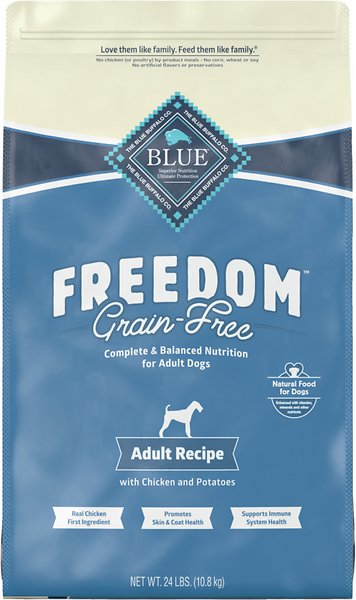
Blue Buffalo Freedom Grain Free (Dry)

Share

Rating: ★★★★☆

Blue Buffalo Freedom Grain Free dry dog food earns the Advisor’s second-tier rating of 4 stars.

The Blue Buffalo Freedom Grain Free product line includes 4 dry dog foods.

Since we could not locate AAFCO nutritional adequacy statements for these products on the Blue Buffalo website, we’re unable to report suggested life stage recommendations.

The following is a list of recipes available at the time of this review.

  • Blue Buffalo Freedom Adult Chicken
  • Blue Buffalo Freedom Puppy Chicken
  • Blue Buffalo Freedom Large Breed Chicken
  • Blue Buffalo Freedom Small Breed Chicken

Blue Buffalo Freedom Adult Chicken dry dog food was selected to represent the others in the line for this review.

Blue Buffalo Grain Free Freedom Adult Chicken

Dry Dog Food

Estimated Dry Matter Nutrient Content

Protein = 27% | Fat = 16% | Carbs = 50%

Ingredients: Deboned chicken, chicken meal, peas, potatoes, pea starch, chicken fat (preserved with mixed tocopherols and citric acid), turkey meal, pea fiber, tomato pomace (source of lycopene), flaxseed (source of omega 3 and 6 fatty acids), natural chicken flavor, alfalfa meal, potato starch, whole carrots, whole sweet potatoes, blueberries, cranberries, barley grass, dried parsley, garlic, dried kelp, taurine, Yucca schidigera extract, l-carnitine, l-lysine, glucosamine hydrochloride, chondroitin sulfate, turmeric, oil of rosemary, dried chicory root, beta-carotene, vitamin A supplement, thiamine mononitrate (vitamin B1), riboflavin (vitamin B2), niacin (vitamin B3), d-calcium pantothenate (vitamin B5), pyridoxine hydrochloride (vitamin B6), biotin (vitamin B7), folic acid (vitamin B9), vitamin B12 supplement,calcium ascorbate, vitamin D3 supplement,,vitamin E supplement, iron amino acid chelate, zinc amino acid chelate, manganese amino acid chelate, copper amino acid chelate, choline chloride, sodium selenite, calcium iodate, salt, caramel, potassium chloride, calcium carbonate, dicalcium phosphate, dried yeast, dried Lactobacillus acidophilus fermentation product, dried Bacillus subtilis fermentation product, dried Enterococcus faecium fermentation product

Fiber (estimated dry matter content) = 7.8%

Red items when present indicate controversial ingredients

Estimated Nutrient Content
MethodProteinFatCarbs
Guaranteed Analysis24%14%NA
Dry Matter Basis27%16%50%
Calorie Weighted Basis23%33%44%

The first ingredient in this dog food is chicken. Although it is a quality item, raw chicken contains about 80% water. After cooking, most of that moisture is lost, reducing the meat content to just a fraction of its original weight.

After processing, this item would probably account for a smaller part of the total content of the finished product.

The second ingredient is chicken meal. Chicken meal is considered a meat concentrate and contains nearly 300% more protein than fresh chicken.

The third ingredient mentions peas. Peas are a quality source of carbohydrates. Plus (like all legumes) they’re rich in natural fiber.

However, peas contain about 25% protein, a factor that must be considered when judging the actual meat content of this dog food.

The fourth ingredient is potato. Potatoes can be considered a gluten-free source of digestible carbohydrates. Yet with the exception of perhaps their caloric content, potatoes are of only modest nutritional value to a dog.

The fifth ingredient is pea starch, a paste-like carbohydrate extract probably used here as a gel-like binder for making kibble.

The sixth ingredient is chicken fat. Chicken fat is obtained from rendering chicken, a process similar to making soup in which the fat itself is skimmed from the surface of the liquid.

Chicken fat is high in linoleic acid, an omega-6 fatty acid essential for life. Although it doesn’t sound very appetizing, chicken fat is actually a quality ingredient.

The seventh ingredient is turkey meal. Like chicken meal, turkey meal is considered a another meat concentrate.

The eighth ingredient includes pea fiber, a mix of both soluble and insoluble dietary fiber derived from pea hulls.

The ninth ingredient is tomato pomace. Tomato pomace is a controversial ingredient, a by-product remaining after processing tomatoes into juice, soup and ketchup.

Many praise tomato pomace for its high fiber and nutrient content, while others scorn it as an inexpensive pet food filler.

Just the same, there’s probably not enough tomato pomace here to make much of a difference.

From here, the list goes on to include a number of other items.

But to be realistic, ingredients located this far down the list (other than nutritional supplements) are not likely to affect the overall rating of this product.

With four notable exceptions

First, garlic can be a controversial item. Although most experts favor the ingredient for its numerous health benefits, garlic (in rare cases) has been linked to Heinz body anemia in dogs.1

However, the limited professional literature we surveyed provided no definitive warnings regarding the use of garlic — especially when used in small amounts (as it likely is here).

Next, chicory root is naturally rich in a substance called inulin, a starch-like compound made up of repeating units of carbohydrates and found in certain roots and tubers.

Not only is inulin a natural source of soluble dietary fiber, it’s also a prebiotic used to promote the growth of healthy bacteria in a dog’s digestive tract.

Thirdly, this food also contains chelated minerals, minerals that have been chemically attached to protein. This makes them easier to absorb. Chelated minerals are usually found in better dog foods.

And lastly, the company appears to have applied friendly bacteria to the surface of the kibble after cooking. These special probiotics are used to enhance a dog’s digestive and immune functions.

Blue Buffalo Freedom Grain Free Dry
The Bottom Line

Judging by its ingredients alone, Blue Buffalo Freedom Grain Free looks to be an above-average dry dog food.

But ingredient quality by itself cannot tell the whole story. We still need to estimate the product’s meat content before determining a final rating.

The dashboard displays a dry matter protein reading of 27%, a fat level of 16% and estimated carbohydrates of about 50%.

As a group, the brand features an average protein content of 28% and a mean fat level of 16%. Together, these figures suggest a carbohydrate content of 49% for the overall product line.

Near-average protein. Near-average fat. And near-average carbs when compared to a typical dry dog food.

When you consider the protein-boosting effect of the peas, this looks like the profile of a kibble containing a moderate amount of meat.

Bottom line?

Blue Buffalo Freedom is a grain-free dry kibble dog food using a moderate amount of chicken and chicken meal as its main source of animal protein, thus earning the brand 4 stars.

Highly recommended.

Those looking for a canned version in the same product line may wish to visit our review of Blue Buffalo Freedom Grain Free canned dog food.

Special Alert

Rice ingredients can sometimes contain arsenic. Until the US FDA establishes safe upper levels for arsenic content, pet owners may wish to limit the total amount of rice fed in a dog's daily diet.

A Final Word

The descriptions and analyses expressed in this and every article on this website represent the views and opinions of the author.

Although it's our goal to ensure all the information on this website is correct, we cannot guarantee its completeness or its accuracy; nor can we commit to ensuring all the material is kept up-to-date on a daily basis.

Each review is offered in good faith and has been designed to help you make a more informed decision when buying dog food.

However, our rating system is not intended to suggest feeding a particular product will result in specific health benefits for your pet.

For a better understanding of how we analyze each product, please read our article, "The Problem with Dog Food Reviews".

Remember, no dog food can possibly be appropriate for every life stage, lifestyle or health condition. So, choose wisely. And when in doubt, consult a qualified veterinary professional for help.

In closing, we do not accept money, gifts or samples from pet food companies in exchange for special consideration in the preparation of our reviews or ratings.

To learn how we support the cost of operating this website, please visit our public Disclosure and Disclaimer page.

Have an opinion about this dog food? Or maybe the review itself? Please know we welcome your comments.

Notes and Updates

02/15/2012 Original review
02/15/2012 Last Update

  1. Yamato et al, Heinz Body hemolytic anemia with eccentrocytosis from ingestion of Chinese chive (Allium tuberosum) and garlic (Allium sativum) in a dog, Journal of the American Animal Hospital Association 41:68-73 (2005)
  • Hound Dog Mom

    The Honest Kitchen and Weruva.

  • Rebecca Mendenhall

    I didn’t know I needed to brush his teeth. My parents never did with our dog growing up. I went to the store and ended up getting 2 kinds of dental treats for him, one of which he likes and already his breath doesn’t smell. So I’m happy about that. He didn’t have any of the symptoms you listed but if the breath comes back I’m going to take him to the vet. Thanks for the help!

  • bethtalierco

    do you know what companies those are? I would buy from them.

  • Hound Dog Mom

    Do you brush your dog’s teeth? The most common culprit when it comes to bad breath is plaque or tartar buildup – smaller dogs seem to be particularly prone to buildup. If you don’t regularly brush your dog’s teeth and/or provide species-appropriate chews (i.e. raw meaty bones) your dog could be developing buildup.

    Some other considerations:
    -Breath that smells “fruity” can indicate diabetes (especially if you’ve noticed increased drinking and/or urination).
    -Breath that smells like urine can indicate kidney disease (especially if you’ve noticed increased drinking and/or urination).
    -Very rank breath (especially if the gums or eyes are tinged yellow) can indicate liver disease.

  • Rebecca Mendenhall

    Help! I switched my small terrier mix puppy to BB Freedom last week and he seems to love it. I started by mixing it with his puppy chow so he could get used to it (since the vet said I could take him off puppy chow) and then he started eating only the BB. Which is great. Except now his breath smells bad and I think it’s the food. Does anyone else have this problem?

  • Hound Dog Mom

    That’s almost the same exact thing that happened to my friend’s golden retriever puppy. She kept trying to transition from Science Diet to Blue and every time she added in the Blue the dog got diarrhea (really really bad diarrhea). She put the dog on chicken and rice, things cleared up. She tried again to transition to Blue but used a different variety (the first time she did chicken, the second time was lamb I believe) and the dog got diarrhea again. She then tried the dog on a different brand of food instead and the diarrhea cleared right up. This was last summer – the issues have been going on for awhile. Last summer I also got a bag of Blue’s cat food that, upon opening, I discovered was covered in mold and a month prior to that I had ordered a bag of their Wilderness biscuits and the bag was full of bugs. The bugs and mold could have been storage issues (however both products were purchased from two different stores, the products weren’t expired and there were no visible holes in the packaging) – but, in addition to what happened to my friend’s puppy, this was too much coincidence for me. I will no longer use or recommend Blue products.

  • tonyj

    Wow! I thought my Lab just had some stomach issues. Indies has been on BB grain free for over a year. Last month we bought a fresh bag of the Natural Evolution diet Chicken recipe within days developed a severe case of diarrhea We stopped it and placed him on a bland diet for a couple of weeks and slow reintroduced another unopened bag BB grain free food. As soon as we got to 75% kibble 25% rice and chicken he developed diarrhea again. We stopped the BB grain free kibble all together and started with BB’s canned food of the same name and no problem. After reading these postings, I believe there is problem with Buffalo Blue latest batch. Maybe they changed the procedure for producing the kibble or changed the ingredients are having it produced someplace else, but there clearly is a problem with their kibble.

  • Hound Dog Mom

    I agree with Betsy – definitely report this to the FDA. A lot of people have had their pets get very sick on Blue Buffalo products (including a friend of mine), but unfortunately nothing will be done to investigate into this matter until enough people complain to the FDA.

  • http://www.facebook.com/profile.php?id=1140685339 Betsy Greer

    That’s horrible, Dean! You should make a report, even if you only suspect the food was the culprit, to the FDA:

    http://www.fda.gov/AnimalVeterinary/SafetyHealth/ReportaProblem/ucm182403.htm

  • Dean

    Hi everyone. We switched our Runt Boston Terrier to BB Grain Free a few months back after she was having digestive issues. The vet said to go grain free and it helped a lot at first. HOWEVER since I recently got a new bag our pup had trouble eating it and would often refuse to eat altogether. We thought it was her teeth and had them checked out at the vet but nothing was wrong. Yesterday she refused to eat her food again then later started having cluster seizures or seizure storms. It literally almost killed her last night as she is very frail to begin with. We threw the rest of her food out and gave her some of our pugs food and she ate it like she had not eaten in weeks.

    I am extremely concerned that we had been feeding her contaminated dog food for several weeks.

  • Pattyvaughn

    If it were fit for human consumption, it would be clearly labeled. It is not fit for human consumption, there are only 2 food companies that can legally make that claim, I believe.

  • Tash

    Hi I own a pet store and have thought of getting Blue Buffalo in but the company will not tell us if the food is fit for human consumption. Have you heard otherwise?
    Thanks

  • Pattyvaughn

    Wilderness has a protein level of something like 38%, which is almost high enough to not need much added to it to bring the level up to what I would consider acceptable, but not quite. My 11 year old JRT has never been healthier than she is now on her high protein diet. Her littermate died two years ago of kidney disease on a diet of Science Diet. Angel just had blood work done and her values were excellent. Moreover, besides the gray hair, she looks and acts like the little athlete she is. Her protein level is 45-50% every day and occasionally higher.

  • Hound Dog Mom

    Hi Wendy –

    Actually his vet is wrong, very wrong. Dogs have a strong carnivorous bias and are designed to eat diets high in protein, moderate in fat and low in carbohydrates. A food this is lower in protein and fat is, consequently, higher in carbohydrates. High levels of protein are not harmful and cannot lead to problems down the road in healthy dogs.

    This is an excerpt from “Small Animal Clinical Nutrition”:

    Feeding protein above requirements or recommendations for healthy dogs and cats does not result in toxicity because the excess amino acids from the protein are catabolized and the waste nitrogen excreted.

    This excretion of waste nitrogen is a passive process that causes no stress or harm to renal function.

    Taken from “The Myths of High Protein” by Kenneth Bovee , DVM, MMedSC:

    A number of false assumptions about the need for reduced protein intake in regard to renal functon have been perpetuated in the literature for many years:

    -Increased urea load causes increased workload for the kidneys.
    -High dietary protein intake injures kidneys.
    -High dietary protein intake causes hyperkalemia.
    -High dietary protein intake causes acidosis.
    -Protein intake results in uremic toxins.
    -Reduced protein intake slows the progression of renal disease.

    [http://www.scribd.com/doc/71690861/Myths-of-High-Protein]

    I have three dogs – a senior that will be 8 next month, a 2 year old adult and a 9 month old puppy – they all eat a diet with protein levels in the 45% – 55% range. They are all extremely active and healthy. Luckily I feed a raw diet so I can achieve these protein levels, however even if I weren’t feeding raw I would never feed a food with less than 30% protein or advise it for an otherwise healthy dog.

  • Wendy

    I am not happy with the dry food kibbles so small in the BB adult chicken recipe, my dog seems to gulp a mouth full and can’t chew them, then when he swallows them he throws them back up onto the floor in a big puddle of goop ! I am looking for a bigger kibble now ! I can’t believe how small they are, this sucks ! Would large breed kibbles be bigger ?

  • Wendy

    Your Vet is right , I’m not going over 28 % protein, I just started my dog on BB Wilderness and I’m going to try the BB Freedom , my dog is 1 1/2 and over a long period of time, 5 years down the road, problems may start

  • Golden Moments

    I can’t believe you all think these prices are too high, i dont think a dog food is is that great if it’s under 60.00 dollars, I sometimes wonder if it’s good dog food at such low price’s. I pay 76.00 to 84.00 for dog food from my vet and yes every one thinks vet food is over priced but a lot of work goes into the product. Have had good results for a ten year old, never any health problems, except that lung cancer took him suddenly at ten. I have one dog on vet food because of the good results I had before, and one starting on BB Wilderness, because of bloating problems she is doing better on Wilderness, but I am worried about the high protein.My older one is starting BB Adult, I’m sure he will be fine on it, he can eat any thing. I’m worried about the high protein and I might try freedom after a month or so.Two dogs from my town died of Kidney failure, both were on high protein foods, about five year olds. Next option is to get blood tests done regularly if on high protein ? My Vet say’s 34 % protein is too much after long term feeding. Any one out there with an older dog on high protein ?

  • Golden Moments

    My vet tells me the same thing because she is concerned about the Wilderness protein at 34 %, over a long period of time she is worried about kidney problems and all these commercial brands are low carb, high protein, listen to your vet because I had to change my dogs veterinary diet because of bloating issues and my dog was doing so well on Veterinary diet, now grain free is helping my dog, she is currently on BB wilderness, but I might try the Freedom because the protein is 24 %, dogs do not need more than 28 % protein, I do not like any fish or duck in recipe’s, she also got sick on fish diet. I have another dog on Veterinary diet and he is doing great since 11/2 year now, he can tolerate corn, rice, wheat, and his coat is beautiful, never any health problems, my third Golden is 4 years and he can eat any thing, except the veterinary food my other eats, the older one gains weight on and I do not want to feed him diet foods, so he is now on BB adult, 24 % protein and I make sure they all have ideal weights. I look for chicken recipe dog foods are safer and more reliable, the vet food I am feeding is Royal Canine Veterinary Exclusive Moderate calorie. Commercial dog foods should rate five star, but they are all not scientifically proven, so research ingredients and find what works, Vet foods do more research. if they are happy, shiny coat and no diahhrea, the food is working. Regular blood tests should be done if feeding high protein over a period of time, what works for some may not work for others., I had a Golden Retriever on Royal Canine for ten years and he never had a health problem, he passed away at ten years from Cancer in lung.

  • JOHANNES

    Thanks for all of the comments. Extremely interesting, helpful, and sometimes confusing. But then nutrition in dogs or humans is very controversial by nature and thus passionate.

  • JOHANNES

    I bought a bag of the small breed version from this brand. I will introduce it to the dogs tomorrow and see what THEY have to say. lol :)

  • anniearies

    thank u, we had managed to control her weight now.we go with regular dog food too.bb wildness is too rich in protein /fat for her. despite we want to feed her sth grain-free, all those tend to have higher fat content.

  • annie

    i too think had feed too much potato.

  • http://www.thegreedypinstripes.com/ BryanV21

    I think Kiara needs to take a break and think, so I wouldn’t go to her for advice.

    How about starting with what Blue Buffalo you’re currently using, and letting us know about any issues your dog may be having? That way we can either recommend a similar food, or one different to try and take care of the issues.

  • http://www.thegreedypinstripes.com/ BryanV21

    Those commercials you speak of ARE for lower protein foods, most of which are looked down upon those with a good knowledge of pet nutrition. So blaming them for the push for a higher protein diet is ignorant.

    A German Shephard and a chihuahua are indeed different, and therefore likely would require different diets. That’s not to say a GSD can’t survive on a lower protein diet, but a higher ANIMAL-BASED protein diet is generally more idea. And smaller dogs, such as chihuahuas typically do not do well on a high protein diet, but that doesn’t mean they can’t at all.

    It’s about the QUALITY of the protein, not how much protein is in it. Protein coming from grains such as corn, and protein coming from meat, are totally different. That is where the confusion exists.

    BTW, read the rules of this website. If you are indeed a vet then you need to present your credentials, because I can sit here and claim to be one too. However, I don’t have to because I have plenty of FACTS to back up my words.

  • Kierstin

    Kiara, I’ve recently read the issues with blue buffalo and am seriously considering switching. Seeing as you work at a clinic do you have any idea what the vets you work with recommend the most for food? I have two labs.

  • Pattyvaughn

    I’m not sure I believe BB is having a problem, but some companies definitely do ignore complaints of sick pets until the FDA is breathing down their neck. The FDA has next to no power to enforce anything, so these companies do not get in much of any trouble at all.

  • Amanda

    I have been feeding this to my GSD mix pup since I got her in September and I also feed our 3 cats the indoor dry food. My eldest cat is 7 and he used to throw up on a daily basis; until I switched their dry food to BB. Does he still throw up? Of course but not like before. The cats’ fur is also amazingly soft now. Even my dog’s fur is super soft and all 4 animals get compliments on their coats. Has my puppy had diarrhea? Yup. Do I think it was from the BB? Nope. She did have a bit of the problem with the lamb and apple treats BUT, it was when I was training her and I am pretty sure it was just because she ate FAR too many in the hour I was training her. A lot of dogs, mine included, have the terrible habit of getting into things they aren’t supposed to. I’m pretty sure anytime my dog has had diarrhea it was from her getting into something she wasn’t supposed to, bird seed, for example, used to be her favorite thing to eat. She has stopped doing that and now her poops are solid again. Does my dog drink a lot of water? Yup, sure does. But she’s a puppy and runs around and plays constantly so of course she is thirsty! She is not in the least bit lethargic, neither are the cats. We have never had a problem with BB. I did get worried when I saw all the complaints on consumer affairs but after 2+ hours of researching dog and cat foods and looking at other reviews here on Dog Food Advisor, I am sticking with BB. Many people on here have pointed out how well structured the “complaints” are on the other sites. Also, BB posted about all of this on their Facebook. I find it hard to believe that a company would ignore it if their food was in fact making animals sick. They could get into some MAJOR trouble if they did.

  • Shawna

    I’m not a vet and I don’t work in the field but I’m pretty knowledgable in dog nutrition and I can read research..

    Although I think dogs greatly benefit from certain foods other than meat/fat, it is established that dogs (current day dogs) do not require carbohydrates – this can even be found in Waltham.

    “Kidney failure due to Blue diets”? Are you suggesting higher amounts of protein cause kidney disease? If so, that is TOTALLY incorrect information. This has been scientifically proven — more on that later.

    The dog in my avatar pic to the left is 1/2 Chihuahua, 1/4 Poodle and 1/4 Boston Terrier weighing in at 9 pounds. She was diagnosed early in life with congenital kidney disease. She has symptoms of polydipsia and polyuria seen as early as 6 weeks of age. She was officially diagnosed during pre-spay bloodwork right after her 1 year birthday. She will be 7 years old the end of June 2013. Her diet since weaning has been HIGH protein raw — with protein amounts ranging from 45 to 54 % (on a dry matter basis). She is unmedicated, has never had sub-q fluid therapy and her only symptoms remain polydipsia and polyuria. If “protein” caused kidney disease there is NO way she’d be with me let alone quite healthy..

    Not only does protein not cause kidney disease but Science Diet says this about protein in kidney treatment.
    “In contrast, multiple studies have failed to confirm a beneficial role for protein restriction in limiting progression of kidney disease in dogs (4, 5, 16).

    There are no randomised controlled clinical trials that address the role of diet therapy in dogs with stage 1 and 2 CKD.”
    http://www.hillsvet.com/pdf/confPro_TheRoleOfNutritionalManagementInDogsWithChronicKidneyDisease_en.pdf

    Mike posted some great data on the topic
    “The mistaken belief that high protein diets cause kidney disease in normal dogs is outdated and no longer accepted by most veterinary professionals.

    For proof, I refer you to an important article by Dr. Kenneth Bovee, Emeritus Professor of Medicine at the University of Pennsylvania. The report is most appropriately entitled, “Mythology of Protein Restriction for Dogs with Reduced Renal Function”.

    Dr. Bovee concludes is article by saying…

    “…the continued existence of this false myth about dietary protein is an uncomfortable reminder of the lack of sophistication, lack of critical thought, and reliance on oversimplified and attractive dogma that persists in our profession.

    “This is only one example of many false myths, misinformation, and partial truths that are repeated from decade to decade.”
    http://www.dogfoodadvisor.com/dog-food-reviews/hills-science-diet-dog-food-mature-adult-dry/#comment-823221651
    The article was published in the respected (and peer-reviewed) Compendium on Continuing Education for the Practicing Veterinarian in 1999 and includes not less than 47 scientifically referenced footnotes

  • http://www.facebook.com/kiara.brown.52 Kiara Brown

    Are you a vet? I think not.
    Did you get a degree in veterinary medicine? Doesn’t seem like it. Do you work in the field? I doubt it. What about the clinics that push Iam’s prescription or Purina Prescription? Don’t speak unless you have facts. I know at my clinic we have treated SEVERAL dogs diagnosed with kidney failure due to Blue diets. Or how about the ones we have had to unfortunately euthanize. Speak when you have facts, stop listening to the commercials, of course they want you to believe that german shep is a direct relative of a wolf, but can you really tell me my chihuahua is and needs the same diet as a wolf? Thats just dumb. Get experience and facts.

  • aimee

    Hi Losul,

    By a passive process I mean the kidney does not actively transport nitrogen waste (urea) out of the blood. It is a simple filtration process. Think of the glomerulus like a colander. Small particles suspended in the fluid pass through the holes. If there are few suspended particles than few pass through and if there are a lot of particles than a lot pass through but there is no “work” being done by the colander. In regards as to “Where the heck do you get that from? ” I “got it” from basic physiology of kidney function. : )

    Losul..I assure you I haven’t missed any points. : ) It is a common error for people to make, as the author you quoted has made, to report that the type of protein fed determines the “work” the kidney does.

  • losul

    I cannot understand what you mean by a passive process. Where the heck do you get that from? As far as I’m concerned, there is work and stress in the process, not just for the liver and kidneys, and if there is not enough water involved, then even more so.

    But the main point that you seem to have sorely missed is that it is more stress and work for the body to excrete the waste from low quality proteins than high quality ones, even if the overall protein percentages are the same.

    “Protein is processed in the liver and any waste materials are filtered and excreted by the kidneys. High quality protein does not generate large amounts of waste that needs to be removed from the body, but poor quality protein which is difficult to digest does and thus puts stress on the kidneys. The liver needs water to process protein and as a medium to carry waste products to the kidneys, where they are filtered out and most of the water is reabsorbed. The less concentrated the waste products in this primary filtrate are, the easier it is for the kidneys to do their filtering work – that’s why it is unhealthy to feed dry food only and so critical that dogs eating mostly or exclusively dry food and dogs with liver disease get lots of extra water. Dogs who eat mostly canned food or a home prepared diet automatically take in more moisture and do not need to compensate as much by drinking. Contrary to what many people think and pet food companies claim, dogs (and cats) do not know instinctively how much extra water they have to drink to make up for what is lacking in the dry food. This is why I so highly recommend that people always add water to the kibble at feeding time.”

    “Now that we have the basics laid out, we can return to the protein in the food. Many people cite old, outdated research that claims high protein percentages in the food are harmful to dogs and do all kinds of damage, especially to the liver. Fact is that these studies were conducted by feeding dogs foods that were made from poor quality, hard to digest protein sources, such as soy, corn, byproducts, blood meal and so on. From my explanation above, you now already know that it is a question of protein quality that affects the kidneys. Consider a wolf in the wild, who will eat relatively little else but meat if they can help it – these animals don’t get kidney diseases on the same scale domestic dogs do. Their protein comes in the form of quality muscle and organ meat though, not processed leftovers from human food processing. It also contains around 70% moisture, whereas most commercial dry foods contain a maximum of 10%. Dogs and other “dog like” animals (canids) evolved eating a diet that consists primarily of meat, fat and bones, which they have been eating for hundreds of thousands of years. Commercial foods, especially dry food, has only been widely available for the past 60 years and we are still learning how much damage certain aspects of it can do. Things have improved quite a bit from hitting rock bottom in the 70s and 80s, but the majority of pet food manufacturers still produce bad foods from poor quality ingredients.”

    http://www.dogfoodproject.com/index.php?page=protein_myth

  • aimee

    Elimination of nitrogenous waste by the kidney is a completely passive process. There is no “work” involved and no stress to the kidney.

    Amino acids from plant or animal origin that are not incorporated into the body are broken down, the resulting energy used or stored, and the nitrogen excreted.

    When tested, dogs on high protein meat based raw diets had higher blood urea nitrogen levels than dogs on commercial foods. This is because there is more nitrogenous waste to excrete when feeding a high protein diet, even when that protein comes from meat; lots of AA in excess of needs.

    If it was “work” to excrete the waste there would be more “work” and “stress” on the kidneys from dogs that eat high meat based protein diets than dogs that ate commercial foods.

    But because the filtration of waste is completely passive it is no problem at all to excrete all the waste generated from high protein diets.

  • Hound Dog Mom

    Hi Losul –

    Good points. A diet comprised of predominantly plant-based and/or low quality proteins (rendered low-grade by-products) and diets low in moisture will be taxing on renal function over time. As far as a dog being overfed however, that will cause an issue regardless of whether the food is high in protein or lower in protein – that’s just a calorie issue. Gram for gram protein and carbohydrates have about the same amount of calories.

  • losul

    Hi HDM,

    I think there can be a few exceptions to the rule;

    1) If much of the protein is coming from low quality sources, i.e. soy, corn gluten meal (60% protein), etc. the kidneys have to work extra hard to excrete the waste, whereas quality muscle meat and organs don’t generate near as much waste or stress for the kidneys to excrete.

    2) The dog is fed high protein dry kibble most of the time, and is not intaking enough water makes it much harder on the kidneys and the rest of the body. I always add water to dry kibble, high protein or not.

    3) If the dog is being overfed, which seems to often be the case more than not, especially inactive, indoor dogs.

  • Hound Dog Mom

    Hi Chlo –

    A healthy dog can’t be fed “too much protein.” When protein is consumed above the minimum dietary requirements the excess amino acids from the protein are catabolized and the waste nitrogen is excreted. Food is comprised primarily of protein, fat and carbohydrates. So if one nutrient is decreased another is increased – in general when protein is decreased the carbohydrate level is increased. This is the case with Blue Freedom versus Blue Wilderness. By feeding Blue Freedom you’re swapping meat for white potatoes. White potatoes – along with other starches and grains – are not species-appropriate and should be limited. So while levels of protein above the minimum dietary requirement won’t provide the dog with any additional benefits per se – it’s necessary to feed a food higher in protein (and in fat) to limit carbohydrate content (and excess carbohydrates are unhealthy). All healthy dogs, regardless of activity level or indoor/outdoor status, have the same basic nutritional requirements and ideally should be fed a food high in protein, moderate in fat and low in carbohydrates. What should differ between an indoor dog and an outdoor dog and an inactive dog and an active dog is energy intake – total calories consumed. An indoor dog should likely eat less than an outdoor dog but that doesn’t mean it should eat a different food than an outdoor dog.

  • losul

    Is your dog one of these, especially the first four?

    Copper: Diets low in copper are recommended for certain breeds such as Bedlington Terriers, Doberman Pinscher, Skye Terrier and West Highland White Terriers, Airedale Terrier, Bobtail, Boxer, Bull Terrier, Bulldog, Cocker Spaniel, Collie, Dachshund, Dalmatian, German Shepherd, Golden Retriever, Keeshond, Kerry Blue Terrier, Pekingese, Poodle, Samoyed, Schnauzer, Wirehaired Fox Terrier.

    These breeds are prone to a form of liver disease called copper storage disease in which too much copper accumulates in the liver and causes problems with liver function. It should be noted that dogs with copper storage disease should not be given Vitamin C because it may increase the damage to the liver. If you have these breeds your dog’s diet should center around foods low in copper such as beef, cheese, eggs and tomatoes. Avoid lamb, pork and duck. Check with veterinary nutrition experts for a complete list.

    (because copper is the problem, you should avoid vitamin C supplementation, but consider zinc and SAM-e.)

    http://www.dog-health-guide.org/canineliverdiseasediet.html

    Not trying to scare, but copper storage can become a serious or deadly problem. Many commercial foods are high in copper. You’ll have to research to find those that aren’t, or commit to home prepped meals. Avoid those with cheap fillers, i.e. corn, wheat, meat by products, preservatives (including rosemary), etc. Also avoid liver, shellfish, legumes, nuts, and kelp.

    Copper storage disease is probably mostly hereditary.

    http://www.petmd.com/dog/conditions/endocrine/c_multi_copper_storage_hepatopathy#.URbj7B2A5gg

  • Pattyvaughn

    There is no physiological reason to limit protein in a healthy dog due to where it lives.

  • Chlo

    I thought feeding a dog that is like an indoor dog to much protein was not a good thing. This is why I feed my dog BB Freedom. I even email BB and they said it would be to much protein if I fed my dog Wilderness. Any opinions?

  • Pattyvaughn

    All dog foods can cause loose stools if your dog is not used to them and dry does not keep the teeth clean like they used to think.  Food with water included in it is more species appropriate, so canned, if you can afford it, is a good choice.

  • Jovetta

    wet dog food can cause loose stools. Its also bad for tarter build up on the teeth. Try to stick to dry food and some water to moisten if you need to.

  • losul

    I’d say it’s true. Most mainstream liver is going to have buildups of toxins in it, i.e. heavy metals  such as cadmium, arsenic, and lead, aflatoxins and mycotoxins, pesticides, herbicides, and veterinary drugs.

    If you don’t KNOW your source (don’t buy Tyson chicken livers or unknown beef livers from the grocery store) it’s best to get your A and B vitamins elsewhere, and preferably from other natural foods, and forgo feeding liver to your dogs or eating it yourself.

    I agree with Patty. Livers from young, organically, free range and/or grass fed animals should be much safer.

    notice the much higher aflatoxin concentrations allowably  fed to animals as they get closer to slaughter. 

    U.S. Food and Drug Administration guidelines are as follows:Aflatoxin Level
    (parts per billion)Commodities & Species20 ppbFor corn, peanut products, cottonseed meal and other animal feeds and feed ingredients intended for dairy animals; for animal species or uses not specified below, or when the intended use is not known.20 ppbFor corn, peanut products and other animal feeds and feed ingredients, but excluding cottonseed meal, intended for immature animals.100 ppbFor corn and peanut products intended for breeding beef cattle, breeding swine or mature poultry (e.g. laying hens).200 ppbFor corn and peanut products intended for finishing swine (100 pounds or more).300 ppbFor cottonseed meal intended for beef cattle, swine or poultry (regardless of age or breeding status).300 ppbFor corn and peanut products intended for finishing beef cattle (i.e., feedlot cattle).

  • Pattyvaughn

    I can’t answer your questions about copper, but I can about ppm.  It means that for any unit of measure you use, 17.35 out of 1 million will be copper.  17.35oz of every 1 million oz will be copper.  17.35 cups will be copper of every 1 million cups.

  • Tazpuppy

    My small dog has a liver problem the vet thinks is related to copper concentration. It didn’t show up until after I had changed to Blue Buffalo. I’ve read the article on this site but need help understanding how to convert your information to ppm. Blue has 17.35 ppm per serving or ounce? Taz is now on Denamarin and Cyclosporine. I understand the Denamarin is a liver protectant and the Cyclosporine is to reduce inflammation. There is also another medicine, Penicillamine, that is to help bind the copper to it and get it out of the liver. We have not started this one yet. He is also on l/d Science Diet.

    All that being said is the level of copper too high? Is the type wrong. Are there good foods that contain the “right” copper?
    What are your thoughts?

  • Pattyvaughn

    It’s true to a certain extent.  The older the animal the more toxins its liver has filtered out.  And the more unnaturally raised the more its liver has to filter out.  So grass fed, organically raisedbeef liver is pretty good and calf liver especially from grass fed or range cows is OK.

  • Kevin

     I heard on the Doctor Oz show that people should not eat liver because that is the organ that takes in all the toxins. So Doctor Oz said that you should not eat liver because you are taking in the toxins of that liver.

  • Kimby37

    I also wish they would give more coupons considering it is very expensive. We switched to another grain free food and noticed it is not the same. On blue Buffalo my dog (not to be gross ) but pooed less and it was easier to pick up. I would love to go back to buying it but now that we rescued a dog from TN we cant afford to have 2 of them eating it.

  • Pattyvaughn

    A lot of the immune system is based on a healthy gut, feeding the same thing day in and day out actually weakens the gut. No food is perfect so by rotating you are less likely to get nutritional gaps. Weakening the gut is what many of us believe causes these food intolerances, yeast infections, etc…
    .
    Some people rotate every three months, some every bag, some every day, and some every meal. When you first start rotating foods your dog might need a couple weeks to get on a new food and a couple weeks to settle before you even consider starting another change. Once your dogs gut gets stronger, you’ll be able to change faster, however you choose.
    .
    If you want to really help your dog’s gut heal then adding pre/probiotics to every meal is a big boost. Just one caution, as your dog begins to get rid of toxins, you may see some symptoms reappear. That’s normal and temporary.

  • Hikerpam

    How often do you suggest that we switch and is it because her body will just get use to the one food and the allergies may return?

  • http://www.facebook.com/profile.php?id=1140685339 Betsy Greer

    I’m curious as to how long he’s been eating grain free food. It sounds as though he switched somewhat recently. I wonder if he might have a systemic candida infection and the skin issues have persisted or worsened as a result detox following the switch to grain free.

    I’d be sure to avoid foods with not only grain, but also white potato and would definitely add the digestive enzymes and probiotics that Patty suggested.

  • Pattyvaughn

    Dogs with this issue often benefit from rotating foods. You might want to pick a few grain free foods and rotate through them.

  • Hikerpam

    My German Shepherd use to have ear scratching issues and the vet never saw a reason for it, we used an ear drop (wash) I believed with a steroid to help reduce the inflammation, that didn’t do a thing. Then I started wondering if it might be food allergies, she was being fed a food with grain, so I weaned her off that and on to BB Freedom Adult after the first 2 smaller bags (I wanted to try it first) the itching was gone. She also has two spoonfuls of wet BB Freedom Grain Free mixed in. She also has a grain free Organic dog biscuit. I am a believer. A bit pricy and I wish more coupons were available but will continue to use.

  • Shelly Parker-Binkley

    Yes, I get her updated newsletters and videos :) and I am on her facebook. Love the lady she isn’t out to make a buck every time she gives out good information.

  • Shawna

    You are absolutely correct!! Nice post :)
    Were you on Dr. Becker’s Mercola Healthy Pets forum before it closed? I was swinn on the site.. I’m hoping they open the forum back up or start another.. It was a GREAT community!!!

  • Melissaandcrew

    tisci02-

    If your dog were a schnauzer, I would say he has comedone syndrome. Never heard of it in a shihtzu. Have you tried dabbing the lesions with witch hazel? In schnauzers, it causes the bumps to dry out quickly w/out forming the crusty/scabby lesions. If it works, you can “get a head of it” by putting some in a spray bottle and misting the whole dog(except face/eyes of course) making sure it gets down to skin level.

    Also, are you using a spot on flea preventative? That stuff travels through the skin/hair follicles and could be making it worse.

  • Shelly Parker-Binkley

    Just like humans with gluten problems etc., animals are showing the same health problems. No grain (all) no corn, no soy (under it’s other names), no rice brown or white. No sugars (potato). Etc.. As time goes on they develop health problems just like humans when on these foods. Notice all the disease now animals are getting that humans get? Some animals will have problems on dairy too. The research is out there, but they really don’t want us to know it. I know it because I have Celiac Disease, but I developed lots of health problems because it wasn’t discovered in time. Do the research don’t take my word on it. Dr. Becker vet (Dr. Mercola site) is a good one to follow she puts out great videos. I love that fact she doesn’t CHARGE for her advice.

  • Shelly Parker-Binkley

    Potato’s are fatting I know :) they turned to sugar, and they aren’t healthy at all. Buy animal food without there. The reason companies use them is they are cheap filler foods. Sick it’s not about quality, it’s about quantity and the mighty dollar.

  • Shelly Parker-Binkley

    They shouldn’t have potatoes period! It’s a filler a cheap filler!

  • tisci02

    He doesn’t scratch & it’s not immediately after eating. The closest thing I can compare it to is a constant skin irritation. He’s had it for 5 years & I’ve tried multiple different foods. My vet has even tested his skin to make sure it’s not any kind of infection. He gets groomed w/special shampoo as well. I’ll definitely try the pumpkin & then if that doesn’t work, maybe some buffalo food or another nonregular protein source. Thank you!!

  • Pattyvaughn

    If he’s scratching a lot and then scabs and bumps pop up, then he may have an intolerance to something in his food, and those things added to his food may help some. Finding a few different foods, different protein sources that he can tolerate and rotating will help some too.
    If he eats and then soon after, he breaks out in bumps(hives), he may have a true allergy, and they can be life threatening, think peanut butter allergy or bee sting allergy. Then those thing will not help and you need to find a different food quick, because his food will kill him. Hope he turns around soon.

  • tisci02

    Thank you! I’ll try adding those in. He gets lesions on his skin, they look like scabs & raised bumps.

  • Pattyvaughn

    If his allergies are generalized itchy skin, stinky ears, eye discharge, etc. then adding pre/probiotics and digestive enzymes may help. Consider adding a spoonful of unsweetened cocoanut flakes to all meals and a spoonful of pure pumpkin too. Good luck finding what works for your pup.
    If you are thinking of switching foods then I would transition very slowly, like over the course of a month, so you have plenty of time to realize whether or not it agrees with him.

  • tisci02

    My 8 year old Shih Tzus has had episodes of Hemmorhagic Gastroentitis in the past, almost killing him & the only thing that seems to cause it is foods that are high in protein. I had been feeding him grain free food because he also has allergies & going grain free seemed to help. Right now, he eats Precise Holistic Complete & it’s low enough in protein & a healthy food, but he still has skin issues. Do any of you have any opinions about trying him on this? Risking his life to find the right higher protein/grain free food isn’t something I’m willing to do.

  • BallouTwo

    Thank you. I have a big yorkie913 lbs.) who has had a rash for a long time. When I heard of dogs havving allergeies to grain,I wondered if this could be the problem and put him on  Blue freedom. He has improve. The rash is gone. He has gained weight and I have reduced the amount to half a cup aday in stead of 2/3 acup.I also give him a lot of fresh cooked chicken and he love raw liver. I feel much better about what I feed him after reading this Article. Sarah D. Campbell

  • Jc5842

     I believe the BB Wilderness line has more protein in it.

  • Shelly

    Also, buy only Organic Pumpkin with no fillers. 

  • http://www.facebook.com/profile.php?id=100000189032407 Aimee Pieper

    I am sure you have already covered this but does your lab swim in a Pool?  Clorine can make the hair break and make them shed.

  • Kcockrell77

    When I say falling out, I mean bald spots and the skin is very flaky where the fur has come out.

  • Dave’s Hounds

     My dogs have done very well on the kibbles I have used for the past 5 years (they get kibble with fresh meat one meal) and fresh meat and canned the next. However the big difference on Brothers is the increased energy, my hounds are not shedding like crazy and no food has been able to do that including ziwipeak. Their ears have not smelled or had any infections. I am sold.

  • Kcockrell77

    Quick question. I have had my lab on blue buffalo for close to 2 years. Last fall he started having problems with his fur falling out. We switched him to the basic formula and basic formula treat. It did not get better, so we switched to basic grain free and switched treats. When we switched him, it was like he was blowing out his winter coat. He shed for a solid month and I mean bad! Then his fur was beautiful. All of the sudden it is falling out again and worse. Could this be related to food?? BTW, he has been to the vet multiple times and the hair loss is not medical. The vet labeled it “environmental” Thanks!

  • http://www.facebook.com/profile.php?id=779037019 Keecia Buster

    I’m sorry, but your vet is wrong.  Dogs are carnivores and they are bred by evolution to eat all meat diets.  Your vet goes to a school (any vet school) that is funded by Science Diet.  Dogs need meat.

  • Kevin

    Thanks for the reply.  

  • InkedMarie

    I’m not John and sure not Christo LOL but he means that Christo eating Brothers Complete dog food is why he looks so good now!

  • Kevin

     Props to Brother’s Complete it worked. What did you mean by that.  I am confused.

  • Johnandchristo

    Funny thing …..

    With my dog, all though I had all sorts of problems, when I did put him on grain free  no problems. Well I guess every dog is different.And not all dog foods are the same. Props to Brother’s Complete it worked.

  • Dave’s Hounds

    After going grain free I had to add pumpkin into my dogs food. Made a huge difference. i also add plain greek yogurt with multiple strains of probiotics.

  • Kevin

     Pumpkin is a good source of fibre and beta carotene (a source of vitamin A). Dogs need fibre in their diet. The current trend is towards  highly digestible diets that lower stool volume and this is not necessarily a good thing. Keeping the GI tract moving helps keep the cells lining the gut healthy.Source:  http://www.moderndogmagazine.com/articles/10-people-foods-dogs/1896

    Do not use Pumpkin Pie filling.  I buy it in the can saying 100 percent pumpkin.

  • Kevin

    If you read my comment earlier – I feed my dog less than what the label says.  I think the label says 2 – 3 cups.  I feed  
    her 1 cup, but I also feed her fruit, and vegetables, and canned tuna or salmon on the side as treats. My dog also loves peanut butter in her kong toy – frozen.   Cut down on what you feed the dog somewhat, and go on walks.  Everything in moderation.  Dogs just love food, so you need to be the judge on how much they need to eat.

  • Linz

    My dog has the same problem as Jerry’s, although she’s an 8 month Anatolian Shepherd weighing 70 lbs currently. She’s been on the Freedom Grain-Free puppy food for a few months, a separate pro-biotic, and still has soft stools. I’ve been giving her 5-6 cups with wet food mixed in, so we’ll try 4 cups with wet mixed and see if that works. Any other suggestions? She has a great energy level and fantastic coat on this food so we’d like to stick with it if all it takes is reducing the amount of food!

  • Hound Dog Mom

    Hi Anniearies,

    Blue Basics and Blue Freedom are both very high carbohydrate foods. Carbohydrates tend to contribute to weight gain in dogs. In my opinion, you would be better of going with the Blue Wilderness (if you wanted to stick with Blue that is). I would go with the regular formula (there’s not a significant enough caloric different between the weight management and regular formulas to justify the decreased protein in the weight control formula in my opinion). Feed her less and exercise her more. Also, if she gained weight that quickly and doesn’t eat much you may want to have her seen by a vet. Sometimes rapid weight gain can signify an underlying health condition.

  • Anniearies

    does this food help with weight control? we are having bb basic turkey and potato formula small kibble. my dog eat only little, but gained a lot of weight. unknown reason, she is sensitive to turkey and potato weight control formula.i heard grain free is better, but it is of higher calorie and fat. wonder if anyone tried both bb basic and bb freedom can tell me the difference in this aspect. thanks a million.

  • Kevin

    I changed dog foods from Blue Buffalo Life Protection to the 
    Freedom.  My dog is a  Norwegian Elkhound mix.  She would shed a lot, so a lot of brushing was required.  Her hair was semi-course. Plus she would scratch a lot when warm weather came.  She scratch so much that she finally had hot spots.  The vet thought she may have allergies, but she didn’t have the signs of allergies besides the scratching. 

    I changed dog foods just to see if there was something to this Grain Free hype.  She has been on Freedom for about 2 months now. Her hair is so soft now, and very glossy.  She doesn’t shed much anymore. Plus the scratching has stop. The Grain Free Freedom has made a huge difference on my dog.   

    I feed her the same amount of dog food I did before. I don’t follow the bag for dog food amounts because if I did my dog without a doubt would become fat.  

    The cost of the Grain Free Freedom is more than I paid before, but with these results it is so worth it.  

  • Marie

     I hope it works out if you decide to try again. I’ve noticed that recommended feeding guidelines are usually a bit inflated.

  • Jerry

    Thanks Marie. I’ll keep that in mind if we go high protein again. I was going with the lowest recommended amount listed on the bag for her size which was 1/2 cup per day (we did 1/4 cup twice a day). Shaving off 1/8 of the portion should be easy enough. Thanks again.

  • Marie

     A lot of times when a dog is put on a higher-protein food and has soft stools, I usually recommend cutting back overall food amount by 1/8-1/4. Soft stools are usually a sign of (unknowingly, of course) overfeeding. Eating less is usually a good thing, because that means your dog is getting more nutrition with smaller amounts. Unless, of course, less interest in eating is combined with other obvious signs of illness.

  • Jerry

    As I just posted in the NV Instinct comments, my 9 lb small breed mix did not handle the transition to high protein-grain free well, having soft stools and gradually eating less.  I thought this may have been from the ingredients as she never had duck in a formula before, so I gradually switched to the beef and lamb based forumula within the Instinct line.  Now she is barely eating at all (will still devour treats and canned food though so I know it’s not a health issue causing her to not eat).  She has been on Nature’s Variety Prairie before and did fine on it, so it leads me to believe that the protein is the culprit here, at least in my dog’s case.

    Based on this I’m going to transition to Blue Freedom kibble.  If she does well on it, upon finishing I will try to switch again to high protein, but we’ll stay within the BB product line and try Wilderness.  I hope she does well on the BB brands.  I am very interested to see what the results are and if her intolerence was due to the protein amount or just the Instinct brand.   

  • Eric

    Then get wilderness…?

  • Marie

    Agreed. I have people ask me why Blue would make a lower protein grain-free food and I just shrug. The canned isn’t so bad though.

  • Dog Food Ninja

    So, the new line blue is towing is that wilderness is “too high” in protein for most average dogs, and freedom is a lower protein grain free alternative. I think that meat is the most expensive ingredient in a dog food, and blue has come up with a clever way to charge the same 55 bucks a bag for a food that costs them less to produce. And, you’d think that they could have at least made the new grain free line potato free as well, to create a worthwhile selling point, or maybe used a unique protein rather than shoveling out yet another chicken based food. But whatever.

  • Scitron

    What our results with the “Freedom” line are, that our two Queensland/Pointer mix dogs, are really looking good, they have lots of energy, and the stools are both firm and small. I do run my dogs at least 2 miles a day out in the desert by my home, and that also keeps them from being too frisky in the house. ( yes, they are spoiled by being inside when ever they want. I also DO NOT feed scraps from the table except for licking the cereal bowls, or plates as a prewash) ( I know, sounds sick, but the plates and bowls go right into the dish washer, so not to worry) the only time I have had any problems were when my male got into the chicken coop, and ate some poop from the chickens….that gave him Coccidiosis, and he had to be treated with antibiotics for about 10 days.

  • mariabonita69

    Which formula are you using?
    Wilderness or the Freedom fomula?

    Maria

  • http://BrothersComplete.com/ Richard Darlington

    Mike P

    ABSOLUTELY BEAUTIFUL!!

    And I must say that Jubilee is looking great too.

  • Shawna

    Correct Mike :) !!!!!  GREAT pictures!!!!!!!!!

  • Mike P

    Correct me if I’m wrong but I believe more protein and less junk snacks will keep your dog nice and lean.

  • Shawna

    Mike P is right — the amount of protein required by a small breed is no different then by a larger breed.  They all need lots of it ;) ..  The amino acids in protein are used to make antioxidants (like glutathione), used to make the very enzymes that digest the food eaten.  Used to repair and build new cells (like muscle and organs).  Used to make hair and nails.  It is the MOST important ingredient in a food…

    You can not feed too much “quality protein” to a dog or cat.  Drs Foster and Smith talk about it on their website.  Quote below

    Also, quality animal based protein does not (they know for sure) cause liver or kidney damage and limiting protein (even in a kidney dog) they now know can actually increase the likelyhood of shortened life span…

    I have 8 dogs living with me (5 are mine, my daughters pup and 2 foster dogs).  They range in size from 5 pounds to 15 pounds and all are on high protein diets.  My dog born with kidney disease has been on a high protein, raw diet since weaning and will be 6 the end of June and is in EXCELLENT health. :)

    “Can I feed my pet too much protein? If your pet eats too much protein, some will be excreted in the urine and the rest will be used as calories or converted to fat”  http://www.drsfostersmith.com/pic/article.cfm?aid=458

  • Mike P

    Hi donnie read Mike’s article on protein.It’s very informative and will probably answer some of your questions.I’m all in on quality animal protein for my dog.I don’t think it matters if a dog is small or large on how much good protein you feed.

  • donnie

    does BB grain free have to much protein for a small breed dog?

  • KMJ

    I started giving our girls the grain free chicken dog food. When they were puppies we fed them regular blue puppy formula, then for a while we just got whatever was cheapest (and my boston terrier got food poisoning from beneful). We have had them back on blue for a few months now, and the grain free formula seems to be very good for them. They have even more energy than they did before. The biggest thing I’ve noticed is that their fur has gotten incredibly soft and smooth since I’ve had them on grain free, and they shed much less. I’m going to continue giving them this formula. My boston turns her nose up at everything but blue anyway. :P

  • Liz

    is anybody feeding BB freedom puppy chicken kibbles to mini poodle??

  • Marie

    Well, Wilderness prices rose (and Blue prices in general) a few weeks ago. I wonder if that was done in advance on purpose…

  • melissa

     Mike P-

    Thanks! Our area is apparently slow in getting it. I went to three stores yesterday and none of them had the Freedom yet. My thought is to perhaps use it in rotation of the Dave’s that is part of our mix right now

  • Mike P

    I went to our Petco and they had a endcap of the freedom line.I believe it was like $34 or $37 a bag.

  • melissa

     Marie-

    Our local Petsmart will not have this out until the 9th of the month, so waiting to see it in person.  Re the price point-With the addition of the Freedom line, it will be interesting to see if the raise the price of the Wilderness-thereby creating a “lower price point” spot for the Freedom to occupy. I try to support a small local store, but 1 1/2 weeks ago, I paid $51.50 for a bag of Wilderness Duck from them, and three days ago, they had raised the price to $57.75. When asked, they said they are bringing their prices in line with Petsmart and Petco, but those two are $54.99 regular price(on sale $5 off right now) i suspect that the price held by the Wilderness is going to be filled with the Freedom. Sigh.

  • Shawna

    To address the second part of your question –
    Dr. Karen Becker DVM (the vet seen on the website Mercola Healthy Pets) wrote an article listing best to worst foods.

    One is the best food to feed your pet.  Veterinary canned foods are number 8 and veterinary kibble foods are number 9.  Meaning there are 7 types of foods better for your pets.  Mike has Dr. Becker’s video here (note she explains why “kibbled” foods can actually contribute to kidney disease)  http://www.dogfoodadvisor.com/choosing-dog-food/karen-becker-best-worst-dog-food/

  • Shawna

    Vets – Drs Foster & Smith website 
    “Does high protein cause kidney disease? No. This myth probably started because, in the past, patients with kidney disease were commonly placed on low-protein (and thus low-nitrogen) diets. Today, we often put them on a diet that is not necessarily very low in protein, but instead contains protein that is more digestible (therefore producing fewer nitrogen by-products).”  http://www.drsfostersmith.com/pic/article.cfm?aid=459#answer_4

    Animal nutritionist and moderator of one of the Yahoo kidney forums. Lew Olson
    “While in the past it was believed that excess protein might cause problems in dogs, it has been shown that dogs have the ability to metabolize excess protein. Protein is an essential part of the canine’s diet, and is necessary to sustain life and maintain the integrity of the internal organs.”  http://www.b-naturals.com/newsletter/proteins-kidneys-senior-dogs/

    Animal nutritionist and also moderator on one of the Yahoo kidney forums, Mary Straus (also writes nutrition articles for Whole Dog Journal and other publications and magazines.
    “Nutrition and Renal Function from the Purina Research Report “Dietary Protein and Renal Function: Results of multiple studies indicated that there were no adverse effects of the high protein diets.”  http://www.dogaware.com/health/kidneyprotein.html

    Also from Mary’s website
    “Dietary Management for Clinical Disorders in Dogs from the Journal of Indian Veterinary Association, Kerala “Recent research on dietary protein and the kidney has shown that 
    — dietary protein does not cause renal failure 
    — dietary protein does not appear to be involved in the progression of chronic renal failure 
    — inappropriate restriction of dietary protein may actually have an adverse effect on the normal or compromised kidney”   http://www.dogaware.com/health/kidneyprotein.html

    There is a lot more information from reputable sources on line regarding the myth that protein causes kidney disease.  Your vet needs to educate himself/herself on the new information (which has been out for over 10 years and has been published in veterinary newsletters etc) or knows the info but is simply trying to get your money..

  • Guest

    So I am officially confused. My Vet says that additional protein in the diet just stresses out the kidneys (even in a healthy dog) and that it may cause problems as the dog ages. He says that dogs don’t need to be on a diet with a protein level over 24%. He also claims that the veterinary diets are best because they are scientifically formulated and that they have the appropriate salt content (compared to commercial brands). I don’t know what to think anymore :S

  • Marie

    I agree that it has a lot of potatoes.  I asked Blue why they made Freedom when they already had Wilderness and their response was that they did a survey and a lot of their customers wanted grain-free without the ”higher” protein. So this deliberately has lower protein despite being grain-free. *shrug*

    That being said, I’m disappointed that it isn’t cheaper per pound than the Wilderness. The price point really should be lowered.

  • Socaldoglover

    I am surprised no one has commented that at 49% carbs most of that is coming from potatoes! Seems like the half the diet is made of potatoes vs more meat of the higher protein GF diets out there. Should dogs have THAT much potatoes everyday? There Wilderness product has more meat, higher protein like CORE and Taste of the Wild. 

  • http://DogFoodAdvisor.com/ Mike Sagman

    Hi Lauren,

    The average fiber content for all the dry dog foods in our database is currently 4.5% dry matter basis.

    So, yes, based on this average, 7% is above average for fiber content in kibble.

    Hope this helps.

  • http://www.dfwpugs.com/ sandy

    Not sure if there is a standard for fiber.  But my dogs have eaten Wilderness and Core Ocean with 7.5% without constipation.

    But all dogs are different…

  • Lauren

    I just noticed that there is 7% fiber in the new BB Freedom.  Is this a bit high for dog food standards?

  • Denirim

    I just bought the Freedom, and my dog had been eating Castor & Pollux Organix, so to get his digestion adjusted I’ve been mixing old with new.  I’ve done this before anytime I’ve changed his food, but what’s interesting this time, is that he loves the Freedom, and is dropping his old kibble on the floor (separating them).  He never had such a reaction over the BB Wilderness.  This has been his favorite so far.  He’s not a big eater, so it means alot for him to like this. 

  • Marie

    My understanding is that Blue wanted to make a grain-free food that wasn’t necessarily high protein or high fat. Hence, Freedom.

  • Toxed2loss

    IMO, the enzymes and probiotics are critical when your feeding anything “cooked.” Heating processes destroy them. The more processed, the more damaged the nutrients. So, if it’s highly processed kibble your feeding, you definitely need added enzymes and probiotics. :-}

  • http://www.facebook.com/EddieHartmann Edward Hartmann

    I currently feed my 2yo great dane blue buffalo but am in a position where I can start getting Caster and Pollux Ultramix cheaper through my work (Whole Foods carries it in their limited pet section).  From the reviews they seem to be nearly identical in ingredients except for the probiotics and chelated minerals.  Do these have a big enough impact to justify $10 more per bag all else equal?  Putting a price on her health isn’t my goal, (I feed her BB currently after all) but this is still a great dane I’m buying for!

  • Wade

    ToTW is not made by Blue, someone can correct me if I am wrong. Blue’s other grain free is Wilderness. The reasoning they have so many different lines…”basics”, “longevity”, “Freedom”, “Wilderness”…that is beyond me.

  • Wade

    I also wish “Freedom” had a bit more protein. One of the few dry foods I have found that contain Pre and Probiotics as well as chelated minerals. Currently have our 3 babies on Blue Wilderness. One thing is for sure, Blue makes a great product.

  • http://DogFoodAdvisor.com/ Mike Sagman

    Hi Lauren,

    You’ll probably better understand the difference by comparing “The Bottom Line” summary of the 2 reviews. Be sure to check out my estimate of the meat content.

    Hope this helps.

  • Lauren

    I just noticed that Blue came out with this new grain-free food.  Any idea why Blue would come out with a second variety of grain-free food?  I currently feed Taste of the Wild (Sierra Mountain formula).  TOTW has 5 star rating and this one only has 4 – can you clarify the difference?  I might be interested in switching.  Thank for the input.

  • http://www.facebook.com/profile.php?id=1332728607 Omar D. Plumey

    Wish it had more protein.