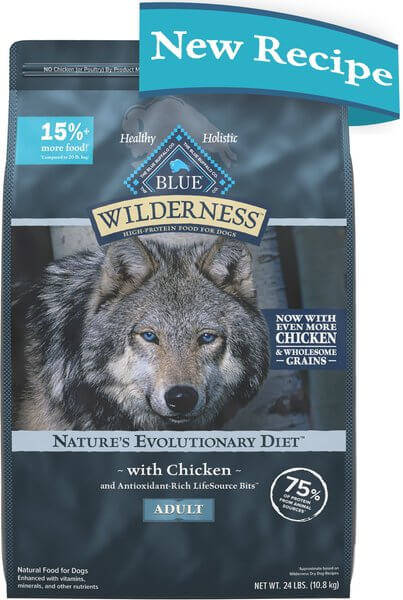
Rating: 


Blue Buffalo Wilderness Dry Dog Food receives the Advisor’s top rating of five stars.
Currently, the Blue Buffalo Wilderness product line includes three dry kibbles… each designed to meet AAFCO nutrient profiles for adult maintenance.
- Blue Buffalo Wilderness Duck Recipe
- Blue Buffalo Wilderness Salmon Recipe
- Blue Buffalo Wilderness Chicken Recipe
Blue Buffalo Wilderness Duck Recipe was selected to represent the other products in the line for this review.
Blue Buffalo Wilderness Duck Recipe
Dry Dog Food
Estimated Dry Matter Nutrient Content
Ingredients: Deboned duck, chicken meal, potato starch, turkey meal, peas, chicken fat (preserved with natural mixed tocopherols and citric acid), potatoes, tomato pomace (natural source of lycopene), natural chicken flavor, flaxseed (natural source of omega 3 and 6 fatty acids), alfalfa meal, whole carrots, whole sweet potatoes, blueberries, cranberries, barley grass, dried parsley, dried kelp, taurine, yucca shidigera extract, l-carnitine, l-lysine, turmeric, oil of rosemary, beta carotene, vitamin A supplement, thiamine mononitrate (vitamin B1), riboflavin (vitamin B2), niacin (vitamin B3), d-calcium pantothenate (vitamin B5), pyridoxine hydrochloride (vitamin B6), biotin (vitamin B7), folic acid (vitamin B9), vitamin B12 supplement, calcium ascorbate (source of vitamin C), vitamin D3 supplement, vitamin E supplement, iron amino acid chelate, zinc amino acid chelate, manganese amino acid chelate, copper amino acid chelate, choline chloride, sodium selenite, calcium iodate, salt, caramel, calcium carbonate, potassium chloride, Saccharomyces cerevisiae, Lactobacillus acidophilus, Bacillus subtilis, Enterococcus faecium
Fiber (estimated dry matter content) = 7.2%
Red items when present indicate controversial ingredients
The first ingredient in this dog food lists duck. Raw duck contains about 80% water. After cooking, most of that moisture is lost… reducing the meat content to just 20% of its original weight.
To reflect its lighter mass, this item should more accurately occupy a much lower position on the list.
The second and fourth items are chicken meal and turkey meal. Since both are considered meat concentrates, they contain almost 300% more protein than fresh poultry itself.
The third ingredient lists potato starch. Potato starch is a quality gluten-free carbohydrate… both digestible and hypoallergenic.
The fifth ingredient lists peas… a quality source of carbohydrates. And like all legumes they’re loaded with natural fiber.
The sixth ingredient includes chicken fat. Chicken fat is obtained from “rendering” chicken… a process similar to making soup in which the fat itself is skimmed from the surface of the liquid.
Chicken fat is notably high in linoleic acid… an omega-6 fatty acid essential for life. A quality ingredient.
From here, the list goes on to include a few other ingredients.
But to be realistic, items located this far down the list (other than nutritional supplements) are not likely to have much of an effect on the overall quality of this product.
Tomato pomace is a controversial ingredient… a by-product left after processing tomatoes into juice, soup and ketchup.
Many praise tomato pomace for its high fiber and nutrient content… while others scorn it as a cheap pet food filler laden with pesticides found on the skin of the tomato before processing.
Just the same, there’s probably not enough tomato pomace here to make much of a difference.
The manufacturer appears to have added back some of the “good” bacteria lost during the cooking process. These special probiotics are used to enhance a dog’s digestive and immune functions.
This dog food also contains chelated minerals… minerals that have been chemically attached to amino acids. This makes them easier to absorb. Chelated minerals are generally found in better dog foods.
Blue Buffalo Wilderness… the Bottom Line
The ingredients used to make Blue Buffalo Wilderness spec out like you’d expect for any other top drawer kibble.
But it’s still important to estimate the amount of meat here before determining a final rating.
The dashboard reports a dry matter protein reading of 38%, a fat level of 17% and an estimated carbohydrate content of 38%.
All three dry Wilderness products report the same nutrient figures. High protein. Moderate fat. And below-average carbohydrates as compared to a typical dry dog food.
With no plant-based protein-boosters and no vital Red Flag items, this is the profile of a kibble containing a generous amount of meat.
Bottom line?
Blue Buffalo Wilderness Dog Food is a grain-free kibble using an abundance of poultry or salmon as its main sources of animal protein… thus earning the brand a well-deserved five stars.
Enthusiastically recommended.
Those looking for a wet food made by the same company may want to read our review of Blue Buffalo Wilderness Canned Dog Food.
A Final Word
Remember, no dog food can possibly be appropriate for every life stage, lifestyle or health condition. So, choose wisely. And when in doubt consult a veterinarian for help.
Have an opinion about this dog food brand… or maybe the review itself? Please know… we welcome your comments.
Notes
11/28/2009 Original review publication date
03/21/2010 Review updated to reflect new recipe

{ 50 comments… read them below or add one }
Hi! I’m just curious, mainly because I’m thinking of trying the Blue Wilderness Duck food, isn’t the protein in the 34ish range? How did you get a protein percentage of 42%? I’m interested in the moderate protein grain-free foods and I thought the new Wilderness Duck as well as their new Salmon formula was in the 34% range. Thanks!
Hi Jan… Thanks for noticing this discrepancy. Unknown to us, Blue Buffalo recently changed the formula for the duck product. Basically, the company appears to have decreased the amount of turkey meal… causing it to change places with the potato starch in the list.
This modification lowered the protein content of the food from 42% down to 38%. As you know, we use “dry matter basis” (instead of the “as fed” percentages used by the company)… which explains the difference between their 34% and our (now) corrected 38% figure.
Thanks for sharing your discovery.
Hello,
I am just wondering… I just got an English mastiff and started feeding him pro PAC for large breed puppy which is suppose to be a premium dog food but I do not see it on your list? Should I consider switching to a more common brand?
Hi Robin… We just started reviewing the dog foods on November 1, 2009 and so our work is only partially complete as of this writing. New reviews are added to the website daily… 7 days a week. It is my intention to cover every major brand for which I can find publicly available information. So stay tuned… soon we’ll be reviewing the Pro Pac Dog Food line. Thanks for your suggestion.
When my first border collie puppy was young, his trainer steered my away from the Wilderness formulation, saying it was “too much protein and too little carb”. I did as I was told but always wondered, was she right? Now, border collie #2 is coming at 16 weeks, and I am looking at a diet for her, different than what I feed #1, who now 3 years old, and an expensive venison and bison eater. I like everything I read about the Wilderness formulation. Is it true that this high protein, low carb formulation is not suitable for pups?
Hi Charles… thanks for your excellent question regarding high protein dog foods and growing puppies. The controversy you mention appears to focus on the potential for high protein dog foods to cause bone and joint damage to growing dogs… especially with larger breeds.
After looking for a satisfactory answer to this common question, I’ve found the white paper published by Champion Petfoods (makers of Orijen and Acana products) to make the most scientific sense.
In a nutshell, the Orijen paper says… “Contrary to myths and popular beliefs, feeding a high-protein diet is healthy for dogs of any age, including puppies of all breeds and sizes, seniors, and overweight dogs. Studies have proven that protein does not cause orthopedic problems in puppies, nor does it lead to kidney disease in older dogs.”
For the most part, I’m inclined to agree.
If you get a chance, this Orijen report makes an excellent argument in favor of a high protein diet for all dogs… and it’s certainly worth a read.
Hi,
I have a six year old Shi Tzu – she apparently has food allergies (maybe chicken/beef). I’ve been feeding her Nutro Natural Choice dry dog food – the lamb and rice formula – that was recommended by her vet, but I’ve been hearing negative comments about this product line.
I am looking to change to a different, healthier brand. At a pet center, someone recommended Blue – the Life Protection Formula with LifeSource Bits – the natural lamb and brown rice recipe. I see you gave five stars to Blue’s Wilderness formula. Is it safe to assume all of Blue’s products are of equal quality? Thank you.
Hi Gail… there are lots of things a dog can be allergic to. Sometimes different meats… and in other cases, certain grains (although we believe that much of what dogs are allergic to might be more a result of what’s IN a grain… rather than the grain itself).
Regarding your question about Blue Buffalo… our rating depends upon which product line you’re considering. Blue Buffalo Wilderness rates different than Blue Wilderness Longevity, etc. Try looking at each “Blue” review when you Search by Brand on our website.
I have an overweight Aussie that is only 2 years old, and a
very slim GSD/Lab mix 1 year old. I have been trying to find a good food that I can feed to both. They get plenty of exercise, but the Aussie seems to have a different metabolism. I have been tempted to try this food, but isn’t the higher fat content in grain free food an issue for obesity?
Hi Jan… you’re correct to associate higher fat with higher protein. That’s because the more meat in a food, (generally) the higher the fat content. But when it comes to weight loss, it’s all about the calories. Provided you have a healthy pet, fat isn’t the critical issue for dogs as it can be for us humans. To find out why dogs are almost immune to common (atherosclerotic) heart disease (clogged arteries), be sure to read my article… “Low Fat Dog Food… Good or Bad for Your Pet?”
For predictable weight loss, always feed a good quality dog food. Just be sure to reduce the caloric intake below the amount of calories the dog needs to maintain current weight.
And that can best be accomplished by feeding a low calorie weight-loss dog food… or by simply cutting back serving size. Of course, it always makes good sense to consult a veterinarian if you have any questions. Hope this helps.
My mini schnauzer eats the Blue Buffalo Lamb and Rice. She loves it. My only concern is the Garlic in the food. Also her breed is known for pancreatitis. Do you have any suggestions on what to do about preventing that? Also about the garlic.
Thanks,
Michelle
Hi Michelle… garlic is a controversial item. In rare cases, it’s been linked to Heinz body anemia in dogs. Yet most of the professional literature we’ve surveyed has not provided any conclusive warnings regarding the use of garlic… especially in the small amounts used in most commercial dog foods.
As far as preventing pancreatitis… most quality dog foods contain a lot of meat. And more meat not only means more protein… it also can imply higher fat.
However, many of our 4 and 5-star dog foods contain a reasonable amount of healthy fats. It may help you to know that the average fat found in the kibbles of our dog food database seem to gravitate around 16% on a dry matter basis… which works out to be about 14% as written on a bag of dog food. I’d try to stay away from products with an exceptionally high fat content.
Blue Buffalo Lamb and Rice clocks-in at a low-to-moderate 12% (as fed). Not bad, at all. Hope this helps.
Hi,
I have two puppies, one 7 months and the other 10 weeks. The 7 month old has been on Hills Science Diet (because I adopted him from the SPCA and that’s what they fed their dogs), EVO, Natures Variety Instinct, and now Natural Balance Sweet Potato and Fish Formula. The 10 week old has been on Natures Variety Instinct and Natural Balance Sweet Potato and Fish. I have been having a hard time finding the right food for them because every time I switch their food they end up with good poop in the morning, starting out good poop but then turns to loose stools in the afternoon, and loose stools at night. They have been to the vet recently to see if anything else could be causing this and both of the fecal test came back negative. When I switch their food, I do it over a period of about a week. Is that too fast? How long should they be on the new food before I know if it is the right food for them? Do you think the high protein is to rich for them (with the EVO and Instinct dog food)? Do you recommend any dog food that would be good for sensitive stomachs (if that is what they have)? Also, the 7 month old came with giardia (but the giardia has been gone for 3 months now) and the 10 week old came with coccidia (but the coccidia has been gone for a month now). Could this be why they are still having mushy stools for part of the day?
Thanks,
Megan
Hi Megan… you should be commended for choosing such great dog foods and especially for adopting these little cuties. They’re lucky to have you. The only problem I see appears to be that maybe you’re not staying with a dog food long enough to achieve the stability and results you’re looking for.
Ease your way into any new diet by adding the new food into the older food a little more each day… a process I like to call “dovetailing”). Dietary fiber can play a significant role in stool condition. Be sure to read my article on “The Amazing Benefits of Dog Food Fiber“. Hope this helps.
I have a 2 year old shar pei/lab mix that has severe allergies and currently have him on Avoderm. He likes the Avoderm but I am trying to find something that has less fillers. I’ve been looking at AVO or Natural Balance. Any feedback would be appreciated.
Hi Eric… Allergies can be a challenging problem for dogs… and their caretakers. There are just so many possible ingredients your dog could be allergic to. So, needless to say, it would be impossible for me to make a truly helpful suggestion.
As a matter of fact, many times, allergies aren’t even a food issue at all… but rather something else in your pet’s environment.
In any case… one of the most frequently overlooked causes of canine food allergies (like atopic dermatitis) can be caused by insect infestations of feed-grade cereal grains. Cheap (and contaminated) grains like these are commonly used to make many commercial dog foods… especially the lower-quality brands.
Sticking with the Advisor’s 4 and 5-star dog foods won’t guarantee a “cure” for your pet’s allergies… but can go a long way toward eliminating the higher-risk (lower-quality) brands.
Later on this year, I’m planning to post an article with specific guidelines and product suggestions for various canine health issues. So, be sure to bookmark our site and check back regularly. Hope this helps.
Thanks for a great site. We adopted a two year old bull mastiff. For 45 days she has been on Nutromax Sensitive Stomach (Oatmeal) and I add Dinovite because it cured a previous dog of allergy problems. However, this dog has terrible gas problems with this setup. We had tried Blue Buffalo on a lab a couple of years ago and he also suffered from gas until he was taken off of it. So my thought is that the probiotics in Blue or Dinovite might be causing the gas??
Hi Dave… gas can come from anything… even the probiotics. But the most common source of gas is usually fermentable fiber in your dog’s diet. Fiber can be a good thing but some dogs may be prone to a “gassy” reaction from this otherwise healthy addition. According to our dog food database, fiber content averages about 5% for most products.
Hi Mike,
I just adopted a 3 year old American Bulldog mix from the SPCA who have been feeding her Science Diet since March. She is still slightly underweight and I’m dovetailing her from the Science Diet into Blue Buffalo Duck Meal. She seems to be having a lot of gas problems. I’ve cut out her treats except for one natural pig ear per day. Is this the right food for her age and breed? I guess I can live with the gas if it’s the best food fit for her.
Thanks for your help and a great site!
Hi Andrew… gas can be related to almost anything in the food… but most commonly it can be the result of the presence of certain types of fiber. If you feel the fiber content is what’s causing the gas, try a food with slightly less fiber. It would be impossible for anyone to know what’s “the best” food for her… I’d just stick with our top-rated 4 and 5-star dog foods until you find one she likes and thrives on.
The Blue Buffalo should be a major improvement over the Hill’s. Don’t give up yet.
I love to see that you’ve been “dovetailing” to the new food. That is a very smart way to handle any diet change.
Hi, I am getting a great dane puppy. I would like your advise on what to feed her since she is a large breed prone to joint issues and stomach bloating.
Hi Sandy… Normally, small to medium dogs should be fed puppy food until about six months of age. But larger breeds (like yours) will continue growing for as long as 12 to 24 months. Many companies provide dog foods specifically designed for large breed puppies like yours.
By the way, I’m not too impressed with breed-specific products… but dog foods made for large breed puppies may be just what you need.
Just browse through our 4 and 5-star dog foods. Near the very beginning of each review, I list all the products sold by each brand. Look for the words “large breed puppy” in the names (or the description).
And, of course, don’t forget to check with a professional… your breeder or your vet. Good luck with your new baby.
Hey Mike,
I have a Miniature Schnauzer and she seems to have gas at night with the higher grade foods, but had very little gas on a lower grade food such as Beneful. So I was wondering ,why does this happen?
Hi Jennice… It’s difficult to say with certainty why your dog has gas. Flatus can come from a large number of factors. GI upset during (and shortly after) changing to new foods can be fairly common. Certain types (and amounts) of fiber in foods can cause normal intestinal bacteria to “ferment” that part of the food and cause bloating and gas.
Unless you’ve tried many different foods, it’s really not fair to blame the production of gas on all “higher grade” foods. I’d suggest you try some others.
And of course… of critical importance is to “dovetail” the newer food into the older one. Start with just a tiny amount of the newer food (about 10%) with the first meal or two and VERY GRADUALLY increase the “dose” of the newer food while simultaneously decreasing the older food (over 2 full weeks) until it finally reaches 100% of the meal. Hope this helps.
In looking for an organic dog food to put my show puppies on through 12months of age, I am confused about the correct protein and fat level I should be looking for. I have heard good things about organix but it seems to me the protein and fat content is rather low.
I have had good results with Royal Canin with stool size and growing nice coats but recently a breeder warned me of using a food with beet pulp because it can cause tear staining. Can you comment on these two areas. Thank you.
Hi Meryl… you are correct to notice most of the organic products are notoriously light on the protein… and fat. And that’s because they appear to rarely be high on meat content. I’d guess that’s because the organic ingredients themselves are so extraordinarily expensive. One exception I can recall is a product called By Nature Organics. But… guess what else it has on its list?
You guessed it… beet pulp. However, I’ve never been able to confirm the rumors I’ve heard about beet pulp staining the coat… or the tears. Let me know if you come across any real scientific proof so I can share it with others.
Hi,
I have an 8 month old Boston Terrier with allergies. He’s constantly itching and chewing on his feet. I’m looking to change his food from Eukanuba Puppy to either Blue Buffalo, Wellness Super5Mix Just for Puppy or Wellness Simple Food Solutions. Any suggestions??
Also, should I stick with puppy food still or is it safe to switch to adult? I read different age suggestions all the time and don’t know what to go by.
Thank you!
Why would you include a food that contains a potentially questionable ingredient as a 5-star food? I would think 5-stars would be reserved for those who had absolutely no questionable products and definitely all positive ones…
Hi Kelly… I’m assuming here you’re questioning the tomato pomace. Thanks for pointing out the fact I had inadvertently left it out of the description below the dashboard.
So, I’ve now placed the appropriate text into the review. Hope this helps explain why we don’t consider beet pulp (in this case) a very significant item.
By the way, there are no “perfect” 5-star foods out there. Sometimes I even find myself questioning almost every one of our own choices, too. In our opinion, Wilderness is still a very nice food, just the same.
Hi Kayla… we follow the guidelines of the respected Waltham Centre for Pet Nutrition which considers small to medium dogs adults at age 6 months. So, your Boston Terrier should be just fine on adult food. I don’t really favor any of your choices over the rest except to say the Wellness “puppy” formula is probably not necessary.
Regarding your dog’s allergies, try avoiding corn and wheat (maybe even all grains). For one approach to the problem, please see my article, “Dangerous Canine Diseases Linked to Grains in Dog Food“. Hope this helps.
Hi I have 2 pugs that are 8 years old. One of my pugs suffers from allergies. I have been feeding them Natural Balance Duck and Potato and venison and potato for the last several years. They are both very picky eaters (yes even though they are pugs) Is there a dry dog food that is out there that is pleasing to the palate and a good food? I also like to feed them canned at night because one of my dogs takes allergy meds and it is easier to put it into canned food to take his pill. If you could give me a few suggestions to try that would be great. I keep hearing all this stuff about dog foods, dry vs, canned and some people say raw diets are the way to go. I thought what I was feeding them was ok and now I am confused! I want to make sure I am feeding them the best food I can. Any help would be greatly appreciated. One of my pugs is a bit overweight and needs to lose a few ounds!
Lyn
Hi Lyn… All things considered, we believe the closer you come to a biologically appropriate canine diet the better off your dog would probably be. Kibble represents the furthest thing from what a dog would be expected to “naturally” eat. Kibbles are designed for convenience only… not to mimic a dog’s natural ancestral (biologically appropriate) diet.
Next in line would be a quality canned food. And the closest would be a raw diet.
Currently, our Bailey is fed a quality kibble “base” with a quality canned topper mixed with it.
Should you decide to switch, be sure to introduce your new food VERY GRADUALLY “dovetailing” it into the old food over a period of 10-14 days. Hope this helps.
Hi Lyn… I am certainly no expert on pugs. But I can tell you we always favor a “biologically appropriate” (canine ancestral) diet for dogs. Of kibble, canned and raw, kibble is the furthest form of food from what a dog would naturally choose to eat.
We feed Bailey a quality kibble with a nice canned “topper” mixed with it… and his finicky eating seems to have gone away. He gobbles the stuff up. We may eventually switch to a raw diet… but it has its own limitations, too.
For weight loss, just cut back on quantity… not quality. Most (but not all) weight control dog foods are terrible. It’s better to feed a quality nutritious dog food… and just feed less of it. Hope this helps.
Hi. My name is Thomas and I have a 5 month old lab and was looking for the best food you could buy from Pets mart. Today I bought the Nutro Ultra puppy food for large breeds but I see the Blue Buffalo has higher ratings. My question is and I know it applies to the particular food but for puppy food for large breed which one has the highest consistent ratings and which is second. Thanks so much!
Hi Thomas… Our ratings are based upon 2 things only… the ingredient quality and the estimated amount of meat in the food. The stars are meant to be a rough guide to help you select a good food for your dog.
Nutro Ultra Puppy is still a very good dog food. Sometimes it is almost impossible for me to decide between two similar ratings myself. So, it would be misleading for me to assure you that one food is nutritionally superior to the other. I like ‘em both.
Hi Mike,
Thanks for all your great work! I have switched my dogs from Natural Balance to Blue Buffalo Wilderness Chicken. During the transition period they would eat all the blue buffalo and leave the Natural balance all over the floor. It was like they were spitting it out-we thought it was hysterical. So I went and bought the biggest bag and some cans of wilderness. Now they won’t eat the dry and only want the canned. Yesterday I just gave them dry and they boycotted eating. So last night I caved and gave them canned. I have tried mixing warm water with the dry but they both weren’t interested. I have a huge bag of dry but I am at a loss and I am looking for some help please! Thanks again!
Hi Gabrielle… You’re not alone. Sometimes, we’ve had the same problem with Bailey. And it can be frustrating. The kibble we’ve used comes in a few “flavor” varieties. So, we’ve found it’s not just the food but usually a particular product he doesn’t like. Be sure to take the time to mix the wet and dry together so completely it becomes difficult for your dogs to avoid what they don’t want.
We’ve found the stew-type wet dog foods to be the most difficult to blend with the kibble. The dry food really stands out from the mixture no matter what we do. So, try to find a wet food that looks like ground meat… what the French call a pate. These foods mix more thoroughly with kibbles… not so easy for your dogs to pick through. Hope this solves your problem.
Hi! I love your site and have shared it with many friends. I have a 10 year old Lab/Chow mix and a 2 year old Chi. I was told by my Vet to place him a Hill’s light for older dogs but after looking it up on your site I have doubts. Would Blue Wilderness be a choice? And also what about a good food for my Chi. We have to be careful with the little tikes since they can get heavy quick.
Hi Mandy… There are many good dog foods you could consider. And I don’t see any reason why Blue Buffalo Wilderness could not be one you could consider for both.
However, these two “breeds” are very different in the size requirements of their kibbles. A large “pellet” could be a challenge to chew for your little guy whereas a small kibble kibble could work for both.
Weight gain has more to do with calories (and portion size) than which dog food you decide to feed. Simply adjust the size of the serving to match each dog’s energy needs and you should be fine.
Hi Mike,
I am currently using this Blue Buffalo food for my dogs but noticed the omega 3 is .3 and omega 6 is 3. I know all brands have different ratios but was curious as to what your thoughts were. Ive tried to find a higher protein, low carb dry food with good omega ratios and apparently it is just not out there. I have a cancer survivor dog that needs more omega 3 and I have to supplement her foods.
Other than that I do like this brand of dry food,
Thanks !
Hi Mike,
I have a 4 month old mini schnauzer and I just switched him to the Blue Buffalo Life Protection Formula (Natural Chicken and Brown Rice for Puppies). When I got him at 8 weeks of age he was being fed Nutro Natural Choice Small Bites Puppy
Chicken Meal, Rice & Oatmeal Formula. It seems to me like I made a good switch, but after reading some of the previous posts I’m wondering if it is safe to feed my puppy BB Wilderness Formula (high protein). Should I wait until he is out of puppyhood to begin feeding him an “adult” formula? I only want the best foods for him and BB is a brand I trust.
Thanks!
Hi Mia… If I’m not mistaken, Blue Buffalo Life Protection is designed for adult maintenance (and not for growth). At four months, your mini Schnauzer is still considered a puppy and is too young for an adult kibble. You should be feeding him a quality food that’s rated by AAFCO for “growth” or “all life stages”.
Hi, I have a, about 2, mixed breed dog (Extreme herding instincts) Maybe a white shepherd mix who is our very loved family pet. I want very much to give him the best I can in his dog food. I have fed him Natural Balance and now Canidae. Not too pleased with either.
My concerns are very largely his extreme shedding, continuos, and year round. Also he is always super hungry yet on the verge of over weight yet I run with him almost daily now.
I have herd many times that his extreme shedding is likely do to his diet. I don’t want him to seem so hungry or unsatisfied. I want him to have a great food. So great food that may influence his shedding. Any suggestions and his energy level is great as is. Please help me put an end to my unending dog food search and doggy diet changes. Ahhh! There are just so many. I keep focusing on Blue Buffalo, Orijen (Price makes me nervous), Evo, and Wellness. Maybe Solid Gold, or Taste of the Wild.
Hi Genni… Searching for the perfect dog food can be an exercise in frustration (because contrary to what you may have heard, the perfect dog food doesn’t exist).
Just the same, you have just named some of our personal favorites. However, it would be unfair and misleading to you (and other readers) for me to pretend I know the best dog food for your animal.
Yes. Even though the diet can have something to do with extreme shedding, the issue can also be genetically unique to your specific pet. In any case, dog foods with healthy omega-3 fatty acid content can be helpful for a dog’s skin and coat. These healthy nutrients can be found in fish oil and ground flax seeds (flax meal).
I have no idea why so many dogs (and people, too) never seem to be completely satisfied… even after eating a filling meal. In a healthy animal, weight is usually a simple matter of calories consumed versus energy expended per day. If your dog tends to be overweight, you may want to consider reducing his food rather than increasing it. You must always remember to adjust the serving size as needed every time you change dog foods.
I want to thank you for taking your time to make this wonderful site. I Have two Siberian Huskies that I am currently feeding Blue Buffalo Wilderness. When I got my first, Skylar, I had him on Nutro Max which he never thrived on. Mostly loose stools and lack of appetite. Though, lack of appetite is normal for a lot of Huskies. When I got my second, Kira, I switched to Iams without any knowledge about good dog foods. They both eventually stopped eating it altogether. Even with wet food mixed in. I found this site and, I must say, it has really taught me what I need to look out for. The first time I brought BB Wilderness home they were both howling and jumping up and down to the smell of it. They still will skip meals at times, but huskies are known for their calorie counting. They both have incredible coats, solid stools, tons of energy, and are at an optimal weight. Thank you so much!
Mike, we have an Airedale, with mild kidney problems. Our vet had prescribed Hill’s K/D for him, but from what I’ve been reading I don’t believe that to be a good food for sustainability. From research, I know we should have him on a low phosphorus, moderate protein food. The problem I’ve had is trying to find a combination like that, which also doesn’t have Omega-6 in it (all the research items say they need Omega-3, but not the -6. Any ideas? The Blue items look close, but are marginal on the phosphorus content. thanks!
I have 2 puppies a 12 week havanese and a 20 week minature labradoodle. Currently, I am feeding them nutro ultra puppy. I would like to feed th the best food possible. What do you reccomend? The labradoodle is around
20lbs and the havanese is around 4lbs.
Hi Lisa… Small to medium size dogs are considered adults at around 6 months (yet larger breeds aren’t adults until about 12 months). I’d look for a 4 or 5-star brand that has a good puppy food in its product line. Or find a quality dog food that’s AAFCO rated for “all life stages”. Hope this helps.
I have a 7 year old miniature schnauzer that was recently diagnose with diabetes. From every thing I have read a low carb/ high fiber diet is suggested. He is not overweight at all.
I have been using blue wilderness (dry and canned – feeding 2 times a day, before injections) and wonder what your thoughts are. Is this considered high fiber food?
Hi Penny… Using the reported fiber content in our database, average dry foods contain about 4.6% dry matter fiber and canned foods contain 6.7% fiber. This would imply BB Wilderness kibble is above-average in fiber content and the canned BBW product is about average.
The canned BBW product appears to be VERY low in carbs which suggests a low glycemic index (good for diabetics). But like most carb-based kibbles, the dry product is probably not. However, at 38%, its carb content is lower than average (for a kibble). Hope this helps.